When people search for "Google AI training jobs," they usually are not looking for one narrow job title. They are using one phrase to describe a much wider category of work: remote AI jobs, AI evaluator jobs, search quality rating, data annotation, human feedback, model evaluation, prompt review, and roles connected to large AI systems like Gemini.
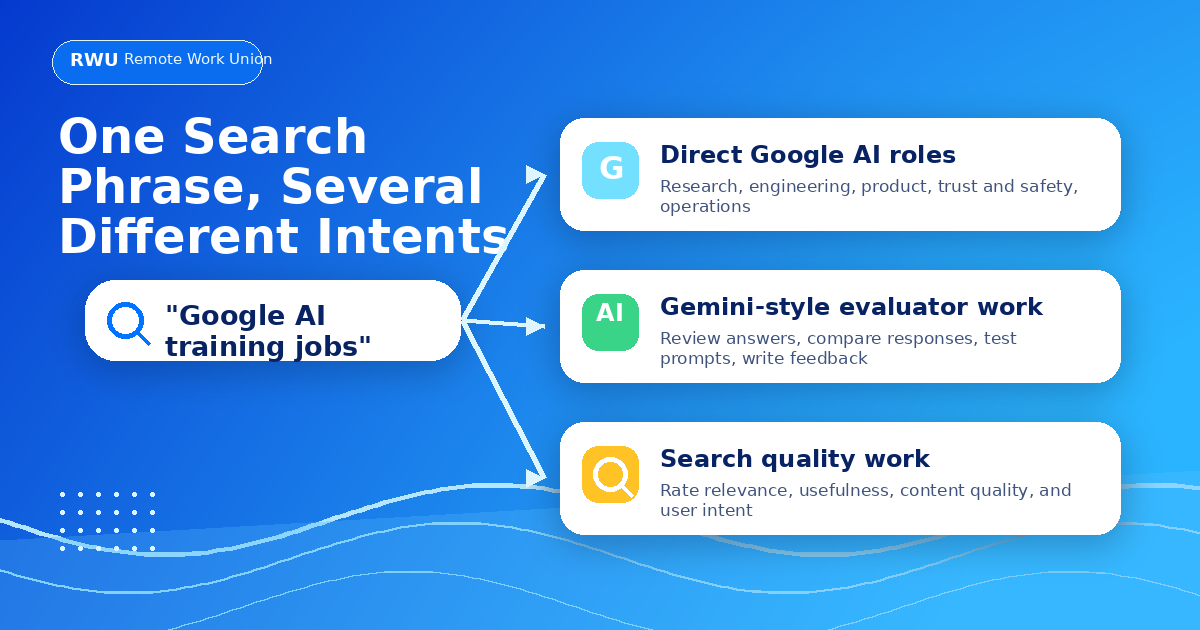
That distinction matters. A person searching that phrase may be looking for a direct job at Google, a Google DeepMind research role, a Google Cloud AI position, a search quality rater role, or a third-party AI training project that involves reviewing chatbot answers. Some of those paths are technical. Many are not. Some are full-time corporate roles. Others are part-time contractor roles. Some involve coding, but many are better suited for strong writers, business professionals, teachers, lawyers, healthcare workers, researchers, finance people, and other subject matter experts.
This guide breaks down what job seekers usually mean by the search, what kinds of work are most realistic, and how to search smarter without assuming that every AI training job is directly offered by Google.
What "Google AI training jobs" usually means
The phrase sounds simple, but it blends several job categories together. Understanding those categories helps you avoid wasting time and helps you find better remote AI work.
1. Direct AI jobs at Google, Google DeepMind, or Google Cloud
The first meaning is the most literal: jobs at Google that involve artificial intelligence. These can include machine learning engineering, AI research, product management, trust and safety, policy, data infrastructure, operations, technical writing, user experience research, cloud AI, and applied product roles.
These jobs are usually competitive, structured, and full-time. They may require advanced technical skill, previous experience at a major technology company, research credentials, or a strong background in product, engineering, data, security, or policy. Google DeepMind and Google Careers are the places job seekers usually check for these direct corporate roles.
Direct Google AI roles are real, but they are not the same thing as the flexible AI evaluator work many remote job seekers are searching for. If your goal is a high-level AI research job, your search should be very different from someone looking for a part-time work-from-home AI training contract.
2. Gemini-style AI evaluation work
The second meaning is more practical for many remote applicants. Some people search for "Google AI training jobs" because they want to help improve AI models like Gemini or similar large language models.
This kind of work often includes tasks such as comparing two AI answers, rating helpfulness, checking factual accuracy, rewriting weak responses, testing prompts, identifying hallucinations, and explaining why one answer is better than another. The work is often called AI evaluator work, AI model evaluation, AI response rating, RLHF, human feedback, AI data annotation, or AI training.
These jobs are not always posted under the Google name. They may appear through AI training platforms, vendor companies, research contractors, or job boards using broader language. If a listing says "AI evaluator," "LLM evaluator," "AI trainer," "model response reviewer," "prompt evaluator," or "AI answer quality reviewer," it may be closer to what the searcher actually wants than a direct Google corporate listing.
3. Search quality and relevance rating
The third meaning comes from the long history of search quality work. Before today's AI training platforms became popular, many remote workers found online jobs evaluating search results, ads, maps, videos, and content relevance. These roles were often called search quality rater, search engine evaluator, ads quality rater, internet safety evaluator, or online data analyst.
That category still matters because AI search, AI summaries, chatbot answers, and recommendation systems all depend on human judgments about usefulness, accuracy, relevance, safety, and user intent. A person who is good at search quality rating may also be a strong candidate for AI evaluator work.
The overlap is simple: both jobs require careful reading, following detailed guidelines, judging whether an answer satisfies the user's intent, and writing clear explanations when needed.
4. Third-party AI training platforms
The fourth meaning is the broadest. Many job seekers use the Google keyword because they associate Google with AI, Gemini, Search, YouTube, Android, and cloud technology. But the work they actually want may come from platforms that recruit contractors for AI training projects across many model builders and enterprise clients.
These platforms may hire writers, business professionals, creatives, lawyers, teachers, doctors and nurses, scientists, coders, researchers, data analysts, editors, and bilingual applicants. The platform may not say Google in the job title at all. The job may simply involve reviewing AI output, ranking responses, writing ideal answers, testing safety issues, or creating domain-specific examples.
This is why a narrow search can miss better opportunities. "Google AI training jobs" is a useful starting keyword, but it should not be your only search phrase.
The common tasks behind AI training work
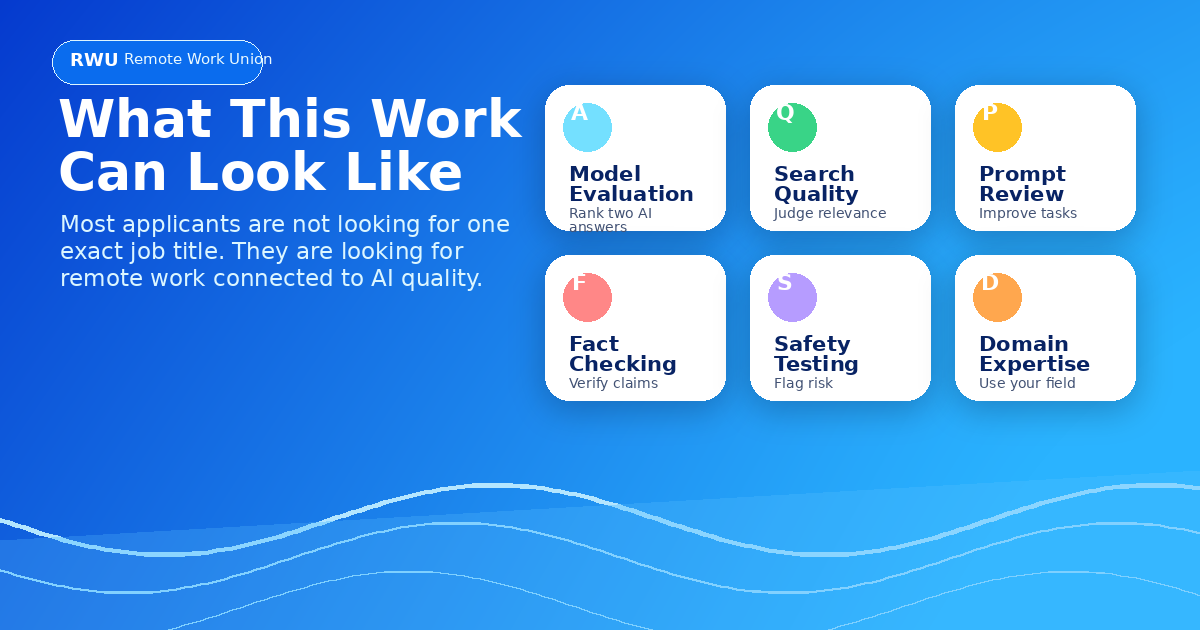
Most AI training and AI evaluation jobs are built around one goal: improving answer quality. The tasks vary by project, but many fit into these categories.
| Task type | What the worker does | Best fit |
|---|---|---|
| AI response rating | Compare two answers and choose the better one | Strong writers, editors, researchers |
| Fact-checking | Verify whether an AI answer is accurate | Journalists, researchers, teachers, subject experts |
| Prompt response writing | Write an ideal answer to a user prompt | Writers, business professionals, educators, creatives |
| Search quality evaluation | Judge whether results match user intent | Detail-oriented readers, SEO-aware workers, research-minded applicants |
| Safety testing | Identify risky, biased, harmful, or misleading answers | Policy, legal, healthcare, education, trust and safety backgrounds |
| Domain expert review | Evaluate answers in a specific field | Lawyers, finance experts, doctors, nurses, scientists, coders, consultants |
| Data annotation | Label examples, categories, claims, entities, or intent | Organized applicants with strong attention to detail |
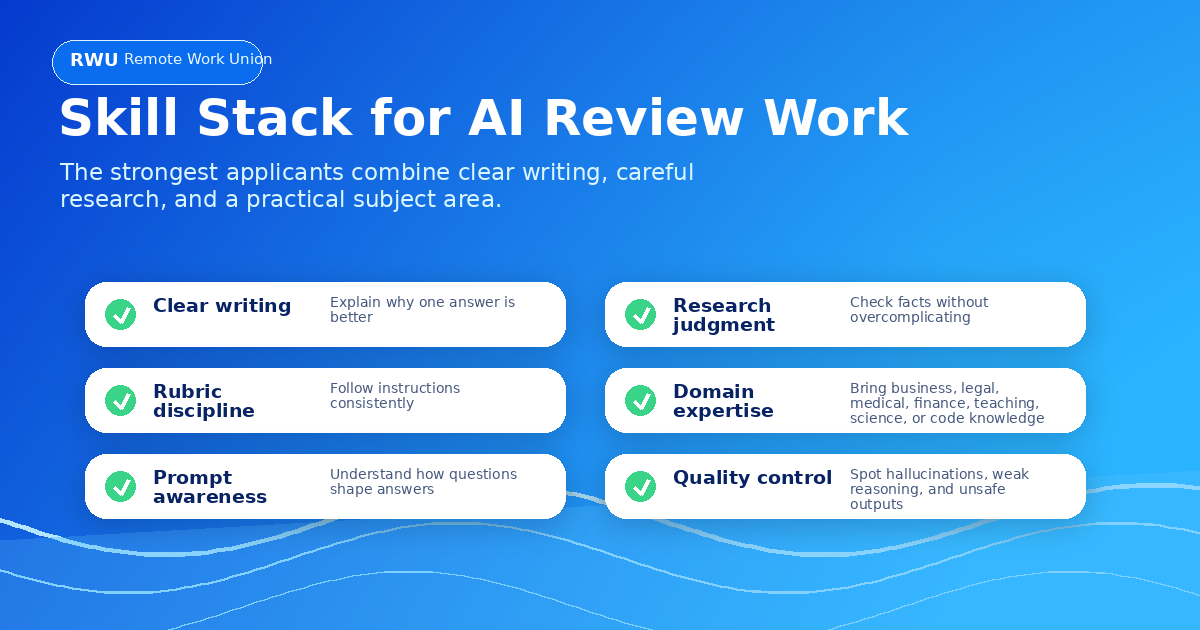
These tasks are not the same as traditional data entry. They reward judgment. The best workers are consistent, careful, and able to explain their reasoning without overcomplicating the task.
Why this search attracts non-coders
A common mistake is assuming that AI jobs are only for software engineers. Some AI jobs are deeply technical, especially direct roles in machine learning research, infrastructure, robotics, security, or model development. But a large part of AI evaluation depends on human judgment from many backgrounds.
AI models answer questions about business, law, medicine, education, finance, science, writing, coding, travel, products, customer support, and everyday life. To improve those answers, companies need people who understand language, context, accuracy, user intent, and subject matter.
That is why non-coders can sometimes qualify for AI training jobs. A business professional may evaluate whether an answer makes sense for a marketing plan. A writer may judge tone, clarity, and structure. A teacher may evaluate whether an explanation is age-appropriate. A lawyer may review legal reasoning at a high level. A healthcare professional may identify unsafe medical phrasing. A scientist may catch weak technical claims. A coder may evaluate programming answers.
The key is not claiming to be an AI engineer if you are not one. The key is positioning your real expertise in a way that matches the evaluation work.
Remote Work Union tracks legitimate remote AI training roles across top platforms. Find opportunities that match your background without sorting through vague listings.
Find Roles Hiring Now →How to search for these jobs smarter
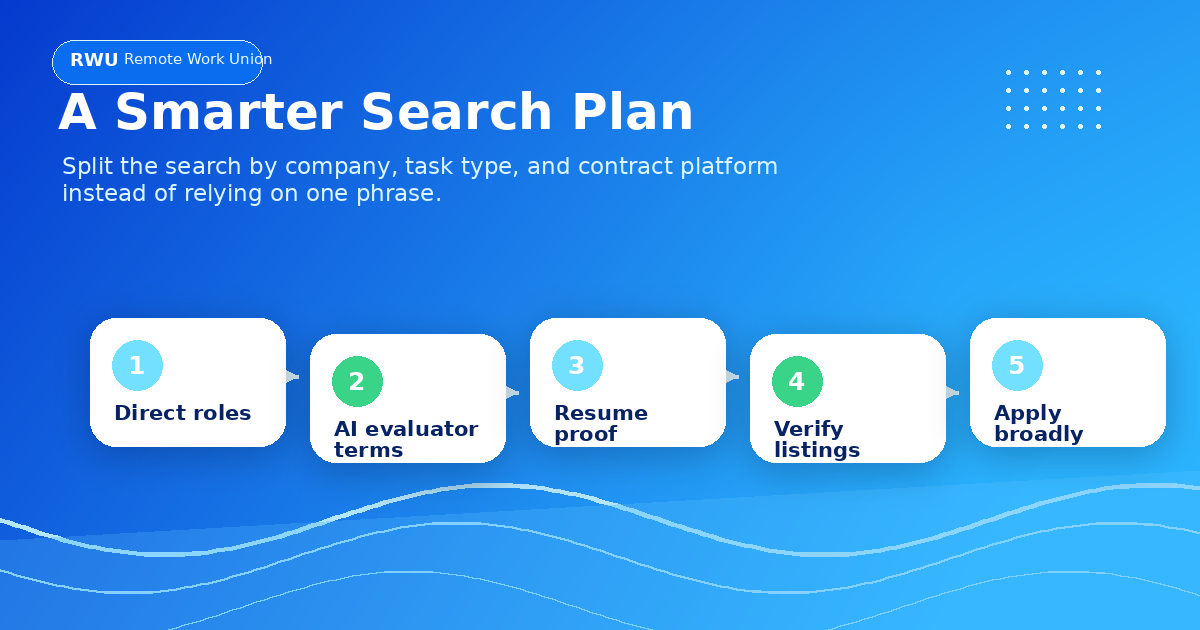
Do not search only "Google AI training jobs" and stop. Use it as one branch of a broader search plan.
Search for direct company roles
Use searches like:
- Google AI jobs
- Google DeepMind careers
- Google Cloud AI roles
- Google trust and safety AI jobs
- Google policy AI jobs
- Google product AI roles
- Google machine learning jobs
- Google data quality jobs
These searches are best if you want a corporate job, have a specialized resume, or are targeting full-time work.
Search for AI evaluator and model review roles
Use searches like:
- AI evaluator jobs remote
- AI model evaluation jobs
- LLM evaluator jobs
- AI response reviewer jobs
- AI training jobs remote
- RLHF jobs remote
- prompt evaluator jobs
- AI writing evaluator jobs
- AI fact-checking jobs
- human feedback AI jobs
These searches are better for remote contractors, writers, subject matter experts, and applicants who want flexible project work.
Search for search quality and relevance roles
Use searches like:
- search quality rater jobs
- search engine evaluator jobs
- ads quality rater jobs
- internet safety evaluator jobs
- online data analyst jobs
- content quality evaluator jobs
- AI search evaluator jobs
These searches are useful because AI search and traditional search evaluation often require similar skills.
Search by your expertise
The strongest strategy is to combine the AI keyword with your background. For example:
- legal AI evaluator jobs
- healthcare AI training jobs
- finance AI evaluator jobs
- business AI trainer jobs
- coding AI evaluator jobs
- creative writing AI training jobs
- education AI reviewer jobs
- science AI evaluator jobs
- bilingual AI evaluator jobs
This helps you find projects that pay for expertise instead of generic task completion.
How to tell whether a listing is actually relevant
A good AI training listing should clearly explain the type of work. Look for words like evaluate, rate, compare, review, annotate, label, fact-check, rank, rewrite, assess, or provide feedback. Those verbs usually signal that the role involves improving AI outputs.
A weak listing may use buzzwords without explaining the tasks. Be careful with listings that say only "train AI from home" but give no company name, no contract terms, no pay range, no task description, and no application process.
A legitimate AI evaluator role usually has some combination of these elements:
- A clear company or platform identity
- A real application page or company domain
- A description of evaluation, writing, rating, or annotation tasks
- A skill requirement that matches the work
- A contract, freelance, part-time, or full-time classification
- A realistic pay structure
- A test, assessment, writing sample, interview, or qualification process
- Clear rules about confidentiality and data handling
Be especially careful with any job that asks you to pay upfront, buy training, send crypto, move the conversation to an unrelated messaging app, or provide sensitive personal information before a legitimate application process.
How to position your resume
Your resume should not simply say "interested in AI." It should translate your background into the skills AI training projects need.
A strong AI evaluator resume highlights:
- Clear writing and editing
- Research and fact-checking
- Experience following detailed guidelines
- Subject matter expertise
- Analytical judgment
- Communication skills
- Experience with spreadsheets, documents, or online tools
- Familiarity with ChatGPT, Gemini, Claude, or other AI tools
- Prompt writing or AI output review
- Quality control, compliance, safety, or policy experience when relevant
For example, a marketing professional could emphasize campaign analysis, customer research, brand messaging, copy review, and evaluating whether content matches audience intent. A teacher could emphasize rubric-based grading, curriculum design, clear explanations, and student feedback. A lawyer could emphasize careful reading, issue spotting, reasoning, and document review. A nurse could emphasize patient education, safety awareness, and medical terminology. A coder could emphasize debugging, code review, technical documentation, and software testing.
The goal is to make your experience look useful for AI evaluation without exaggerating.
What to expect from assessments
Many AI training platforms use assessments before giving applicants paid work. These tests are not always easy, even for smart applicants. They often test whether you can follow instructions exactly, understand a rubric, compare answers fairly, avoid overthinking, and write a concise explanation.
You may be asked to:
- Choose the better of two AI responses
- Rate answers on helpfulness, accuracy, safety, or completeness
- Explain your decision in one or two short paragraphs
- Identify factual errors
- Rewrite a flawed response
- Answer domain-specific questions
- Complete a writing, coding, legal, medical, finance, or education evaluation
The biggest mistake is treating the assessment like a casual opinion survey. AI evaluation is structured. The platform usually wants consistent reasoning, not personal preference. Read the instructions first, then apply the rubric.
Should you try to work directly for Google?
It depends on your goal.
If you want a full-time corporate career in AI, Google, Google DeepMind, Google Cloud, and other major AI companies are worth researching. That path usually requires a targeted resume, strong credentials, and a role-specific application strategy.
If you want flexible remote AI work, do not wait for one perfect Google-branded listing. You will usually find more opportunities by applying to multiple AI training platforms, evaluator roles, search quality roles, and subject matter expert projects. The work may involve similar skills even when the client name is not public.
For most applicants, the better strategy is to separate the search into two tracks:
- Direct company roles at major AI companies.
- Remote AI training, evaluation, and human feedback roles across platforms.
That gives you more surface area and prevents you from missing good jobs because the title does not include the word Google.
Final takeaway
"Google AI training jobs" is a real search intent, but it is not one single job category. It can mean direct AI jobs at Google, Google DeepMind careers, Gemini-related AI evaluation, search quality work, AI data annotation, model response rating, RLHF, prompt evaluation, or remote contractor projects that help improve AI systems.
The smartest move is to search beyond the exact phrase. Use direct Google AI keywords if you want a corporate role. Use AI evaluator, model evaluation, search quality rater, AI response reviewer, human feedback, and subject-specific AI training keywords if you want remote project work. Then position your resume around the skills that matter: writing, research, rubric-following, accuracy, domain knowledge, and clear judgment.