When people search for Gemini AI jobs, they are usually not looking for a traditional software engineering job. They are often looking for a way to get paid for helping AI systems produce better answers. That can include reviewing chatbot responses, ranking two answers against each other, fact-checking model outputs, writing short explanations, or testing whether an AI answer is helpful, accurate, safe, and clear.
Gemini is closely associated with Google's AI ecosystem, but the job search phrase is bigger than one company. In practice, many opportunities connected to Gemini-style work appear under broader titles like AI evaluator, AI trainer, AI data annotator, search quality rater, model response reviewer, AI writing evaluator, AI safety evaluator, and AI fact-checker. The important idea is simple: advanced AI systems still need human judgment. A model can generate an answer, but humans help decide whether that answer actually works for a real person.
What People Mean by "Gemini AI Jobs"
A search for Gemini AI jobs can mean several things. Some applicants are looking for jobs directly connected to Google's AI products. Others are using Gemini as shorthand for modern AI tools, similar to how people search for ChatGPT jobs, Claude AI training jobs, Microsoft Copilot jobs, Meta AI jobs, or Grok-related AI work.
The most realistic path for many non-technical applicants is not a full-time role building the model. It is human evaluation work around AI answer quality. These roles help AI teams understand where a model succeeds, where it fails, and what kind of feedback should be used to improve future behavior.
That distinction matters. A role may never include the word Gemini in the title, but it may still involve the same type of work people mean when they search for Gemini AI jobs: reviewing answers, judging model performance, labeling data, testing prompts, and improving AI output quality.
Why Human Reviewers Still Matter
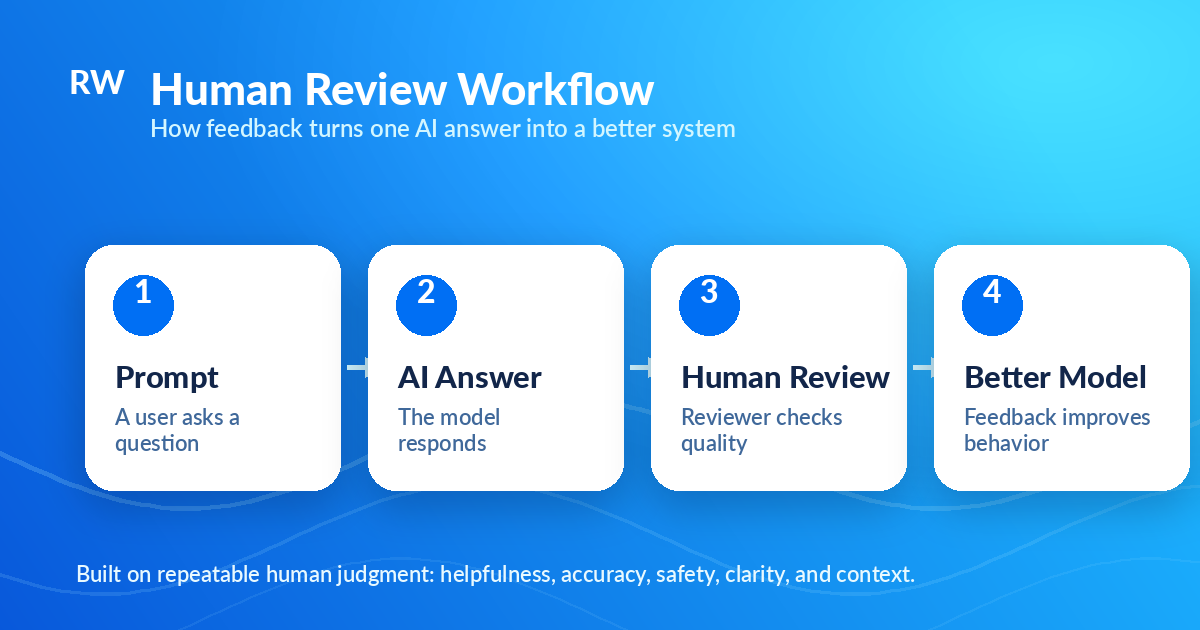
AI systems are powerful, but they can still misunderstand instructions, make unsupported claims, miss important context, overcomplicate simple questions, or give answers that sound confident without being reliable. Human reviewers provide the judgment layer that automated systems cannot fully replace.
A human reviewer can notice when an answer is technically correct but unhelpful. They can tell when a response is too vague, too wordy, too risky, too generic, or missing the point. They can compare two answers and explain why one is more useful. They can identify whether the model followed the user's request, avoided hallucinations, handled uncertainty, and gave a practical next step.
This is why AI model evaluation has become one of the most important categories of remote AI work. The model generates. The human reviewer judges. The feedback helps the system improve.
What Human Reviewers Actually Do
Gemini-style AI review work can vary by platform, client, and project, but many tasks fall into a few repeatable categories.
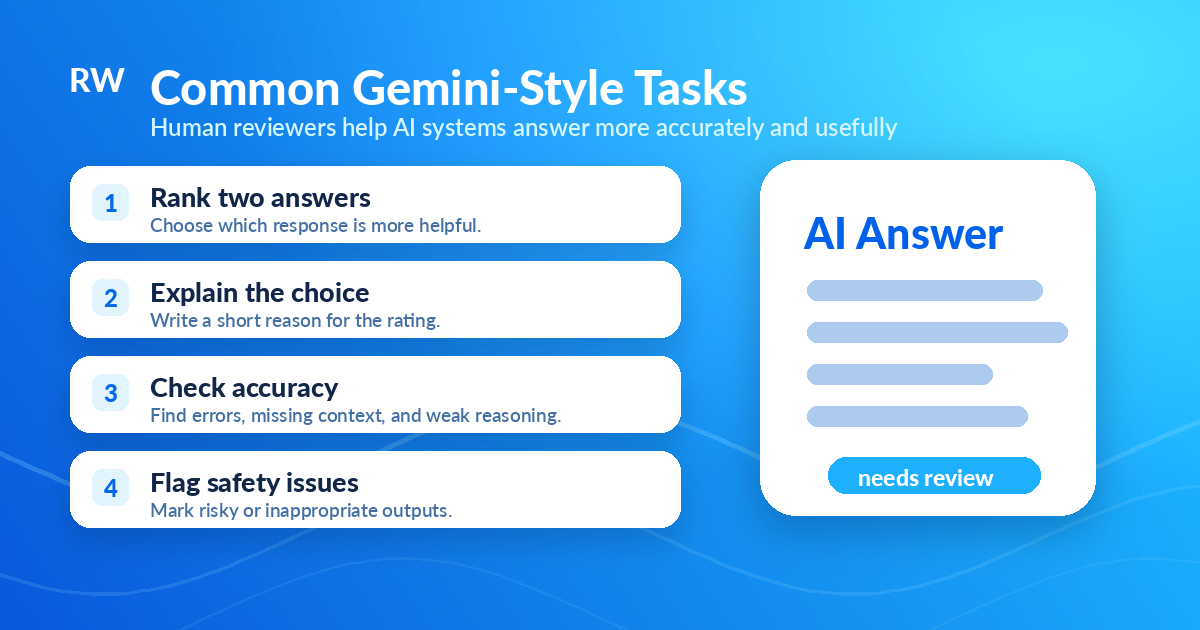
- Ranking AI answers. A reviewer compares two model responses and decides which one better satisfies the user's request. The better answer may be more accurate, more complete, more natural, more useful, or safer.
- Rating one response. A reviewer scores an AI answer on dimensions such as helpfulness, correctness, instruction-following, clarity, tone, formatting, and safety.
- Writing feedback. Many projects ask reviewers to explain their rating in one or two concise paragraphs. This is where strong writing skills matter. The feedback should be specific, fair, and actionable.
- Fact-checking. Some tasks require the reviewer to verify claims, identify hallucinations, or explain what the model got wrong. This is common in research, finance, health, legal, local information, and current-events-style tasks.
- Safety review. Reviewers may evaluate whether an answer handles sensitive topics responsibly. The goal is not to block every difficult topic. The goal is to help AI systems answer useful questions while avoiding harmful, misleading, or unsafe guidance.
- Prompt testing. Some projects ask reviewers to create prompts that reveal weaknesses in the model. This can include edge cases, confusing instructions, long documents, math problems, professional questions, or situations where context matters.
- Multimodal review. Because modern AI systems can work with text, images, audio, video, code, documents, and search-like experiences, some reviewers evaluate more than plain text. They may check whether the model interpreted an image correctly, summarized a document accurately, or used visual context in a reasonable way.
The Core Quality Standards
Most AI evaluation projects use their own guidelines, but the same basic standards show up again and again.
Helpfulness: Did the answer actually solve the user's problem? A helpful answer is not just long. It is relevant, practical, and clear.
Accuracy: Did the model avoid false claims? Did it distinguish facts from guesses? Did it handle uncertainty correctly?
Instruction-following: Did the model do what the user asked? If the user requested a short answer, did it stay short? If the user asked for a list, did it provide one?
Clarity: Is the answer easy to understand? Does it avoid unnecessary jargon? Does it organize information in a useful way?
Safety: Does the answer avoid harmful instructions, misleading certainty, or inappropriate advice? Does it handle sensitive topics carefully?
Context awareness: Did the answer understand the user's situation, constraints, tone, and intent? This is where human judgment is especially valuable.
Who Can Be a Good Fit for Gemini-Style AI Jobs
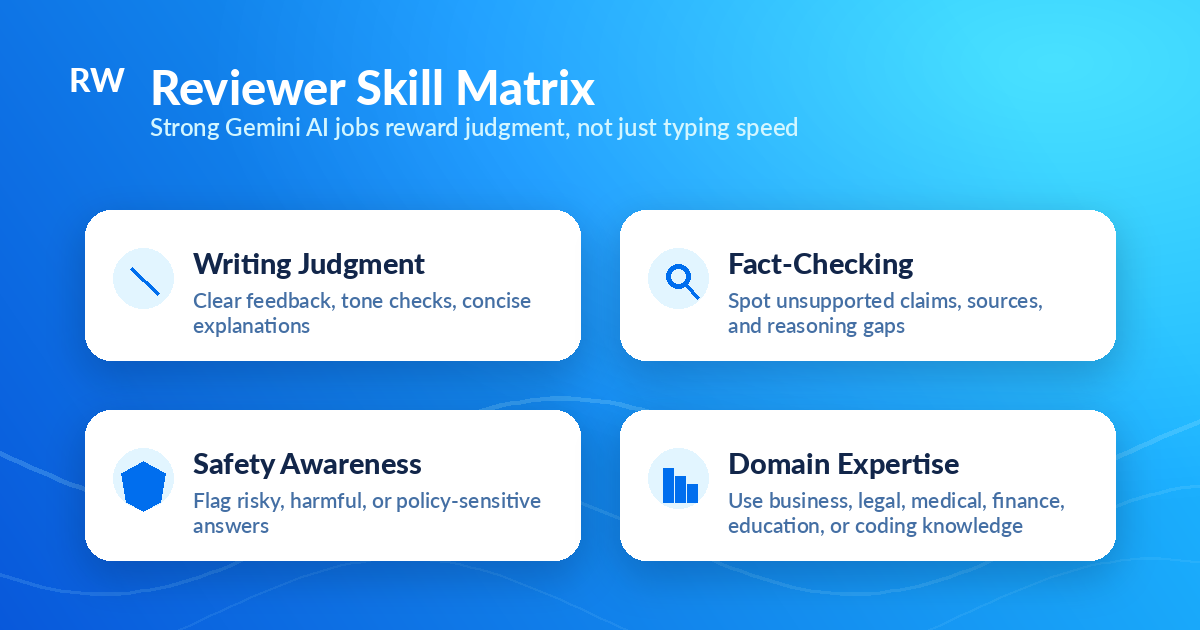
You do not need to be a machine learning engineer to do many AI reviewer jobs. Some technical roles require coding, math, data science, or advanced domain expertise, but many evaluation projects need people who can read carefully, think clearly, and explain judgments in plain English.
Good fits often include business professionals, writers, editors, consultants, researchers, teachers, lawyers, medical professionals, finance professionals, product managers, data analysts, and people with strong general reasoning skills. Coding can help for technical AI evaluation, but it is not the only path.
The strongest applicants usually have three traits: they can understand a task quickly, they can apply written guidelines consistently, and they can explain why one answer is better than another without overthinking or rambling.
Remote Work Union tracks legitimate remote AI training roles across top platforms. Find opportunities that match your background without sorting through vague listings.
Find Roles Hiring Now →Skills to Emphasize on Your Resume or Profile
If you are applying for AI evaluator jobs, do not only say that you use AI tools. Show the skills that make you useful as a reviewer.
Useful resume keywords include AI model evaluation, prompt writing, response ranking, fact-checking, quality assurance, content review, editorial judgment, research, analytical writing, data annotation, search quality, rubric-based evaluation, and subject matter expertise.
For a Gemini AI jobs search, it also helps to mention familiarity with major AI tools and ecosystems, such as Gemini, ChatGPT, Claude, Microsoft Copilot, Meta AI, and Grok. Do not exaggerate. The point is to show that you understand the category and can evaluate AI outputs with care.
If you have professional expertise, make that obvious. A finance analyst should highlight financial modeling, Excel, accounting, investing, or business analysis. A teacher should highlight curriculum, grading, tutoring, lesson design, and student feedback. A writer should highlight editing, research, tone, style, and factual accuracy. A lawyer or law student should highlight legal research, issue spotting, citations, and careful reasoning.
How to Search for Real Roles
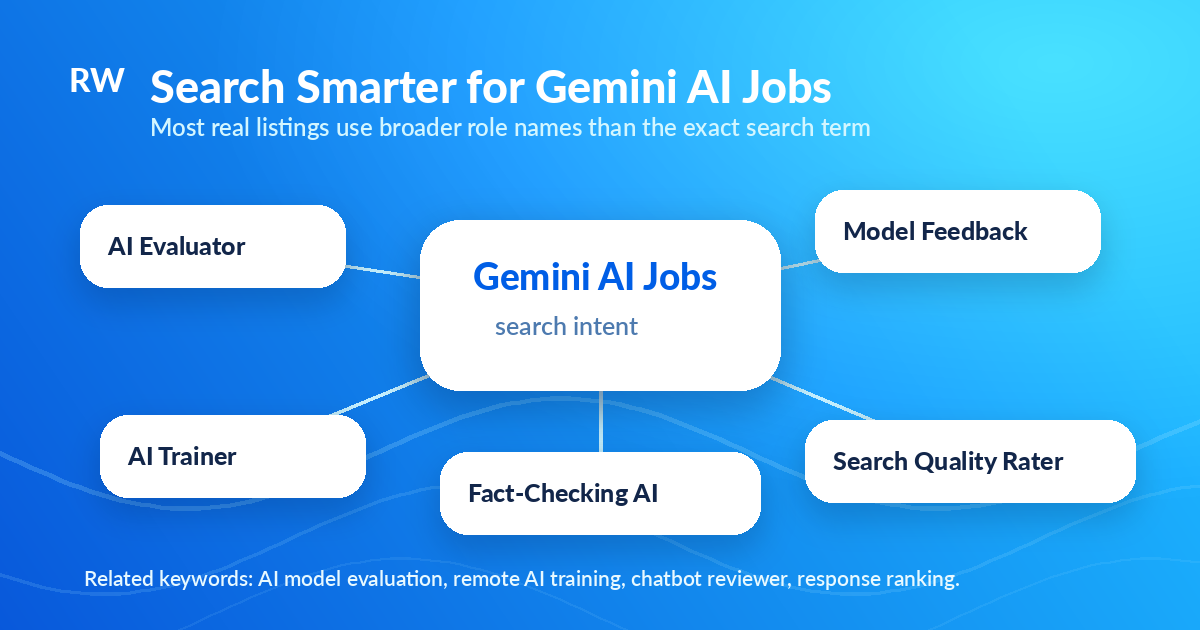
The exact phrase Gemini AI jobs may return a mix of product news, Google roles, AI tool tutorials, and unrelated listings. To find real opportunities, expand the search. Try role-based searches instead of only company-based searches.
Search terms to try include:
- AI evaluator jobs
- AI trainer jobs
- Remote AI training jobs
- AI model evaluation jobs
- Human feedback AI jobs
- AI response rating jobs
- Search quality rater jobs
- AI writing evaluator jobs
- AI fact-checking jobs
- AI safety evaluator jobs
- Data annotation AI jobs
- Google AI training jobs
- Gemini AI reviewer jobs
Also search by expertise. For example: finance AI evaluator, legal AI training jobs, medical AI reviewer, coding AI evaluator, business analyst AI trainer, education AI evaluator, and writing evaluator AI jobs. The more specific your background, the more likely you are to find projects that value your judgment.
Where These Jobs May Appear
Gemini-style AI review work can appear in several places. Some roles show up on large job boards like LinkedIn. Some appear through remote AI work platforms such as Handshake AI, Mercor, micro1, and Outlier AI. Some are posted by data annotation companies, AI labs, research vendors, search quality contractors, staffing firms, or specialized expert networks.
The listing may not say Google or Gemini. It may describe tasks like rating chatbot responses, evaluating AI-generated answers, reviewing prompts, comparing model outputs, assessing search result quality, or labeling examples for AI training. Those are the phrases to look for.
Be careful with listings that promise guaranteed income, require upfront payment, or claim that anyone can earn high hourly rates with no screening. Legitimate AI evaluation work usually includes some kind of application, assessment, onboarding, guideline review, or quality control.
Common Mistakes Applicants Make
A common mistake is applying with a generic resume that only says customer service, sales, admin work, or content creation. Those backgrounds can be useful, but the resume should translate them into AI evaluation skills. For example, customer service can show judgment, tone control, problem solving, and written communication. Admin work can show accuracy, organization, and attention to detail. Content work can show editing, research, and audience awareness.
Another mistake is overusing AI buzzwords without proving judgment. A profile that says AI, ChatGPT, Gemini, prompt engineering, and machine learning may still look weak if it does not show writing ability, evaluation experience, or domain knowledge.
A third mistake is treating the assessment casually. Many applicants fail because they rush, ignore instructions, write vague feedback, or make unsupported claims. AI evaluation tests are often less about memorization and more about careful reading.
How to Prepare Before Applying
Before applying for Gemini AI jobs or related AI evaluator roles, prepare three things.
First, create a resume version focused on AI evaluation. Add a short summary that says you can review AI-generated content, compare responses, follow detailed guidelines, and write clear feedback. Include any relevant domain expertise.
Second, practice comparing answers. Take two AI responses to the same question and write three sentences explaining which one is better. Mention accuracy, completeness, clarity, tone, and instruction-following. This is close to the work many evaluators do.
Third, gather examples of your expertise. Writers can include editing samples. Teachers can include curriculum or feedback experience. Business professionals can include analysis work. Lawyers, healthcare professionals, coders, and finance workers can emphasize specialized reasoning. The goal is to make your profile look credible for higher-quality projects.
Frequently Asked Questions
Are Gemini AI jobs usually direct Google jobs?
Not always. Some people are searching for Google-related roles, but many real opportunities use broader titles like AI evaluator, AI trainer, search quality rater, model response reviewer, or data annotator. The job may not mention Gemini in the title at all, but the work may still involve evaluating AI answers in a similar way.
Do I need coding skills for Gemini AI evaluation jobs?
Not for every role. Coding is useful for technical AI evaluation, but many projects focus on writing, research, business, education, healthcare, law, finance, safety, or general reasoning. Strong writers, business professionals, teachers, lawyers, and healthcare workers can all qualify for many AI evaluator roles.
Can this work be done remotely?
Many AI evaluation and data annotation roles are remote or contract-based, but requirements vary by company, country, client, and project. Some roles are restricted by country, language, or work authorization. Always read the listing carefully before applying.
What makes a good AI reviewer?
A good reviewer is consistent, specific, accurate, and clear. They can follow guidelines and explain why an AI answer is strong or weak. The best reviewers slow down to apply the rubric carefully rather than relying on first impressions or personal preference.
Should I search only for Gemini-related terms?
No. Search for Gemini AI jobs, but also search broader terms like AI evaluator, AI trainer, AI model evaluation, AI response rating, search quality rater, and AI fact-checking jobs. Task-based searches usually surface more relevant remote opportunities than company-name-only searches.