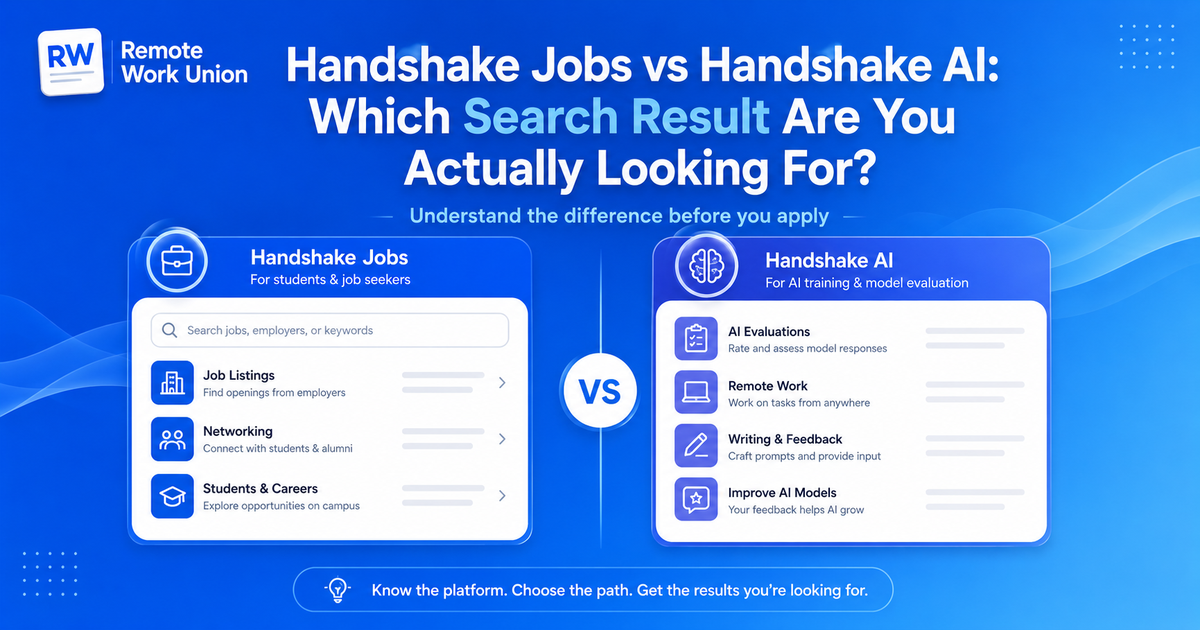
A search for "Handshake jobs" can mean more than one thing. Some people are looking for a student job marketplace, internship listings, campus recruiting, and employer pages. Other people are looking for remote AI work, AI training jobs, model evaluation projects, prompt review tasks, writing-based feedback work, or flexible online opportunities connected to the fast-growing AI economy.
That difference matters. If you click the wrong result, you can waste time reading the wrong page, building the wrong profile, or applying to work that does not match your actual goal. A person searching for internships through a school career center is not always looking for the same thing as a person searching for AI evaluator jobs, AI rater jobs, RLHF projects, human feedback jobs, data annotation work, prompt evaluation roles, or remote AI training contracts.
This guide explains the practical difference between Handshake Jobs and Handshake AI-style search intent. It is written for remote job seekers, students, recent graduates, writers, researchers, generalists, bilingual workers, coders, subject-matter experts, and anyone trying to understand where AI-related remote work actually appears.
The Core Difference: Job Board Search vs AI Work Search
The easiest way to separate the two searches is to look at intent.
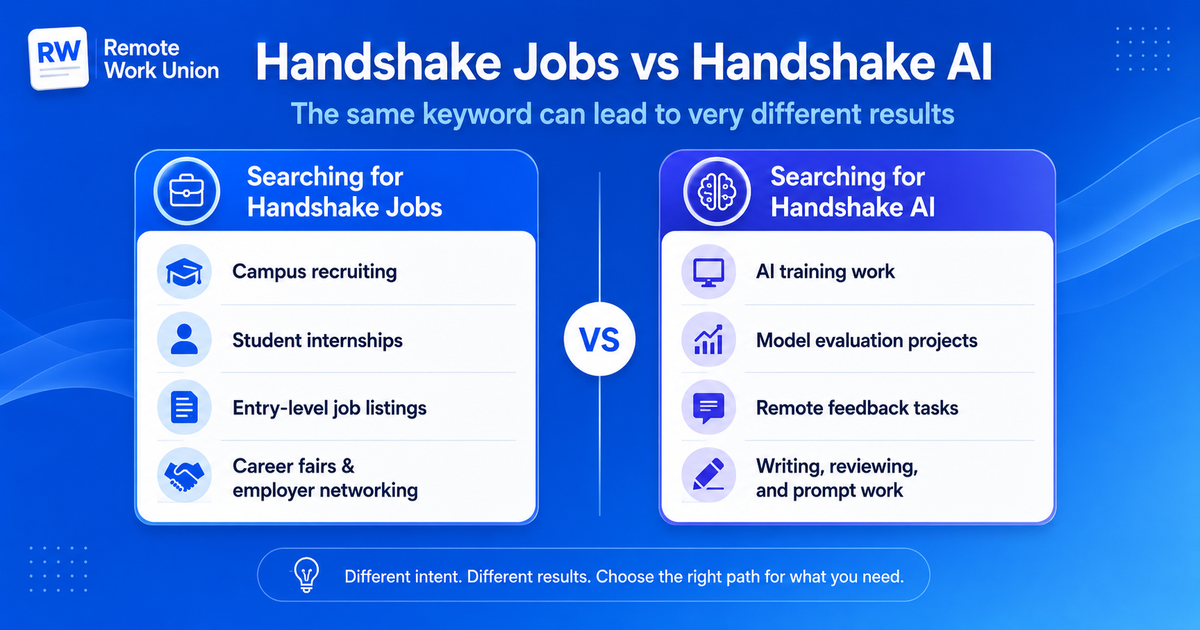
When someone types "Handshake Jobs," they are usually looking for a job board or career platform experience. Their goal is to find companies, internships, entry-level roles, on-campus recruiting events, alumni connections, employer pages, application portals, and career center resources.
When someone types "Handshake AI," they may be looking for something different: AI training work, model evaluation tasks, human feedback projects, writing and research evaluation, AI response review, prompt quality testing, chatbot rating, or remote contract work that helps improve AI systems.
The words are similar, but the path is different. One search is usually about finding traditional jobs and employers. The other search is often about understanding whether there are AI-related projects where humans review, rate, edit, compare, or improve model outputs.
What People Usually Mean by Handshake Jobs
Handshake Jobs usually points toward conventional job search activity. This can include internships, part-time jobs, entry-level jobs, campus recruiting, career fairs, employer information sessions, and early-career hiring programs. For students and recent graduates, a platform like this can be useful because it organizes employer access around schools, career centers, resumes, and recruiting timelines.
A typical Handshake Jobs searcher might be asking questions like: Which companies are hiring students? Are there entry-level roles near me? Can I find internships through my school? What employers are recruiting on campus? How do I build a basic profile and submit applications?
That is a very different mindset from someone searching for remote AI training jobs. The traditional job board path is usually built around employers, job descriptions, resumes, degree programs, locations, and hiring cycles. It may include remote jobs, but remote AI training is not always the main focus.
What People Usually Mean by Handshake AI
Handshake AI-style search intent is more likely to overlap with the modern remote AI work category: AI evaluation jobs, AI model trainer jobs, AI rater jobs, data annotation jobs, prompt evaluation jobs, AI response reviewer jobs, RLHF jobs, and human feedback roles. These are jobs or projects where humans help improve AI systems by checking answers, testing model behavior, labeling information, comparing responses, writing ideal answers, rating helpfulness, or reviewing accuracy.
This kind of work exists because modern AI systems are not improved by code alone. Large AI companies and AI-focused teams often need human judgment. A model can produce an answer, but a human may need to decide whether that answer is correct, useful, safe, well-written, properly reasoned, or aligned with the task instructions.
That is why keywords like "AI training," "model evaluation," "AI rater," "AI reviewer," "prompt evaluator," "chatbot evaluator," "human feedback," "RLHF," "data annotation," "AI data annotation," "AI research," and "remote AI jobs" matter. They signal a search that is not just about finding a generic job board. It is about finding the category of remote work where judgment, writing, analysis, and subject expertise can be valuable.
Why This Confusion Happens
The confusion happens because job seekers often search in broad phrases. They may type the name of a platform, add "AI," add "jobs," or add "remote," and expect the search engine to understand their intent. Search engines can return results for student job boards, company pages, AI tools, job posts, reviews, Reddit threads, platform sign-up pages, and unrelated career content all on the same results page.
This is especially common with AI work because the category is still developing quickly. A person may hear about OpenAI, Anthropic, Google, Meta, Microsoft, xAI, Scale AI, Surge AI, Mercor, Outlier, micro1, Stellar AI, Handshake AI, or other AI-related opportunities and then search a short phrase instead of a precise job category. The shorter the search, the more mixed the results can be.
The fix is not to search less. The fix is to search more clearly. Instead of only searching "Handshake jobs," add the type of work you actually want: "remote AI evaluator jobs," "AI model training jobs," "prompt evaluation work," "AI response reviewer jobs," "data annotation jobs from home," "RLHF jobs," "human feedback AI jobs," or "remote AI training jobs for writers."
Quick Comparison Table
Use this table to decide which path you are probably looking for.
| Category | Handshake Jobs | Handshake AI-style search intent |
|---|---|---|
| Main goal | Find employers, jobs, internships, and early-career opportunities | Find AI training, model evaluation, and remote feedback work |
| Typical user | Student, recent graduate, early-career applicant, career center user | Remote worker, writer, researcher, reviewer, coder, specialist, generalist |
| Common keywords | jobs, internships, career center, employers, campus recruiting | AI training, AI evaluator, model evaluation, prompt review, data annotation |
| Work style | Traditional applications, job board listings, employer pages | Often project-based, remote-friendly, task-based, assessment-driven |
| Best next step | Build a standard job profile and apply to relevant employers | Use AI-work keywords and prepare for evaluation tests or trial tasks |
If You Want Traditional Job Listings, Look for These Signals
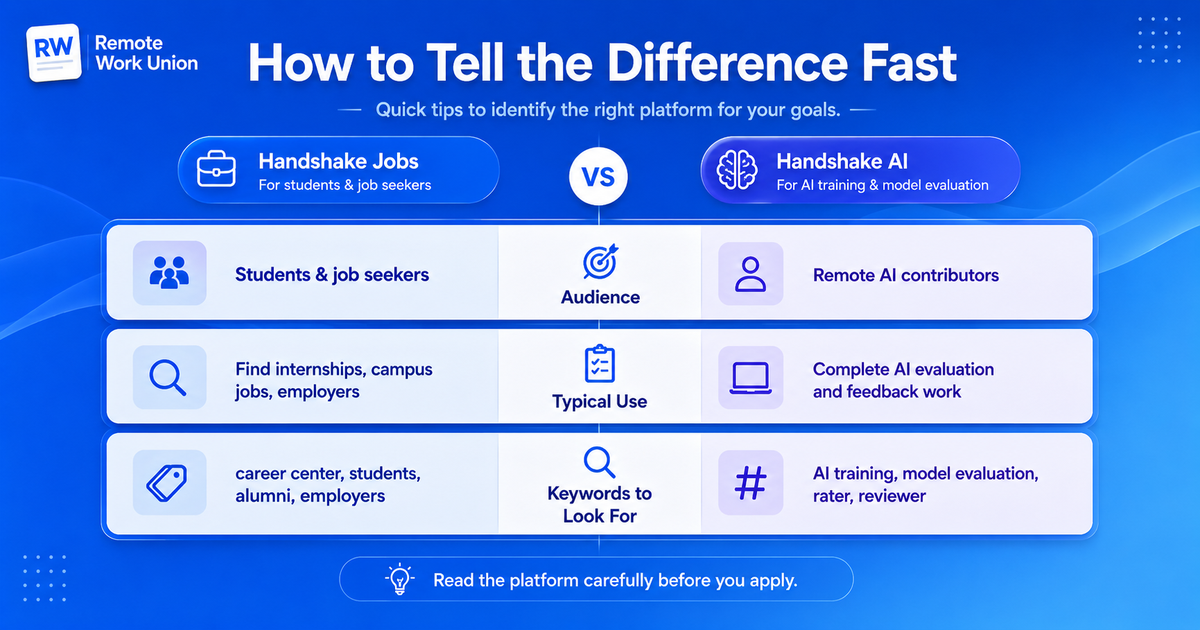
You are probably looking for Handshake Jobs or a standard job board experience if the page talks mainly about employers, internships, college career centers, campus recruiting, alumni networks, job fairs, entry-level hiring, resume uploads, employer profiles, or applications tied to school accounts.
That does not mean the result is bad. It may be exactly what you need if you are a student, recent graduate, career switcher, or entry-level applicant. But if your real goal is remote AI training work, traditional job board language may not be specific enough.
Look for phrases like "internship," "campus recruiting," "career center," "student profile," "employer events," "entry-level job," "job fair," and "early talent." These are useful phrases, but they usually describe a broader career marketplace instead of a dedicated AI training work category.
If You Want Remote AI Training Work, Look for These Signals
You are probably looking for Handshake AI or an AI-work-related result if the page talks about AI model evaluation, AI training, prompt writing, response comparison, answer rating, human feedback, RLHF, data annotation, subject-matter review, coding evaluation, language evaluation, or research-based tasks.
This category is often project-based, contract-based, flexible, and remote-friendly. Some roles are generalist roles where strong writing, careful reading, fact-checking, and reasoning matter. Other roles require specialized knowledge in law, medicine, finance, accounting, education, coding, mathematics, science, translation, or other domains.
Look for phrases like "AI evaluator," "AI trainer," "model evaluator," "AI rater," "prompt evaluator," "response reviewer," "human feedback," "data annotation," "AI research," "LLM evaluation," "chatbot rating," "remote contractor," and "expert review." These phrases are stronger signals that the result may connect to AI training work instead of a generic job board.
Remote Work Union helps you find legitimate remote AI training and evaluation roles. Search smarter, apply faster, and get matched with work that fits your skills.
Find Roles Hiring Now →How to Search Smarter
A better search query saves time because it filters out irrelevant results earlier. Instead of searching only the platform name, combine the platform or company name with the work type, remote intent, and your skill category.
For example, a writer might search "remote AI writing evaluator jobs" or "prompt evaluation jobs for writers." A researcher might search "AI research evaluation remote jobs" or "AI fact checking jobs from home." A coder might search "AI coding evaluator jobs" or "LLM code review contract work." A bilingual applicant might search "AI language evaluator jobs" or "bilingual data annotation remote jobs."
Searches like these are more useful because they describe the actual work. They also help separate traditional jobs from AI training roles, AI model evaluation projects, and human feedback work.
The Resume Difference
The profile or resume you use for traditional jobs may not be the same one you should use for AI evaluation work. A standard job-board resume often emphasizes job titles, employers, education, internships, leadership, and career history. That is still useful, but remote AI training applications often need more evidence of judgment and task fit.
For AI evaluator jobs, your resume should make your relevant skills obvious. Include writing, editing, research, fact-checking, analysis, prompt writing, AI tools, spreadsheet work, domain expertise, coding languages, legal research, medical writing, finance, accounting, teaching, tutoring, language skills, or other relevant abilities. If you have used ChatGPT, Claude, Gemini, Grok, Perplexity, Copilot, or other AI tools in a serious workflow, explain what you did with them rather than just listing the tool name.
A strong AI-work resume is usually direct. It shows that you can read instructions, judge quality, compare outputs, explain mistakes, write clearly, and handle detail-oriented tasks without needing constant supervision.
The Application Difference
Traditional job-board applications often ask for a resume, cover letter, profile, work history, location, school, degree, and availability. AI training applications may ask for those things too, but they often add assessments, writing samples, domain tests, coding tests, reasoning tests, or trial tasks.
That is why preparation matters. If you are applying for AI model evaluation work, practice reading instructions carefully. Practice comparing two answers and explaining which one is better. Practice spotting hallucinations, unsupported claims, weak reasoning, vague writing, missing citations, or answers that fail to follow the prompt. Practice writing concise feedback that a reviewer could actually use.
The best applicants do not only say they are interested in AI. They show that they can evaluate AI output with patience, clarity, and consistency.
How to Avoid Misleading Results
Do not assume every result with "AI" in the name is a remote work opportunity. Some pages are tools. Some are company pages. Some are student platforms. Some are job board listings. Some are reviews or forum posts. Some are outdated. Some are low-quality aggregator pages built only to capture search traffic.
Before you apply, check the basics: What company or platform is actually behind the listing? Is the role remote, hybrid, or location-specific? Is it employee work, freelance work, or contract project work? Does it require a degree? Does it require a school account? Does it mention AI evaluation, human feedback, data annotation, or model training tasks? Is the pay structure clear? Are the instructions professional?
A real opportunity should give you enough information to understand what you are applying for. If the page is vague, asks for money from job seekers, makes unrealistic promises, or hides the actual company, slow down.
Where Remote Work Union Fits
Remote Work Union is built around the job seeker who wants to find remote work more intelligently, especially in categories like AI training, model evaluation, data annotation, remote research, AI response review, writing-based evaluation, and flexible online work. The goal is not to make every job sound the same. The goal is to help people understand the category, use better search terms, and find roles that match their actual skills.
A person with strong writing skills may be a fit for prompt evaluation, AI response review, editing, and quality rating. A teacher may be a fit for education evaluation or tutoring-related AI tasks. A lawyer or paralegal may be a fit for legal AI review. A nurse or medical writer may be a fit for healthcare-related evaluation. A finance or accounting professional may be a fit for domain-specific AI review. A coder may be a fit for AI code evaluation without taking a full-time software engineering job.
The key is to stop searching only for vague phrases and start searching with a clear work category. "Remote AI evaluator," "AI model trainer," "AI rater," "data annotation from home," "human feedback AI jobs," and "prompt evaluation jobs" are usually stronger than generic job searches.
Practical Search Terms to Try
Use combinations like these when searching job boards, AI work platforms, LinkedIn, Google, company career pages, and remote work newsletters.
General AI work: remote AI training jobs, AI evaluator jobs, AI model trainer jobs, AI rater jobs, AI response reviewer jobs, human feedback jobs, RLHF jobs, LLM evaluation jobs, chatbot evaluator jobs.
Writing and research: prompt evaluation jobs, AI writing evaluator jobs, AI fact-checking jobs, remote research evaluator jobs, AI content reviewer jobs, AI editor jobs, answer quality reviewer jobs.
Data and annotation: data annotation jobs from home, AI data annotation jobs, labeling jobs for AI, remote annotation projects, data quality reviewer jobs.
Specialist searches: AI coding evaluator jobs, legal AI reviewer jobs, healthcare AI evaluator jobs, finance AI evaluation jobs, education AI training jobs, bilingual AI evaluator jobs, language model evaluation jobs.
Frequently Asked Questions
What is the difference between Handshake Jobs and Handshake AI?
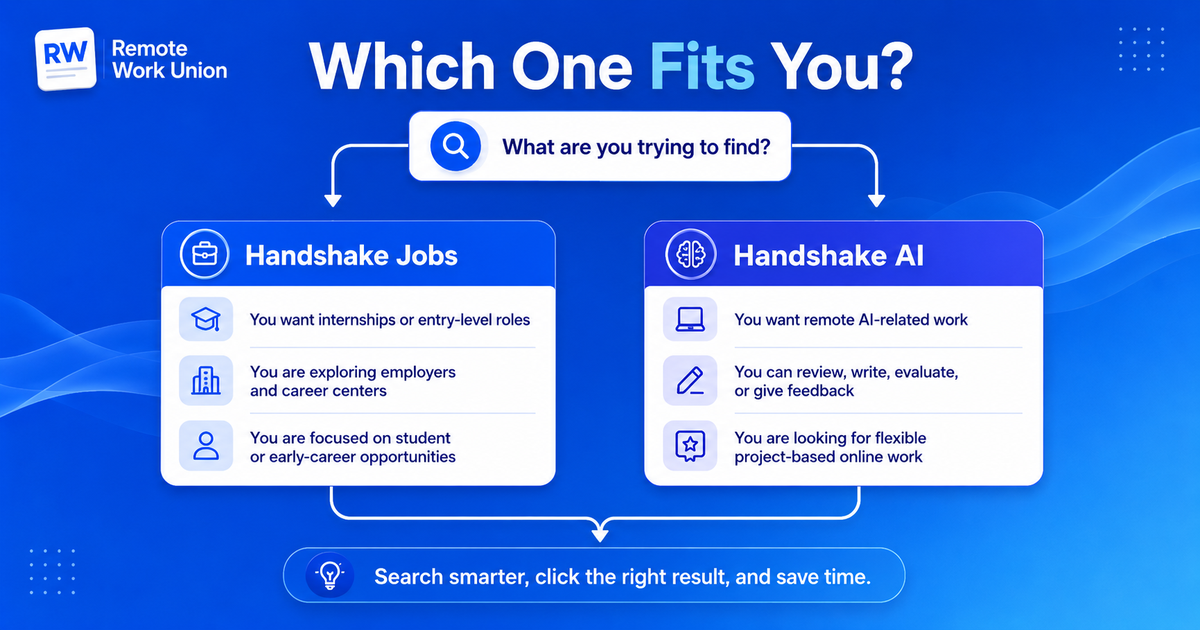
Handshake Jobs usually refers to a student job marketplace focused on internships, campus recruiting, employer pages, and early-career hiring. Handshake AI-style search intent usually refers to remote AI training work, model evaluation, human feedback projects, prompt review, data annotation, and AI response rating. The words are similar, but the path, profile, and application process are different.
Do I need a different resume for AI training jobs vs traditional job board applications?
Yes. A standard job-board resume emphasizes titles, employers, and career history. An AI training application resume should highlight evaluation ability, writing, research, fact-checking, domain expertise, and relevant tools. Include language like AI evaluation, prompt review, response comparison, rubric-based review, and any relevant domain knowledge.
What search terms should I use to find remote AI training jobs?
More specific terms produce better results. Try: remote AI training jobs, AI evaluator jobs, AI model trainer jobs, AI rater jobs, AI response reviewer jobs, human feedback jobs, RLHF jobs, prompt evaluation jobs, data annotation jobs from home, and specialist variants like AI coding evaluator jobs or bilingual AI evaluator jobs.
How do I know if a search result is for a traditional job board or remote AI work?
Look for signal phrases. Traditional job board results use terms like internship, campus recruiting, career center, employer events, student profile, and entry-level job. Remote AI work results use phrases like AI evaluator, AI trainer, model evaluator, AI rater, prompt evaluator, response reviewer, human feedback, data annotation, and remote contractor.
Can AI training work appear on traditional job boards?
Yes. Remote AI training jobs can appear on LinkedIn, standard job boards, and platforms that mix traditional and remote contract work. The key is to read postings carefully and confirm whether the role is AI model evaluation work, standard employment, or freelance contract work before investing time in the application.
What does Remote Work Union help with?
Remote Work Union is built for job seekers who want to find remote work more intelligently, especially in categories like AI training, model evaluation, data annotation, remote research, AI response review, and flexible online work. The goal is to help people understand the category, use better search terms, and find roles that match their actual skills.
Final Takeaway
The phrase "Handshake Jobs vs Handshake AI" is really a search intent problem. If you want internships, campus recruiting, employer pages, student job listings, and early-career hiring, you are probably looking for a traditional Handshake Jobs-style result. If you want remote AI training work, model evaluation, prompt review, data annotation, human feedback, or AI response rating, you need to search with more precise AI work keywords.
Neither path is automatically better. They solve different problems. The right path depends on whether you want a conventional job board experience or a remote AI work opportunity. Once you know the difference, you can search faster, apply more intelligently, and avoid wasting time on results that do not match your goal.