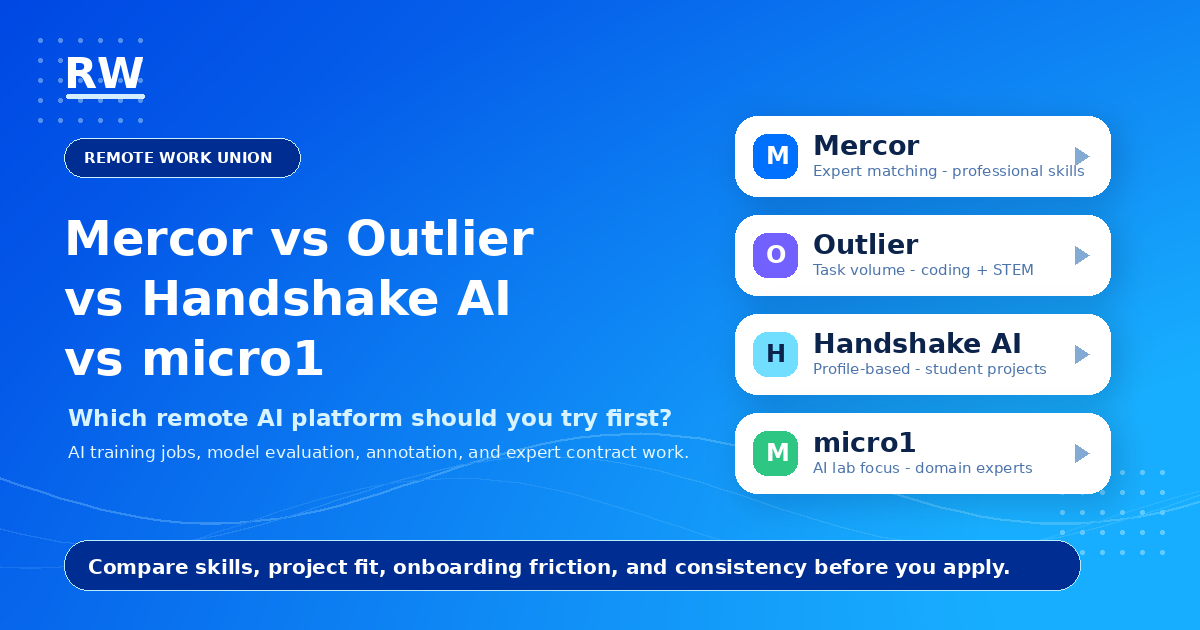
Mercor, Outlier, Handshake AI, and micro1 all sit inside the fast-growing market for remote AI training work — jobs where humans help improve large language models by writing prompts, ranking model answers, reviewing factual accuracy, applying professional judgment, and creating examples that teach AI systems how experts think.
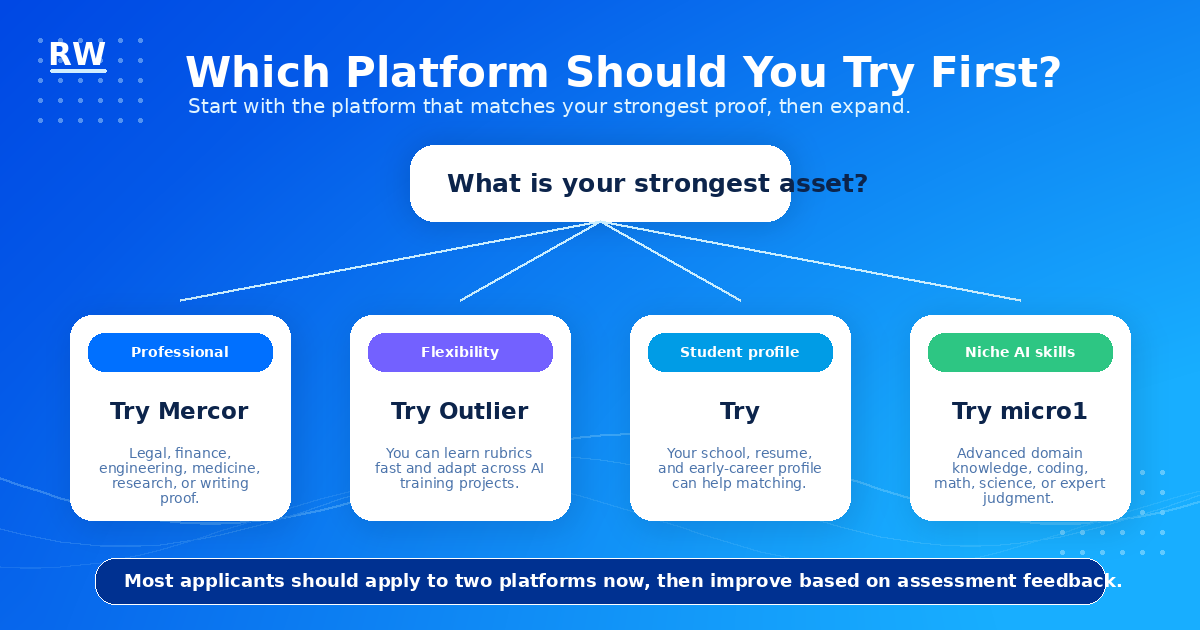
The simplest answer is this: try Mercor first if you have valuable professional expertise, try Handshake AI first if you are a student, graduate, PhD, postdoc, or academically credentialed expert, try Outlier first if you want the broadest entry point into flexible AI training work, and try micro1 first if you have strong technical or specialized expertise and want projects matched through an AI interview.
The smarter answer is to apply to all four, then prioritize the platform that gives you the best combination of pay rate, project availability, onboarding clarity, and fit with your background. These are not normal salaried jobs. They are usually freelance, contractor, part-time, or project-based roles. Treat them like a remote income channel, not a guaranteed career path by themselves.
The Quick Verdict: Which One Should You Try First?
If you are a marketing or sales professional, finance or business expert, consultant, writer or creative, customer experience lead, software engineer, lawyer, doctor, scientist, or any experienced subject-matter expert, start with Mercor. Mercor is strongest when your professional background is the product — its best use case is expert AI review, model evaluation, domain-specific reasoning, and training frontier AI systems with real human expertise.
If you are a college student, graduate student, recent graduate, PhD, postdoc, academic, or someone with a strong educational profile, start with Handshake AI. It is positioned more like a fellowship and expert community, especially relevant for people who can credibly say, "I know this subject deeply, and I can help an AI lab evaluate work in this domain."
If you are a writer, bilingual professional, math tutor, coding student, detail-oriented generalist, or someone trying to break into AI training with no AI experience, start with Outlier. Outlier has a broader marketplace feel, with remote work across writing, coding, language, math, and general AI training projects.
If you are an engineer, researcher, data or quantitative specialist, or technical domain expert who wants higher-rate work matched through an AI interview, start with micro1. micro1 vets contributors with an AI interview and leans toward higher-skill technical and specialist projects, with expert rates that can reach $50–$200/hr.
What These Platforms Actually Do
These platforms exist because AI companies still need humans. Even the best models need people to evaluate reasoning, judge usefulness, correct errors, compare answers, and create training data. A remote AI trainer may do several types of work: write prompts, compare two model answers, score answers against a rubric, identify hallucinations, correct coding errors, review legal or financial reasoning, write expert-level explanations, classify unsafe responses, or create examples of what a strong answer should look like.
This work is often described with keywords like AI trainer, AI evaluator, LLM evaluator, prompt evaluator, model response reviewer, AI content reviewer, RLHF specialist, expert reviewer, subject-matter expert, AI research contractor, data annotation specialist, and human feedback contributor.
The important distinction: these jobs are not always "AI jobs" in the traditional engineering sense. In many cases, the skill being sold is your judgment. A marketer judges whether messaging is persuasive and on-brand. A salesperson judges whether outreach would actually land. A finance analyst reviews financial reasoning. A customer service lead spots replies that would frustrate a real customer. A writer reviews tone and clarity. A lawyer reviews legal reasoning. A software engineer reviews code correctness.
Mercor: Best for High-Value Expert Profiles
Mercor is strongest for people with clear professional expertise. It is designed to connect skilled professionals with AI training projects that need domain knowledge — especially interesting for people in marketing, sales, finance, business operations, customer experience, consulting, writing, software engineering, law, medicine, accounting, science, and other expert fields.
A strong Mercor applicant should present themselves like a consultant, not like someone looking for random online tasks. Your application should make your expertise obvious quickly: your role, credentials, years of experience, specific tools or industries, and the kinds of decisions you are qualified to review.
Mercor may involve an AI interview or evaluation process. That can feel unusual, but it makes sense for the category — these platforms need to screen thousands of applicants and match them to projects quickly. The goal is to prove you can think clearly in your domain without needing constant supervision.
Mercor pros: High upside for specialized professionals, strong fit for expert AI training, relevant for impressive resumes, potential access to more complex projects, clear story around applying professional judgment to AI systems.
Mercor cons: More competitive than generic remote work, less predictable than a salaried job, possible waiting time after screening, project availability can depend heavily on your niche, AI interview format may not be comfortable for everyone.
Best for: Marketing and sales professionals, finance and business experts, consultants, writers and creatives, customer experience leads, operators, software engineers, lawyers, doctors, accountants, scientists, and other credible specialists.
Outlier: Best Broad Entry Point Into AI Training Work
Outlier is the most straightforward option for many people searching for remote AI training jobs. It has a marketplace feel: create a profile, select areas of expertise, complete onboarding or screenings, and work on available projects when they match your skills.
Outlier is especially relevant for people searching for work from home jobs that are not customer support, not sales, not surveys, and not basic data entry. The work can involve real judgment: writing, editing, evaluating model outputs, checking math, reviewing code, or comparing answers.
The tradeoff is consistency. Like many AI training platforms, available work can change. Pay can vary by task, project, expertise, country, and demand. A great week on a platform does not guarantee a great month. Outlier is also a good first choice if you want to start learning how AI training platforms work — their basic rhythm of prompt evaluation, answer ranking, quality rubrics, and asynchronous remote work.
Outlier pros: Broad range of roles, flexible remote work, good fit for writers and language experts, opportunities for math and coding skills, no traditional office schedule, useful entry point for people trying to break into AI training.
Outlier cons: Project availability can be inconsistent, pay rates can vary, onboarding may not always lead immediately to paid work, some projects may be lower-paying than expected.
Best for: Writers, editors, language experts, coding students, math tutors, detail-oriented generalists, students, bilingual workers, and people who want a flexible way to test remote AI work.
Handshake AI: Best for Students, Graduates, and Academic Experts
Handshake AI is different because it is tied to a career network and presented through a fellowship-style structure. That makes it especially relevant for students, recent graduates, graduate students, PhDs, postdocs, professors, and people with academic credibility.
Handshake AI is positioned around paid, remote AI training work that can help fellows gain AI experience — which matters early in a career. A remote AI project can become a resume signal: you contributed to model evaluation, expert feedback, prompt quality, or AI research support.
The main limitation is eligibility and fit. Some opportunities may be oriented toward U.S.-based work authorization, academic credentials, or specific domains. If you do not match the current project needs, you may need to wait or apply elsewhere in parallel.
Handshake AI pros: Strong fit for students and academic experts, fellowship-style positioning, remote part-time work, domain-based opportunities, useful AI experience for a resume, clearer structure for people who like academic or credential-based pathways.
Handshake AI cons: Not every applicant will match current projects, eligibility can matter, some roles may favor degrees or specialized fields, project availability can still change based on AI lab demand.
Best for: College students, recent graduates, graduate students, PhDs, postdocs, academic experts, technical majors, humanities experts, domain specialists, and people who want a paid AI fellowship-style experience.
micro1: Best for AI-Interview-Matched Expert and Technical Work
micro1 vets contributors with an AI interview and matches them to expert AI training and evaluation projects. It leans toward higher-skill technical and professional work, which makes it a strong fit for engineers, researchers, data and quantitative specialists, and domain experts who can demonstrate verifiable expertise. Qualified experts can earn around $50–$200/hr.
The defining feature is the AI interview (often referred to as "Zara"). Instead of a long manual review, you talk through your reasoning, and the match favors people who can explain their thinking clearly and concisely in their domain. Prepare for it like a real technical or professional interview, not a survey.
micro1 pros: Strong fit for technical and specialist experts, AI-interview matching that rewards demonstrable skill, higher-rate expert projects, fast vetting for qualified applicants, clear focus on expertise over availability.
micro1 cons: Best suited to people with real depth in a domain, the AI interview format may feel unfamiliar, project availability still depends on demand in your specialty.
Best for: Engineers and coders, researchers, data and quantitative specialists, and domain experts who want AI-interview-matched, higher-rate technical and professional projects.
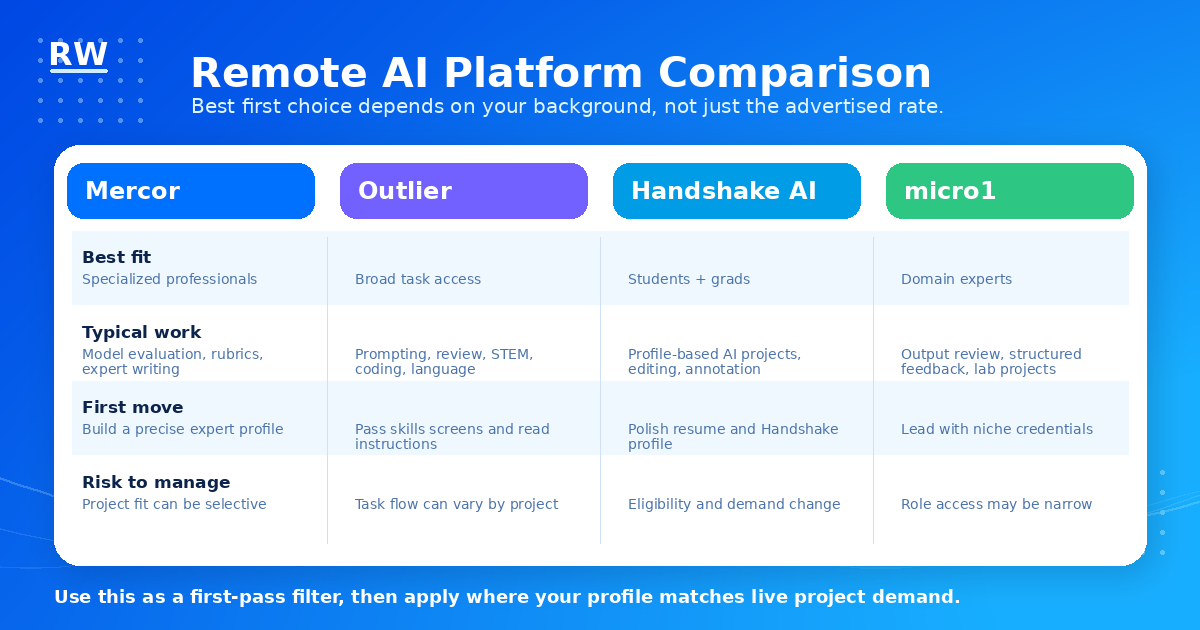
Platform Comparison Table
| Platform | Try first if… | Best strengths | Watch-outs |
|---|---|---|---|
| Mercor | You have high-value professional expertise. | Expert AI training, domain review, higher-ceiling specialist roles. | Competitive screening; project matching may take time. |
| Outlier | You want broad remote AI training access. | Flexible tasks, writing/language/math/coding categories, beginner-friendly. | Rates and task availability vary by project. |
| Handshake AI | You are a student, grad, PhD, postdoc, or academic expert. | Fellowship-style structure, degree/domain fit, resume-friendly AI experience. | Eligibility and current project needs matter. |
| micro1 | You have strong technical or specialist expertise and want AI-interview-matched projects. | Expert and technical review, AI-interview vetting, higher-rate specialist work ($50–$200/hr). | Best for genuine domain depth; the AI-interview format is different. |
Which Platform Should Writers and Marketers Try First?
Writers and marketers should usually start with Outlier and Mercor. Outlier often maps well to writing, editing, response evaluation, language quality, tone, clarity, and content review. Mercor can be strong if the writer has a specialized background: technical writing, legal writing, finance writing, UX writing, brand strategy, SEO, advertising, social media, or content operations.
The key is to translate writing experience into AI training language. Instead of saying only "content writer," say "I can evaluate helpfulness, clarity, factual accuracy, tone, and instruction-following in model-generated content." That is the bridge between normal writing jobs and remote AI training jobs.
Which Platform Should Engineers Try First?
Engineers should try Mercor and micro1 first, then Outlier, then Handshake AI if the profile also fits academic or fellowship-style roles. micro1 is particularly worth prioritizing for engineers, since its AI interview is built to surface real technical depth. Coding expertise is one of the clearest fits for AI training because models are frequently evaluated on code generation, debugging, architecture, tests, documentation, and reasoning through software problems.
A strong engineering profile should list languages, frameworks, years of experience, code review experience, debugging ability, and any production systems you have worked on. Apply like someone who can judge whether a model-generated solution is actually correct, not like a general remote worker.
Useful keywords for engineering profiles: code evaluator, AI coding trainer, software engineering expert, Python reviewer, JavaScript reviewer, code quality reviewer, LLM code evaluation, debugging expert, and technical prompt evaluator.
Which Platform Should Lawyers, Finance Pros, and Consultants Try First?
Lawyers, finance professionals, and consultants should usually try Mercor first. These fields involve structured reasoning, high-cost mistakes, professional standards, and detailed domain judgment — exactly where AI labs need better human feedback.
For legal experts, the value is the ability to spot unsupported reasoning, distinguish jurisdictions, identify missing caveats, and evaluate whether an answer is precise enough. For finance professionals, the value is the ability to review assumptions, calculations, definitions, risk language, and business logic. For consultants, the value is structured thinking, issue trees, market analysis, and executive-level clarity.
Which Platform Should Students and Recent Graduates Try First?
Students and recent graduates should try Handshake AI first, then Outlier, then Mercor. Handshake AI is naturally aligned with students and early-career professionals because it already lives near the career network and fellowship model.
Outlier can be a useful second option because it may provide broader opportunities and a faster way to learn how AI evaluation tasks work. Mercor can still be worth applying to, especially for students with strong technical, finance, legal, medical, scientific, or math backgrounds.
The student mistake is applying like you have no expertise. You may not have ten years of experience, but you may still have a domain: economics, statistics, biology, chemistry, physics, computer science, literature, philosophy, psychology, education, accounting, music, language, or writing.
Looking for remote AI training roles across all platforms? Apply through Remote Work Union.
Browse Roles Now →How to Apply Without Looking Like a Generic Applicant
The biggest mistake applicants make is treating these platforms like survey sites. You are not trying to prove you can click buttons. You are trying to prove you can improve AI quality.
A strong profile answers five questions quickly: What do you know? How deeply do you know it? What kind of outputs can you evaluate? What proof do you have? What rate or project type makes sense for your expertise?
The Best Application Strategy: Apply to All Four, Then Prioritize
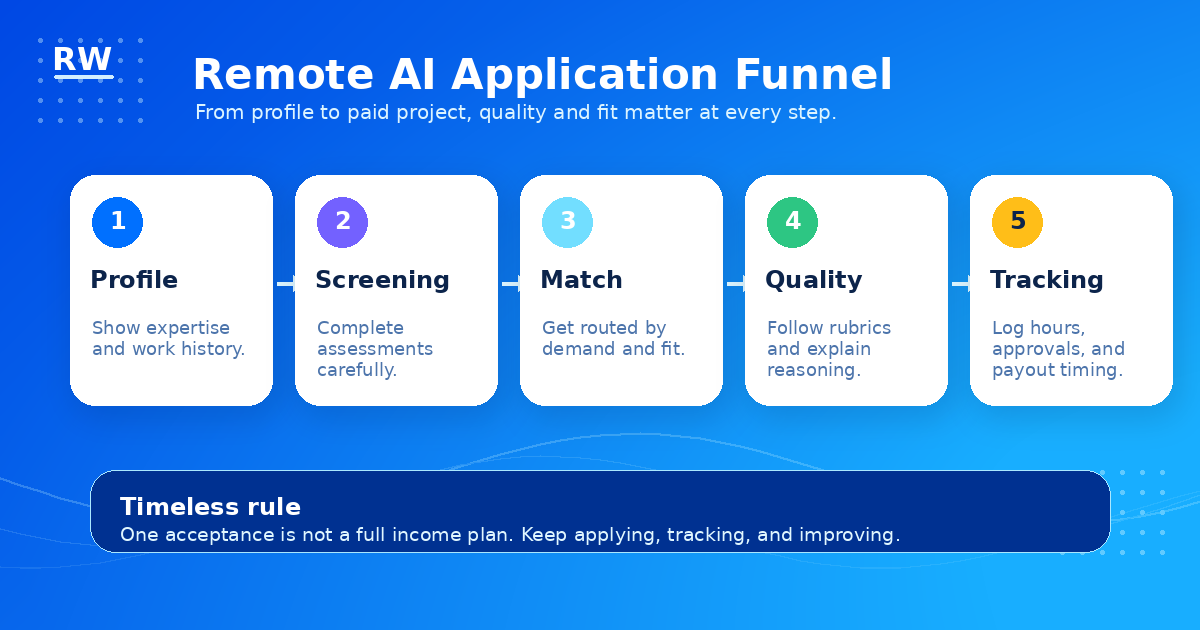
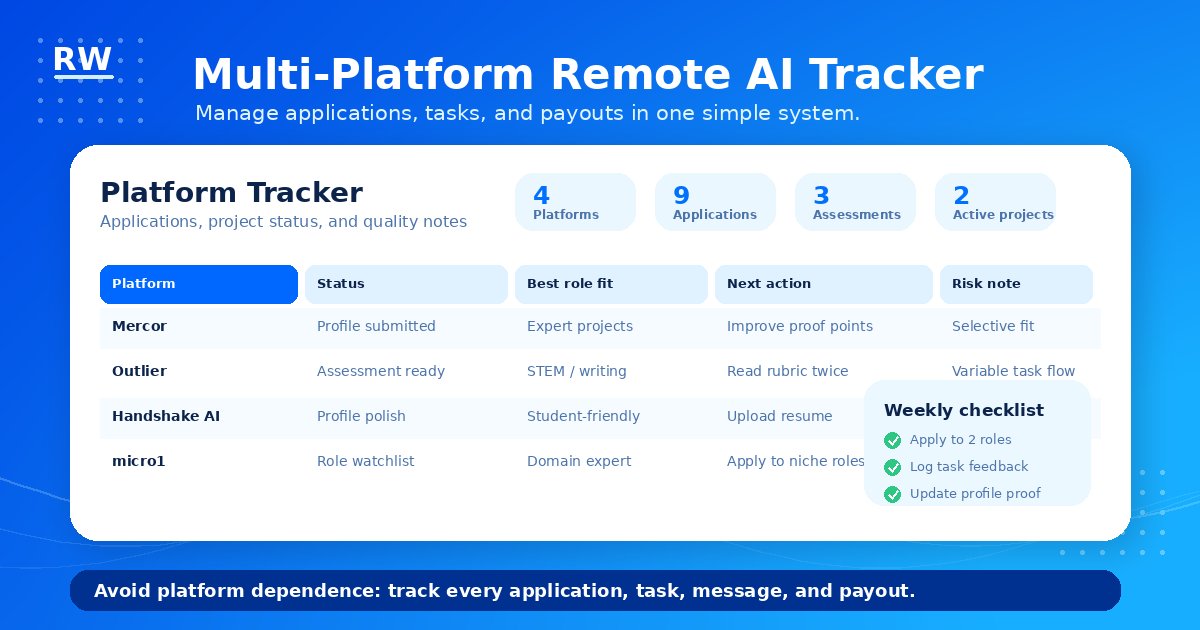
Do not spend two weeks trying to decide which platform is perfect. Apply to Mercor, Outlier, Handshake AI, and micro1 with slightly different positioning, then track what happens. Use a simple tracker with columns for platform, role, date applied, assessment status, interview status, hourly rate, project type, onboarding steps, payment method, and notes.
Your first goal is not to find the perfect platform. Your first goal is to get real signal: Which platform accepts you? Which one gives you assessments? Which one offers paid work? Which one matches your expertise? Which one pays enough to justify your time?
Once you have signal, prioritize ruthlessly. If Mercor offers expert work at a strong rate, focus there. If Handshake AI gives a clean fellowship project, take it seriously. If Outlier gives steady tasks and fast payment, use it as a flexible income stream. The right answer is practical, not ideological.
Red Flags to Avoid
Remote AI training is real, but the category attracts scams because job seekers are searching for flexible online income. Avoid any opportunity that asks you to pay to get hired, buy an account, rent someone else's account, use a VPN to fake location, share a login, upload confidential employer documents, or accept vague payment terms.
Never submit proprietary work from a past employer unless you clearly own the rights and are allowed to share it. Do not upload confidential client files, private codebases, unreleased financial models, internal documents, or anything covered by a nondisclosure agreement.
Real platforms should have official domains, clear onboarding, identifiable payment terms, and direct account access. A random person on Telegram promising guaranteed AI training work is not the same as an official platform.
The Final Ranking by Profile Type
- High-value experts (marketing/sales pros, finance and business experts, consultants, lawyers, engineers, doctors): Mercor first, micro1 second, Handshake AI third, Outlier fourth.
- Students and academic profiles: Handshake AI first, Outlier second, Mercor third, micro1 fourth.
- Writers, editors, language experts, and generalists: Outlier first, Mercor second, Handshake AI third, micro1 fourth.
- Engineers and technical workers: Mercor and micro1 first, Outlier second, Handshake AI third.
- No tech background: Outlier first, Handshake AI second, Mercor third — unless you have strong real-world expertise in a non-technical field, in which case Mercor or micro1 may fit.
- Needs stable full-time income: Apply to these platforms, but do not rely on them alone. Use them alongside remote job boards, freelance outreach, and direct applications. AI training work can pay well, but it is still project-based.
Bottom Line
Mercor, Outlier, Handshake AI, and micro1 are all worth trying if you want remote AI jobs, AI training work, expert review projects, or online jobs from home that go beyond surveys and data entry.
Mercor is strongest for experts. Outlier is strongest as a broad starting point. Handshake AI is strongest for students, graduates, and academic profiles. micro1 is strongest for AI-interview-matched technical and specialist work. The best move is not to pick one platform forever. The best move is to apply to all four, learn where your profile converts, and build a remote work system around the platforms that actually pay you.
Remote AI training is not magic money. It is paid judgment. The people who win are the ones who can prove they know something valuable, follow instructions carefully, communicate clearly, and evaluate AI outputs better than the average applicant.