Handshake AI is one of the more curated options in the remote AI training and expert feedback market. While platforms like Outlier AI focus on broad task-based AI training work, Handshake AI has been associated with fellowships, expert projects, and opportunities that tend to target candidates with specific academic credentials, research experience, or strong professional backgrounds.
If you have been wondering what Handshake AI jobs actually involve, who they are designed for, and how to position yourself to get matched with better projects, this guide covers the practical answers. It also explains how Handshake AI fits into a broader multi-platform remote work strategy alongside Outlier AI and Mercor.
What Is Handshake AI?
Handshake AI is a platform that offers paid, remote AI training and fellowship opportunities. It sits in the broader AI human feedback market, connecting qualified contributors with projects that help AI companies improve the quality of their models. The platform has historically been associated with students, graduate students, early-career professionals, and domain experts, though available opportunities can vary by project and timing.
Like other AI training platforms, Handshake AI uses human feedback to help AI systems learn what high-quality responses look like. Contributors may be asked to evaluate AI outputs, compare model responses, write ideal answers, review domain-specific content, annotate data, or provide expert judgment on AI-generated material in fields like writing, law, medicine, finance, coding, math, or research.
The "fellowship" framing is notable — it signals a more structured, cohort-style engagement than typical gig platforms, though the specifics depend on the current opportunities available. Availability and eligibility can change by region, work authorization, and project cycle. Always check the current terms before applying.
How Handshake AI Jobs Usually Work
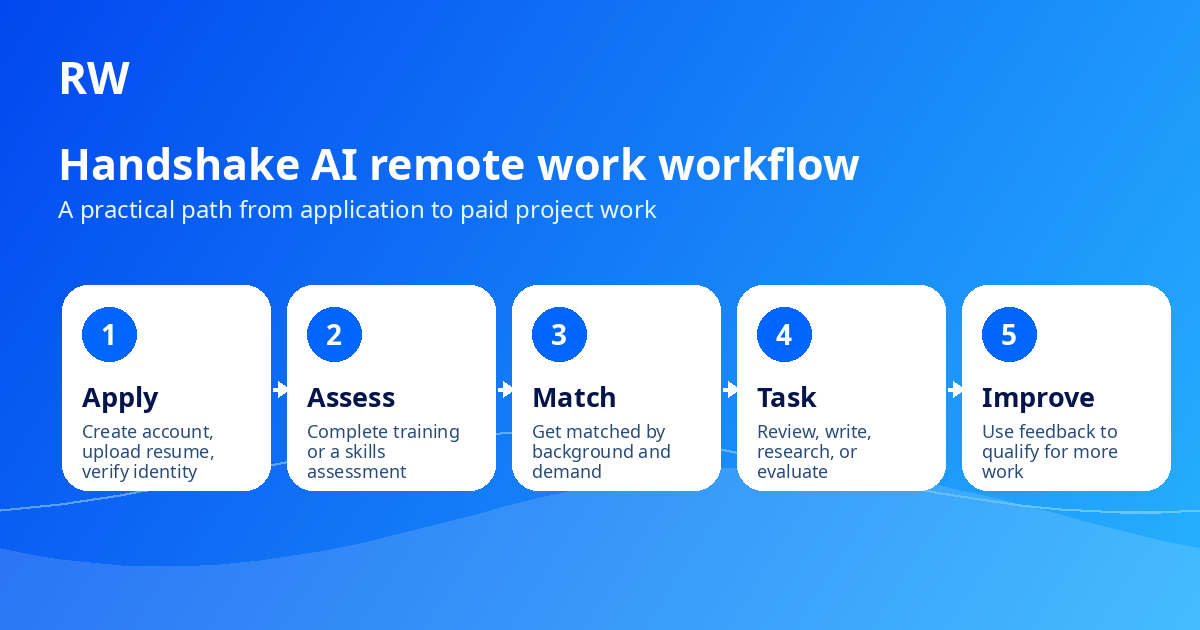
The general workflow follows a similar pattern to other AI training platforms:
- You create a profile and declare your expertise area.
- You apply to a specific fellowship or expert project opportunity.
- The platform reviews your credentials, background, and fit.
- If matched, you complete onboarding and any project-specific qualification steps.
- You work on tasks — evaluating outputs, writing prompts, providing expert feedback — within the project's guidelines.
- Completed work is reviewed for quality and you are paid for accepted tasks.
The key difference from general task platforms is that Handshake AI fellowships and expert projects tend to have more defined scopes, clearer credential requirements, and more structured selection processes. That makes the barrier to entry slightly higher — but for qualified candidates, it also means less competition from generic applicants.
Task Types and Project Categories
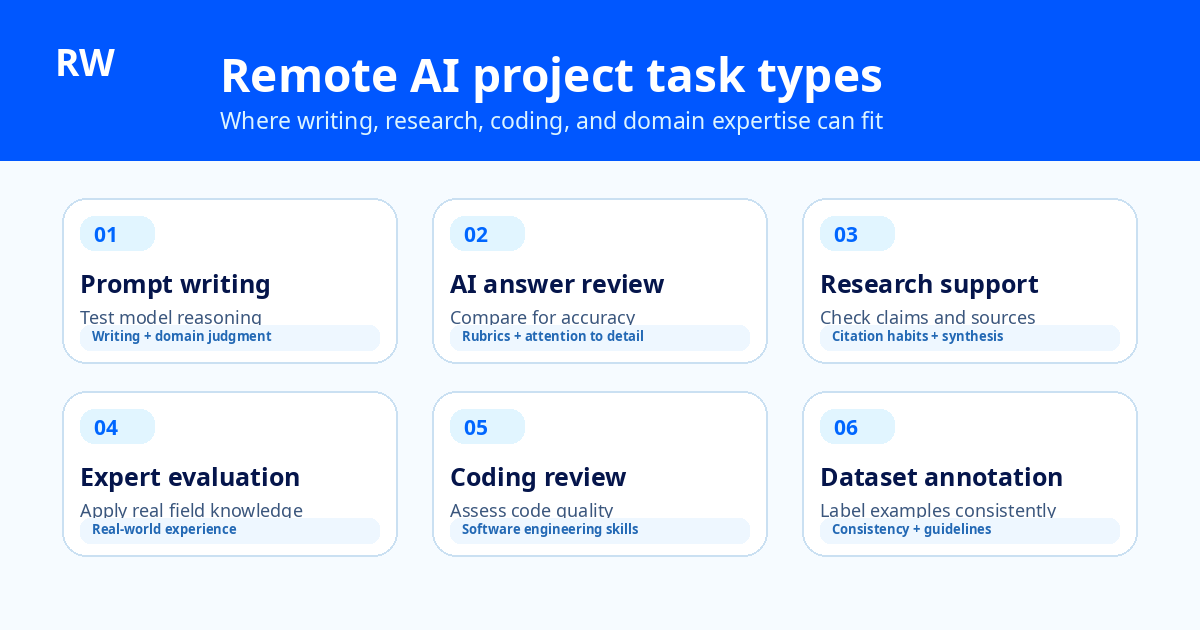
Handshake AI project tasks are generally variations of the same human-feedback work that powers AI model improvement. The specific projects available change over time, but common categories include:
AI Response Evaluation
Compare two or more AI-generated responses and select the better one based on a rubric. Judge responses for accuracy, completeness, safety, tone, reasoning quality, and instruction-following. This is the core task type across most AI training platforms and one of the most common Handshake AI project types.
Expert Domain Review
Use specialized professional knowledge — law, medicine, finance, data science, education, engineering — to evaluate whether AI outputs in that field are accurate, safe, and appropriately nuanced. Expert review is where Handshake AI can particularly reward deep credentials.
Prompt and Instruction Writing
Create high-quality prompts or instructions that test AI reasoning, edge-case handling, knowledge accuracy, or instruction-following. Strong prompt writers understand both what they want the model to do and how to write a prompt that clearly surfaces the model's real capability.
Data Annotation and Classification
Label, categorize, or classify AI-generated or human-created content according to project-specific guidelines. This may involve tagging safety-relevant material, annotating research summaries, or classifying content by quality category.
Research and Fact Verification
Verify claims made in AI-generated content, identify unsupported statements, check sources, and distinguish between well-evidenced conclusions and AI hallucinations. Strong research backgrounds are valuable for this category.
Who Handshake AI Is Best For
Handshake AI's fellowship and expert project structure tends to reward candidates with specific depth rather than generalist interest. The platform is often a strong fit for:
- Students and graduate students in STEM, law, medicine, business, social science, and humanities fields who can demonstrate academic rigor and domain knowledge.
- Recent graduates who have strong credentials, clear subject-matter expertise, and the flexibility for project-based remote work.
- Researchers and academics with experience in technical writing, data analysis, literature review, and structured evaluation.
- Working professionals in law, finance, medicine, coding, science, and education who can prove applied domain expertise.
- Bilingual and multilingual speakers who can provide evaluation or annotation work across language pairs.
Handshake AI may be a less obvious fit for people who are looking for simple gig-style tasks without clear subject expertise, or for people who need immediate, guaranteed daily task availability. The platform's strength is its curated approach — which means the opportunities it offers tend to be higher-quality but potentially more selective.
Remote Work Union connects you to remote AI training and evaluation roles across multiple platforms including Handshake AI-style expert projects. Apply for free.
Find Roles Hiring Now →How to Build a Strong Handshake AI Profile
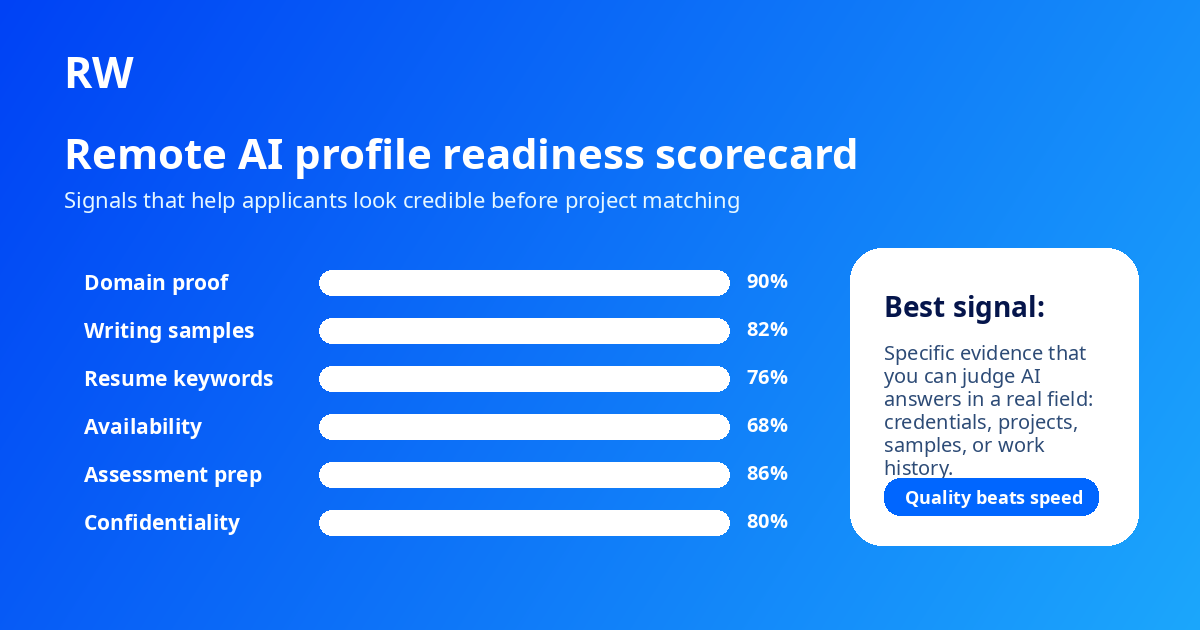
A Handshake AI profile needs to communicate your expertise quickly and credibly. Because the platform skews toward academic and professional credentials, your profile should emphasize proof over personality.
Key elements of a strong Handshake AI profile:
- Clear credential statement: Name your degree, program, institution, graduation year, or professional license. Be precise. "PhD candidate in computational biology" is more useful than "science background."
- Specific domain description: Describe exactly what you can evaluate. "I can review AI-generated legal reasoning for accuracy, proper framing, and jurisdictional awareness" is stronger than "I have law experience."
- Proof of judgment: Include publications, research projects, teaching experience, professional work, writing samples, or portfolio examples that demonstrate evaluative ability — not just knowledge.
- Availability and format: State your weekly hour availability, time zone, and comfort level with remote, asynchronous work.
- AI-adjacent language: Use relevant terms: AI evaluation, response ranking, rubric-based review, human feedback, annotation, factual accuracy review, domain expert review, model quality assessment.
Tip: Do not overstate credentials. Handshake AI's curated approach means the platform may verify or match credentials against project requirements. Accurate positioning builds trust and leads to better project matches; overstating expertise creates mismatches.
How Handshake AI Fits Into a Multi-Platform Strategy
The mistake many remote workers make is treating any single AI training platform as their entire strategy. A better approach is to treat Handshake AI, Mercor, micro1, and Outlier AI as complementary channels, each useful for different project types and timing.
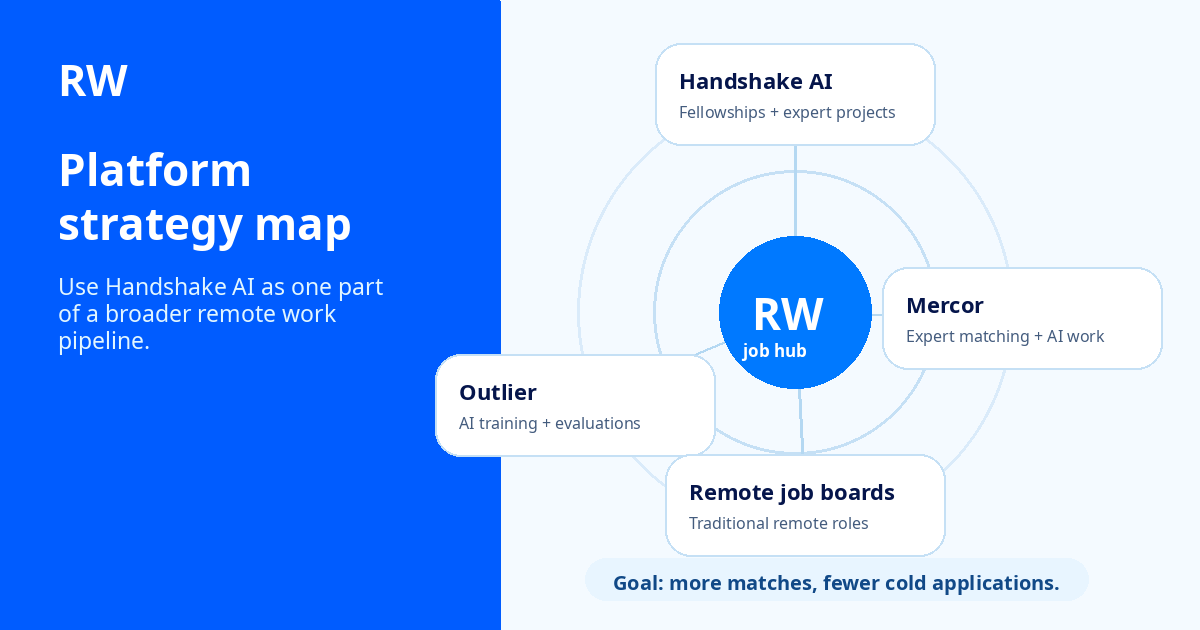
Think of the platforms like this:
- Handshake AI — best for structured fellowships, curated expert projects, and academically strong candidates. Use this when you want more defined project scopes with stronger credential requirements.
- Outlier AI — best for broad AI training task access across writing, language, coding, and domain review categories. Use this for flexible, task-based work when projects are available.
- Mercor — best for presenting yourself as a high-signal professional expert matched to AI labs and enterprise AI work. Use this when you want more targeted expert project matching.
Building one strong master profile — with clear credentials, specific domain description, and AI evaluation language — lets you adapt it for each platform without starting from scratch. The core positioning is the same; the emphasis shifts based on what each platform values most.
How to Apply and What to Expect
When applying to Handshake AI opportunities, treat the application like a professional job application rather than a quick form. The platform's curated nature means that the quality of your application matters more than the speed of submission.
Before you apply:
- Read the specific fellowship or project description carefully. Understand exactly what the project requires.
- Confirm you meet the eligibility requirements — work authorization, location, academic status, and field of expertise.
- Prepare any samples or portfolio materials the application requests.
- Write a focused, specific cover statement (if required) that connects your credentials to the project's needs.
After applying, expect a review period before hearing back. Unlike some task platforms that onboard immediately, Handshake AI's fellowship model typically involves a selection or review process. If selected, you may receive onboarding materials, project guidelines, and qualification tasks before starting paid work.
Respond quickly to any communications after applying — project seats may be limited, and platforms typically prioritize responsive candidates during onboarding windows.
Common Mistakes to Avoid
Applying with a generic profile. The curated nature of Handshake AI projects means generic applications are especially likely to be overlooked. Specificity about your expertise and what you can evaluate is essential.
Overstating credentials. Unlike platforms that rely purely on self-reported skills, credential-focused platforms may verify claims or match them against project requirements. Accurate positioning creates better matches and longer-term access.
Treating it as an immediate income source. Fellowship-style applications take time to process. Apply to Handshake AI as part of a multi-platform pipeline, not as your only immediate income plan.
Ignoring the project-specific guidelines. Even after being accepted, the quality of your work on each task determines whether you continue to receive project access. Read every guideline carefully before starting tasks.
Depending on one platform. As with any project-based AI training platform, availability can fluctuate. Use Handshake AI as one channel in a wider remote work strategy that also includes Mercor, micro1, Outlier AI, and direct remote AI evaluator roles.
Frequently Asked Questions
What kinds of projects does Handshake AI offer?
Handshake AI offers a range of project types including AI fellowships, expert review tasks, response evaluation, domain-specific annotation, and research-heavy projects. The exact projects available depend on current demand, your expertise, and your location and work authorization.
Who is Handshake AI best for?
Handshake AI tends to be well-suited for students, graduate students, recent graduates, researchers, and working professionals with strong credentials in areas like writing, law, finance, medicine, coding, math, or science. The platform's fellowship-oriented and expert-project focus rewards people with demonstrated academic or professional depth.
Do I need to be a student to use Handshake AI?
Not necessarily. While Handshake AI has historically been associated with student and early-career opportunities, it also targets working professionals and domain experts for AI training and evaluation projects. Check the current eligibility requirements on the platform for the specific opportunity you are applying to.
How does Handshake AI compare to Outlier and Mercor?
All three platforms sit in the remote AI training and expert feedback market. Handshake AI tends to focus more on curated fellowships and academic or early-career expert projects. Outlier AI offers broader AI training task work across many domains. Mercor focuses on expert project matching for high-signal professionals. The best strategy is to apply to all three and track which ones match your profile.
Is Handshake AI legit?
Yes, Handshake AI is a real platform that offers paid, remote AI training and fellowship opportunities. As with any platform-based contractor work, eligibility, project availability, and pay can vary. Do not pay anyone to apply and always read the payment terms before starting work.
How do I apply to Handshake AI?
Create a profile on the Handshake AI platform, highlight your strongest domain expertise and academic or professional credentials, and apply to the opportunities that match your background. Treat the application like a professional job application rather than a form to rush through. Specific, evidence-based profiles tend to perform better than vague ones.