Healthcare AI training jobs are a strong fit for people who understand medicine, patient communication, documentation, and clinical reasoning. These roles usually do not look like a traditional hospital job. They are often remote, contract-based, and built around reviewing the quality of AI model outputs. A doctor, nurse, pharmacist, medical writer, clinical researcher, or healthcare editor may be asked to decide whether an AI answer is accurate, safe, complete, clear, and appropriate for the audience.
The most important point: healthcare AI training is not the same as practicing medicine online. You are reviewing AI-generated text, medical reasoning, patient education language, or structured labels inside a controlled workflow — not diagnosing real patients or providing personal medical care.
What Are Healthcare AI Training Jobs?
Healthcare AI training jobs are remote roles where human experts help evaluate, correct, label, or improve AI outputs connected to medicine and healthcare. A platform may show you a prompt and two AI answers, then ask which answer is better. Another task may ask you to identify whether a medical explanation contains a hallucination, unsafe advice, missing context, or a misleading claim. Some projects focus on patient-friendly writing; others focus on clinical reasoning, medical terminology, documentation, or research summaries.
Common job titles include healthcare AI evaluator, medical AI trainer, clinical AI reviewer, medical content reviewer, AI model evaluator, RLHF medical expert, medical data annotator, healthcare prompt evaluator, physician reviewer, nurse reviewer, and subject matter expert for AI training. The wording varies by company, but the core idea is similar: a human reviewer uses professional judgment to help AI systems produce better answers.
Why Healthcare Experience Matters in AI Model Evaluation
Medical content is not like ordinary writing. A sentence can sound confident and still be wrong. An explanation can be technically accurate but unsafe for the audience. A chatbot answer can miss an emergency warning, oversimplify a medication issue, or imply a diagnosis when it should recommend professional evaluation. Healthcare-trained reviewers are valuable because they can see these problems quickly.
Healthcare AI evaluation often rewards a specific kind of judgment: not just asking "Is this answer correct?" but asking "Is it correct enough, complete enough, safe enough, and clear enough for the intended reader?" That combination of accuracy, safety, and communication is exactly where healthcare professionals can stand out.
Best Healthcare Backgrounds for Remote AI Training Work
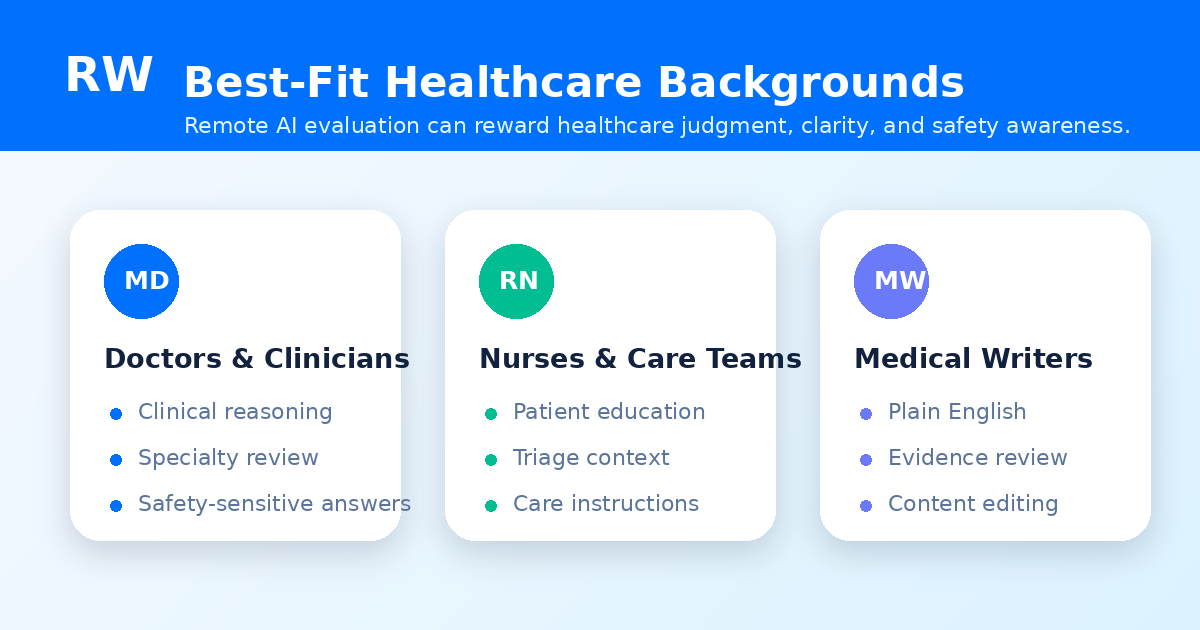
Doctors and physicians can be strong candidates for specialist AI evaluation work, especially when projects need clinical reasoning, specialty review, or medical accuracy judgment. A physician profile should highlight specialty, board status if relevant, clinical setting, research background, teaching experience, and writing ability.
Nurses can be strong candidates because many AI health answers are written for ordinary people. A nurse often understands how patients interpret instructions, where confusion appears, and what safety context should not be skipped. Nursing backgrounds can be useful in patient education review, triage language review, medication explanation clarity, and healthcare communication tasks.
Medical writers, healthcare editors, clinical researchers, pharmacists, therapists, and public health professionals may also fit certain projects. A medical writer may not need to claim clinical authority to be useful. Clear writing, evidence review, terminology accuracy, and the ability to identify unsupported claims can be enough for many medical content evaluation roles.
Common Tasks in Healthcare AI Training Jobs
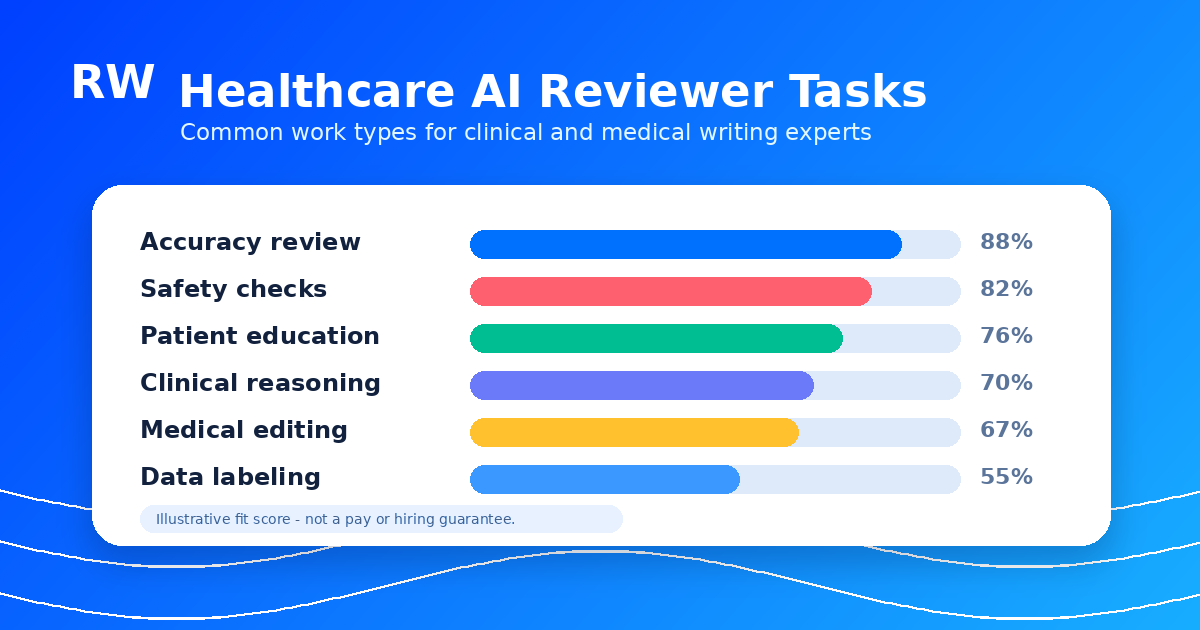
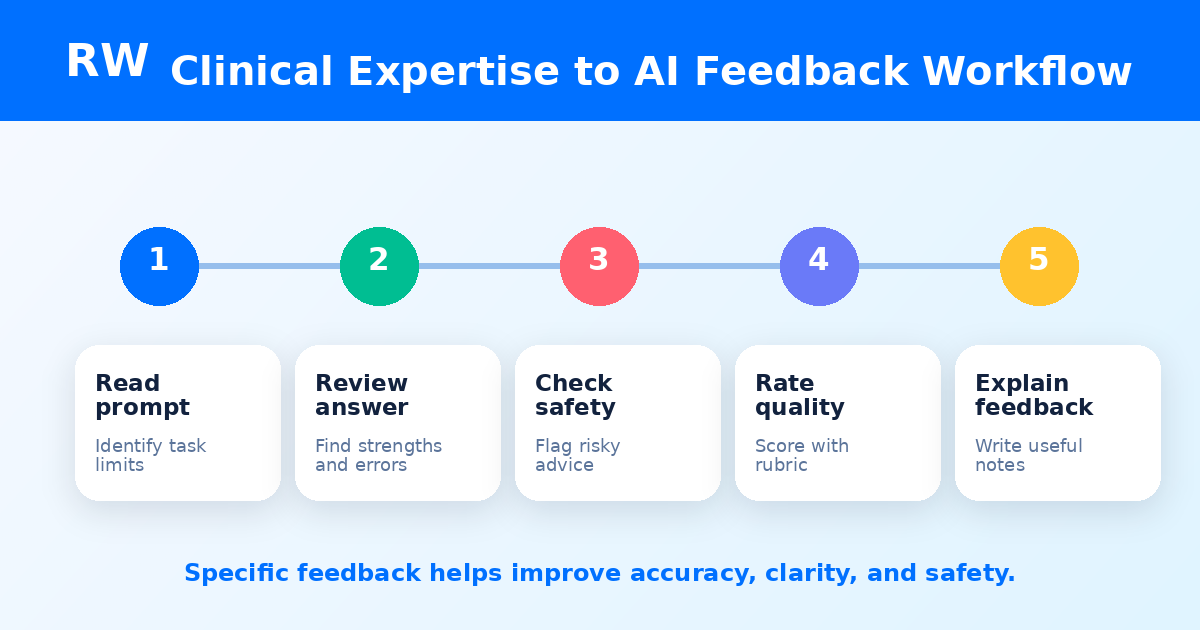
The most common task is comparing AI answers. You may see two responses to the same healthcare prompt and choose which one is more accurate, safe, helpful, and clear. The strongest reviewers do not just pick a winner — they explain the reason. One answer may include a better emergency warning, avoid unsupported certainty, or recommend seeking professional care when appropriate.
Another common task is identifying hallucinations. In AI work, a hallucination is a statement that sounds plausible but is false, unsupported, or fabricated. In healthcare, hallucinations are especially important because a confident but incorrect claim can mislead the reader. Reviewers may be asked to flag unsupported treatment claims, incorrect drug information, inaccurate anatomy, misleading statistics, or fabricated study references.
Healthcare AI reviewers may also edit patient education content — simplifying jargon, improving structure, removing panic-inducing language, adding appropriate caveats, or making instructions easier to follow. Some projects involve structured data labeling: categorizing prompts, marking safety issues, identifying specialty areas, or labeling reading levels.
Skills That Matter More Than Coding
Many healthcare AI training jobs do not require coding. The core skills are healthcare judgment, clear writing, careful reading, and rubric-following. A reviewer must be able to look at an AI answer and separate surface-level fluency from actual quality.
Strong applicants should be comfortable writing short explanations. Instead of writing "Response A is better," a strong reviewer might write: "Response A is safer because it avoids diagnosing the user, includes a clear emergency warning, and explains the next step in plain language. Response B overstates certainty and omits when to seek urgent care." Other useful skills include medical terminology, evidence awareness, attention to safety disclaimers, documentation literacy, and the ability to follow project instructions exactly.
Remote Work Union connects healthcare professionals to legitimate remote AI evaluation roles. Apply for free and find roles hiring now.
Find Roles Hiring Now →How to Position Your Resume or Profile
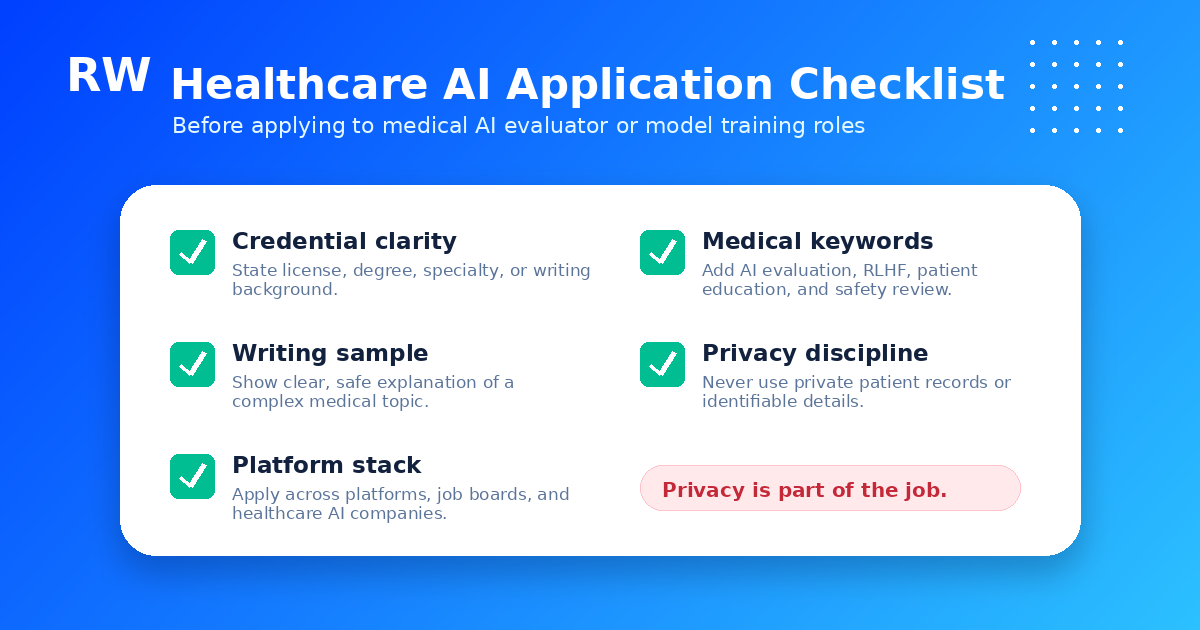
A healthcare AI resume should make your expertise searchable. Include plain keywords that match the work: healthcare AI, AI model evaluation, medical AI reviewer, medical writing, patient education, clinical documentation, clinical reasoning, fact-checking, safety review, RLHF, data annotation, content evaluation, prompt evaluation, healthcare communication, and remote contract work.
Doctors should include specialty, clinical experience, research, teaching, writing, and publications. Nurses should include care setting, patient education, triage experience, documentation, specialty unit, and any teaching or writing experience. Medical writers should include therapeutic areas, regulatory or clinical content experience, editing, literature review, and plain-language writing.
Where to Find Healthcare AI Training Jobs
Healthcare AI training jobs may appear on AI training platforms and expert AI marketplaces such as Handshake AI, Mercor, micro1, and Outlier AI, as well as data annotation companies, general remote job boards, LinkedIn, healthcare technology company career pages, and AI company vendor networks. Search terms that can help include: medical AI evaluator, healthcare AI trainer, clinical AI reviewer, physician AI evaluator, nurse AI evaluator, medical content reviewer, medical writer AI jobs, healthcare data annotation, AI model evaluation healthcare, RLHF medical expert, and remote AI healthcare jobs.
It is also useful to search around major AI company keywords because many applicants search for work connected to OpenAI, Anthropic, Google, Gemini, Meta, Microsoft, and other AI labs. The role may not be posted directly by the lab — it may come through a vendor, platform, contractor marketplace, or partner company.
What to Avoid in Healthcare AI Work
Do not use confidential patient information. Never upload private charts, screenshots, messages, lab results, names, dates of birth, medical record numbers, or identifiable patient stories into an AI training platform unless the platform has explicitly provided properly de-identified material inside the task.
Do not treat AI training tasks as personal medical consultations. If a task involves a sample prompt, stay inside the task instructions. Do not overstate credentials — AI platforms may verify education, licenses, publications, or work history. It is better to be precise: registered nurse, medical writer, public health researcher, pharmacist, physician assistant, resident physician, board-certified specialist, or healthcare editor.
Quality tip: Quality matters more than speed. Rushing through medical AI evaluations can lead to missed safety issues and lower reviewer scores. Build accuracy first. Speed improves after you understand the task rubric.
Frequently Asked Questions
Do doctors and nurses qualify for healthcare AI training jobs?
Yes. Healthcare AI training jobs can be a strong fit for doctors, nurses, pharmacists, medical writers, clinical researchers, and other healthcare professionals who can evaluate AI-generated medical content for accuracy, safety, and clarity.
What do healthcare AI training tasks actually involve?
Tasks typically involve comparing two AI-generated medical answers, identifying hallucinations or unsafe advice, reviewing patient education content for clarity and safety, labeling medical content, and explaining why one response is better than another.
Do healthcare AI training jobs require clinical licensing?
Requirements vary. Some projects require advanced credentials or board certification. Others are open to medical writers, nurses, or health educators with strong communication skills. Read each listing carefully to understand the specific requirements.
Is healthcare AI training work the same as practicing medicine online?
No. Healthcare AI training involves reviewing AI-generated text and providing feedback within a controlled task workflow. It is not the same as diagnosing real patients or providing personal medical care.