Healthcare professionals are a strong fit for remote AI work because many AI systems need more than generic feedback — they need people who can read a medical explanation, notice where it becomes vague, identify when a claim needs evidence, and explain what a safer, clearer answer would look like. That is exactly where nurses, medical writers, clinical researchers, health educators, and healthcare subject matter experts can stand out. These expert-tier remote AI roles commonly pay $50–$200/hr, depending on your clinical specialization and how much judgment a project requires.
Remote AI jobs in healthcare are not usually traditional bedside jobs. They are often project-based or contract roles where you review AI responses, evaluate medical content, annotate healthcare data, rewrite patient-facing explanations, compare two model answers, or flag safety issues. The work can sit under many job titles: AI evaluator, medical content reviewer, clinical AI rater, healthcare data annotator, medical prompt evaluator, expert reviewer, patient education writer, or medical research fact-checker.
Why Healthcare Expertise Is Valuable in Remote AI Work
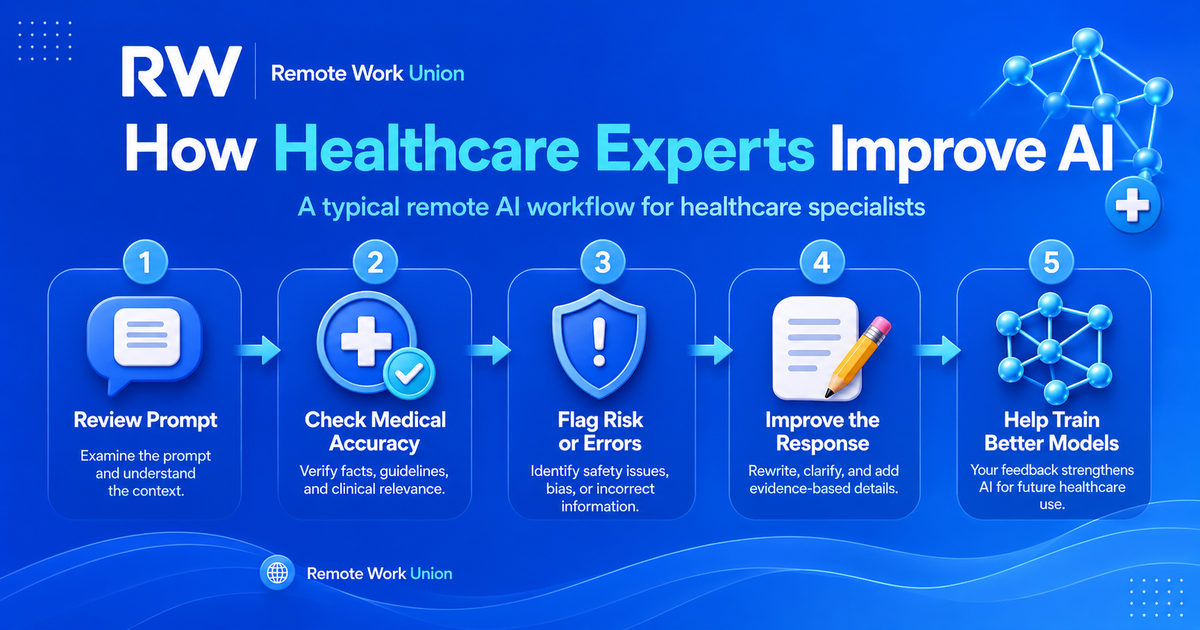
AI models can write fluent answers, but fluency is not the same as accuracy. In healthcare, a response can look polished and still be incomplete, misleading, too confident, or missing an important safety caveat. A general reviewer may notice grammar problems. A healthcare reviewer is more likely to notice the clinical risk.
That difference matters. Healthcare experts can help teams assess whether an answer is medically reasonable, whether it uses clear language, whether it stays within safe boundaries, whether it needs a referral to a licensed professional, and whether it makes unsupported claims.
Healthcare backgrounds are especially useful for AI projects involving medical search, patient education, health insurance explanations, clinical documentation, pharmacy content, wellness apps, telehealth tools, medical coding support, symptom triage disclaimers, care navigation, and healthcare customer support automation.
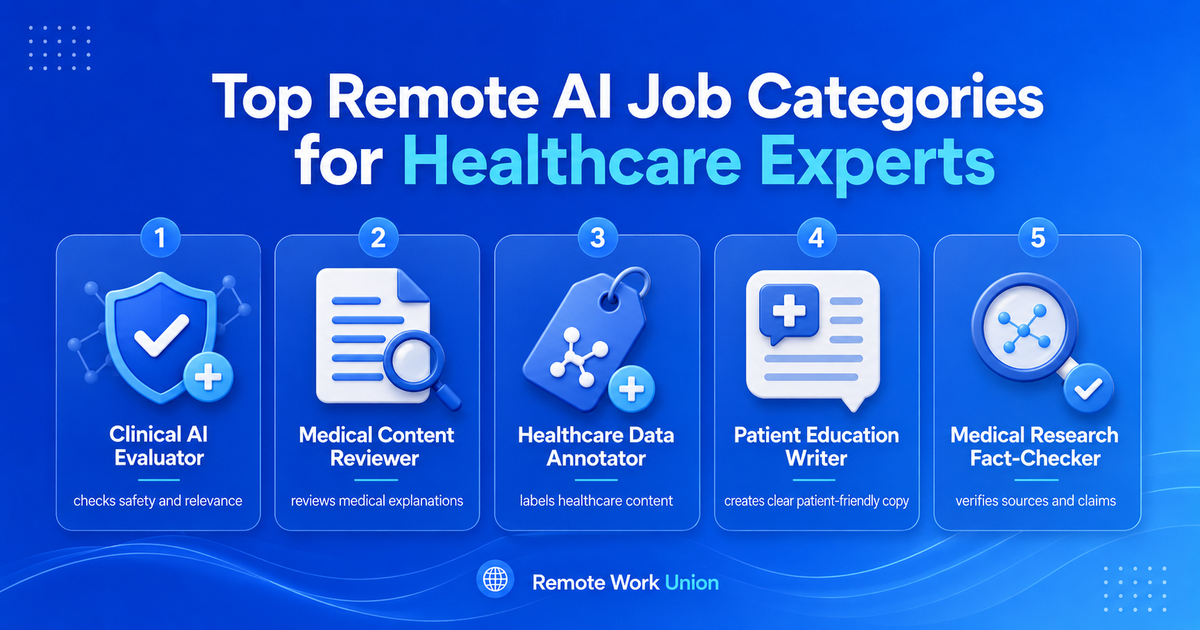
7 Best Remote AI Job Types for Healthcare Experts
1. Clinical AI Evaluator
A clinical AI evaluator reviews AI-generated answers and scores them against a rubric. You may be asked to compare two chatbot responses, rank which one is safer, identify whether an answer followed instructions, or explain why a response should be rewritten.
For nurses and clinicians, this can be one of the best remote AI roles because it rewards practical judgment. Common tasks include checking whether an AI answer gives safe general information, spotting overconfident medical claims, evaluating whether the answer recommends appropriate next steps, and flagging missing context. Strong applicants highlight clinical judgment, patient communication, documentation habits, and experience explaining complex information clearly.
2. Medical Content Reviewer
Medical content reviewers assess health-related explanations before they are used in apps, websites, search tools, or AI systems. The content may be written by a human, generated by an AI model, or produced through a mix of both.
This role is a strong fit for medical writers, nurses, health educators, pharmacists, therapists, and dietitians who can evaluate accuracy and clarity. The best medical content reviewers do more than say whether something is right or wrong — they explain why, suggest safer wording, identify missing context, and help simplify technical language without removing important nuance.
3. Healthcare Data Annotator
Healthcare data annotation involves labeling examples so AI systems can learn from them. The data may include medical questions, de-identified snippets, search queries, structured labels, or conversation turns. Some projects ask annotators to classify intent, tag medical topics, label severity, identify whether a response contains a claim, or mark whether a source supports a statement.
This is a good entry point for healthcare experts who want remote AI work but do not want to write long-form content. If you have charting, intake, coding, quality assurance, or research coordination experience, those skills can translate well.
4. Patient Education Writer
Patient education writing is one of the most natural remote AI-adjacent jobs for medical writers and healthcare professionals who can make complex topics understandable. AI companies, health startups, telehealth brands, and digital clinics all need clear explanations that are accurate without sounding robotic.
The work may include rewriting AI outputs, creating examples of excellent patient-friendly answers, improving readability, or drafting reference content that models should learn from. The strongest patient education writers avoid both extremes: they do not overcomplicate simple topics, and they do not oversimplify important safety information.
Healthcare professional ready for remote AI work? RemoteWorkUnion.com lists roles hiring now.
Find Roles Hiring Now →5. Medical Research Fact-Checker
Medical research fact-checking is a strong fit for clinical researchers, medical writers, and public health professionals who are comfortable reading sources. In AI evaluation work, fact-checkers may verify whether a model answer is supported by reliable evidence, whether citations match the claim, or whether a response has exaggerated a study finding.
The best feedback is direct and practical: the claim is unsupported, the source is outdated, the answer confuses correlation with causation, the wording is too broad, or the response should say that the evidence is limited. Search terms: medical research reviewer, health fact-checker, evidence reviewer, AI research evaluator, medical claims reviewer, source verification specialist.
6. Medical Prompt Evaluator
A medical prompt evaluator reviews how AI systems respond to health-related prompts. The prompt may be a patient question, a clinician-style request, a search query, or an instruction written by a project team. Your job is to judge whether the AI understood the task and produced a useful answer.
This role can involve A/B testing, rubric scoring, option selection, qualitative feedback, and rewriting. Useful resume language: AI response evaluation, prompt evaluation, rubric-based review, medical accuracy review, healthcare content QA, annotation, A/B comparison, and expert feedback.
7. AI Safety Reviewer for Healthcare Content
Healthcare AI safety review focuses on risk. The reviewer looks for answers that could cause harm, create false confidence, omit a serious warning sign, encourage inappropriate self-treatment, or cross the line into personalized medical advice when the situation calls for professional care.
A safe answer should be useful, but it should also respect boundaries — avoid diagnosis when there is not enough information, avoid certainty where evidence is unclear, and encourage urgent care when symptoms suggest a possible emergency. Nurses, urgent care workers, pharmacists, and therapists often have an advantage here because they are used to identifying risk quickly.
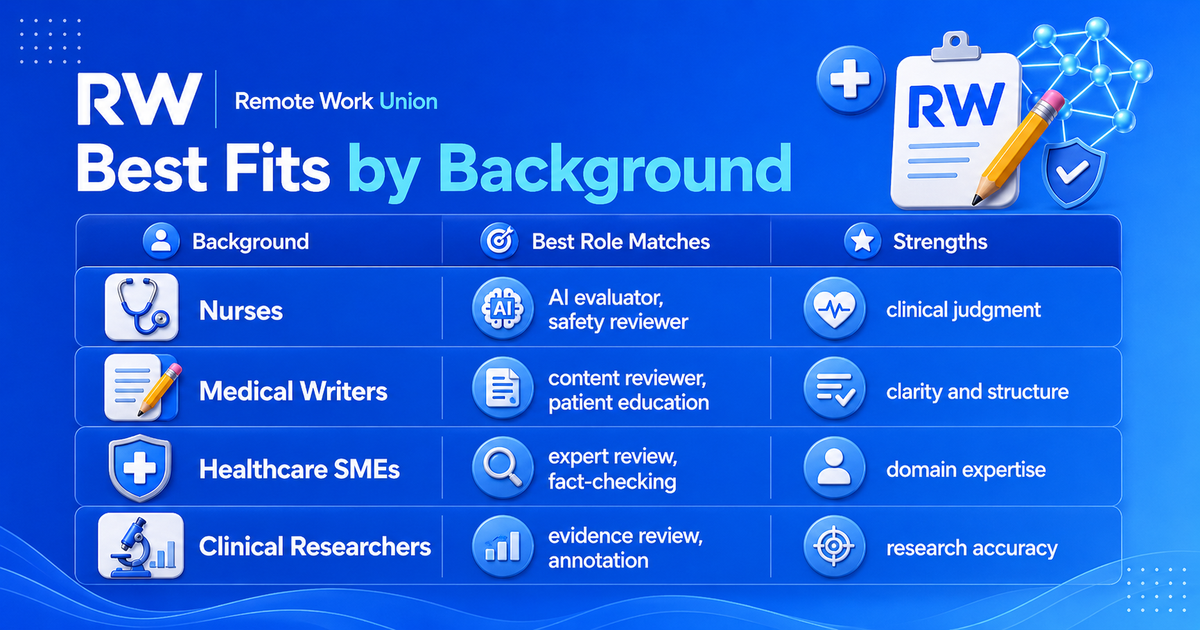
Best Remote AI Job Matches by Background
Nurses often fit clinical AI evaluation, safety review, triage-related content review, and patient communication assessment. Medical writers often fit content review, patient education writing, medical SEO content, fact-checking, and response improvement. Healthcare subject matter experts fit expert review, claims evaluation, and specialized annotation. Clinical researchers fit evidence review, research summarization, data labeling, and source verification.
The key is to translate your experience into the language of AI work. Instead of only saying "registered nurse," add phrases like clinical judgment, patient education, safety review, documentation, accuracy review, and rubric-based evaluation. Instead of only saying "medical writer," add content QA, evidence-based editing, patient-friendly copy, fact-checking, and AI response review.
Skills That Help Healthcare Experts Get Remote AI Work
The most useful skill is not memorizing every AI tool — it is showing that you can produce reliable judgment at scale. Remote AI work often requires reading instructions, applying a rubric consistently, documenting your reasoning, and moving through tasks without losing quality.
Important skills include medical accuracy review, concise writing, source evaluation, patient-friendly communication, attention to detail, annotation, prompt evaluation, content QA, risk identification, and comfort comparing model responses. Healthcare experts should also be comfortable working with uncertainty. Many AI evaluation tasks do not have a perfect answer — you may be choosing the better of two imperfect responses. The best reviewers can explain tradeoffs: one answer may be clearer, but the other may avoid unsupported claims.
How to Search for These Jobs
Use broader searches and specific searches. Useful search terms include remote AI evaluator healthcare, medical AI evaluator jobs, healthcare data annotation jobs, medical content reviewer remote, AI trainer medical expert, clinical AI reviewer, patient education writer remote, medical fact-checker AI, medical prompt evaluator, AI response reviewer healthcare, human feedback jobs healthcare, RLHF medical expert, and expert review jobs from home.
You can also combine role terms with major AI and tech keywords: ChatGPT evaluator healthcare, Claude AI medical reviewer, Gemini AI evaluation jobs, Microsoft Copilot healthcare content review, OpenAI contractor medical review, Anthropic expert evaluator, Google AI training jobs healthcare, medical AI rater jobs. Do not assume every company name search will lead to direct hiring — use these as keyword paths to discover platforms, contractor projects, vendors, and related job boards.
How to Make Your Application Stronger
A strong application should make your healthcare expertise easy to understand and easy to match to AI work. Do not bury the most relevant details under a long clinical history — lead with the connection between your background and the task.
A nurse could write: "Registered nurse with experience reviewing patient-facing information, identifying clinical risk, documenting clearly, and evaluating whether explanations are safe, accurate, and appropriate for non-clinical audiences." A medical writer could write: "Medical writer experienced in evidence-based editing, source review, patient education, and improving complex healthcare content for clarity, accuracy, and readability." A clinical researcher could write: "Clinical research professional with experience reviewing protocols, evaluating claims against source material, and maintaining accuracy in structured documentation."
If the application asks for writing samples, choose samples that show clarity and judgment. If you have not done AI evaluation before, create a short sample where you compare two medical answers, identify risks, and rewrite the better response.
Resume Keywords to Include
Relevant resume keywords include AI evaluation, medical content review, healthcare data annotation, clinical judgment, patient education, rubric-based review, prompt evaluation, response ranking, A/B comparison, fact-checking, source verification, evidence review, medical accuracy, content QA, expert feedback, risk review, safety review, and plain-language writing.
Important boundary: Most remote AI healthcare work is evaluation, review, writing, annotation, or quality control — it is not a substitute for licensed care. Position yourself as someone who improves accuracy, clarity, safety, and usefulness of information, not someone providing medical advice through AI platforms.
What to Avoid
Avoid applications that promise fast money with no screening, vague tasks, or unrealistic pay for generic work. Real AI evaluation projects usually test your writing, reasoning, domain knowledge, or ability to follow rubrics.
Also avoid applying only to jobs with the word "medical" or "healthcare" in the title. Many relevant roles are labeled AI evaluator, clinical reviewer, health content QA, patient education reviewer, research annotator, or domain expert. If the job involves reviewing AI outputs against medical standards, it may be relevant even if the title is generic.
The best path is to start with your strongest professional advantage and translate it into remote AI language. The opportunity is not just "working with AI" — it is using healthcare expertise to make AI answers safer, clearer, and more useful.