Finance experts are becoming unusually valuable in remote AI training because large language models are no longer limited to simple writing tasks. People now ask AI tools to explain financial statements, compare investments, summarize filings, build spreadsheet logic, identify accounting mistakes, and reason through business decisions. A general reviewer can judge whether a sentence sounds clear. A finance reviewer can judge whether the answer is actually correct.
That difference matters. When a model gives a confident but wrong answer about EBITDA, cash flow, compounding, tax treatment, or a valuation assumption, the output may sound polished while still being financially weak. AI companies and data providers need human reviewers who can catch those errors — and that is where finance professionals can fit into the AI training market.
What Does It Mean to Train AI Models as a Finance Expert?
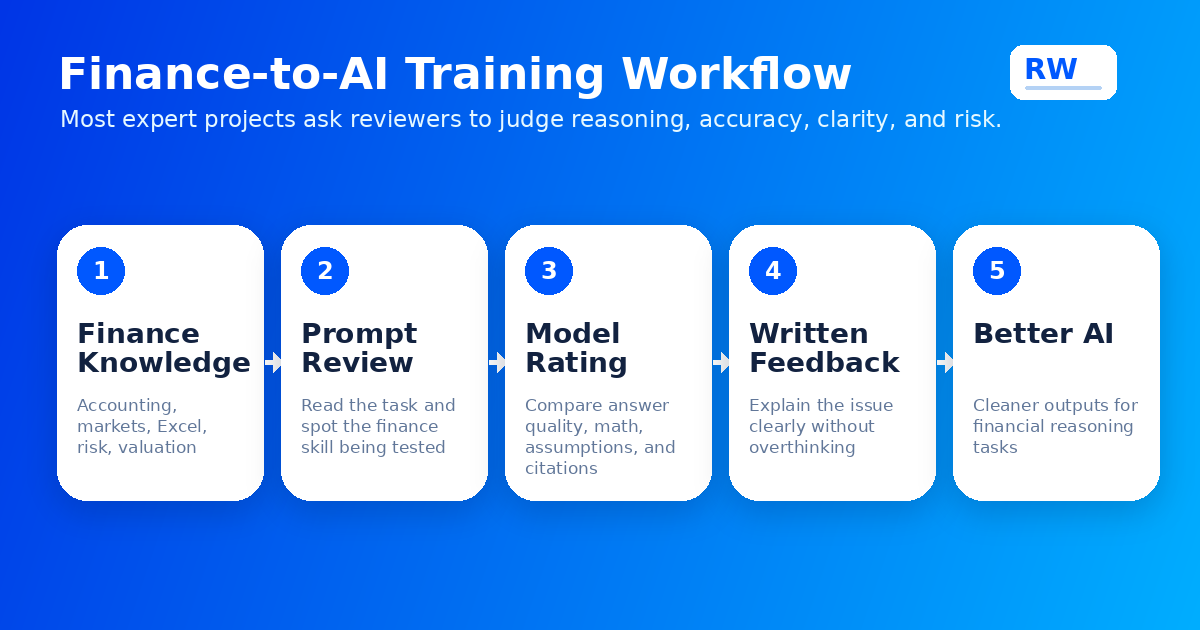
In this context, training AI models does not usually mean building the model from scratch or writing machine learning code. Most remote AI training jobs are human review jobs. You may be asked to evaluate an AI answer, compare two responses, write a better answer, label a mistake, verify a calculation, check a spreadsheet-style explanation, or explain why one response is safer and more useful than another.
For finance experts, the core value is judgment. The platform may already have engineers and data scientists. What they may not have at scale is a large pool of people who can read a financial prompt and say: this answer uses the wrong assumption, this ratio is being interpreted backward, this claim needs a source, or this calculation is off.
Why Finance Expertise Is Useful for AI Training
Finance is a high-context field. Many answers depend on assumptions, definitions, jurisdiction, time horizon, risk tolerance, accounting standard, company stage, or the difference between theoretical logic and real-world practice. AI models can produce fluent financial language, but they can also blur important distinctions.
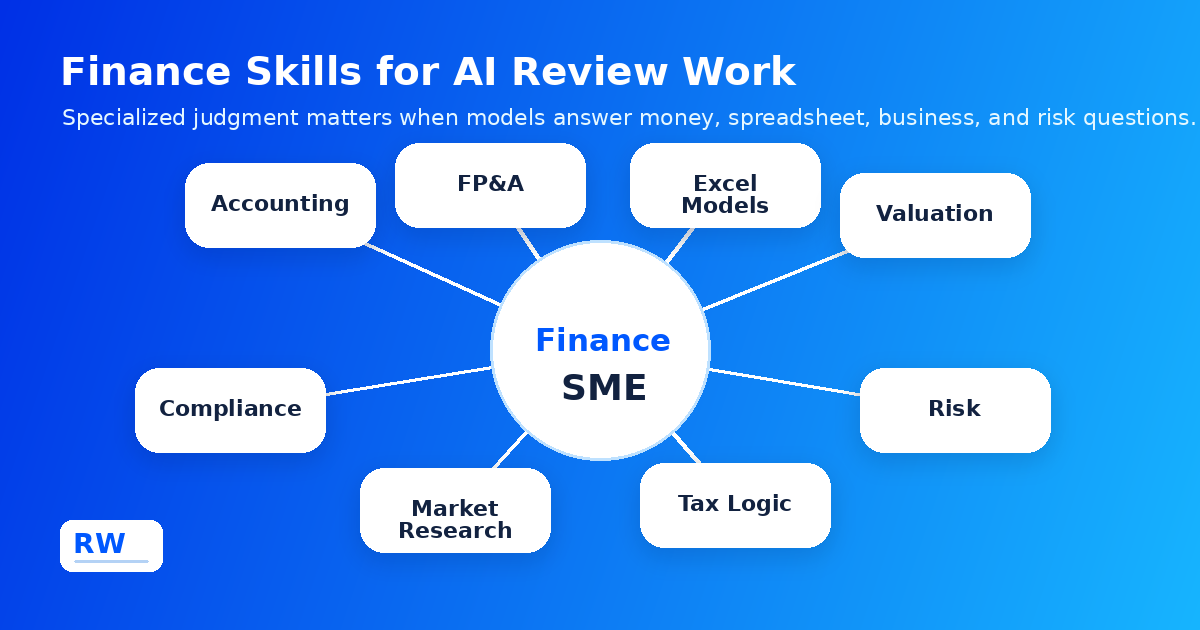
A finance expert can improve model quality by catching problems such as confused revenue and cash flow, incorrect use of gross margin, weak DCF assumptions, unsupported investment conclusions, misleading loan explanations, incomplete tax caveats, poor Excel formula logic, and overconfident personal finance guidance. These mistakes are easy for non-specialists to miss because the answer may still sound professional.
Types of Finance AI Training Work
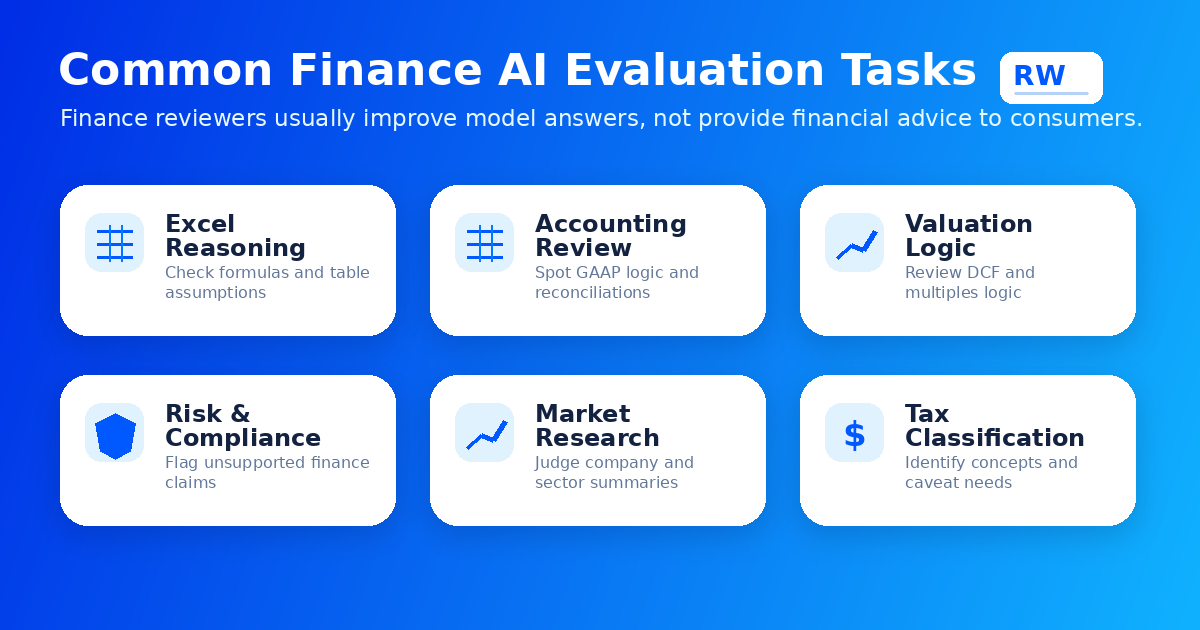
Financial question-answer evaluation. You may read an AI response to a finance question and judge whether it is accurate, helpful, complete, and appropriately cautious — for topics like bonds, diversification, working capital, depreciation, or private company valuation.
Spreadsheet and Excel reasoning. Many finance tasks involve formulas, tables, forecasts, or step-by-step calculations. Reviewers may check whether an AI-generated formula makes sense or a model explanation follows the numbers. Experience with Excel, financial modeling, and scenario analysis is valuable here.
Accounting and audit review. Accounting experts may evaluate answers about journal entries, revenue recognition, accruals, reconciliations, inventory, cash flow statements, audit logic, and financial controls.
Investment research and valuation analysis. People with equity research, investment banking, private equity, or business valuation experience may review prompts about DCF models, multiples, market sizing, comparable companies, unit economics, due diligence, or earnings summaries.
Risk, compliance, fraud, and credit analysis. Finance reviewers can evaluate answers about creditworthiness, lending assumptions, fraud indicators, insurance logic, compliance red flags, and operational risk.
Who Is a Good Fit for Finance AI Training Jobs?
You do not need to have the exact title of finance expert to be useful. Strong candidates can come from accounting, audit, tax, FP&A, treasury, corporate finance, investment research, banking, consulting, insurance, real estate finance, fintech operations, revenue operations, business analytics, or entrepreneurship. MBA graduates, CFA candidates, CPA candidates, analysts, controllers, finance managers, bookkeepers, and Excel-heavy operators can all have relevant experience.
The best fit is someone who can combine domain knowledge with clear writing. Finance professionals who can write concise notes, document assumptions, and explain tradeoffs are usually better suited than people who only want to click quick labels.
Remote Work Union connects finance professionals to legitimate remote AI evaluation roles. Apply for free and find roles hiring now.
Find Roles Hiring Now →Skills That Make Finance Applicants Stand Out
Finance AI training rewards a mix of analytical skill, communication skill, and carefulness. Useful skills include financial statement analysis, accounting fundamentals, Excel formulas, spreadsheet auditing, budgeting, forecasting, unit economics, DCF models, valuation multiples, business writing, market research, risk assessment, and source evaluation.
Excel and spreadsheet skills deserve special emphasis. If you know XLOOKUP, pivot tables, financial modeling, sensitivity tables, cash flow forecasts, or scenario planning, make that visible in your profile. Writing also matters — a good finance reviewer can write: "The response correctly defines free cash flow, but it subtracts interest expense twice and does not state whether it is using levered or unlevered free cash flow."
How to Position Your Resume and Profile
Your profile should make your finance specialty obvious within a few seconds. Do not rely on a broad title like "analyst" if your real strength is financial modeling, accounting, audit, FP&A, tax, or investment research. Use direct language such as: "finance analyst with experience reviewing financial models, Excel forecasts, company filings, and business research" or "FP&A operator with experience building budgets, variance analysis, dashboards, and executive reporting."
How the Work Is Usually Evaluated
Finance AI training tasks are commonly judged on accuracy, clarity, completeness, helpfulness, and safety. Accuracy means the numbers, definitions, and logic are correct. Completeness means the model addresses the prompt without skipping important assumptions. Safety means the model avoids unsupported claims, overconfident advice, or instructions that create financial harm.
In finance tasks, safety does not only mean avoiding obvious scams. It can also mean avoiding personalized investment advice, tax advice, legal conclusions, or guarantees. A model can explain how a Roth IRA works in general terms. It should be much more careful about telling a specific person exactly what to do with their money, taxes, or retirement plan.
Where to Look for Remote Finance AI Jobs
Finance AI training jobs can appear on AI work platforms, expert marketplaces, remote job boards, LinkedIn, company career pages, contractor networks, and specialized annotation platforms. Searches that may help include: remote finance AI evaluator, AI training finance expert, accounting AI trainer, Excel AI evaluation, financial model reviewer, AI data annotation finance, RLHF finance, investment research AI evaluator, and subject matter expert AI training.
Applicants often search for platform names such as Mercor, Outlier AI, Handshake AI, Surge AI, micro1, and Stellar. They also search for major AI company keywords like OpenAI, Anthropic, Google, Meta, Microsoft, Claude, Gemini, ChatGPT, and Copilot. Avoid assuming every remote AI job is stable full-time employment — many roles are contract-based, project-based, or variable.
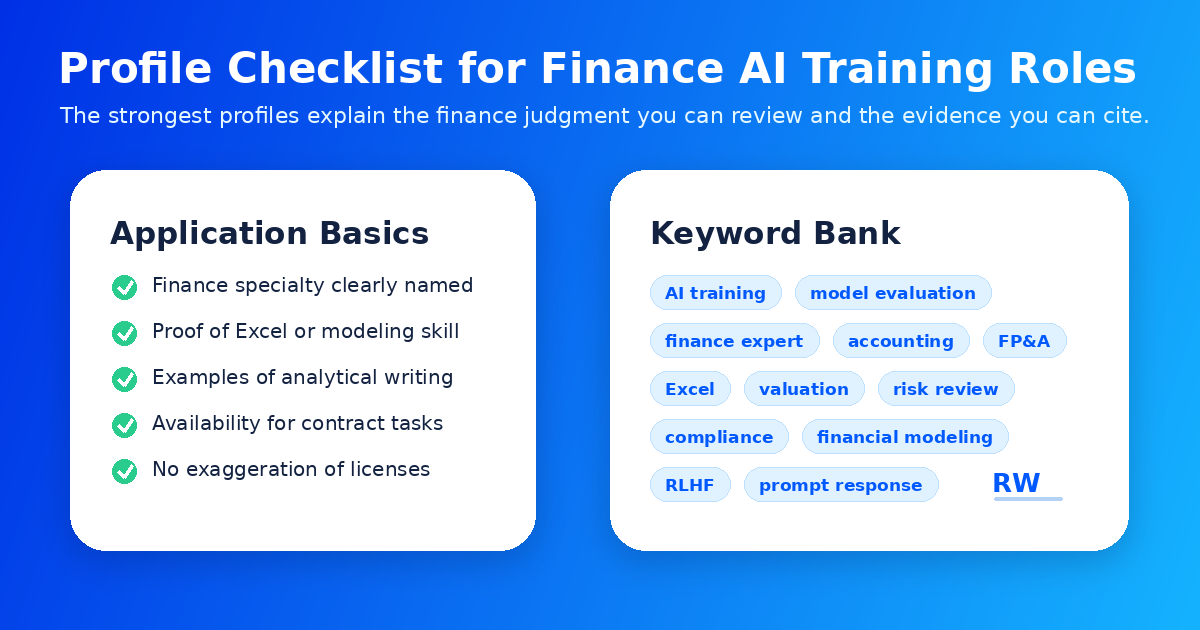
Example profile summary: "Finance analyst with experience in Excel modeling, budgeting, variance analysis, financial statement review, and business research. Skilled at evaluating financial reasoning, checking spreadsheet logic, explaining assumptions, and writing concise feedback."
Frequently Asked Questions
Do you need to be a Wall Street analyst to get finance AI training jobs?
No. Finance AI training can fit people who have built budgets, reconciled accounts, managed forecasts, analyzed data, or explained financial concepts professionally. You do not need an elite credential — you need practical finance judgment and the ability to write clear feedback.
What kinds of tasks do finance professionals do in AI evaluation work?
Common tasks include evaluating financial question-and-answer responses, checking spreadsheet and Excel reasoning, reviewing accounting explanations, assessing investment research and valuation logic, and identifying when a model gives overconfident or unsafe financial advice.
How important is Excel skill for finance AI evaluation?
Excel expertise is particularly valuable. Fewer applicants can verify spreadsheet logic, check formulas, or trace financial model assumptions. If you know XLOOKUP, pivot tables, financial modeling, or scenario planning, that can help you stand out for many finance AI review tasks.
What keywords should a finance professional use when searching?
Try remote finance AI evaluator, AI training finance expert, accounting AI trainer, Excel AI evaluation, financial model reviewer, AI data annotation finance, RLHF finance, investment research AI evaluator, and subject matter expert AI training. Also search platforms like Handshake AI, Mercor, micro1, and Outlier AI.