Finance, accounting, and business analysis are not separate from AI work. They are some of the strongest backgrounds for remote AI jobs because modern AI systems need reviewers who can judge numbers, logic, assumptions, requirements, evidence, and business context. The best of these roles are expert-tier and commonly pay $50–$200/hr, depending on your specialization and the depth of judgment a project requires.
Many people hear "AI job" and assume the work requires machine learning engineering or full-time software development. But a large and growing category of remote AI work depends on human judgment: evaluating model answers, testing prompts, checking financial reasoning, reviewing spreadsheet logic, labeling business data, and explaining why one answer is better than another. That is where finance professionals, accountants, auditors, FP&A analysts, consultants, data analysts, and business analysts can compete.
Why Finance and Analyst Backgrounds Fit Remote AI Work
AI systems are increasingly used to summarize reports, reason through scenarios, draft financial explanations, classify transactions, produce business plans, create dashboards, and answer domain-specific questions. Those outputs can sound confident while still being incomplete, misleading, or wrong. A strong reviewer has to notice the difference between fluent language and correct analysis.
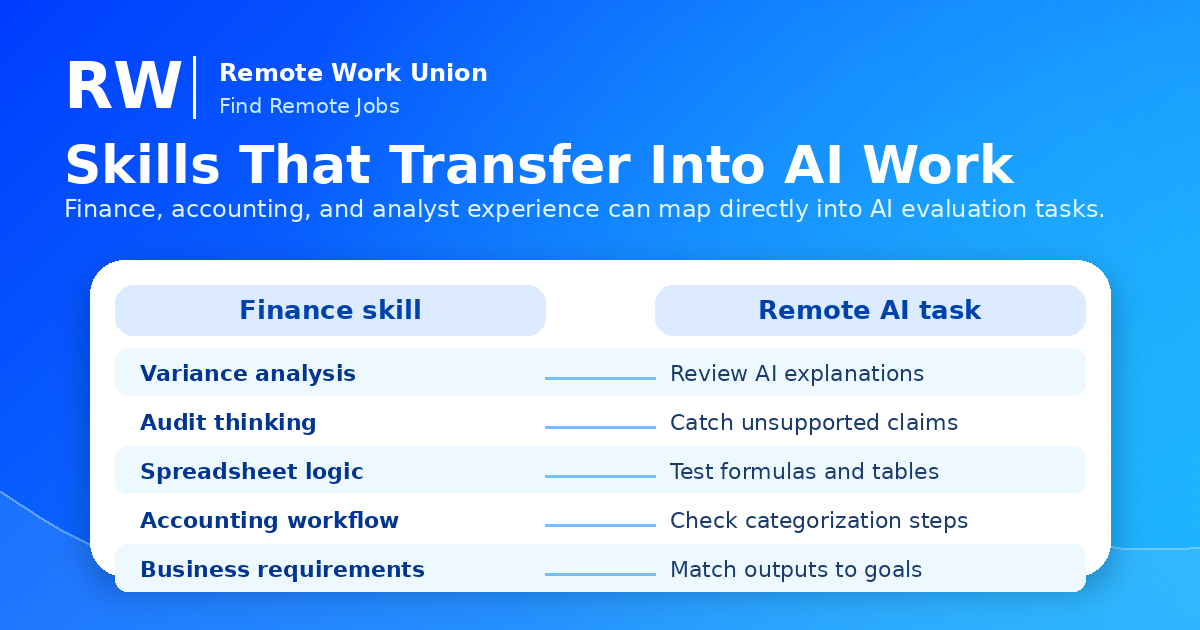
Finance and accounting professionals are trained to do exactly that. They look for reconciliation problems, missing assumptions, inconsistent definitions, weak evidence, and numbers that do not tie out. Business analysts bring a similar skill set: they translate vague goals into clear requirements, test workflows, compare options, and communicate tradeoffs.
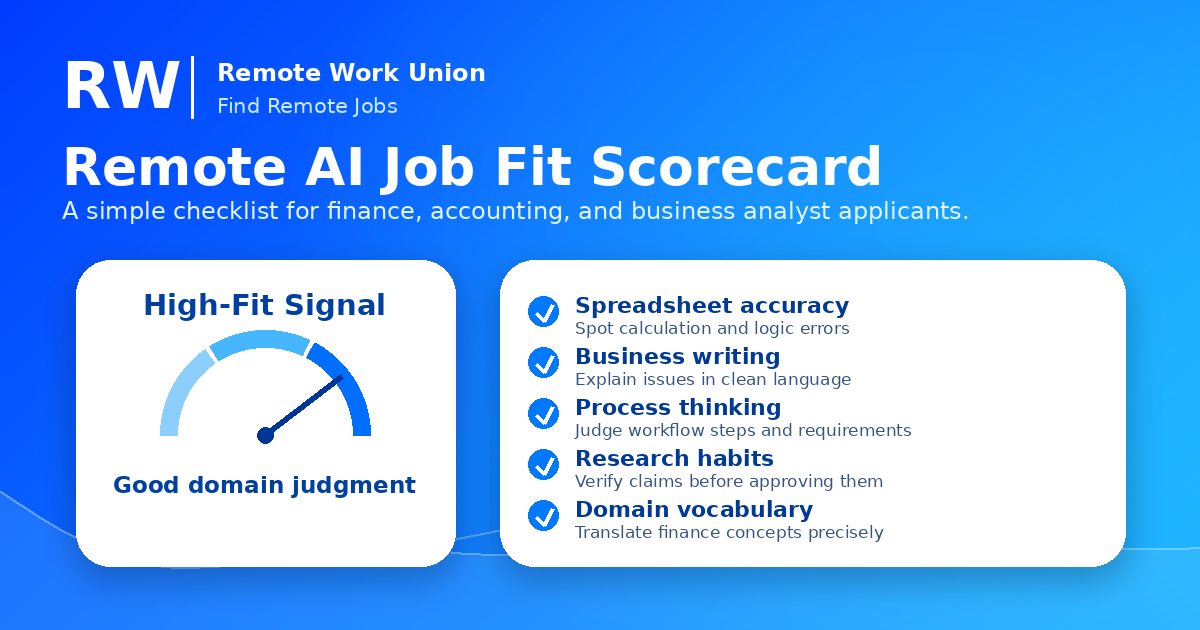
Remote AI jobs reward this combination: domain vocabulary, precision, skepticism, and written feedback. You may not be building the model — you may be helping improve it by showing which answers are useful, safe, accurate, complete, and aligned with the user's actual request.
8 Best Remote AI Job Types for Finance and Business Professionals
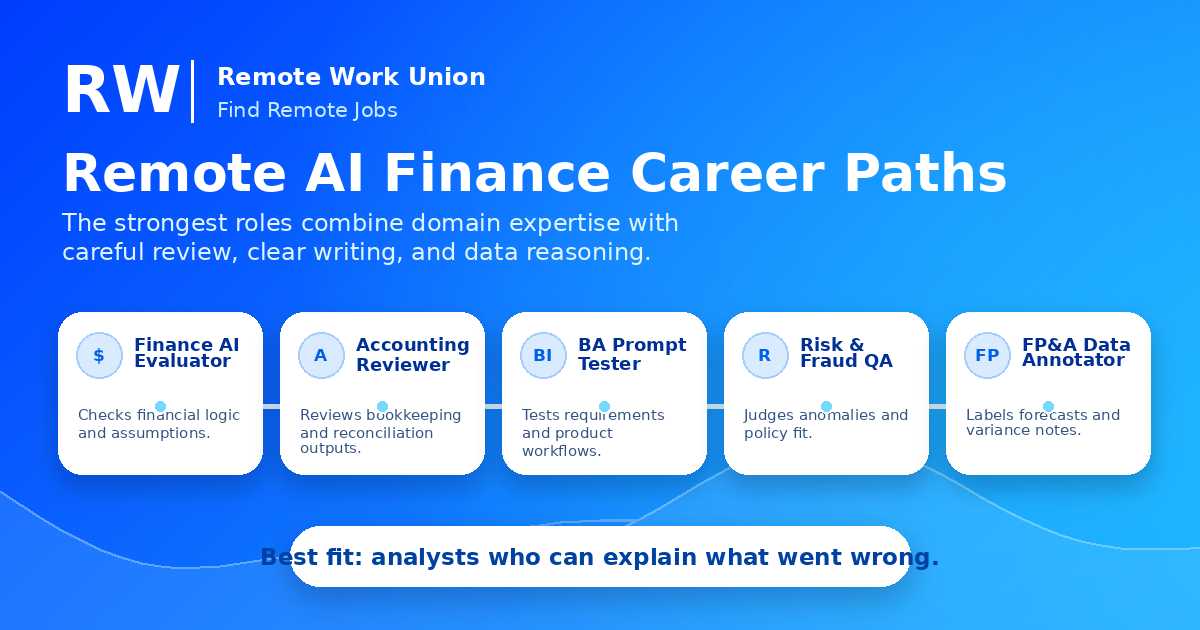
1. Finance AI Evaluator
A finance AI evaluator reviews AI-generated answers to questions about budgeting, forecasting, investment concepts, company analysis, valuation basics, financial planning, or business tradeoffs. The task may ask you to compare two model responses, score a single response, flag unsupported claims, or write feedback explaining what the model missed.
This role fits FP&A analysts, investment analysts, corporate finance professionals, consultants, MBA candidates, and people comfortable with financial statements. Useful search terms: remote AI finance evaluator, finance AI trainer, financial analysis AI reviewer, AI model evaluator finance, finance prompt evaluator, paid AI research jobs finance.
2. Accounting AI Reviewer
An accounting AI reviewer checks whether an AI system handles bookkeeping, journal entry reasoning, expense categorization, reconciliation steps, basic tax concepts, audit logic, or accounting workflow instructions correctly. The work is often about spotting bad process, unsupported categorization, or steps that would create errors in a real workflow.
This role fits accountants, bookkeepers, auditors, controllers, accounting students, and professionals who can explain the difference between a clean accounting answer and a plausible but risky one. Useful search terms: accounting AI reviewer, remote accounting AI jobs, bookkeeping AI evaluator, AI data annotation accounting, audit AI rater, AI trainer accounting.
3. Business Analyst Prompt Tester
A business analyst prompt tester evaluates how well an AI system handles business requirements, workflow descriptions, product questions, stakeholder notes, process maps, and operational problems. You may test prompts, compare outputs, identify gaps, and explain whether the answer solves the user's business problem.
This mirrors requirements review: Does the response understand the goal? Did it miss a constraint? Did it invent a requirement? Is the recommendation actionable? Useful search terms: business analyst AI jobs, remote AI evaluator business analyst, prompt evaluation jobs, AI response reviewer business, AI model evaluation analyst.
4. Financial Data Annotation Specialist
Financial data annotation work involves labeling, organizing, categorizing, or evaluating finance-related text and data so AI systems can learn from high-quality examples. Tasks may involve invoices, transaction descriptions, earnings call snippets, financial news, company descriptions, budget notes, or spreadsheet outputs.
The better opportunities require judgment: understanding the category, applying instructions consistently, and noticing edge cases. Useful search terms: financial data annotation jobs from home, AI data annotation finance, remote data annotation accounting, finance labeling jobs, AI data quality analyst remote.
Finance professional ready for remote AI work? RemoteWorkUnion.com lists roles hiring now.
Find Roles Hiring Now →5. Risk, Fraud, and Compliance AI Evaluator
Risk and fraud work translates well into AI review because many tasks involve anomaly detection, policy interpretation, evidence quality, and careful wording. A reviewer may judge whether an AI answer identifies the right risk, explains a suspicious pattern, avoids overclaiming, or follows a policy rubric.
This path fits fraud analysts, credit analysts, compliance analysts, AML/KYC professionals, internal audit teams, fintech operators, and insurance analysts. Useful search terms: risk AI evaluator, fraud AI reviewer, compliance AI jobs remote, AML AI annotation, fintech AI evaluator, trust and safety AI analyst.
6. Spreadsheet and BI Output Evaluator
Many AI tools are now used to create spreadsheet formulas, summarize data tables, suggest chart types, analyze dashboards, and write SQL-like logic. A spreadsheet and BI output evaluator checks whether those outputs make sense. Strong Excel, Google Sheets, Tableau, Power BI, SQL basics, or metric-definition experience can be enough for many analyst-oriented review tasks.
Useful search terms: spreadsheet AI evaluator, Excel AI reviewer, Power BI AI jobs, remote BI analyst AI, AI data analyst evaluator, SQL prompt evaluator.
7. Financial Research and Fact-Checking Reviewer
AI systems often summarize companies, industries, filings, news, market concepts, and business events. A financial research reviewer checks whether the answer is supported, balanced, current enough for the task, and free from fabricated details. This path fits research analysts, consultants, business writers, and anyone with a disciplined sourcing habit.
Useful search terms: paid AI research jobs from home, finance fact checking AI, AI answer reviewer finance, financial research evaluator remote, AI response reviewer jobs.
8. AI Training Roles for Fintech and Business Software
Fintech, accounting software, banking tools, procurement systems, payroll platforms, ERP systems, and analytics products all create AI-related review needs. Some projects may test how an assistant answers customer questions or evaluate internal workflow automation.
This route is especially useful for people with SaaS, operations, support, implementation, revenue operations, ERP, CRM, payroll, or payments experience. Useful search terms: fintech AI jobs remote, AI trainer SaaS, accounting software AI reviewer, ERP AI evaluator, business software AI testing, AI support response reviewer.
What the Work Actually Looks Like
Remote AI evaluation work usually happens through a task platform, contract project, research vendor, or company workflow. The day-to-day work often includes these patterns:
- Compare two AI answers and choose the better one based on accuracy, completeness, clarity, and instruction following.
- Score an AI answer against a rubric.
- Identify calculation mistakes, unsupported assumptions, missing caveats, or hallucinated details.
- Rewrite a better answer or explain what a strong answer should have included.
- Label data into categories using detailed instructions.
- Test prompts for spreadsheet logic, business scenarios, accounting workflows, or financial reasoning.
- Write concise comments that help model trainers understand what went wrong.
The best workers are not necessarily the fastest at clicking through tasks. They are consistent. They follow instructions. They notice edge cases. They explain their reasoning. They do not approve an answer just because it sounds polished.
Skills to Highlight on Your Resume and Profile
Position yourself around transferable judgment, not just job titles. Strong resume keywords include: financial analysis, FP&A, variance analysis, forecasting, budgeting, accounting, audit, reconciliation, compliance, risk review, fraud analysis, data quality, spreadsheet modeling, SQL, Excel, Google Sheets, Power BI, Tableau, QuickBooks, NetSuite, business requirements, workflow analysis, QA, rubric-based evaluation, annotation, A/B comparison, prompt evaluation, AI response review, and human feedback.
A strong profile sentence: "Finance and business analysis professional with experience reviewing financial assumptions, spreadsheet outputs, business requirements, and written business recommendations; interested in remote AI evaluation, AI model training, prompt testing, and domain-specific response review."
How to Search Without Wasting Time
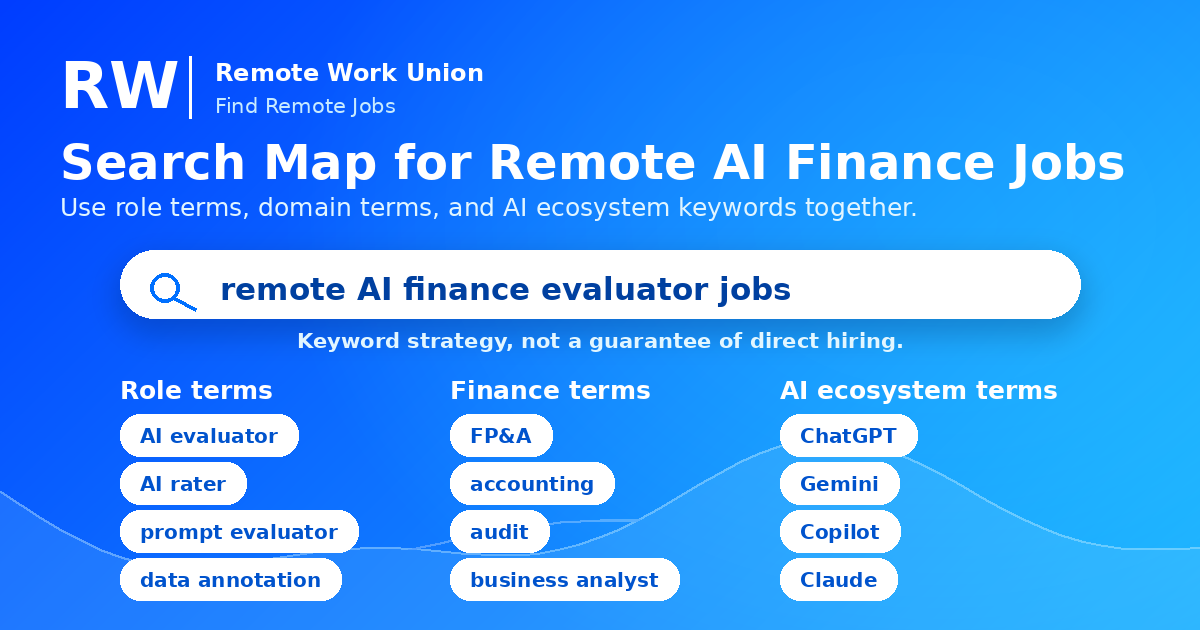
Do not search only for "AI jobs" — that phrase is too broad and often returns engineering roles. Combine remote-work terms, AI evaluation terms, and your finance domain keywords.
Try combinations like: remote AI evaluator finance, work from home AI rater accounting, AI model evaluation business analyst, prompt evaluator finance, remote data annotation finance, RLHF finance expert, human feedback accounting jobs, AI response reviewer financial analysis, AI trainer business analyst, and AI research reviewer remote.
You can also use major AI ecosystem terms as keyword anchors: ChatGPT, OpenAI, Google Gemini, Microsoft Copilot, Anthropic Claude, Meta AI, Amazon Bedrock, IBM watsonx, Perplexity, and enterprise AI assistants. Use those names carefully as search signals — they are not promises that a specific company is hiring for the exact role you want.
How to Stand Out as a Finance Applicant
Translate your experience into review language. Instead of only listing responsibilities, show how you made judgments: reviewed variance explanations, reconciled discrepancies, validated assumptions, tested forecast inputs, documented requirements, QA'd dashboards, audited transactions, or compared business recommendations.
Show writing ability. A reviewer who can say "this answer is wrong because the model confuses gross margin with net margin and fails to account for fixed costs" is more useful than a reviewer who simply marks an answer bad.
Demonstrate tool comfort. Excel, Google Sheets, SQL basics, Power BI, Tableau, QuickBooks, NetSuite, or ERP familiarity can help. You do not need to claim advanced engineering skills if you do not have them.
Be honest about your level. A bookkeeper, a CPA, an FP&A analyst, and a business analyst can all fit different AI projects. The goal is to match your real judgment to the projects that need it.
Frequently Asked Questions
Do I need coding skills for remote AI finance jobs?
Not always. Some roles require SQL, Python, or data analysis skills, but many AI evaluation and response review roles focus on domain judgment, written feedback, spreadsheet logic, and careful comparison. Coding helps for certain projects, but it is not the only path.
Are accounting AI jobs the same as bookkeeping jobs?
No. Some tasks may involve bookkeeping concepts, but AI review work usually focuses on evaluating, labeling, testing, or explaining outputs rather than managing a company's live books. Think of it as quality review and training support, not traditional client accounting.
Can business analysts get remote AI jobs?
Yes, business analysts can be a strong fit because they are used to requirements, workflows, stakeholder needs, data interpretation, and structured communication. Search for prompt evaluation, AI response review, business analyst AI jobs, and model evaluation analyst roles.
What is the best background for AI model evaluation in finance?
The best background depends on the project. FP&A is useful for forecasting and variance tasks. Accounting is useful for transaction and workflow review. Audit and compliance are useful for risk and policy tasks. Business analysis is useful for requirements, systems, and process testing.
A Simple 7-Day Preparation Plan
Day 1: Rewrite your resume headline around finance, accounting, business analysis, AI evaluation, and remote work. Day 2: Build a keyword list of 20 search terms combining AI evaluator, AI rater, prompt evaluator, data annotation, finance, accounting, audit, risk, FP&A, and business analyst. Day 3: Create a short writing sample where you compare two AI answers to a finance question and explain which one is better. Day 4: Refresh your Excel, Sheets, SQL, Power BI, or accounting software keywords. Day 5: Apply to platforms and roles that mention domain expertise, expert review, or AI model evaluation. Day 6: Track every application in a spreadsheet with role title, platform, pay model, requirements, and next step. Day 7: Improve your profile based on what listings keep asking for.
Application pitch template: "I have a finance and business analysis background with experience reviewing financial assumptions, spreadsheet outputs, business requirements, and written recommendations. I am interested in remote AI model evaluation and human feedback projects where I can test AI answers for accuracy, logic, clarity, and practical usefulness. I am comfortable following detailed rubrics, comparing outputs, documenting issues, and explaining why one answer is stronger than another."