Remote AI training jobs can pay very differently from one platform, project, and applicant to the next. One person may see simple data annotation tasks at the lower end of the market. Another person with software engineering, legal, medical, finance, writing, research, or advanced STEM experience may qualify for expert AI model evaluation work at a much higher hourly rate.
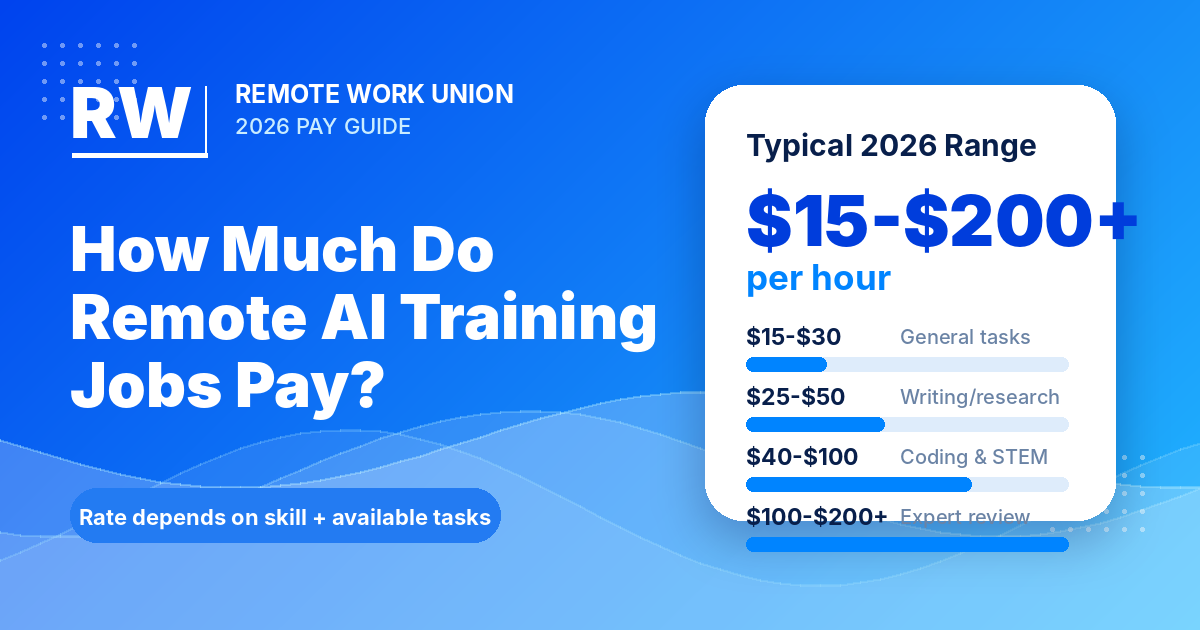
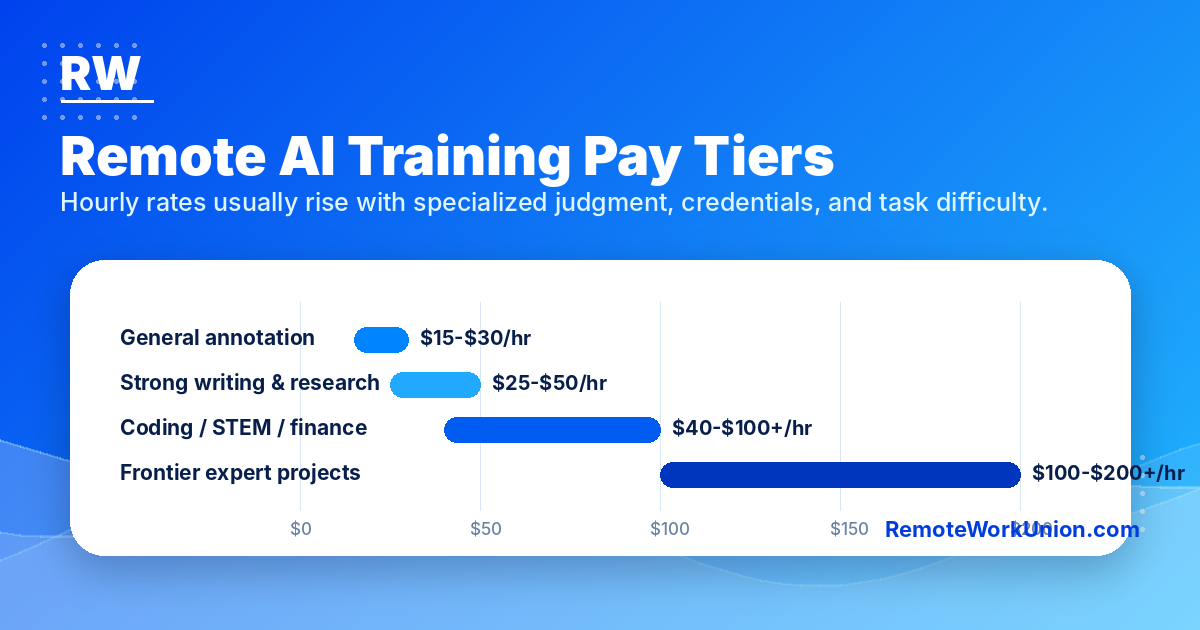
That is why the honest answer is not a single number. In 2026, remote AI training jobs commonly fall into a broad range from about $15 to $30 per hour for basic generalist work, $25 to $50 per hour for stronger writing, research, language, or evaluation tasks, $40 to $100+ per hour for technical and domain-specific work, and $100 to $200+ per hour for rare expert projects.
Important: The hourly rate is only one part of the income picture. These are usually contract roles. Work may be part-time, project-based, paused between batches, or available only after you pass assessments. A $100/hr project with three hours available is not the same as a $35/hr project with consistent weekly task flow.
Why AI Training Work Has Such a Wide Pay Range
AI companies and AI labs need people to review, correct, compare, and improve AI model outputs. The work can include rating chatbot answers, checking factual accuracy, writing better responses, reviewing code, building evaluation rubrics, testing model reasoning, annotating data, or judging whether an AI system handled a complex professional scenario correctly.
The easier the work is to teach, the lower the rate usually is. The harder the judgment is to replace, the higher the rate can become. A basic annotation task might ask you to label text, compare two answers, or follow a simple rubric. A higher-value AI evaluation task might ask you to decide whether a model made a subtle legal reasoning mistake, missed a medical risk, wrote unsafe code, or misunderstood a finance workflow. Those tasks require more than availability. They require judgment.
Typical Remote AI Training Pay Ranges in 2026
Basic annotation and general AI tasks: about $15–$30 per hour
This is often the entry-level end of remote AI training. The work may include simple labeling, basic text evaluation, following a rubric, comparing two AI answers, or reviewing straightforward outputs. Some global generalist roles advertise rates around the mid-teens. Other general writing or evaluation projects may start closer to $25 to $30 per hour. This range is most realistic for beginners who have strong English and good attention to detail but do not yet have a verified professional niche.
Writing, research, content evaluation, and language work: about $25–$50 per hour
Applicants with strong writing, editing, research, translation, localization, or content judgment can often qualify for better projects than simple annotation. These roles may involve checking whether an AI response is clear, accurate, natural, helpful, well-structured, and aligned with a prompt. This is a strong category for writers, editors, content creators, teachers, marketers, journalists, communications professionals, and bilingual professionals.
Coding, STEM, finance, legal, healthcare, and technical review: about $40–$100+ per hour
The biggest jump in pay usually happens when your background gives you expertise that is expensive to replace. Coding tasks can include evaluating AI-generated code, debugging model answers, or checking Python or JavaScript solutions. STEM projects can require math, physics, biology, chemistry, statistics, or research credentials. Finance, healthcare, legal, and business projects may require real professional judgment. This is where remote AI training starts looking less like gig work and more like flexible expert contract work.
Frontier expert projects: about $100–$200+ per hour
The highest-paying AI training jobs are not usually beginner jobs. They tend to involve specialized expertise, verified credentials, complex rubrics, sensitive evaluation work, or advanced professional scenarios. These projects are attractive, but they are also harder to get — they may require interviews, credentials, work samples, advanced tests, or direct proof of subject-matter expertise. The rate can be real, but the work is not always steady.
Remote Work Union helps you find AI training roles that match your expertise level. Apply today to get started.
Find Roles Hiring Now →Why Two Applicants Can See Completely Different Rates
Two people can sign up for the same platform and have very different experiences. One may see only low-volume general tasks. Another may be invited to a high-paying expert project. That does not mean one platform is better — it often means the matching system is sorting applicants by skills, location, test results, project demand, and client requirements.
The main rate drivers are: skill level (strong writing, research, coding, math, legal, medical, finance, and technical skills raise your ceiling); scarcity (platforms pay more when fewer people can do the task well); verification (higher-paying projects often require assessments, credentials, interviews, or work samples); quality (accuracy and clear explanations help you stay eligible for better work); and location and client rules (some projects are limited to specific countries or professional backgrounds).
Hourly Rate Is Not the Same as Monthly Income
This is the mistake most beginners make. Monthly income depends on three factors: hourly rate × paid hours available × how consistently you stay matched to projects.
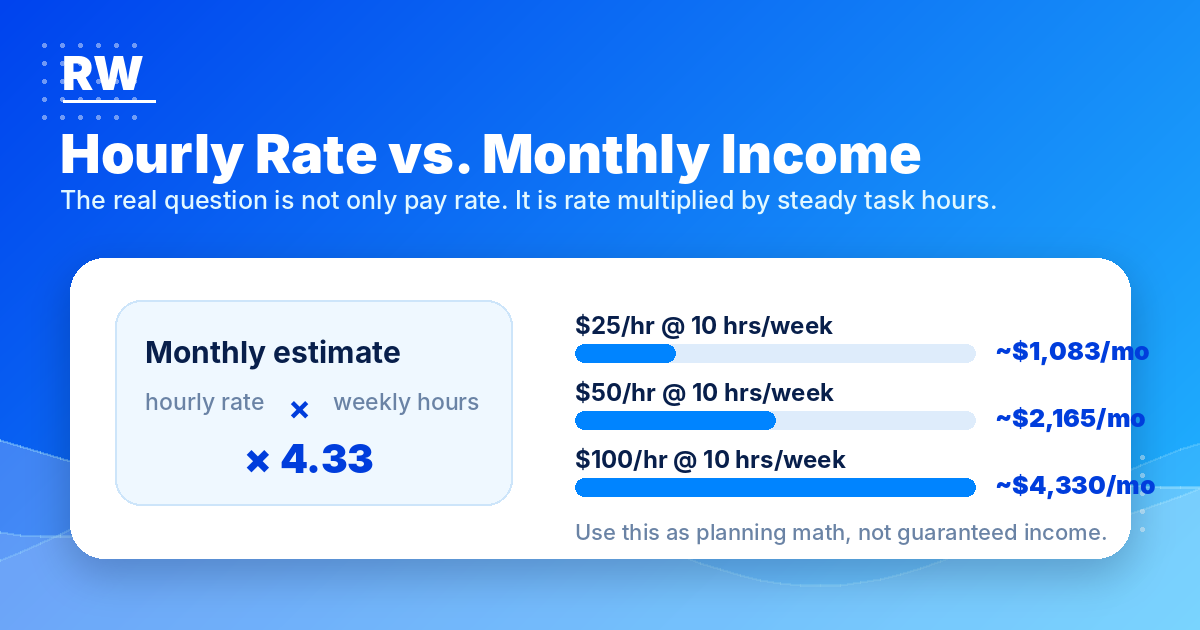
For example, someone earning $25/hr for 10 hours per week is around $1,083 per month before taxes. Someone earning $50/hr for 10 hours per week is around $2,165 per month before taxes. Someone earning $100/hr for 10 hours per week is around $4,330 per month before taxes. But a person with a lower rate and steady tasks may out-earn someone with a higher rate and inconsistent access. This is why experienced remote workers often apply to multiple legitimate AI training platforms instead of depending on one dashboard.
Which Skills Lead to Higher Pay?
The highest-paid remote AI training jobs tend to reward people who can evaluate complex outputs. Useful backgrounds include software engineering, Python, JavaScript, data structures, and debugging; medicine, nursing, healthcare administration, and clinical reasoning; law, contracts, legal research, compliance, and policy analysis; finance, accounting, investing, and risk analysis; math, statistics, physics, chemistry, biology, and engineering; writing, editing, journalism, SEO, and communications; education, curriculum design, tutoring, and assessment design; business operations, consulting, HR, recruiting, sales, and project management; and translation, localization, and bilingual review.
How to Increase Your AI Training Pay Rate Over Time
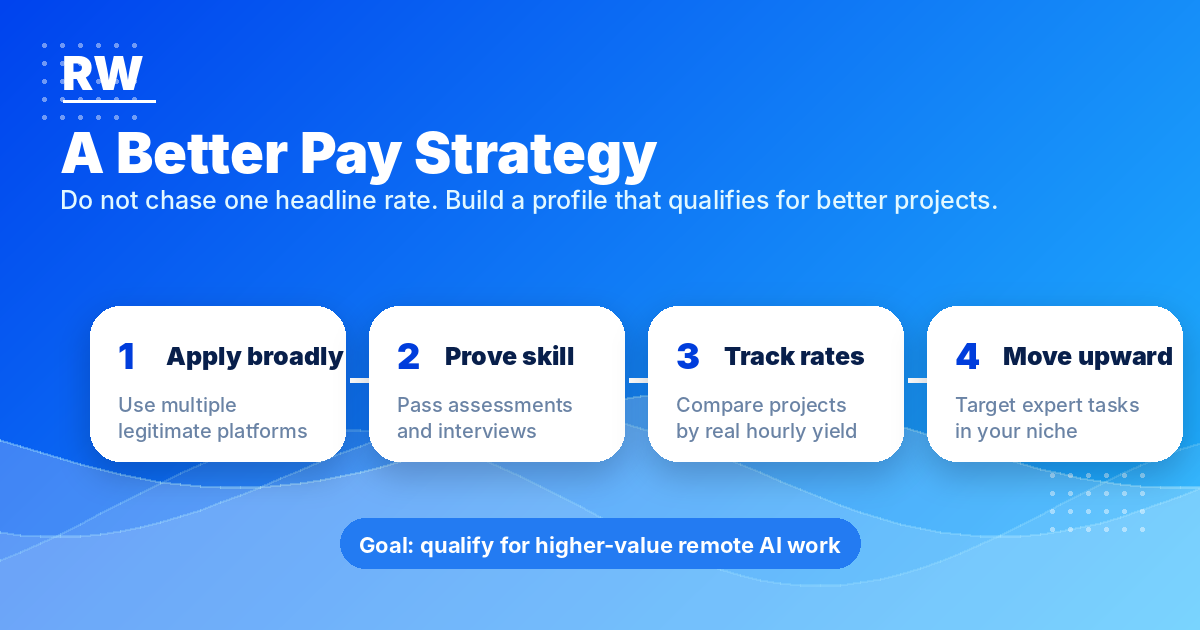
You usually cannot force a platform to give you the highest-paying project immediately. Build a profile around actual skills — list the categories where you can genuinely evaluate quality. Take assessments seriously; many applicants rush through onboarding, then wonder why they are not matched. Apply to more than one legitimate platform. Track your real hourly yield — compare what you actually earn for the time you spend. And move toward expert categories: if you have a professional niche, do not stay in the lowest generalist pool forever.
Frequently Asked Questions
How much do remote AI training jobs pay per hour in 2026?
Remote AI training jobs commonly pay $15–$30/hr for basic generalist annotation, $25–$50/hr for writing, research, and language evaluation, $40–$100+/hr for technical and domain-specific work, and $100–$200+/hr for rare frontier expert projects. The rate depends heavily on your skill level, domain expertise, and the specific platform and project.
Do you need AI experience to get a higher pay rate?
Not always. For non-coding roles, the more important skills are writing, reasoning, accuracy, and the ability to follow detailed instructions. However, higher-paying projects often require proof of expertise — if you are applying for medical, legal, finance, or engineering roles, the platform may expect you to demonstrate that background through assessments or credentials.
Why is hourly rate different from monthly income in AI training?
Monthly income depends on hourly rate multiplied by paid hours available multiplied by how consistently you stay matched to projects. A person with a lower rate and steady tasks can out-earn someone with a higher rate and inconsistent access. This is why experienced remote workers apply to multiple platforms instead of depending on one.