A remote work profile is not just a resume copied into a text box. On many modern hiring platforms, your profile is the first matching document. It tells the platform what kinds of work you can do, what keywords describe your experience, how credible you look, and whether you are easy to place into a project quickly.
This matters even more for remote AI jobs, AI training jobs, model evaluation work, data annotation, prompt writing, research review, content evaluation, and other work-from-home roles where companies often need to sort thousands of applicants before assigning a task or interview. A strong profile helps a reviewer, recruiter, or matching system understand your best fit in seconds.
The goal is not to sound impressive in a vague way. The goal is to be specific enough that a platform can match you to the right type of remote work faster. That means clear skills, searchable keywords, proof of ability, clean formatting, and a profile that reads like a real person wrote it.
Why remote work profiles matter more now
Remote hiring has become more profile-driven. For traditional jobs, a resume and cover letter may still carry most of the weight. For many remote platforms, your profile is the front door. It may be scanned before your resume is opened. It may decide which projects you see. It may influence whether you are routed toward writing, research, customer support, operations, design, sales, AI evaluation, or expert-review work.
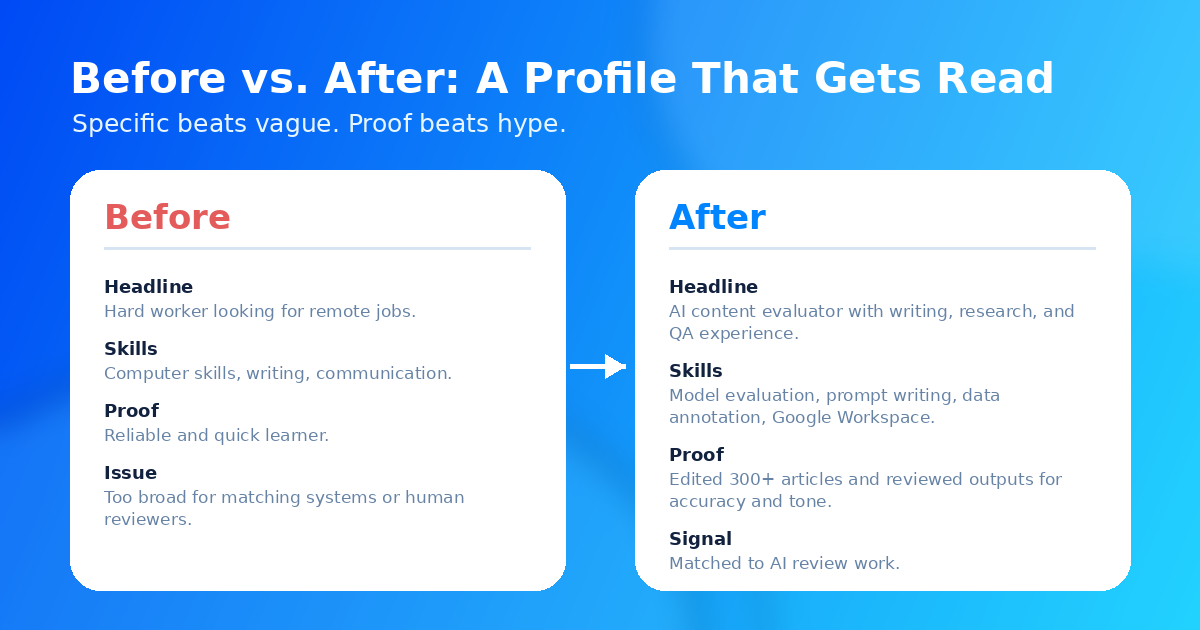
This is why two people with similar backgrounds can get very different results. One person says, "I am looking for remote work and I am a fast learner." Another says, "I evaluate AI-generated content for factual accuracy, tone, and instruction-following, with experience in editing, research, Google Sheets, customer communication, and quality assurance." The second profile gives the system more useful signals.
A faster match usually comes from clarity. Platforms do not need you to be perfect. They need enough information to understand which lane you belong in.
What a matching system or recruiter is trying to understand
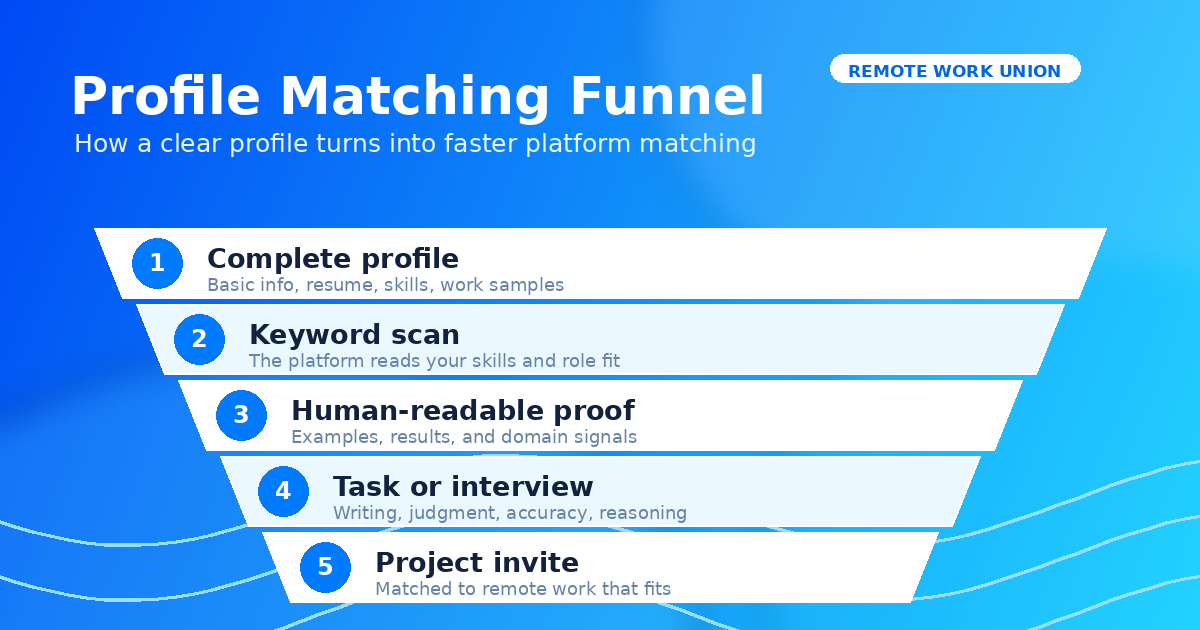
A remote work profile should answer five questions quickly: What work can you do? What topics or industries do you understand? What proof shows you can do it? What tools can you use? Are you available and reliable enough for remote work?
Those questions apply to broad work-from-home jobs and to AI-focused work. A company hiring for customer success wants to see communication, ticketing tools, CRM experience, empathy, and follow-through. A company hiring for remote AI training work may want writing ability, factual judgment, attention to detail, prompt evaluation, data labeling, model evaluation, or subject-matter expertise. A company hiring for expert AI review may want legal, finance, medical, engineering, coding, marketing, or research experience.
Major AI companies and AI labs such as OpenAI, Anthropic, Google, Meta, and xAI/Grok create demand for people who can evaluate outputs, improve datasets, review prompts, test responses, and apply human judgment. Platforms such as Mercor, Handshake AI, micro1, and other remote work marketplaces often rely on profile information to decide where an applicant may fit.
Step 1: Pick a clear lane before writing your profile
A common mistake is trying to look qualified for everything. A broad profile may feel safer, but it often makes matching harder. A better approach is to choose one primary lane and one or two secondary lanes.
Your primary lane is the main type of remote work you want. Examples include AI content evaluator, remote researcher, AI data annotation worker, customer success specialist, virtual assistant, copywriter, editor, prompt writer, sales development rep, operations coordinator, UX researcher, paralegal, accountant, or subject-matter expert.
Your secondary lanes give the profile flexibility without making it confusing. For example, a writer could position themselves as "AI content evaluator, editor, and research assistant." A customer service rep leaving the phones could position themselves as "customer support QA, help center writer, and AI response evaluator." A finance professional could position themselves as "financial analyst, spreadsheet reviewer, and expert AI evaluator."
A clear lane helps the platform understand what to show you first.
Step 2: Write a headline that is specific, not generic
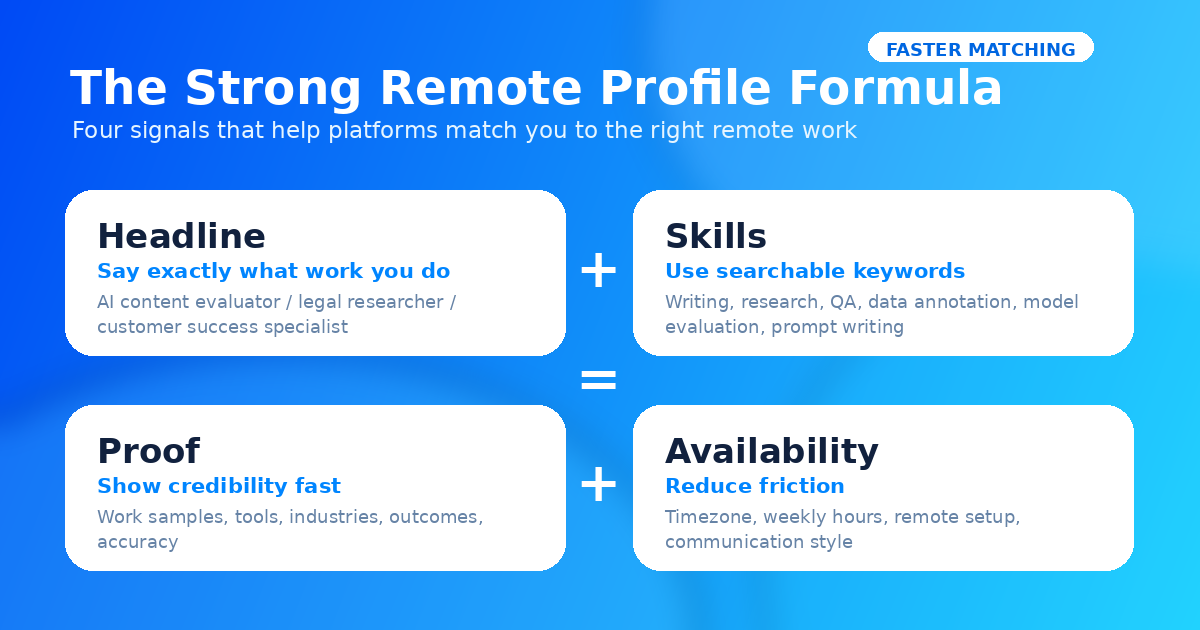
Your headline is usually the first thing a reviewer sees. It should combine the role you want with the strongest skills you bring. Avoid empty phrases such as "hard worker," "motivated professional," or "looking for remote opportunities." These are not wrong, but they do not help matching systems categorize you.
Use a headline like: "AI Content Evaluator with Writing, Research, and QA Experience." Another strong example is: "Remote Customer Support Specialist Skilled in Help Desk, Documentation, and AI Response Review." If you have a professional niche, include it: "Legal Researcher and Paralegal Available for Remote AI Evaluation Work."
A useful formula is: target role + core skills + domain or proof. For example: "Marketing Strategist with SEO, Copywriting, and AI Content Evaluation Experience." This gives both humans and matching systems immediate context.
Step 3: Use keywords naturally in your skills section
Keywords help your profile get understood. The point is not to stuff random terms into your profile. The point is to name the work you can actually do in language that remote platforms, recruiters, and AI training companies recognize.
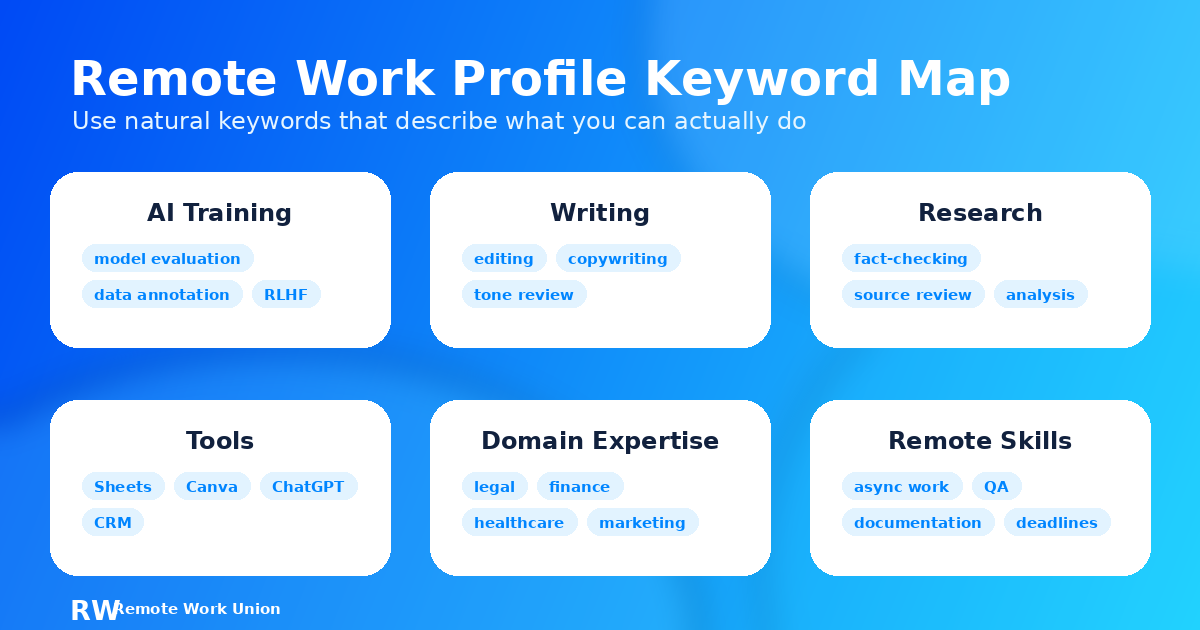
Strong keywords for remote AI jobs may include AI training, AI evaluator, AI reviewer, model evaluation, data annotation, data labeling, prompt writing, prompt evaluation, response ranking, RLHF, instruction-following, factual accuracy, content moderation, research review, editing, proofreading, quality assurance, and spreadsheet review.
Strong keywords for general work-from-home jobs may include customer support, email support, chat support, virtual assistant, administrative support, sales operations, account management, recruiting, bookkeeping, UX research, project coordination, social media management, SEO, content writing, CRM, Google Workspace, Microsoft Excel, Notion, Slack, Zendesk, HubSpot, Canva, and Airtable.
Choose the keywords that match your actual background. A focused list of true skills is stronger than a giant list that looks copied.
Step 4: Add proof without making the profile too long
A profile should not read like a full autobiography. It should give fast proof. Proof can be a result, a work sample, a tool, a project, a credential, a portfolio, or a simple description of tasks you have done repeatedly.
Instead of saying "I am good at writing," say "Edited long-form articles for clarity, accuracy, tone, and SEO." Instead of saying "I know spreadsheets," say "Built tracking sheets, cleaned data, and reviewed rows for errors." Instead of saying "I am interested in AI," say "Reviewed AI-generated answers for factual accuracy, instruction-following, and tone."
You do not need a perfect resume to show proof. You need concrete evidence. Numbers help when they are real. "Handled 40+ support tickets per day," "edited 200+ product descriptions," "managed a weekly content calendar," or "created SOPs for a remote team" are all stronger than generic claims.
Step 5: Make your profile easy to scan
Remote platforms often move fast. A reviewer should not have to dig for the important parts. Keep paragraphs short. Use clear section labels. Put the strongest details near the top. Avoid long blocks of text, unexplained acronyms, and vague language.
A simple structure works well: headline, short summary, skills, proof, tools, industries, availability, and links. If the platform gives you separate fields, use each field for its intended purpose. Do not paste the same paragraph into every box. That can make the profile look careless.
Scanning matters because matching is partly about reducing uncertainty. When your profile is organized, the reviewer can quickly decide whether to move you forward, assign a task, or route you to a better-fitting project.
A clear, keyword-rich remote work profile helps platforms match you to better opportunities faster. Find roles that fit your skills now.
Find Roles Hiring Now →Step 6: Build your profile around the work you want next
A remote work profile should point forward. Your past jobs matter, but the profile should emphasize the tasks you want to be matched with now. If you worked in retail but want remote customer support, highlight communication, problem solving, customer questions, conflict resolution, and documentation. If you worked in marketing but want AI training jobs, highlight writing, editing, brand voice, SEO, research, and evaluating content quality.
Career changers should translate their experience into remote-friendly language. Teachers can emphasize feedback, rubric-based grading, writing review, lesson planning, and subject expertise. Real estate agents can emphasize sales, client communication, contracts, local research, and follow-up. Operations managers can emphasize process improvement, scheduling, SOPs, spreadsheets, vendor coordination, and remote team communication.
The best profile does not hide your background. It reframes your background so remote platforms can understand it.
Step 7: Tune the profile for AI training and model evaluation roles
Remote AI work often rewards skills that many non-technical professionals already have. You may not need to code to qualify for certain AI training, AI evaluation, data annotation, prompt writing, or response-review roles. What matters is whether you can follow instructions, notice errors, explain your reasoning, compare outputs, and apply judgment consistently.
For these roles, your profile should show writing clarity, reading comprehension, attention to detail, topic knowledge, and reliability. Mention relevant domains such as finance, law, healthcare, education, marketing, science, operations, customer support, software, or creative writing only when you can actually support those claims.
A strong AI-focused profile might say: "I review AI-generated content for accuracy, helpfulness, instruction-following, tone, and completeness. My background includes editing, research, SEO, customer communication, and spreadsheet-based QA." That sentence is much stronger than "I am interested in AI."
Step 8: Avoid the mistakes that slow down matching
The biggest mistakes are vagueness, overclaiming, missing keywords, no proof, messy formatting, and applying with an unfinished profile. Another mistake is sounding like you want any remote job, no matter what it is. Platforms usually need to match people to specific work, not general desire.
Do not claim expert status in every field. Do not list tools you cannot use. Do not use a profile that sounds generated and generic. Do not leave your work history empty if you have relevant experience. Do not ignore short-answer fields, because those fields often reveal how clearly you write.
Also avoid making your profile too casual. Remote work still requires trust. A clean, direct, professional profile makes it easier for platforms to believe you can handle independent work without constant supervision.
A simple profile template you can adapt
Use this structure as a starting point:
Headline: AI Content Evaluator with Writing, Research, and Quality Review Experience.
Summary: I help review, edit, and evaluate written content for accuracy, clarity, tone, and instruction-following. My background includes writing, research, customer communication, spreadsheet tracking, and quality assurance. I am interested in remote AI training, model evaluation, prompt review, content editing, and research-based work.
Skills: AI training, model evaluation, data annotation, prompt writing, response ranking, editing, proofreading, factual accuracy, research, Google Workspace, Microsoft Excel, Slack, documentation, customer communication, and QA review.
Proof: Edited and reviewed written materials for clarity and accuracy; built tracking sheets; followed detailed guidelines; communicated with remote teams; completed deadline-driven work independently.
Availability: Available for remote work, flexible project-based tasks, async communication, and independent assignments.
15-minute profile refresh checklist
First, update your headline so it names the exact work you want. Second, rewrite your summary so the first two sentences explain your target role and strongest skills. Third, add 10 to 20 relevant keywords that match your actual experience. Fourth, add proof in the form of results, tools, projects, industries, or examples. Fifth, remove vague language. Sixth, check that your profile mentions availability, location or timezone when relevant, and remote readiness. Seventh, read it out loud and delete anything that sounds inflated or unclear.
A profile does not need to be perfect forever. It should improve as you learn which roles you are getting matched to. If you apply to micro1, Mercor, Handshake AI, or other remote work platforms and you do not get the right projects, your profile may need sharper keywords, clearer proof, or a more focused target lane.
Final thought
A remote work profile gets stronger when it becomes easier to understand. The best profiles are not the longest. They are specific, credible, keyword-aware, and built around the work the applicant wants next.
If you want to get matched faster, do not just apply more. Improve the document that every platform reads first. Make your profile clear enough that a recruiter, marketplace, or AI training platform can quickly answer: this person fits this kind of work.
Frequently Asked Questions
What should a remote work profile include?
A specific headline naming your target role, a short summary with your strongest skills, relevant searchable keywords, proof of ability through work samples or results, tools you can use, and your availability. The goal is to give a matching system or recruiter enough signal to route you to the right work quickly.
How do I write a good headline for a remote work profile?
Combine your target role with your strongest skills. For example: "AI Content Evaluator with Writing, Research, and QA Experience" or "Legal Researcher Available for Remote AI Evaluation Work." Avoid vague phrases like "hard worker" or "looking for remote opportunities" — they do not help matching systems categorize you.
What keywords should I include in my remote work profile for AI jobs?
Strong keywords include AI training, AI evaluator, model evaluation, data annotation, prompt writing, response ranking, RLHF, fact-checking, research review, editing, quality assurance, and any domain expertise (law, finance, healthcare, marketing, education, etc.) you can actually support with proof.
How often should I update my remote work profile?
Update it when your skills improve, when you add new tools or platform experience, and when the work you are getting matched to does not reflect your best fit. A 15-minute profile refresh — sharper headline, better keywords, added proof — can meaningfully change which projects you see.