Flexible remote work is not just a job category. It is a lifestyle design problem. The goal is to find work that pays reliably, matches your actual skills, and gives you control over when you log in, when you focus, and how you build income around the rest of your life.
The best flexible remote jobs usually have one thing in common: the work is judged by output, not by whether you sat in a chair from 9 a.m. to 5 p.m. That is why many of the strongest opportunities are asynchronous, project-based, task-based, or deadline-based. They may involve AI training, writing, research, data annotation, expert review, coding review, finance review, legal analysis, medical review, customer support, virtual assistance, tutoring, or content operations.
This guide explains how to find flexible remote jobs you can do on your own schedule, how to search for them, how to evaluate whether they are real, and how to build a profile that gets matched with better online work over time.
Start With the Right Definition of Flexible
Many job listings use the word flexible, but they do not all mean the same thing. Some companies call a role flexible because it is remote two days a week. Others mean you can choose shifts from a limited menu. The strongest version of flexibility is different: you can decide when to work as long as the task is completed accurately and on time.
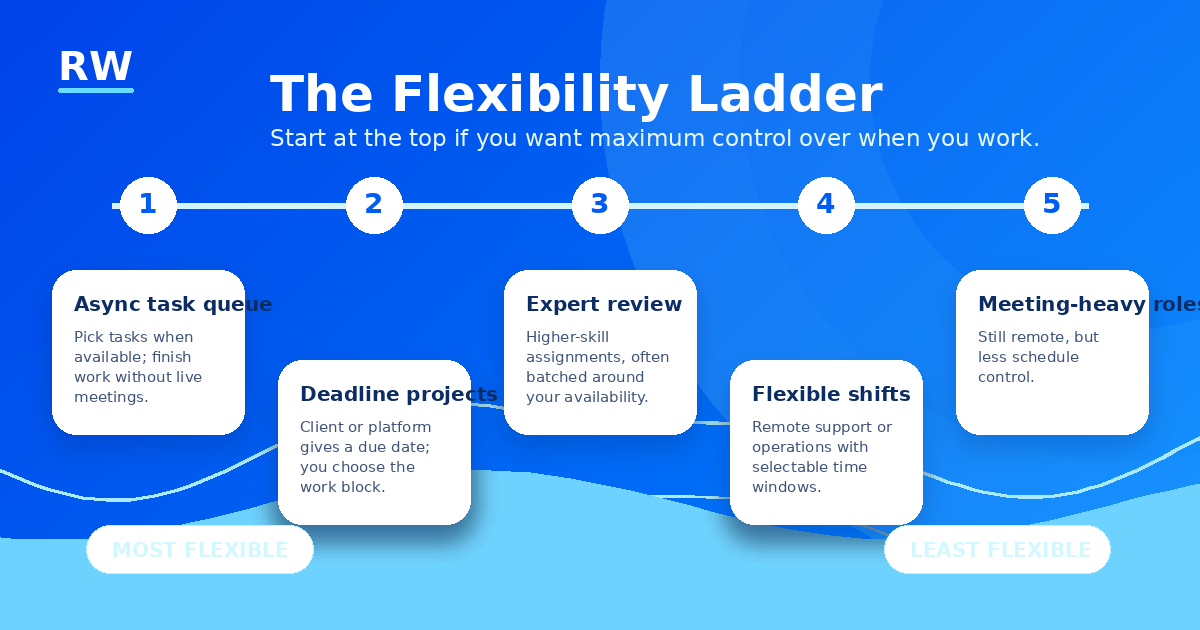
Before applying, separate remote jobs into five categories. This helps you avoid wasting time on listings that sound flexible but still require constant availability.
- Fully asynchronous task queues: You choose tasks from a platform or project dashboard and complete them when available.
- Deadline-based projects: You are assigned a deliverable with a due date, but you choose the work blocks.
- Expert review assignments: You use specialized knowledge in writing, law, finance, medicine, coding, research, or another field to review AI outputs or human-created work.
- Flexible shifts: You choose from available support, moderation, tutoring, or operations blocks.
- Meeting-heavy remote jobs: You work from home, but the schedule is controlled by meetings, internal calls, and live collaboration.
For people who want to work from home on their own schedule, the first three categories are usually the best fit. They reward skill, accuracy, and consistency more than constant availability.
The Best Flexible Remote Jobs to Search For
The highest-probability path is not searching for one perfect role. It is building a basket of flexible remote opportunities that match your strongest skills. One person might combine AI training tasks with writing projects. Another might combine finance review with research work. Another might start with no-coding online jobs and later move into higher-skill AI evaluation.
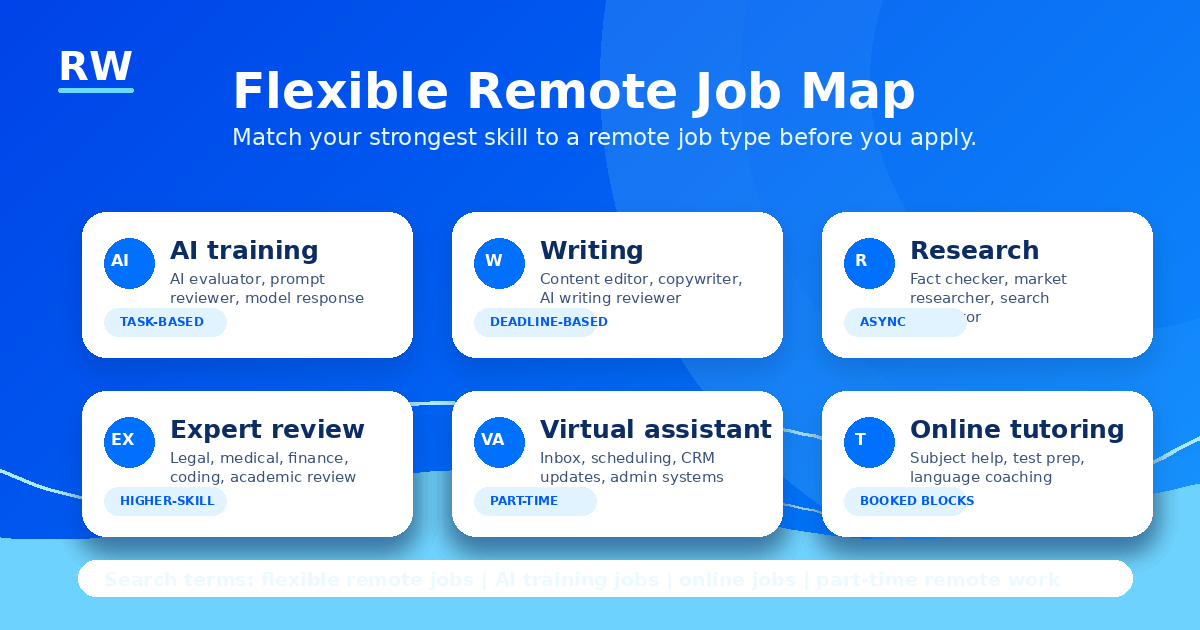
1. AI Training and AI Evaluation Jobs
AI training jobs are one of the most flexible categories because many tasks can be reviewed asynchronously. Workers may compare AI responses, grade answers with rubrics, write ideal responses, test prompts, check factual accuracy, review code, evaluate reasoning, or judge whether a model followed instructions.
Search terms to use include AI training jobs, remote AI jobs, AI evaluator jobs, AI model evaluation, data annotation jobs, AI response reviewer, prompt evaluator, RLHF jobs, LLM evaluator, AI writing evaluator, and human feedback AI jobs. This kind of work is especially attractive for people who know writing, research, coding, math, finance, law, medicine, education, science, or business.
2. Writing, Editing, and Content Review Jobs
Writing remains one of the most schedule-friendly remote skills. The best opportunities are not just generic content mills. Look for editing, copywriting, technical writing, AI writing evaluation, prompt writing, SEO content editing, newsletter production, social media content systems, and brand voice cleanup. A client or platform cares whether the article, review, rewrite, or rubric is strong — not whether you wrote it at 7 a.m. or 10 p.m.
3. Research and Fact-Checking Jobs
Research work fits flexible schedules because it is often output-based. Typical tasks include gathering sources, summarizing findings, verifying claims, comparing products, checking AI answers, building data tables, and organizing notes for a team. These jobs can be listed as online research assistant, market research analyst, search evaluator, fact checker, data researcher, remote research contractor, or AI fact-checking reviewer.
4. Expert Review Jobs
Expert review is where flexible remote work can become more valuable. Companies and AI labs need people who understand specific domains. A lawyer can review legal reasoning. A finance professional can review valuation logic. A doctor, nurse, or medical researcher can review health-related outputs. A software engineer can review code. A teacher can review educational explanations. The strongest profiles make the expertise obvious.
5. Virtual Assistant and Remote Operations Jobs
Virtual assistant work is still a practical entry point for beginners. The flexible versions involve clear task lists: inbox cleanup, calendar scheduling, lead research, data entry, CRM updates, customer follow-up, spreadsheet cleanup, travel planning, or content uploading. The less flexible versions require live availability all day — read listings carefully before applying.
6. Online Tutoring and Coaching
Tutoring is not always asynchronous, but it can be schedule-friendly if you control your availability. Subject tutoring, test prep, English language coaching, music lessons, fitness coaching, and software tutoring can all be remote. The tradeoff is that you need scheduled blocks, but you can often choose which blocks to offer.
Use Search Keywords That Reveal Real Flexibility
Generic searches like "remote jobs" or "work from home jobs" are too broad. Use keyword combinations that signal asynchronous work, task-based work, and project-based output.
Start with these search strings:
- flexible remote jobs own schedule
- asynchronous remote jobs
- task-based remote jobs
- remote AI training jobs
- AI evaluator jobs remote
- data annotation jobs from home
- AI response reviewer remote
- online writing jobs flexible schedule
- remote research assistant contract
- expert review AI jobs
- part-time remote jobs flexible hours
- work from home jobs no coding experience
- freelance remote jobs deadline-based
Add your skill to the search. A finance person should search "remote finance AI reviewer," "financial analysis evaluator," or "valuation review contractor." A writer should search "AI writing evaluator," "content editor remote," or "prompt writer contract." A coder should search "code reviewer AI training," "Python evaluator remote," or "software engineering assessment reviewer."
How to Tell Whether a Remote Job Is Truly Flexible
A flexible job listing should answer three questions: when do you work, how is work assigned, and how is performance measured? If the listing cannot answer those questions, assume the schedule may be less flexible than advertised.
Look for phrases like asynchronous, work anytime, choose your hours, task-based, project-based, deadline-driven, independent contractor, flexible weekly commitment, self-paced onboarding, remote-first, no set schedule, or work when tasks are available.
Also look for the opposite signals. If a listing mentions core hours, daily standups, required availability, rotating shifts, live phone queue, weekend coverage, mandatory meetings, or set schedule, it may still be remote, but it is not truly on your own schedule.
Build a Profile That Gets Matched With Better Online Jobs
The fastest way to improve your results is to stop presenting yourself as a generic remote worker. Flexible remote platforms and clients need to know what type of work you can do without heavy supervision. Your profile should make your skill, judgment, and reliability obvious.
A strong remote work profile includes five elements:
- A clear skill headline: Examples: AI writing evaluator, finance reviewer, legal research assistant, medical content reviewer, Python code evaluator, remote operations assistant.
- Proof of judgment: Mention rubrics, annotation, A/B comparison, option selection, editing, review, QA, compliance, fact-checking, or analysis where relevant.
- Domain keywords: Include the industries, tools, and subject areas you know.
- Availability range: State how many hours per week you can realistically work and whether you prefer evenings, mornings, weekends, or flexible blocks.
- Accuracy signals: Emphasize careful reading, clear writing, instruction following, consistency, and ability to explain decisions.
For AI training jobs specifically, do not only say you like AI. Say that you can evaluate model responses, compare outputs, identify hallucinations, follow detailed rubrics, write ideal answers, check factual claims, or review domain-specific reasoning. That language helps match you to better remote AI jobs.
Remote Work Union connects you to legitimate flexible remote AI training and evaluation roles — apply for free and skip the platform-hunting step.
Find Roles Hiring Now →Apply in Batches Instead of Randomly
Most people fail at remote job searching because they apply randomly. They open a job board, send a few applications, get no response, and assume the market is impossible. A better system is to apply in focused batches by job type.
Use this weekly application structure:
- Pick three job categories that match your skills. Example: AI training, writing, and research.
- Create one profile version for each category with the same resume foundation but different headline, summary, and keyword emphasis.
- Apply to ten to twenty roles or platforms in each category over a defined period.
- Track every application, test, onboarding step, and response in a spreadsheet.
- Double down on the category that produces tests, interviews, or paid trial tasks.
This approach prevents emotional decision-making. Instead of asking whether one listing will change your life, you are building a pipeline. Flexible remote income usually comes from repeated exposure to the right opportunities, not one lucky application.
Do Not Ignore Tests and Trial Tasks
Many flexible online jobs use tests because the employer cannot judge your ability from a short resume. This is especially true for AI training, writing evaluation, coding review, research, and expert review roles. A test may ask you to compare responses, edit text, explain which answer is better, solve a domain problem, or follow a detailed instruction set.
Treat tests like paid work, even when the test itself is unpaid. Read the instructions twice. Slow down. Explain your reasoning clearly. Do not rush to finish. For remote AI jobs, the worker who follows the rubric usually beats the worker who sounds confident but misses instructions.
Tip: The goal is not to pass every test. The goal is to take enough relevant tests that your strongest categories reveal themselves. Track which test formats you pass and which you struggle with — this is useful data.
Avoid the Low-Paying Remote Job Trap
Not all remote work is worth your time. Some listings use the dream of working from home to attract applicants into low-quality tasks, vague commission jobs, unpaid training funnels, or roles with unrealistic expectations.
A flexible remote job should still have a rational value exchange. You provide skill, time, judgment, writing, research, support, or expertise. In return, the role should provide clear pay terms, real tasks, a defined process, and a way to continue earning if your work is good.
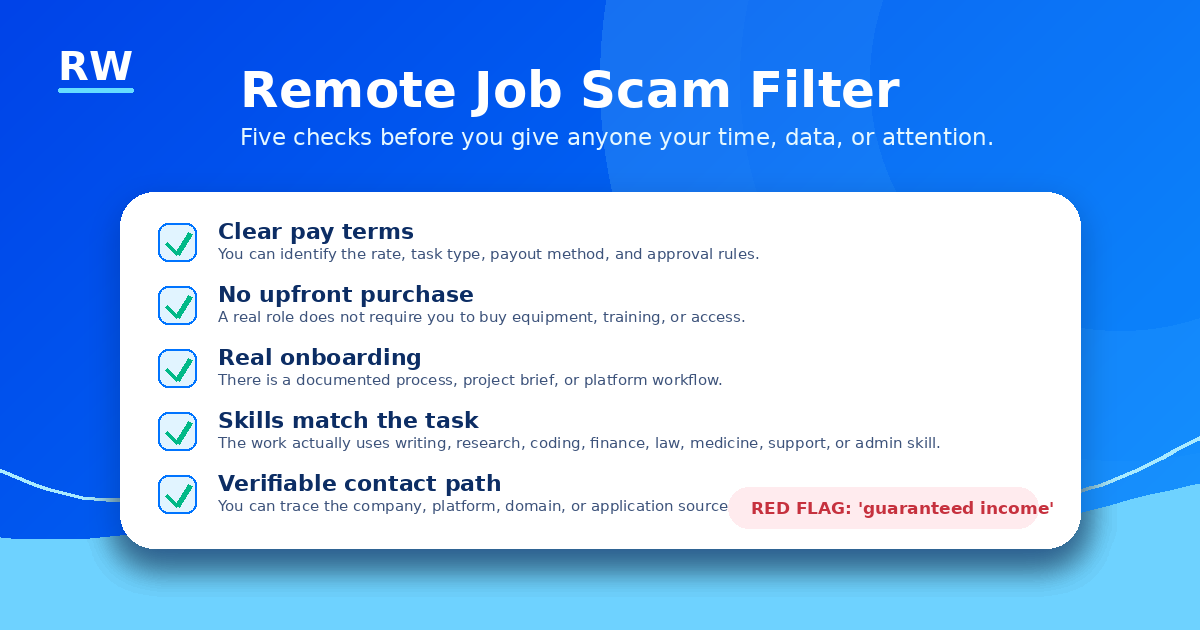
Be especially careful with listings that promise guaranteed income, ask for payment upfront, require you to buy a course before applying, hide the company name, use fake urgency, or avoid explaining what you will actually do. Real remote jobs can be competitive, but they do not need to be mysterious.
How to Combine Multiple Flexible Platforms
The most stable flexible remote workers rarely depend on one platform. They build a stack. One platform may have AI training tasks. Another may have writing projects. Another may provide expert review work. Another may offer occasional research assignments. The point is to create optionality without creating chaos.
A simple stack could look like this:
- Primary income lane: The category that pays best and matches your strongest skill.
- Secondary income lane: A related category that can fill gaps when work is slow.
- Skill-building lane: A lower-pressure category where you improve speed, accuracy, or domain depth.
- Opportunity lane: Applications to better platforms, higher-paying contracts, and longer-term remote roles.
For example, a strong writer might use AI writing evaluation as the primary lane, SEO editing as the secondary lane, research tasks as the skill-building lane, and applications to remote content strategy roles as the opportunity lane. A finance person might use AI finance review as the primary lane, spreadsheet analysis as the secondary lane, market research as the skill-building lane, and fractional analyst roles as the opportunity lane.
Create a Schedule Before You Get Busy
Flexible work only works if you create structure. Without structure, own-schedule work can become scattered. You check tasks too often, apply at random, miss deadlines, or accept work during hours when you are not focused.
Build a weekly rhythm before you need it. Reserve your best mental hours for tests, paid tasks, writing, coding, expert review, or research. Put lower-value admin tasks into shorter blocks. Review your applications once or twice per week instead of constantly refreshing inboxes.
A practical weekly system might include three types of blocks: earning blocks for paid work, pipeline blocks for applications and tests, and maintenance blocks for profile updates, invoices, notes, and follow-ups. This turns flexible work from a guessing game into a repeatable routine.
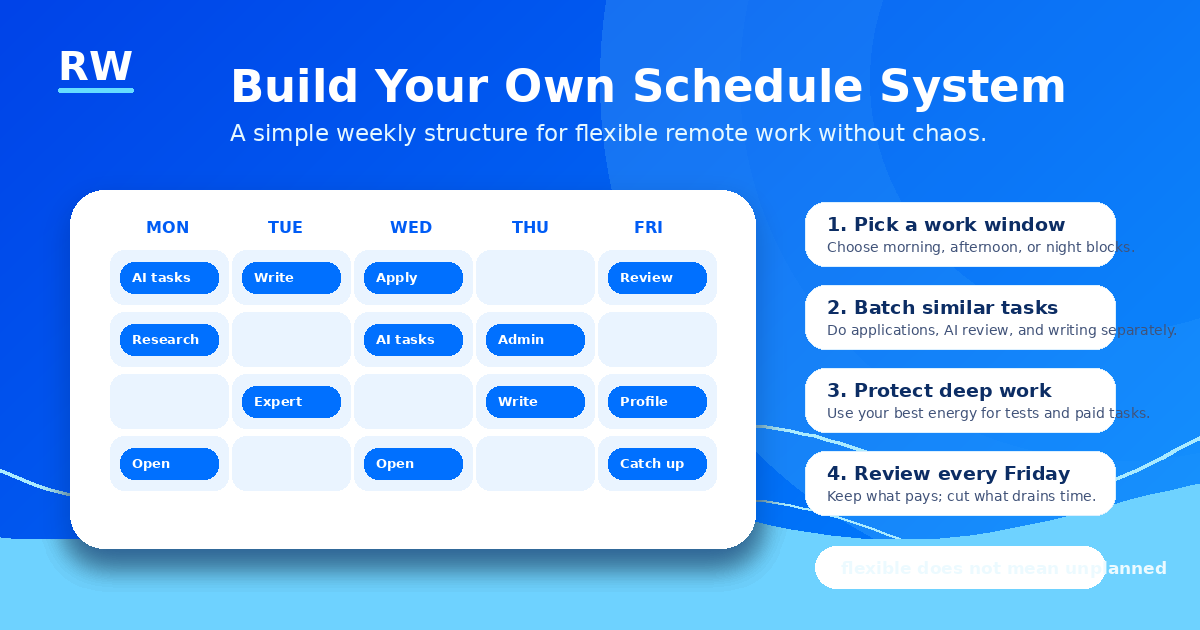
The Side-Hustle Schedule
This schedule works for someone with a full-time job, school, parenting responsibilities, or another main commitment. The goal is five to ten hours per week. Use two evening blocks for applications or tests, one weekend block for paid tasks, and one short maintenance block for profile updates.
The Contractor Schedule
This schedule works for someone trying to build real online income. The goal is fifteen to thirty hours per week across two or three platforms. Use your best hours for paid tasks, keep applications moving twice per week, and leave open blocks for sudden task availability.
The Full Remote Transition Schedule
This schedule works for someone replacing a traditional job with flexible remote work. The goal is to build multiple income lanes. Start with one primary skill category, add one secondary category, and track hourly earnings, acceptance rates, stress level, and repeat work. Keep improving the categories that pay and remove the ones that waste time.
Final Checklist Before You Apply
Before applying to any flexible remote job, ask these questions:
- Does the listing clearly explain the task or work category?
- Can I tell whether the schedule is asynchronous, deadline-based, shift-based, or meeting-heavy?
- Do my skills match the task well enough to pass a test?
- Are the pay terms, platform, company, or client reasonably clear?
- Can I create a profile version that uses the exact keywords this role is likely screening for?
- Is this role part of a broader pipeline, or am I applying randomly?
- Would I still want this work if it produced steady income for three months?
The best flexible remote jobs are not always the loudest listings. They are the opportunities where your skill, schedule, and output line up. Search with specific keywords. Build a clear profile. Apply in batches. Take tests seriously. Avoid vague opportunities. Track what works. Over time, flexible remote work becomes less about luck and more about positioning.
Frequently Asked Questions
What counts as a truly flexible remote job?
A truly flexible remote job lets you decide when to work as long as the task is completed accurately and on time. Asynchronous task queues, deadline-based projects, and expert review assignments offer the most control. Jobs with required meetings, daily standups, or live coverage windows are remote but not truly schedule-independent.
What are the best flexible remote jobs for people without coding experience?
Writing, research, AI evaluation, expert review, virtual assistant work, data annotation, and online tutoring are all strong flexible remote options that do not require coding. Many AI training jobs specifically value writing, domain knowledge, careful reading, and judgment rather than programming skills.
How do I search for flexible remote jobs effectively?
Use specific keyword combinations instead of broad searches. Try "asynchronous remote jobs," "task-based remote jobs," "AI evaluator jobs remote," "online writing jobs flexible schedule," or "remote research assistant contract." Add your specific skill or domain to narrow results to roles that match your background.
How can I avoid remote job scams?
Check for five things: clear pay terms, no upfront purchase required, a real onboarding process, tasks that match your skills, and a verifiable contact path. Avoid any listing that promises guaranteed income, asks for payment before work, hides the company name, or pushes you to messaging apps outside the platform.
How many flexible remote jobs should I apply to at once?
Apply in batches by category rather than randomly. Target ten to twenty roles or platforms per skill category, track every application, and double down on the category that produces responses. This creates a pipeline instead of scattered one-off attempts.
Can I work multiple flexible remote jobs at the same time?
Yes. The most stable flexible remote workers build a stack of two to four income lanes: a primary lane that pays best, a secondary lane that fills gaps, a skill-building lane, and an opportunity lane where they apply to better roles. The key is tracking each platform separately and creating a weekly schedule so income lanes do not conflict.