One of the biggest search questions in remote work right now is how to get paid to train AI for companies like OpenAI, Anthropic, Google, and Meta. The search intent behind that question is understandable. People know the major AI companies are building large models, and they assume there must be remote work connected to that growth. They are right, but the path is not always as simple as applying to one public job listing and immediately getting hired.
A lot of this work happens through broader ecosystems: direct company teams, research operations, specialized vendors, talent networks, and remote work platforms that screen contributors for evaluation, writing, research, and review tasks. That means the real opportunity is larger than one brand name. If you understand how the ecosystem works, you can target the whole lane instead of waiting for one perfect listing.
What "Companies Like" Really Means
The phrase companies like OpenAI, Anthropic, Google, and Meta matters because it keeps the frame accurate. Many remote workers will not be hired directly by a big-name lab. Instead, they may contribute through a partner network, a project vendor, a platform, or a team that supports model-building work behind the scenes. The work can still be real AI training work, and it can still pay well, but the hiring path is often indirect.
That is why a smart remote job search focuses on role type, task type, and skill fit rather than only chasing famous logos. The best approach is to look for AI training jobs, AI evaluator roles, expert review projects, remote AI research support, and domain-specific rating opportunities. If your search filter is too narrow, you miss the actual pipeline of work.
What Kinds of Work These Ecosystems Need
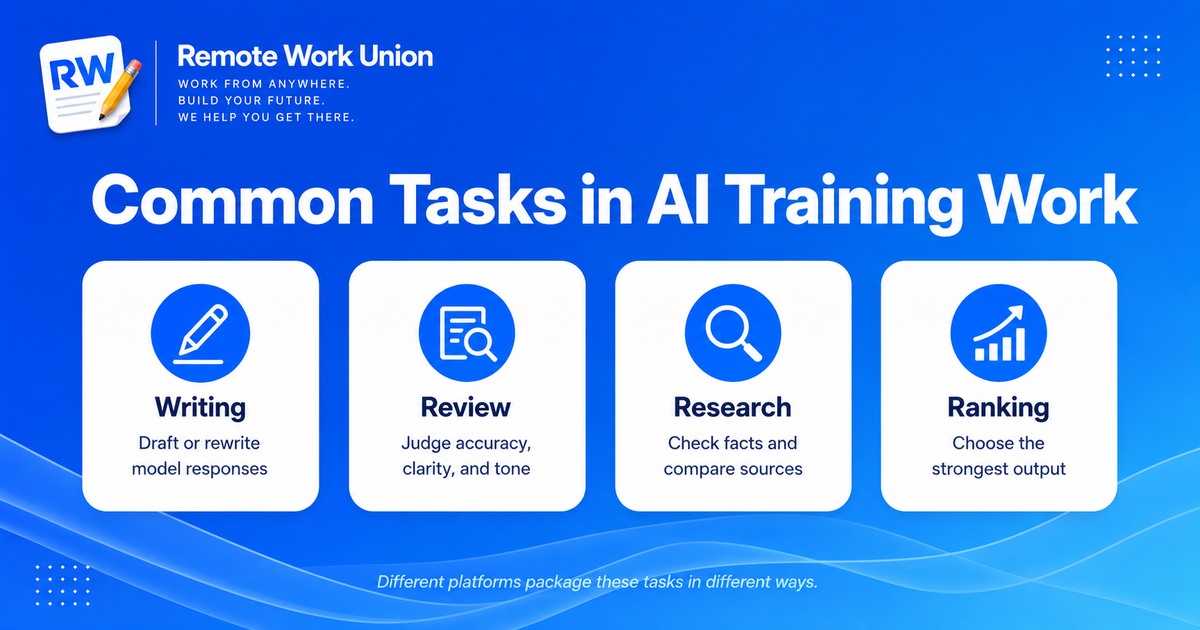
The model-building ecosystem needs more than coders. It needs people who can help shape quality. Writers help improve phrasing, structure, clarity, tone, and helpfulness. Researchers help check claims, compare sources, and test whether answers hold up. Legal professionals can evaluate contract-style reasoning, policy explanations, and compliance-related language. Finance professionals can review analytical logic, spreadsheet reasoning, and business explanations. Engineers can test code quality, debugging steps, or technical explanations. Marketers can judge copy quality, persuasion, segmentation, and brand alignment.
This is why remote AI jobs are attractive to people with real-world backgrounds. A strong applicant is often someone who already has expertise, not someone who only knows AI buzzwords. The market rewards usable judgment.
How to Position Yourself for the Work
If you want to get paid to train AI, the most important move is translating your background into task value. Do not just say you are a writer, marketer, lawyer, analyst, or engineer. Show what that means in a task environment. A writer can say they edit for clarity, argument strength, and tone. A marketer can say they evaluate audience fit and messaging. A lawyer can say they review reasoning, definitions, and overclaims. A finance professional can say they assess logic, calculations, and analytical soundness.
This translation matters because screening teams are not only judging your career history. They are judging whether your career history fits the actual evaluation work. Resume language, portfolio examples, and application answers should all make that connection obvious.
How the Application Process Usually Works
The application flow for remote AI training jobs is usually more structured than the average online job search. First, you fill out a profile or application. Then you may answer screening questions about your experience. After that, many platforms use an assessment. The test may check your writing clarity, reasoning, instruction-following, or domain expertise. If you pass, you can be invited into a project queue, matched to work, or placed into a contributor pool for future assignments.
That is why it helps to treat these opportunities seriously. Many applicants rush through the form because they assume it is just another quick signup. But the platforms that pay best often filter hard. They want people who can perform reliably and justify their judgments. Thoughtful applications beat careless speed.
How to Stand Out
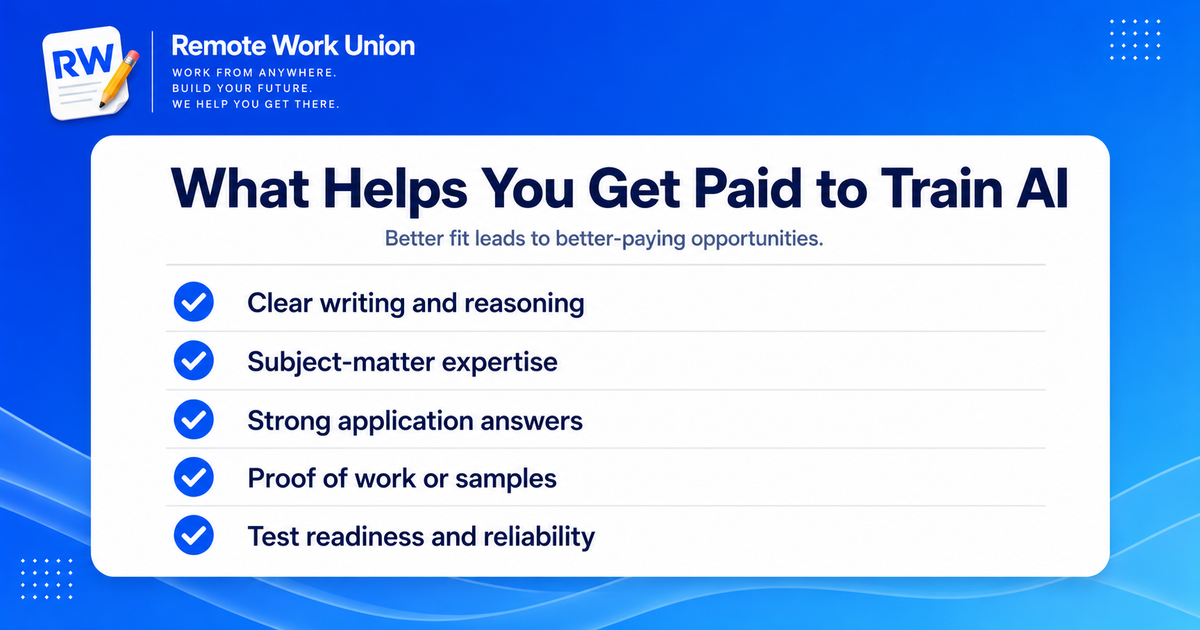
Standing out in this category usually comes down to five things. First, your writing has to be clean. Second, your reasoning has to be explicit. Third, your domain experience has to be relevant. Fourth, your application answers need to sound grounded, not generic. Fifth, your work samples, portfolio links, or project examples need to show proof.
A surprising number of applicants lose ground because they keep everything vague. They say they are detail-oriented, analytical, or passionate about AI. That language is weak. Stronger language sounds like this: reviewed ad copy across industries, analyzed financial statements, wrote long-form research summaries, edited business writing for clarity, taught technical concepts, or evaluated policy language. The more concrete the signal, the easier it is for a reviewer to place you into the right type of remote AI work.
Where to Look
Remote workers usually find this kind of opportunity through a mix of dedicated AI work platforms, expert talent marketplaces, remote work communities, and direct application channels. Platforms such as Handshake AI, Mercor, micro1, and Outlier AI often enter the conversation because they are tied to this broader lane of AI training, expert review, and contributor matching. But the goal is not to rely on one site alone. The goal is to build a repeatable search around remote AI jobs, expert evaluation work, research support, and domain-specific review opportunities.
The major AI companies also create demand across a much wider labor network. That means the strongest remote job hunters cast a wide, well-filtered net instead of waiting for a single public posting from a famous lab.
Common Mistakes to Avoid
The biggest mistake is chasing the brand while ignoring the job fit. The second is using weak application answers. The third is assuming every platform offers the same quality of opportunity. The fourth is expecting top pay without proof of expertise. And the fifth is treating assessments casually.
In this category, better filtering matters. A smaller number of high-fit applications is usually stronger than blasting generic forms everywhere. If you want to get paid to train AI, your edge comes from precision.
Key insight: Treat every application like a sample of your work quality. The screening form, the assessment answers, and the written explanations are all signals that platforms use to decide which projects to match you with. Vague answers get matched to low-value work.
Conclusion
You do not need to work inside a famous AI company office to contribute to the AI economy. Remote workers can get paid to train AI by positioning their existing expertise for the broader ecosystem around companies like OpenAI, Anthropic, Google, and Meta. Focus on the work itself, not just the logo. Target the platforms, vendors, and role types that value human judgment, and make your skill fit obvious.