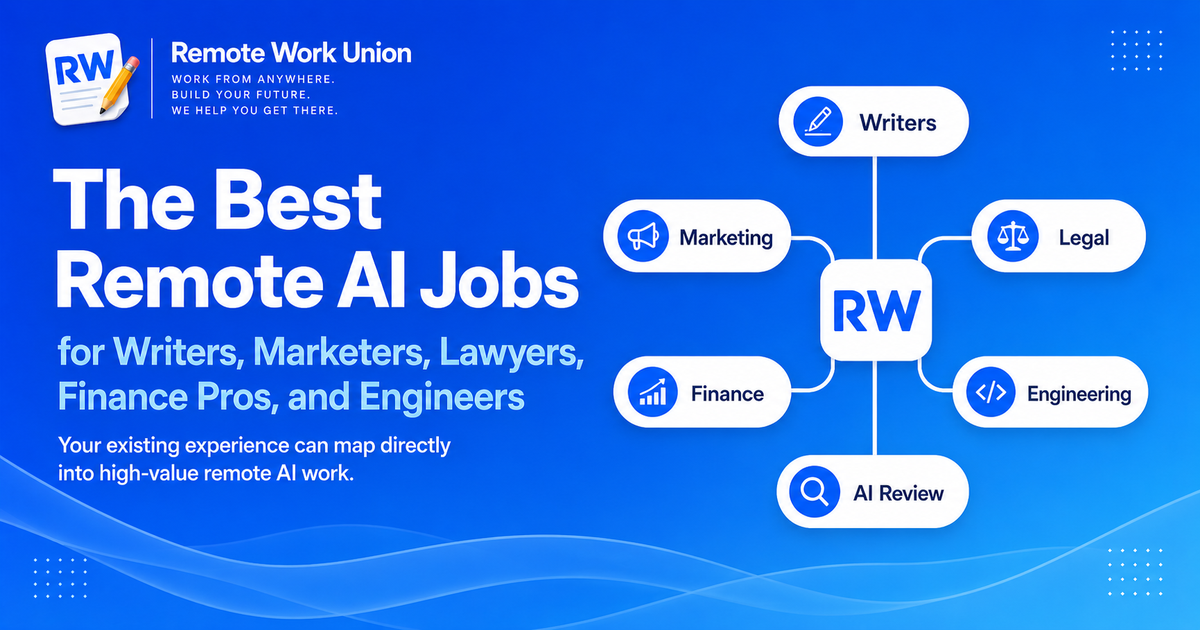
The best remote AI jobs are not reserved for one type of person. That is one of the biggest reasons this category matters. Many remote job seekers assume AI work is only for engineers or data scientists. In reality, a large share of remote AI training work depends on people with strong language skill, professional judgment, and domain expertise. Writers, marketers, lawyers, finance professionals, and engineers can all fit, but they fit in different ways. The expert-tier roles commonly pay $50–$200/hr, depending on your field and how much specialized judgment a project requires.
The opportunity is bigger when you stop asking, "Can I work in AI?" and start asking, "Where does my background create value inside AI training, review, or evaluation?" That shift turns remote AI jobs into a practical search category instead of a vague trend.
The Main Categories of Remote AI Work
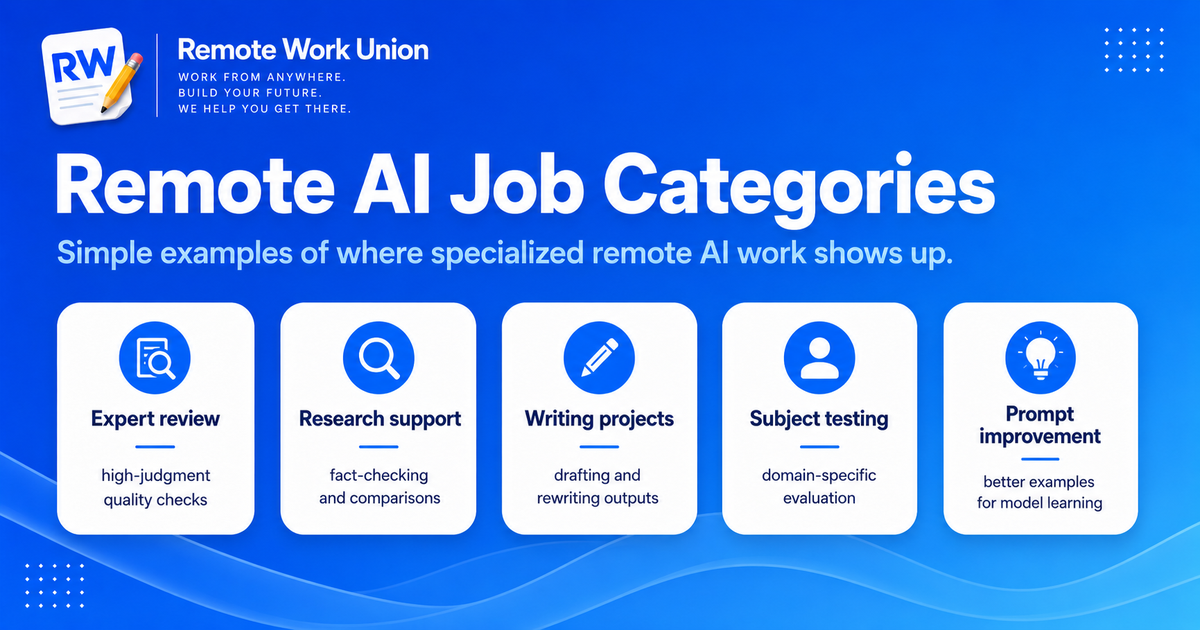
Before looking at backgrounds one by one, it helps to understand the main categories of work. Expert review roles focus on judging accuracy, logic, and quality. Research support roles help compare sources, verify claims, and spot missing context. Writing projects involve drafting, rewriting, or improving outputs. Subject testing roles evaluate how well answers perform inside a specific discipline. Prompt improvement roles help generate better examples and better instruction sets.
These categories overlap, but they create a useful map. Once you understand the categories, it becomes easier to place your experience into the right lane.
Best Remote AI Jobs for Writers
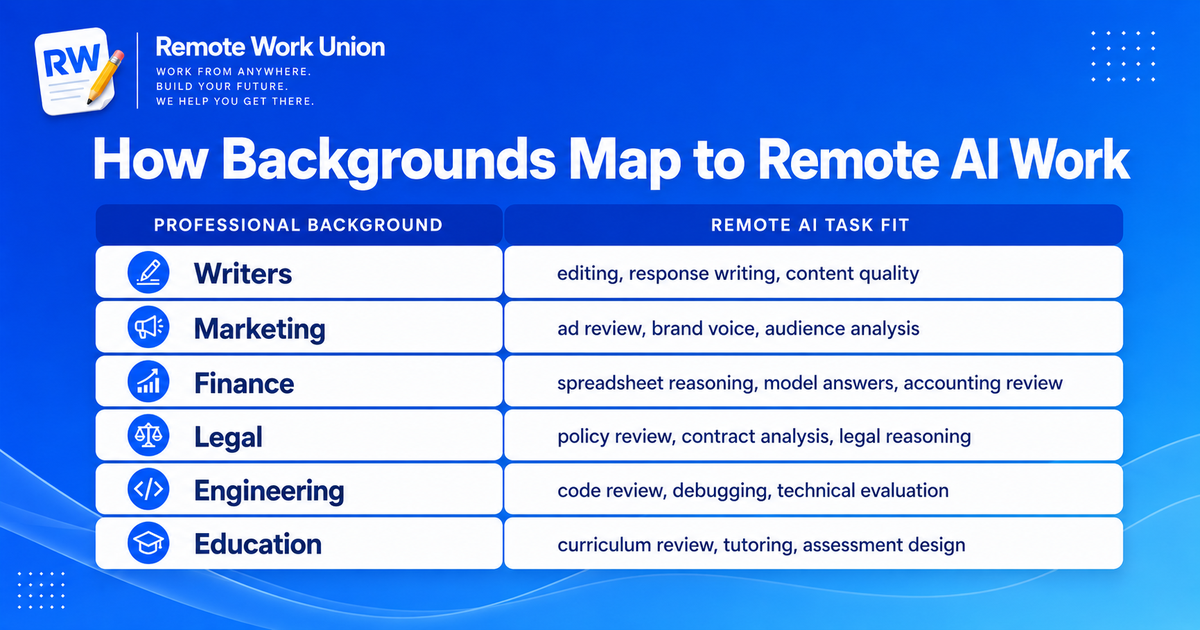
Writers often fit naturally into AI response writing, editing, rewriting, summarization, style review, and clarity evaluation. A good writer can tell whether an answer rambles, misses the point, sounds awkward, or fails to answer the prompt. That is highly valuable in AI training. Some projects focus on creating stronger example outputs. Others focus on ranking responses based on tone, structure, and usefulness.
Writers who have experience in business writing, journalism, copywriting, long-form content, or editing often have an edge because they already think in terms of audience, structure, and clarity. If you are a writer, your best search terms include AI writing projects, response reviewer, prompt evaluator, content quality reviewer, and remote AI editor.
Best Remote AI Jobs for Marketers
Marketers bring a different kind of judgment. They understand audience fit, messaging, persuasion, positioning, and brand consistency. That makes them useful for ad-copy review, response quality evaluation, audience segmentation tasks, and commercial content testing. In AI training, marketing skill shows up whenever a model output needs to be not only correct, but also compelling and aligned with user intent.
Strong marketers can also help with product-language review, UX messaging, campaign concept evaluation, and customer-journey reasoning. If you come from marketing, the key is showing that you can do more than write catchy copy. Show that you know how to evaluate whether communication actually works.
Best Remote AI Jobs for Lawyers
Lawyers and legal professionals are a strong fit for tasks that involve legal-style reasoning, contract interpretation, policy review, and careful language analysis. AI systems often struggle with overstatement, ambiguity, and edge cases. Legal minds are trained to notice exactly that. In remote AI jobs, this can translate into reviewing whether answers are precise, whether claims go too far, whether definitions are handled correctly, and whether reasoning is internally consistent.
The value of legal experience is not just subject knowledge. It is disciplined reading. That is a major asset in AI evaluation work.
Best Remote AI Jobs for Finance Professionals
Finance professionals often fit into analytical review, business reasoning evaluation, spreadsheet logic, accounting-style judgment, and explanation quality for financial topics. AI outputs related to markets, budgets, valuation, accounting, or business decisions need reviewers who can tell the difference between plausible language and actual logic. That is where finance experience becomes powerful.
If you work in finance, accounting, FP&A, investing, operations analysis, or business strategy, you can often map that experience into AI model evaluation. The strongest positioning makes your analytical skill concrete: interpreting numbers, checking assumptions, reviewing calculations, and assessing whether explanations hold up.
Best Remote AI Jobs for Engineers
Engineers are one of the clearest fits because technical projects often require code review, debugging judgment, system reasoning, and evaluation of technical explanations. But even here, the highest value is not raw technicality alone. It is your ability to evaluate whether something works, why it works, and how clearly it is explained.
Software engineers, QA professionals, DevOps practitioners, and technically fluent product people may all fit into engineering-adjacent AI work. Search terms can include code evaluator, technical reviewer, debugging evaluator, and engineering AI trainer roles.
How to Translate Your Background into Remote AI Work
The best remote AI jobs usually go to applicants who connect their experience to task outcomes. Instead of presenting your resume as a list of titles, present it as evidence of fit. A writer should point to editing, summarization, and content quality. A marketer should point to messaging judgment and audience understanding. A lawyer should point to reasoning, precision, and policy language. A finance professional should point to analysis and numerical logic. An engineer should point to technical evaluation and debugging.
This framing helps whether you are applying through a remote work marketplace such as Handshake AI, Mercor, micro1, or Outlier AI, a contributor platform, or a direct project channel. Reviewers need to know not just who you are, but what kind of tasks you can handle well.
How to Choose the Best Lane
The best lane is usually the intersection of three things: what you already know, what you can prove, and what you can explain clearly. If you have strong writing skill but weak technical depth, go toward writing and review work. If you have a niche professional background, lean into domain-specific evaluation. If you have broad analytical skill, target structured research and ranking work.
The remote AI market rewards clarity. If your background is broad, create a focused narrative. If your background is specialized, make the specialization obvious. Either way, make it easy for a platform or hiring team to see your fit.
Key insight: You do not need to reinvent yourself to work in remote AI. You need to translate what you already know into language that makes your task fit obvious. The clearer your positioning, the better your project matches will be.
Conclusion
The best remote AI jobs are not one-size-fits-all. They are skill-mapped opportunities. Writers, marketers, lawyers, finance professionals, and engineers all have strong entry points, but each background fits different task categories. If you understand where your judgment is most useful and present that clearly, you can compete for stronger remote AI jobs instead of getting stuck in generic work-from-home searches.