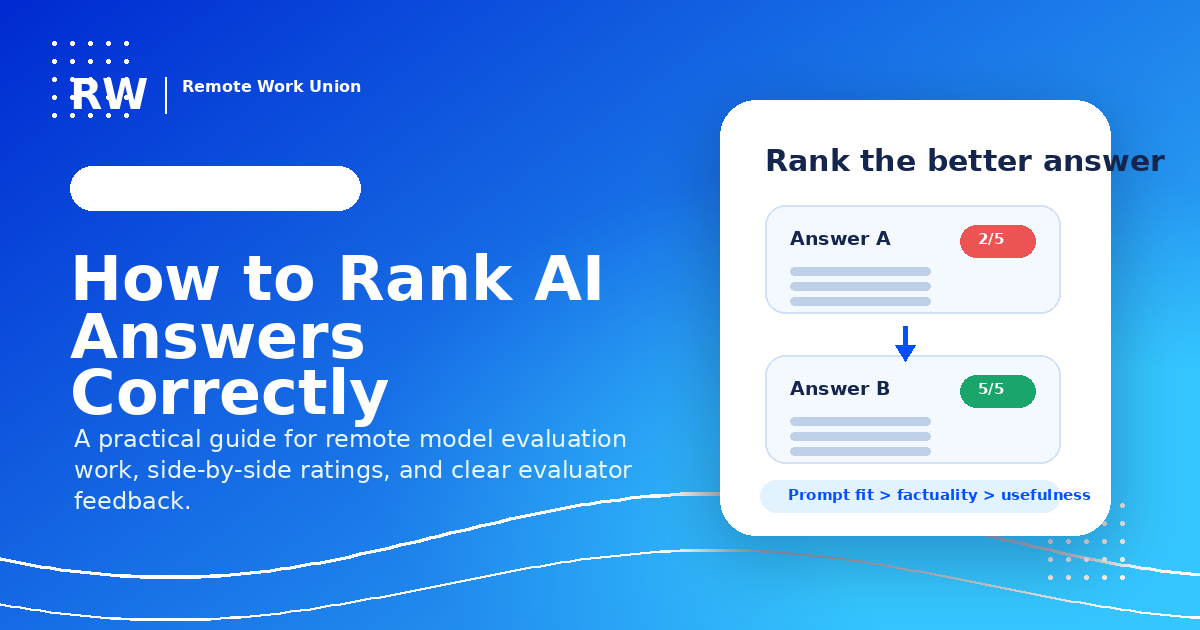
Ranking AI answers is one of the core skills behind remote AI training jobs and model evaluation work. The task sounds simple: read two AI responses and decide which one is better. In practice, the best evaluators are not just choosing the answer they personally like. They are checking whether each answer follows the prompt, tells the truth, helps the user, avoids unsafe advice, and explains the right level of detail.
This matters because modern AI systems are trained and tested with human feedback. A model may produce two different answers to the same prompt, and a human reviewer may be asked to rank them. That feedback can help improve systems like ChatGPT, Claude, Gemini, Grok, and other AI products built by major AI companies including OpenAI, Anthropic, Google, Meta, and related labs.
For remote workers, ranking tasks are common across AI evaluation platforms, AI data annotation projects, and expert review jobs. You may see this work described as model evaluation, AI response rating, RLHF, preference ranking, side-by-side evaluation, chatbot review, search quality evaluation, or AI answer feedback. The wording changes by platform, but the core skill is the same: compare outputs carefully and explain your judgment clearly.
What It Means to Rank AI Answers
To rank AI answers, you compare two or more model responses to the same user prompt and decide which response is better according to the task instructions. Sometimes the task asks for a simple choice: Answer A is better, Answer B is better, they are tied, or both are bad. Other tasks ask for a numeric rating, written feedback, or a ranking across several responses.
The most important rule is that ranking is not a popularity contest. The better answer is not always the longer answer, the more confident answer, or the answer that sounds more polished. The better answer is the one that satisfies the user's request most accurately, safely, and usefully.
A strong evaluator asks: What did the user ask for? What constraints did they include? Which answer followed those constraints? Which answer is more factually reliable? Which answer would actually help the user complete the task? Which answer avoids unnecessary risk? If you answer those questions in order, your rankings become more consistent.
Step 1: Read the Prompt Before Reading the Answers
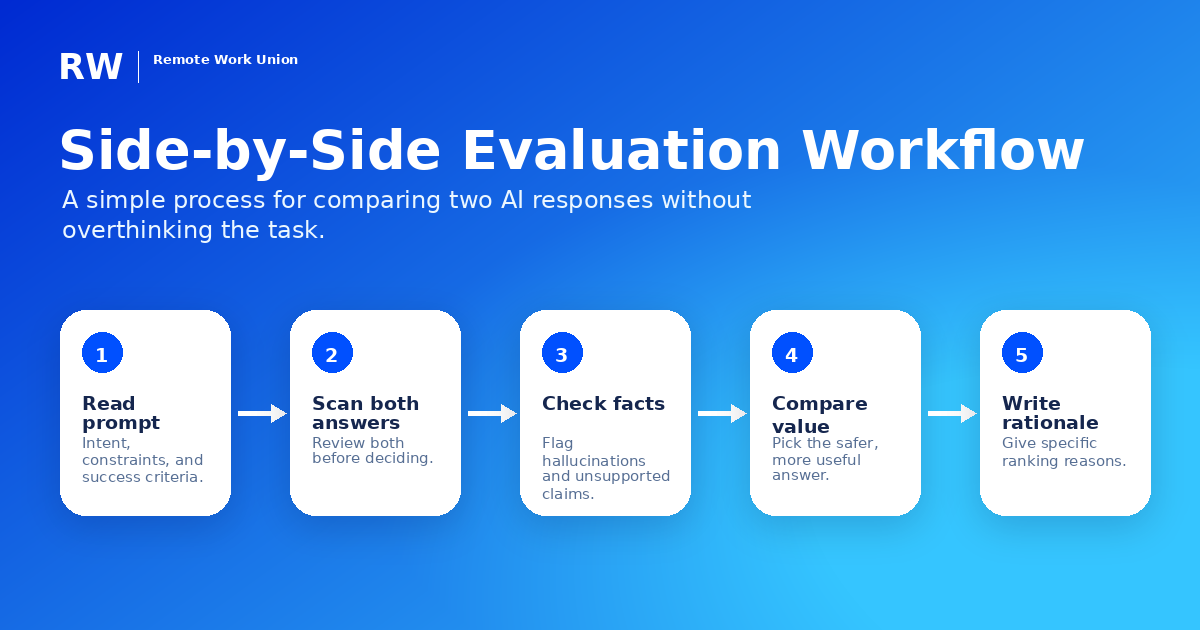
Many new reviewers make the same mistake: they start judging Answer A before fully understanding the prompt. In model evaluation work, the prompt is the source of truth. Before comparing responses, identify the user's actual intent.
Look for the task type. Is the user asking for a factual answer, a rewrite, a list, a strategy, code, a comparison, a summary, a recommendation, or a safety-sensitive explanation? Then look for constraints. Did the user ask for a specific format? Did they say to keep it short? Did they ask for no bullet points? Did they provide source material that must be used? Did they ask for current information, citations, or a direct answer?
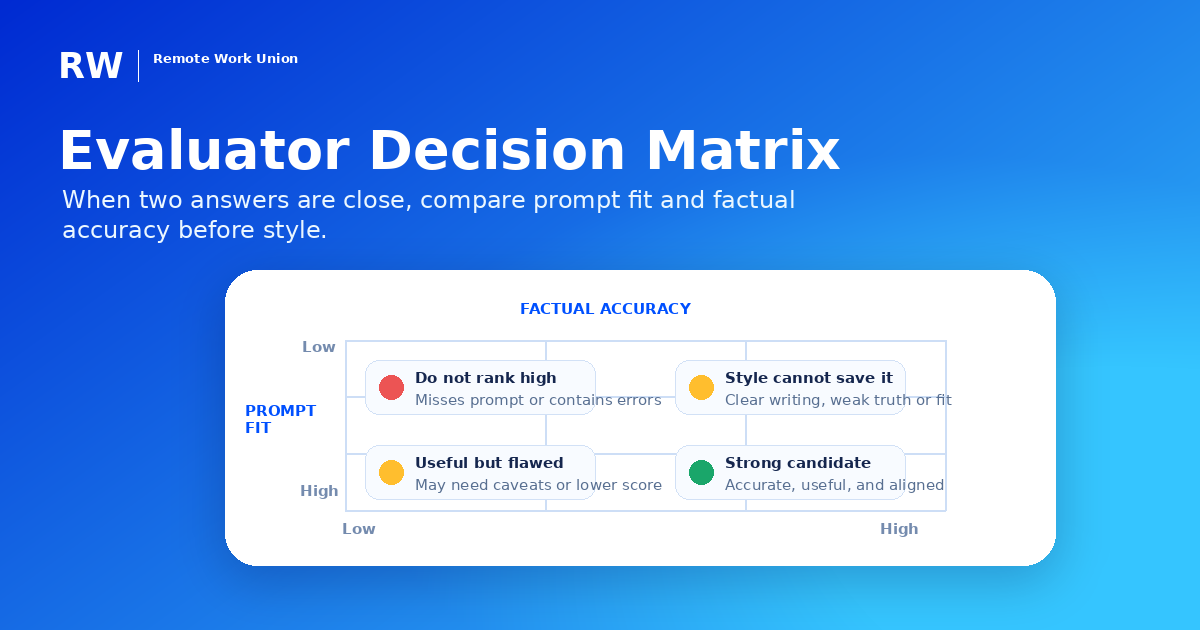
A response that ignores the prompt should usually rank lower, even if the writing is good. If the user asked for a three-sentence answer and one response gives a long essay, that is a prompt-following problem. If the user asked for a comparison table and one response gives vague paragraphs, that is also a prompt-following problem. In AI evaluation, following instructions is often the first filter.
Step 2: Check Accuracy Before Style
Factual accuracy should carry more weight than style. A fluent answer that invents facts is dangerous because it can look trustworthy while being wrong. Evaluators should watch for hallucinations, unsupported claims, outdated details, fake citations, incorrect names, wrong dates, false numbers, and overconfident statements.
When a task involves factual information, ask whether the answer is grounded. If the prompt includes source material, the answer should reflect that source rather than adding claims that are not supported. If the prompt asks about a changing topic, the answer should acknowledge uncertainty or use the required sources. If the answer makes a specific claim that seems suspicious, do not reward it simply because the sentence is well written.
In many AI training jobs, the best answer is not the one that tries to know everything. The best answer may be the one that says what can be answered, notes what is uncertain, and avoids pretending. A careful answer that includes the right caveat can outrank a confident answer that is wrong.
Step 3: Compare Helpfulness and Completeness
After prompt fit and accuracy, evaluate usefulness. A helpful answer gives the user what they need in a practical way. It may include steps, examples, caveats, definitions, or a clear recommendation depending on the prompt. It should not bury the answer under filler.
Completeness does not mean maximum length. An answer is complete when it covers the necessary parts of the user's request. If the user asks for a quick definition, a concise answer may be better than a long one. If the user asks for a detailed plan, the answer should include enough structure to be usable. The correct length depends on the job the user is trying to get done.
When ranking two answers, ask which one reduces friction. Which answer is easier to use? Which answer anticipates obvious follow-up questions without wandering? Which answer gives the user a realistic next step? In remote AI evaluator work, practical usefulness is a major quality signal.
Step 4: Weigh Safety and Policy Issues
Safety matters even when a task is not obviously risky. AI responses can create problems by giving dangerous instructions, encouraging illegal activity, exposing private information, giving medical or legal advice too confidently, or helping a user do something harmful.
A safer answer is not always a refusal. In many cases, a good response can redirect the user, provide general information, suggest safer alternatives, or explain boundaries. The key is whether the answer handles risk appropriately for the prompt.
If Answer A is more helpful but includes unsafe details, and Answer B is slightly less complete but handles the risk responsibly, Answer B may deserve the higher ranking. Safety is not a bonus category. It can be the reason one answer wins.
Remote Work Union connects you to legitimate remote AI training and evaluation roles across multiple platforms. Apply for free.
Find Roles Hiring Now →Step 5: Do Not Overvalue Formatting
Formatting can improve a response, but it should not hide deeper problems. A clean table, bold headings, or polished bullets are valuable only when the underlying answer is correct and relevant.
This is a common trap in side-by-side AI evaluation. One answer may look more professional at first glance, while the other is more accurate. Slow down before choosing. Read the substance. If the polished answer misses a key instruction, invents a fact, or gives generic advice, it should not win simply because it looks better.
Good formatting is a tiebreaker, not a substitute for quality. Use formatting to decide between two otherwise strong responses. Do not use it to rescue a flawed response.
Step 6: Look for the Better Answer, Not the Perfect Answer
Model evaluation work often requires relative judgment. You may not be choosing a perfect answer. You may be choosing the better of two imperfect answers.
If both answers have issues, identify which issue is more serious. A minor style problem is usually less important than a factual error. A missing example may be less important than ignoring the prompt. A slightly wordy response may still beat a concise response that gives the wrong answer.
This is where strong evaluators stand out. They can separate small flaws from fatal flaws. They do not mark every imperfection as equally bad. They rank based on the impact of the problem on the user's actual task.
A Simple AI Answer Ranking Rubric
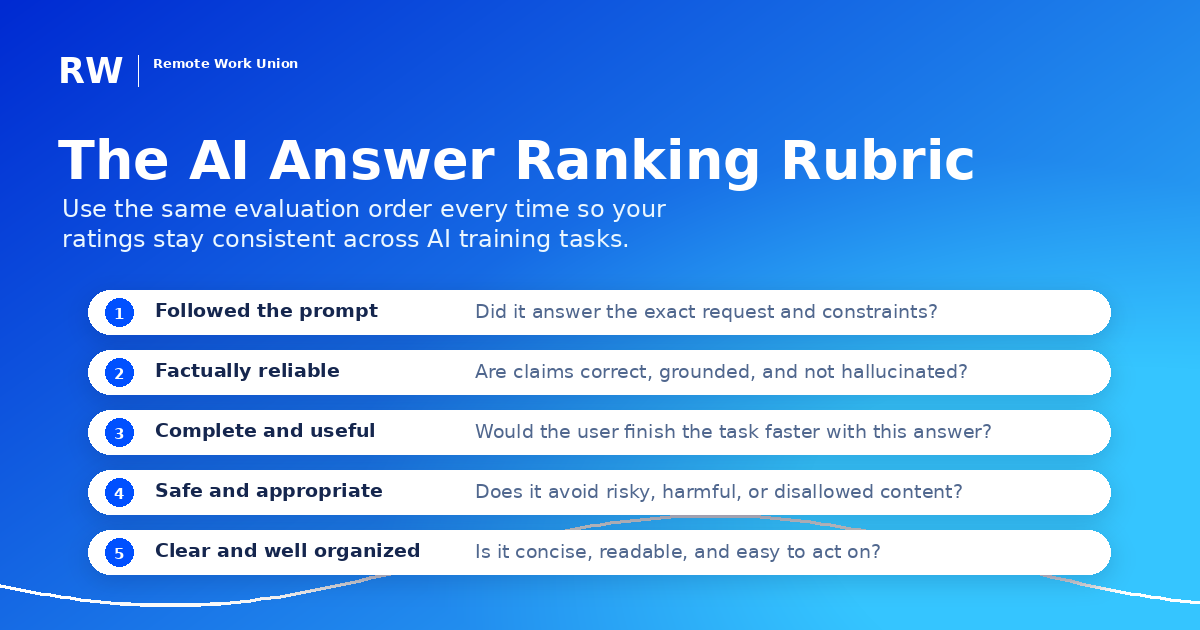
A useful ranking rubric applies these criteria in order:
- Prompt following: Did the answer do what the user asked?
- Accuracy: Are the claims correct and grounded?
- Completeness: Does the answer cover the necessary parts of the request?
- Helpfulness: Would the user be able to act on it?
- Safety: Does it avoid risky, harmful, or inappropriate guidance?
- Clarity: Is it easy to understand without unnecessary filler?
- Tone: Does it match the situation and user need?
Use this order to avoid bias. Prompt following and accuracy usually come before elegance. Helpfulness and safety usually come before personality. Clarity matters, but clarity cannot fix a wrong answer.
How to Write a Good Ranking Explanation
Many AI evaluation tasks ask you to explain why one answer is better. A good explanation is specific, brief, and tied to the prompt. Do not write vague feedback like "Answer B is better" or "Answer A sounds nicer." Explain the reason.
A strong rationale might say: "Answer B is better because it directly follows the user's request for a short checklist, includes the key safety caveat, and avoids the unsupported statistic used in Answer A." This is much stronger than saying: "Answer B is more detailed."
Your explanation should mention the most important differences only. Focus on issues that affected the ranking: factual accuracy, missed constraints, unsafe content, missing steps, irrelevant information, or clearer structure. The goal is not to rewrite the answer. The goal is to justify the ranking.
Tip: A good rationale has three parts: the winner, the main reason it wins, and the most important weakness in the other response. Keep it short and evidence-based.
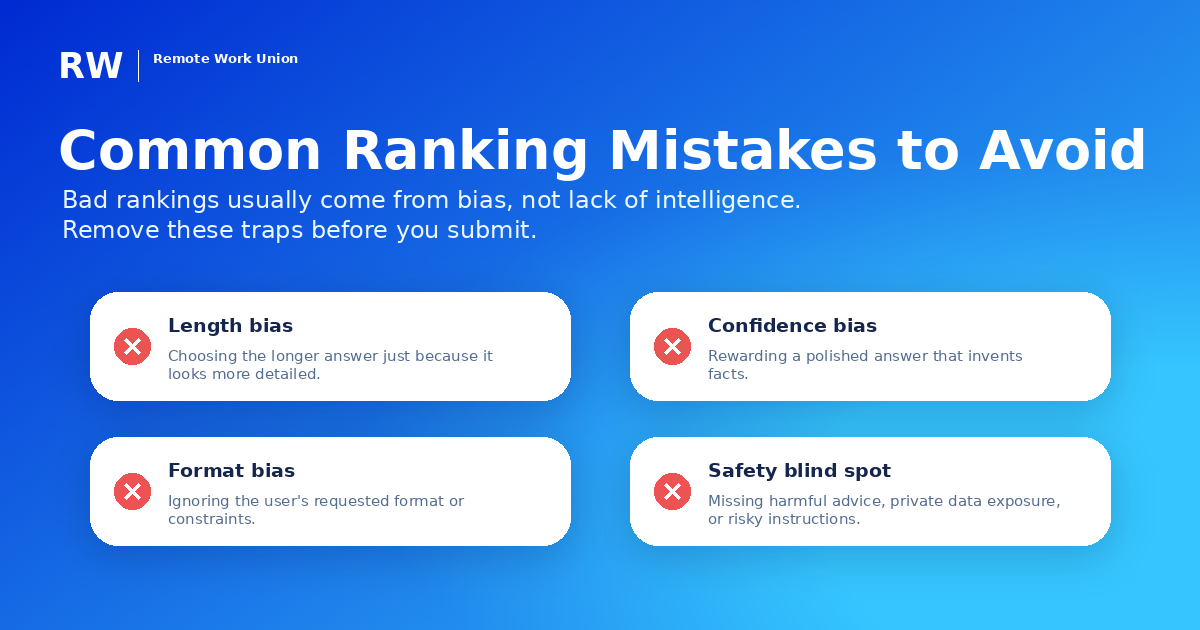
Common Mistakes New AI Evaluators Make
New reviewers often reward length. A long answer can feel more valuable, but length can also hide repetition, hallucinations, or irrelevant sections. Judge whether the extra information helps the user.
Another mistake is rewarding confidence. AI answers can sound certain even when they are wrong. Confident language should not increase a score unless the content is accurate.
Some reviewers also ignore the user's constraints. If the user asked for a specific format, audience, tone, or length, that instruction matters. A response that fails the constraint may be less useful even if the general topic is correct.
Finally, new evaluators sometimes overthink close calls. If both answers are good, choose the one that better satisfies the prompt and explain the small difference. If they are truly equivalent, a tie rating may be appropriate if the task allows it.
What Platforms Look for in Strong Evaluators
AI training platforms want reviewers who are consistent, careful, and able to explain judgment. Whether the work comes through Mercor, Outlier AI, Handshake AI, micro1 AI, Surge AI, LinkedIn listings, or direct contractor programs, the pattern is similar. Strong evaluators do not rush. They apply the rubric. They avoid personal preference. They write clear feedback.
Subject matter expertise can help, especially for legal, medical, finance, coding, education, science, business, and writing tasks. But even expert reviewers need sound evaluation habits. A finance expert still needs to check prompt following. A writer still needs to check factuality. A programmer still needs to test whether code actually satisfies the request.
The best remote AI evaluators combine domain knowledge with disciplined review. That combination is why model evaluation work can be a strong fit for educated professionals, writers, researchers, analysts, teachers, editors, and technical specialists.
How to Practice Ranking AI Answers
You can practice by taking any prompt and generating two possible answers. Then compare them using the rubric: prompt following, accuracy, completeness, helpfulness, safety, clarity, and tone. Write a one-paragraph rationale explaining which answer is better.
You can also practice by rewriting bad rationales. Turn "Answer A is better because it is more helpful" into something specific: "Answer A is better because it answers the user's exact question in three steps, while Answer B gives general background and misses the requested comparison."
This practice builds the skill that platforms are testing. Ranking AI answers correctly is less about guessing what a company wants and more about applying the same quality standards consistently.
Final Takeaway
Ranking AI answers correctly means putting the user request first. Read the prompt carefully, check accuracy before style, compare usefulness, watch for safety issues, and explain your decision with specific evidence.
For anyone interested in remote AI training jobs, AI evaluator work, RLHF rating, or model evaluation projects, this is one of the most important skills to develop. The work can vary by platform, but the core standard stays the same: choose the answer that best follows the prompt, tells the truth, helps the user, and avoids unnecessary risk.
Frequently Asked Questions
How do you rank AI answers in model evaluation work?
Start with the prompt. Check which response followed the instructions, then compare accuracy, helpfulness, and safety. Rank based on observable differences, not style preference.
What is the most common mistake in AI answer ranking?
Length bias — choosing the longer answer because it seems more thorough. A shorter answer that fully satisfies the prompt can easily outrank a longer one that drifts or adds unsupported claims.
How do you handle a tie in AI model evaluation?
If both responses are genuinely equal, a tie is a valid rating. But most close calls have a differentiating factor: one response may follow a constraint better, avoid a minor factual issue, or be slightly more useful. Look for the smallest meaningful difference.
What skills do you need for AI answer ranking jobs?
Careful reading, prompt analysis, factual accuracy awareness, safety judgment, and the ability to write a concise evidence-based explanation. These skills transfer across Handshake AI, Mercor, micro1, Outlier AI, and other AI training platforms.