Remote work is real. Work from home customer support, remote marketing roles, virtual assistant jobs, AI training jobs, AI data annotation, model evaluation, prompt writing, research review, and subject matter expert work all exist. The problem is that scammers use the same language as real remote employers. They know job seekers are searching for flexible work, higher pay, no commute, and work from anywhere opportunities.
That means the goal is not to become suspicious of every remote job. The goal is to know the difference between a legitimate remote work opportunity and a fake job designed to steal your money, identity, or time.
This guide explains how to spot remote work scams before you apply, what warning signs matter most, how to verify a recruiter, and how to protect yourself when applying for remote jobs, remote AI jobs, and work from home roles in 2026 and beyond.
The quick rule: real jobs pay you, scams make you pay first
The clearest remote work scam warning sign is simple: the company asks you to pay before you can work.
A legitimate employer, staffing company, freelance marketplace, or AI training platform should not require you to send money to unlock tasks, buy training, purchase special equipment from a vendor they choose, pay a processing fee, pay for a guaranteed interview, or deposit cryptocurrency before you can withdraw earnings.
There are normal career expenses, such as improving your resume, buying a better webcam, or taking an optional course. Those are your decisions. They are different from a recruiter saying you must pay them before you can start.
Key rule: If the job requires you to pay to get paid, treat it as a scam until proven otherwise.
Why remote job scams are harder to spot now
Remote job scams used to be obvious. The emails looked strange, the grammar was poor, and the company names were easy to dismiss. Today, scammers can copy real company branding, clone job listings, create fake recruiter profiles, use polished offer letters, and imitate the language used by legitimate AI companies and remote work platforms.
They may claim to represent OpenAI, Anthropic, Google, Meta, Grok, a fast-growing AI startup, a staffing agency, or a remote-first company. They may use terms like AI trainer, search quality rater, data annotation specialist, prompt evaluator, model response reviewer, customer success associate, virtual assistant, or remote operations coordinator.
Those job categories can be legitimate. The scam is usually not the title. The scam is the process.
A legitimate process gives you a clear company, a real website, a normal application flow, written role details, reasonable screening, secure onboarding, and no upfront payment demand. A scam process rushes you, avoids verification, asks for sensitive information too early, or tries to move money through you.
15 signs a remote job is probably a scam
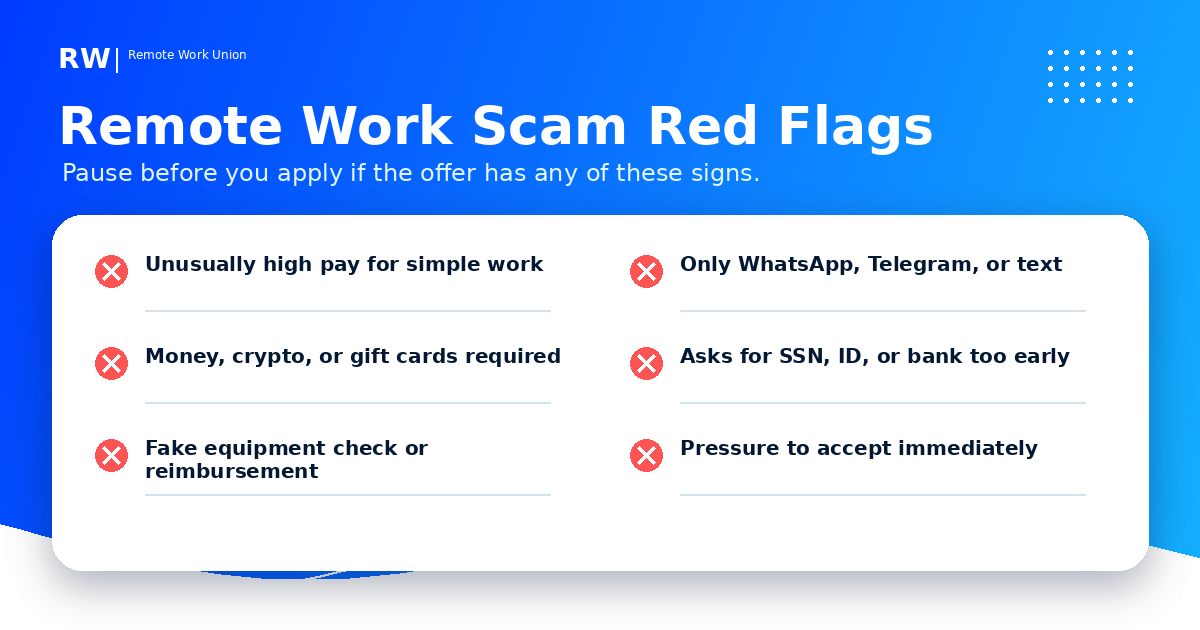
1. The pay is extreme for the work described
Remote jobs can pay well. Expert AI training, coding evaluation, legal review, finance review, healthcare review, technical writing, and specialized research work can command high rates. But a beginner role promising very high pay for very simple work should be questioned.
Examples that should make you pause: $80 per hour to like videos, $300 per day for copy-paste tasks, $1,500 per week for basic data entry with no interview, or high hourly pay for "optimization tasks" that require no skill or experience. The more the job promises high income with low effort, the more you should verify before applying.
2. They ask you to pay for equipment, training, software, or onboarding
This is one of the most important red flags. Scammers often say you need to pay for a laptop, payroll setup, security software, background screening, certification, task access, or training materials. They may promise reimbursement later.
A real company may issue equipment, reimburse approved expenses through payroll, or let you use your own device. It should not tell you to send money to a recruiter, vendor, crypto wallet, payment app, or personal account before you start.
3. They send you a check and ask you to buy equipment
This is a classic fake check scam. The fake employer sends a check, tells you to deposit it, then asks you to use part of the money to buy equipment or send the leftover amount somewhere else. Your bank may initially show funds as available, but the check can still bounce later. If it bounces, you may be responsible for the money you sent.
No legitimate employer should need you to move company money through your personal bank account before you are onboarded.
4. The recruiter only communicates through WhatsApp, Telegram, Signal, or text
Some real recruiters may text to schedule. But a serious hiring process should not exist only inside a messaging app. If the recruiter refuses to email from a company domain, refuses to provide a company career page, and refuses to move to a normal interview process, stop.
Scammers prefer messaging apps because they are fast, informal, and harder for candidates to verify.
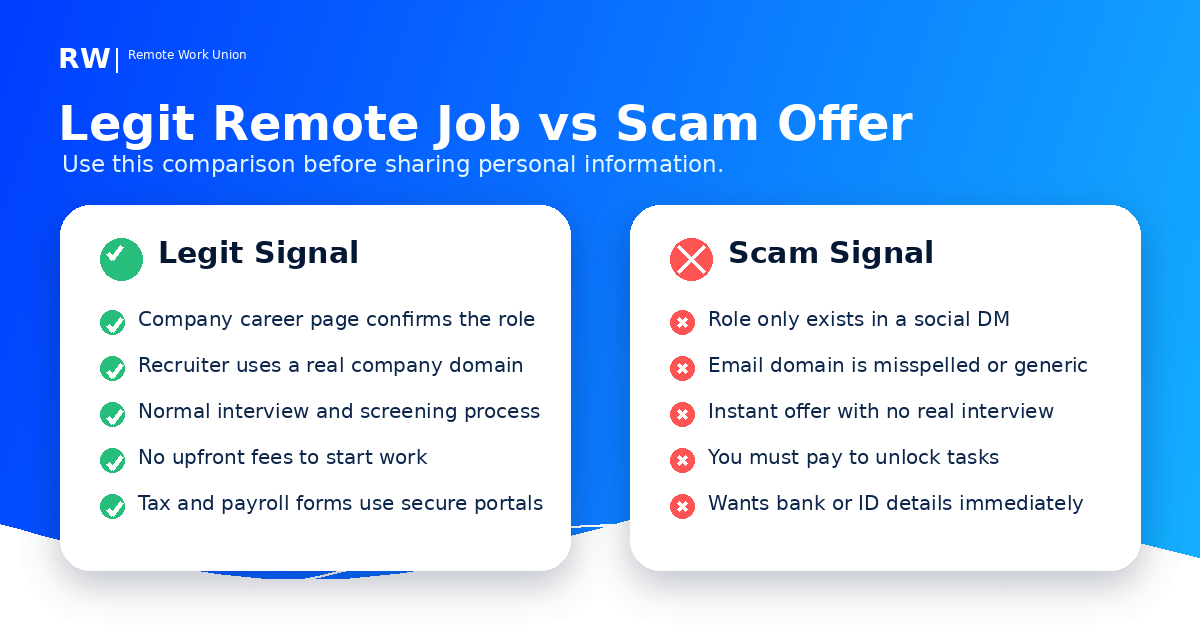
5. The email domain does not match the company
A legitimate recruiter for a company should usually use a company email domain. Watch for small spelling changes, extra words, hyphens, unusual endings, or free email accounts.
For example, if a company is called Example AI, scammers might use domains like example-ai-careers.com, exampleaihr.net, exampleaijobs.org, or a Gmail address that looks official at a glance. Before applying, search the company name and go to the official site yourself. Do not rely only on the link sent by the recruiter.
6. The job is not listed on the company's official careers page
A role can sometimes be posted through a legitimate recruiting partner, but you should still be able to verify the company, the staffing agency, or the platform. If a recruiter claims to represent a major company and the job exists nowhere except a social media post or DM, be careful.
For remote AI jobs, this matters because scammers often borrow the names of major AI companies. They may say the work is for OpenAI, Anthropic, Google, Meta, Grok, or another recognizable company to make the opportunity feel more credible.
7. You get hired instantly without a real interview or assessment
Legitimate remote work may have a short application process, especially for contract tasks. But there is usually some form of screening: resume review, skills test, writing sample, identity verification, interview, qualification quiz, or trial task.
An immediate offer for a high-paying remote job after a few messages is suspicious.
8. They ask for sensitive information too early
Employers may need personal information eventually. For example, after a legitimate offer, you may need to complete tax forms, payroll setup, background checks, or identity verification in a secure system. The issue is timing and context.
Be cautious if someone asks for your Social Security number, driver's license, passport, bank account, direct deposit details, or tax forms before you have verified the company and confirmed the role is real.
9. They pressure you to act immediately
Scammers create urgency. They may say the role closes today, the equipment invoice must be paid now, the onboarding window is only open for one hour, or you will lose the position if you ask too many questions.
Real employers have deadlines, but they do not usually collapse when you ask to verify the opportunity.
10. The job involves receiving packages or reshipping goods
Be extremely cautious with remote jobs that ask you to receive packages, inspect items, re-label boxes, or ship products to another address. These jobs can be connected to stolen goods or fraud. Even if the posting sounds like logistics, quality control, or remote operations, the structure is a major red flag.
11. The job asks you to deposit money to unlock tasks
Task scams often begin with small payments to build trust. You may see fake earnings inside a dashboard or app. Then the platform says you must deposit money, top up your balance, pay taxes, pay a withdrawal fee, or complete a paid task bundle before you can access your earnings.
Real work does not require you to fund the employer's platform in order to get paid.
12. The contract or offer letter looks official but avoids specifics
Fake offer letters often include logos, signatures, and corporate language. But they may avoid clear details like the manager's name, company address, job duties, pay schedule, tax classification, official email contacts, or normal onboarding steps.
A polished PDF is not proof. Verify the sender and the company independently.
13. The job description is vague but the income promise is specific
Scam listings often say things like "earn daily from your phone," "remote assistant needed," "AI platform tasks," or "simple online work" without explaining what the actual work is. At the same time, they may promise exact daily pay, bonuses, or guaranteed income.
Real job descriptions usually explain responsibilities, skills, tools, time expectations, and how performance is evaluated.
14. They avoid normal business questions
Ask basic questions: What is the company website? What is the official careers page? What is the recruiter's company email? What is the role title and department? Is this employee, contractor, or freelance work? How is pay processed? What platform handles onboarding?
A legitimate recruiter should be able to answer. A scammer will redirect, pressure, or become vague.
15. The opportunity sounds like it was built around your desperation
Remote work scammers know what job seekers want to hear: flexible schedule, no experience, high pay, no phone calls, work anywhere, instant approval, daily payout, and no manager. Some legitimate jobs have flexible features, but no real role is perfect in every direction.
When every part of the offer sounds designed to remove your doubts, slow down.
How to verify a remote job before you apply
Use this process before submitting personal information.
Step 1: Search the company independently
Do not click only the recruiter's link. Open a browser and search the company name yourself. Look for the official website, careers page, LinkedIn page, and recent business presence. Search the company name plus words like scam, review, complaint, fake job, and recruiter.
One bad review does not prove a company is fake, but repeated reports with the same pattern are important.
Step 2: Verify the job posting
Check whether the role exists on the company's official careers page or the legitimate platform where the company hires. If it does not, ask the recruiter for the official posting link.
Be careful with links that look close to the company domain but are not exact. Scammers often use cloned domains to capture applications.
Step 3: Check the recruiter's identity
Search the recruiter's name. Look for a credible LinkedIn profile, company affiliation, and normal work history. Be cautious with brand-new profiles, generic profile photos, mismatched company names, or profiles with very little activity.
If the recruiter claims to work for a company, ask them to email you from that company's domain.
Step 4: Compare the pay to the skill level
High pay is not automatically fake. Remote AI training roles can pay more when the work requires specialized knowledge, writing ability, coding skill, legal judgment, finance expertise, scientific expertise, research ability, or strong evaluation judgment.
But high pay for low-skill tasks with no screening is suspicious. Ask: why would this company pay so much for this task, and how do they evaluate quality?
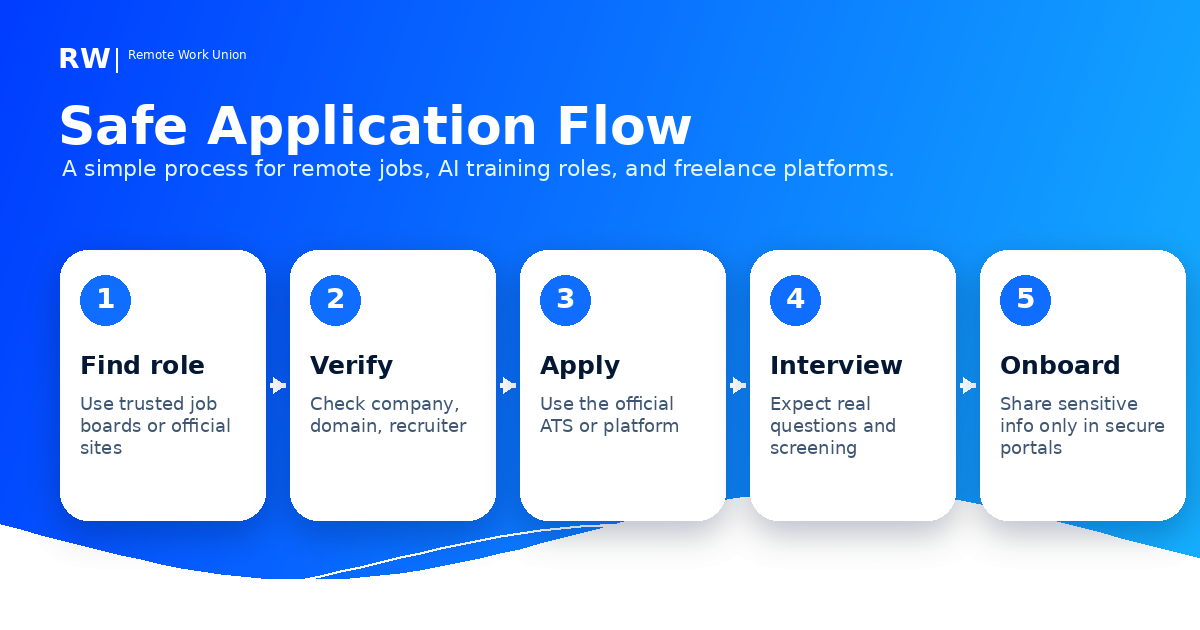
Step 5: Keep your personal information staged
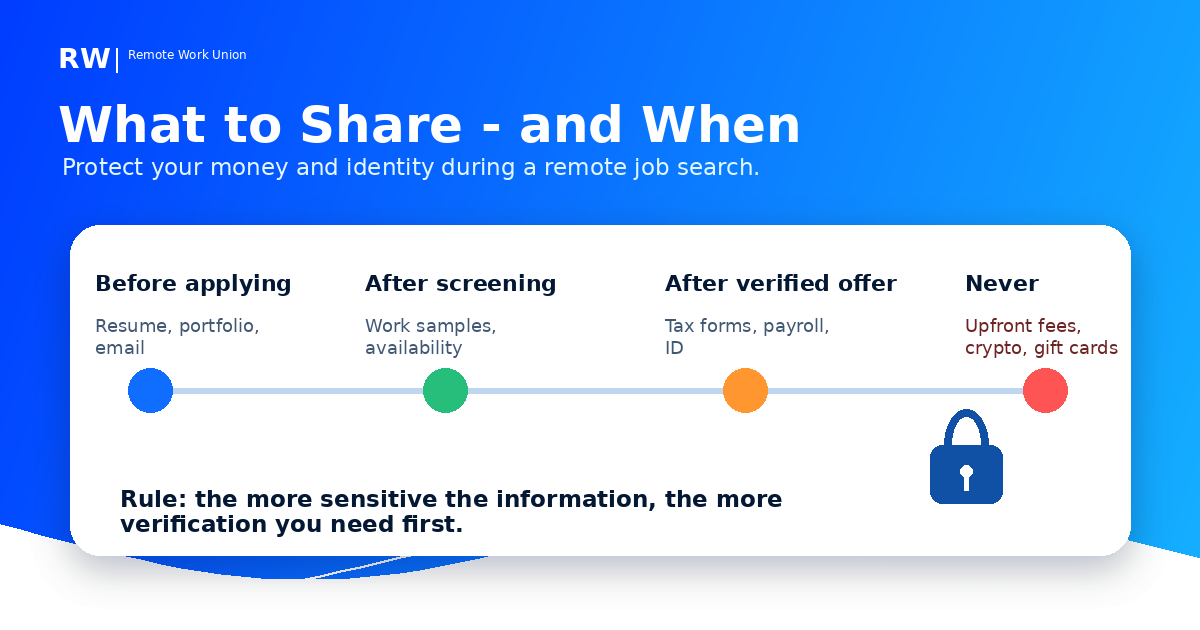
Before applying, it is normal to share a resume, portfolio, email address, general location, work history, and relevant skills.
After you verify the company and receive a real offer, you may share sensitive payroll or tax information through a secure portal.
Before verification, do not share your Social Security number, passport, bank details, full driver's license image, or direct deposit information.
Step 6: Refuse money movement
Do not deposit checks, send part of a check back, buy gift cards, pay in crypto, use Zelle or Cash App for onboarding, or receive and reship packages for a remote job. These are not normal steps in a legitimate hiring process.
Looking for real remote AI training jobs and work from home opportunities? Find vetted roles at RemoteWorkUnion.com.
Find Roles Hiring Now →Remote AI job scams: what to watch for
Remote AI work is one of the fastest-growing categories of online work, which makes it attractive to scammers. Real AI training work may include tasks like rating model responses, writing prompts, reviewing AI answers, labeling data, evaluating search quality, testing chatbots, checking factual accuracy, or using professional expertise to judge outputs.
Legitimate remote AI work may involve platforms, assessments, skill matching, project qualification, secure identity verification, tax forms, and variable task availability. It may not always be full-time. It may have pauses between projects. It may require careful reading, writing, research, and judgment.
Scam AI job offers often look different. They may promise guaranteed daily income, instant approval, no assessment, no quality standards, and easy tasks that require you to deposit money before withdrawing pay. They may claim to be connected to OpenAI, Anthropic, Google, Meta, Grok, micro1, Mercor, Handshake AI, Outlier, or another AI company without giving you a way to verify the relationship.
The safest approach is to apply through official websites, known platforms, or trusted referral pages. Do not trust a logo, screenshot, or recruiter name by itself.
A simple remote job safety checklist
Before you apply, answer these questions:
- Can I find the company outside the recruiter's message?
- Does the email domain match the company?
- Does the job exist on an official site or trusted platform?
- Is the pay realistic for the work and skill level?
- Did they explain the responsibilities clearly?
- Is there a normal interview, assessment, or screening step?
- Are they avoiding upfront payment requests?
- Are they avoiding fake checks, gift cards, crypto, and money apps?
- Are they waiting to collect sensitive information until after verification?
- Would I still trust this opportunity if I removed the remote work promise?
If the answer to several of these is no, do not move forward.
What to do if you already applied to a suspicious job
If you only sent a resume, your risk may be limited. Still, watch for follow-up phishing, fake offers, and impersonation attempts.
If you shared sensitive information or sent money, act quickly:
- Stop communicating with the recruiter.
- Do not deposit or spend checks from the company.
- Contact your bank or payment app if money moved.
- Change passwords if you created an account through a suspicious link.
- Enable two-factor authentication on email, banking, and job platform accounts.
- Consider freezing your credit if you shared identity documents or Social Security information.
- Save screenshots, emails, phone numbers, domains, payment details, and offer letters.
- Report the scam to the job board or social platform where you found it.
- Report fraud to the appropriate consumer protection or cybercrime reporting agencies in your country.
Do not be embarrassed. Remote work scams are built to look legitimate. The right move is to stop the damage quickly and document everything.
The best protection is a repeatable process
You do not need to become paranoid to find remote work. You need a consistent application process.
Use trusted sources. Verify the company. Check the recruiter. Compare the pay to the work. Protect your personal information. Never pay to start. Never move money for an employer. Apply through official sites whenever possible.
Remote work, AI training, data annotation, prompt writing, customer support, virtual assistant work, remote operations, marketing, editing, research, and professional expert review can all be legitimate paths. The key is to separate real opportunity from fake urgency.
Frequently Asked Questions
How can I tell if a remote job is a scam?
The clearest sign is any request to pay before you work. Other red flags include fake checks that require you to send money back, communication only through WhatsApp or Telegram, email domains that do not match the company, instant hiring with no interview, high pay for minimal work, and requests for sensitive personal information before you have verified the company.
What should I do if I already applied to a suspicious remote job?
Stop communicating with the recruiter immediately. Do not deposit any checks they sent. Contact your bank if money has already moved. Change passwords if you used a link from the recruiter. Freeze your credit if you shared identity documents or a Social Security number. Save all screenshots and messages, and report the scam to the job board or platform where you found it.
Are remote AI training jobs legitimate?
Yes. Remote AI training, model evaluation, data annotation, prompt writing, expert review, and research jobs are real categories. The scam risk comes from fake postings that use legitimate AI job titles while requiring upfront payment or fake check deposits. Real platforms like micro1, Mercor, Handshake AI, and Outlier do not ask you to pay to start.
What is a fake check scam in remote work?
A fake check scam is when someone sends you a check before you have started real work and asks you to deposit it, then send part of the money elsewhere to buy equipment or pay fees. The check bounces later and you are responsible for any money you sent. No legitimate employer needs you to move company funds through your personal bank account.