The Philippines is one of the strongest countries in the world for remote work because many applicants already have the skills companies want: English communication, customer service, admin support, research, writing, bookkeeping, social media, and the ability to work with clients in the United States, Canada, the United Kingdom, and Australia.
But the remote job market is crowded. A Filipino applicant can waste weeks applying to low-quality listings, fake agencies, survey apps, unpaid test tasks, and jobs that look remote but only hire in one country. The better strategy is to focus on real remote work categories, build a reusable profile, apply across several platforms, and avoid anything that asks you to pay before you can work.
This guide is for people in the Philippines who want legitimate work from home jobs, online jobs, AI training jobs, data annotation jobs, virtual assistant roles, customer support roles, and other remote jobs that can be done from a laptop.
Best remote work jobs in the Philippines
The best remote jobs are not always the easiest-looking jobs. The best opportunities usually pay for judgment, reliability, communication, attention to detail, or subject knowledge. That is why Filipino applicants should look beyond generic data entry and apply for roles where strong English, organization, and critical thinking matter.
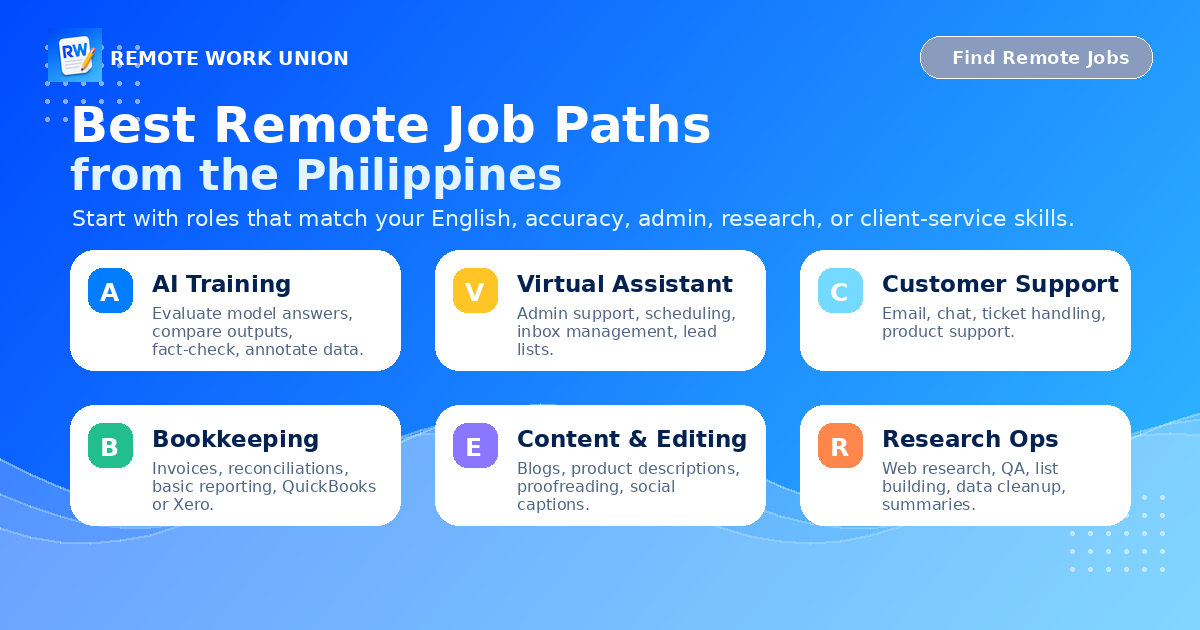
1. AI training and data annotation jobs
AI training work is one of the fastest-growing remote job categories because AI companies need human reviewers to improve model quality. The work can include reviewing AI-generated answers, comparing two responses, labeling data, checking facts, rating search results, editing model outputs, writing test prompts, or explaining why one answer is better than another.
This is not the same as being a software engineer. Many AI training jobs do not require coding. They require reading comprehension, good writing, patience, consistency, and the ability to follow detailed guidelines. Some projects are generalist projects. Others need subject matter expertise in law, finance, medicine, math, software, writing, marketing, education, operations, or other fields.
Search for keywords like AI evaluator, AI trainer, LLM evaluator, AI data annotator, search quality rater, model response evaluator, prompt evaluator, content quality analyst, data labeling, RLHF, human feedback, AI content reviewer, and AI research assistant. Major AI companies such as OpenAI, Anthropic, Google, Meta, xAI, and Grok rely on human feedback and data work in different forms, but many of the remote contractor roles come through platforms, staffing partners, and data vendors rather than directly from the AI lab.
2. Virtual assistant jobs
Virtual assistant work is one of the most established remote work paths for Filipino applicants. VA roles can include calendar management, inbox management, customer follow-up, appointment setting, travel planning, CRM updates, lead list building, document formatting, e-commerce support, Shopify admin, podcast support, and social media scheduling.
The best VA applicants do not present themselves as generic helpers. They choose a niche. A real estate VA, executive assistant, medical admin VA, e-commerce VA, podcast VA, legal VA, recruiting VA, or operations VA is usually easier to place than someone who simply says they can do anything.
3. Customer support and chat support jobs
The Philippines has a deep customer service talent base. For remote applicants, the best roles are usually email support, chat support, SaaS support, e-commerce support, technical support, billing support, onboarding support, and customer success coordinator roles. These jobs are often better than phone-heavy roles if you want calmer work, written communication, and flexible remote schedules.
When applying, highlight ticketing systems, response quality, empathy, escalation judgment, typing speed, written English, and familiarity with tools like Zendesk, Freshdesk, Intercom, HubSpot, Gorgias, Slack, Google Workspace, and Notion.
4. Bookkeeping and accounting support
Bookkeeping is a strong remote category because many small businesses need help with invoices, reconciliation, expenses, payroll support, accounts receivable, accounts payable, and monthly reporting. Applicants with accounting education, QuickBooks, Xero, Excel, Google Sheets, or finance admin experience should apply for bookkeeping assistant, accounting VA, billing coordinator, finance operations assistant, and accounts payable support roles.
5. Writing, editing, and content support
Remote writing work is competitive, but Filipino applicants with strong English can still find opportunities in content editing, blog formatting, product descriptions, SEO briefs, proofreading, newsletter support, YouTube descriptions, social captions, research summaries, and AI content review. The strongest applications include writing samples, editing samples, and proof that you can follow a brand voice.
6. Research, lead generation, and operations support
Research roles are good for people who are accurate, patient, and organized. These jobs can include building lead lists, verifying company data, researching contact information, cleaning spreadsheets, checking websites, summarizing information, categorizing companies, and preparing reports. Use keywords like research assistant, lead generation specialist, data researcher, operations assistant, market research assistant, and business development researcher.
Where to apply for remote work from the Philippines
Do not rely on one website. Remote work is inconsistent. A platform can be active one month and quiet the next. A job board can have good listings and scam listings at the same time. A contractor platform can accept you but not have projects immediately. Treat the job search like a pipeline, not a lottery ticket.
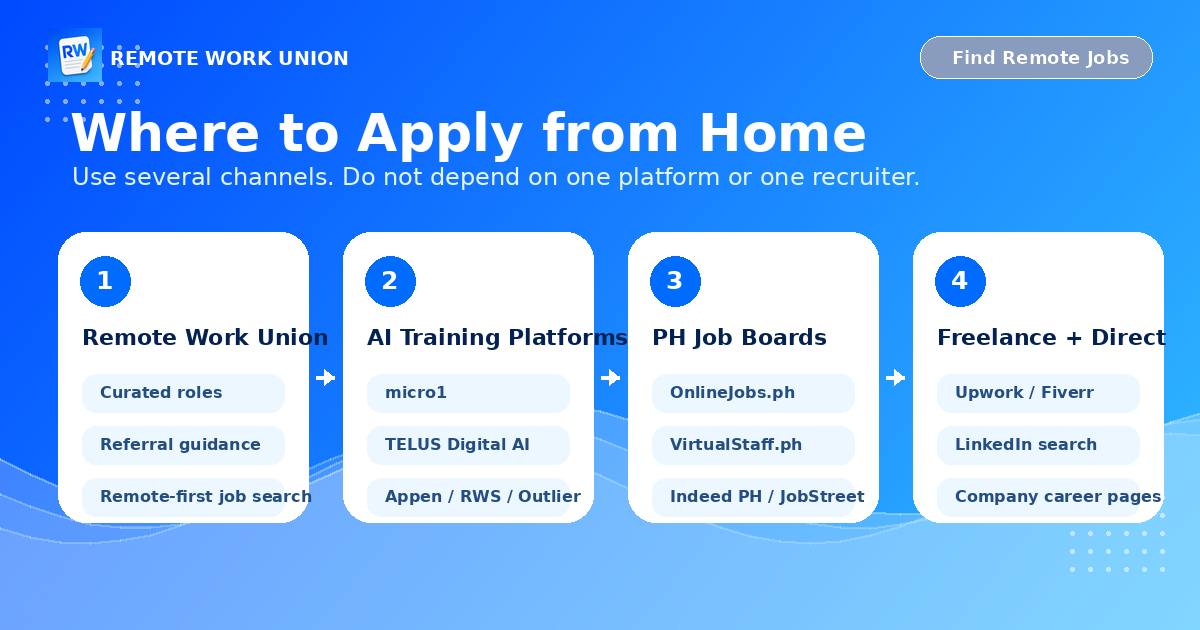
1. Remote Work Union
Start with Remote Work Union if you want a simpler way to find remote roles, AI training opportunities, and application guidance. The goal is to help applicants find real roles faster instead of spending hours sorting through confusing listings. Remote Work Union is especially useful if you are applying to AI training jobs, remote reviewer work, data annotation jobs, and other roles where the job title changes from platform to platform.
2. AI training and data annotation platforms
AI training platforms and data companies are worth checking because they often hire remote contractors for evaluation, annotation, rating, research, and quality tasks. Look for micro1, TELUS Digital AI, Appen, RWS, Outlier, DataAnnotation, Invisible Technologies, Innodata, and similar companies. Availability can change by country, language, skill set, and project demand, so always check the location requirements before spending time on a long application.
The best way to approach these platforms is to apply to several, complete your profile carefully, take assessments seriously, and then wait for project matching. Passing an assessment does not always mean immediate work. Many platforms match workers based on project demand, client needs, language, country, skill set, and quality scores.
3. Philippines-focused remote job boards
Philippines-focused boards can be useful for virtual assistant, customer support, bookkeeping, admin, sales support, and e-commerce jobs. OnlineJobs.ph and VirtualStaff.ph are two common places to look for remote roles built around Filipino talent. These sites can be useful, but you still need to screen employers carefully. A listing being on a known job board does not automatically mean it is safe.
4. International freelance marketplaces
Upwork, Fiverr, Freelancer, and similar marketplaces can work if you have a clear offer. The mistake most beginners make is applying with a broad profile like "I can do admin, data entry, writing, and customer service." A better profile is specific: "E-commerce customer support assistant for Shopify stores," "Real estate VA for lead management," "SEO blog editor," or "AI content quality reviewer." Specific profiles are easier for clients to understand.
5. LinkedIn, Indeed Philippines, JobStreet, and company career pages
Traditional job boards still matter. Search LinkedIn, Indeed Philippines, JobStreet, Google Jobs, and direct company career pages using remote-specific keywords. Search for "remote," "work from home," "contract," "freelance," "AI evaluator," "data annotator," "virtual assistant," "customer support," "chat support," "bookkeeper," and "research assistant." When a job board shows a role you like, also search for the company website and apply directly if the listing appears on the company career page.
How to build a remote work profile that gets responses
Most applicants do not lose because they are unqualified. They lose because their profile is too vague. A remote employer needs to understand what you can do, how fast you can start, what tools you know, what schedule you can support, and why you are trustworthy without meeting in person.
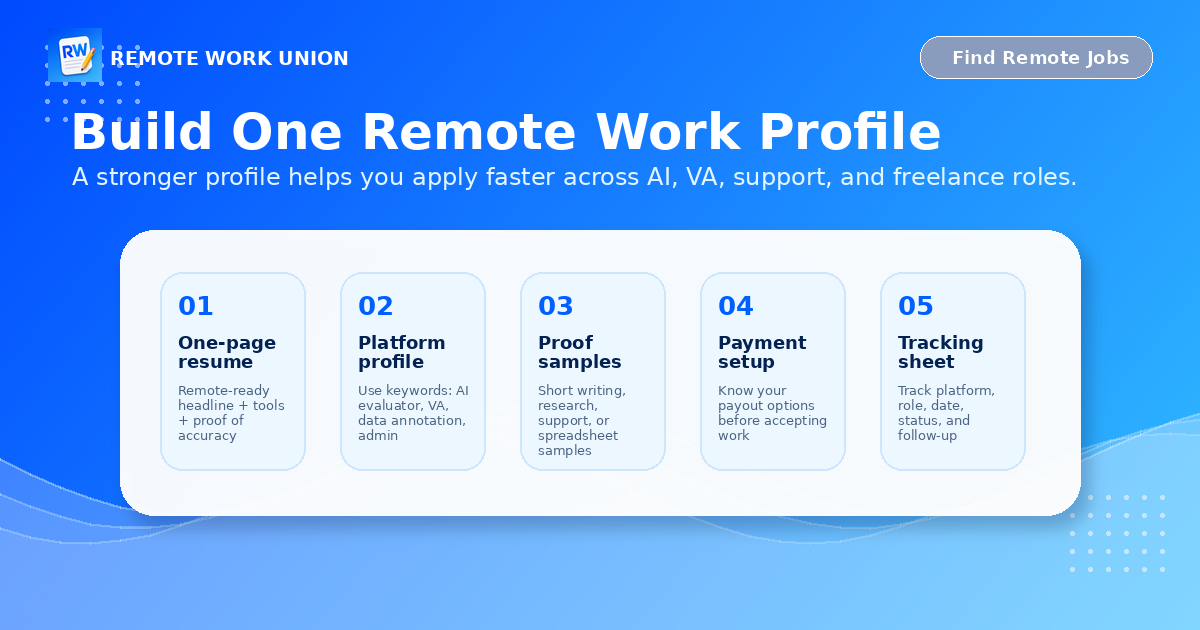
Build one core profile that can be reused across platforms. It should include a one-page resume, a short profile summary, a skills section, tool keywords, two or three proof samples, and a short message template for applications.
Use a clear headline
Your headline should match the job you want. Strong examples include "AI Data Annotator and Content Quality Reviewer," "Virtual Assistant for E-Commerce and Admin Support," "Remote Customer Support Specialist," "Bookkeeping Assistant for Small Businesses," or "Research Assistant and Lead Generation Specialist." Avoid headlines that say only "Hardworking Filipino freelancer" or "Looking for online work."
Show tools and proof
Remote employers often search by tools. Mention Google Workspace, Microsoft Excel, Google Sheets, Notion, Slack, Trello, Asana, Airtable, HubSpot, Salesforce, Zendesk, Intercom, Shopify, Canva, WordPress, ChatGPT, Claude, Perplexity, QuickBooks, Xero, or other tools you can actually use. Do not stuff keywords you cannot support. Add proof with a small portfolio, sample spreadsheet, writing sample, edited paragraph, support response sample, or research sample.
Write application messages like a professional
A good application is short, specific, and relevant. Mention the role, the closest experience you have, the tools you know, your availability, and one reason you can do the job well. Do not send a long life story. Do not copy the same generic message to every role. For remote AI training jobs, emphasize accuracy, writing quality, research ability, and your ability to follow guidelines.
How to avoid remote work scams
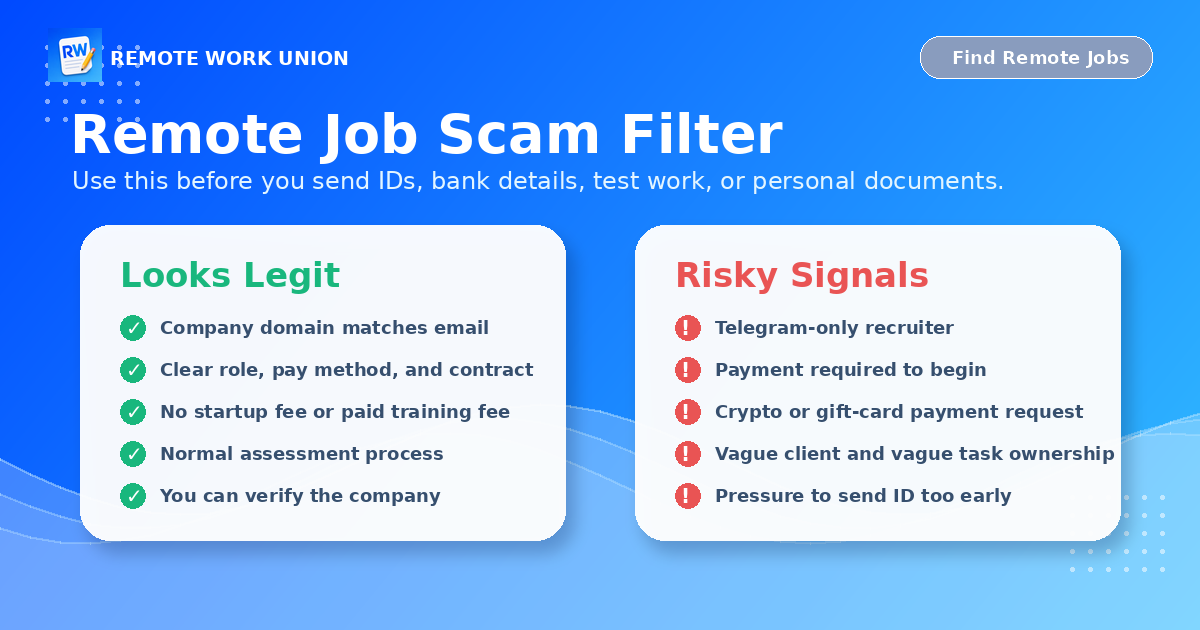
Remote work scams are common because applicants are looking for income quickly. Use a basic rule: real remote jobs pay you; they do not require you to pay to start. Be cautious with anyone who asks for a registration fee, paid training fee, equipment deposit, crypto wallet, gift card purchase, or money transfer before you are hired.
Other warning signs include Telegram-only communication, fake email domains, pressure to send government IDs before you verify the company, vague job descriptions, unrealistically high pay for simple tasks, no written contract, no company website, and "test tasks" that look like real client work. Legitimate companies may ask for identity verification later in the hiring process, but you should first confirm that the company and role are real.
How Filipino applicants can stand out
Filipino remote applicants often compete against large applicant pools. The way to stand out is not to say you are passionate. The way to stand out is to show evidence. Show that you can write clearly. Show that you can follow instructions. Show that you can organize information. Show that you understand the client's timezone. Show that you can use remote tools. Show that you can communicate without creating more work for the manager.
For AI training jobs, accuracy matters more than speed at the beginning. Read the guidelines twice. Explain your reasoning clearly. Do not overuse AI tools if the platform does not allow them. Do not submit rushed work just to increase task volume. Quality scores can affect whether you receive more projects.
For VA and support jobs, reliability matters. If you say you can work U.S. hours, be realistic. If you can only overlap for four hours, say that. If you are applying from the Philippines to Australian clients, highlight timezone compatibility. If you are applying to U.S. clients, be clear about your available shift.
Filipino applicants can find legitimate remote work, AI training roles, and data annotation jobs from home. Find opportunities that match your background.
Find Roles Hiring Now →Common mistakes to avoid
The first mistake is applying only to easy-looking jobs. The easiest jobs often have the most competition and the lowest pay. Data entry, survey apps, captcha work, and "simple typing" jobs are usually not the strongest path. A role that requires judgment, communication, or tool knowledge is often better.
The second mistake is using one generic resume. A virtual assistant resume should not look exactly like an AI evaluator resume. A customer support resume should not look exactly like a bookkeeping resume. Keep one master resume, then create versions for the role categories you are targeting.
The third mistake is waiting after one application. Remote work is a numbers game, but not a blind numbers game. Apply consistently, improve your profile, learn which titles get responses, and stop applying to categories that never respond.
30-day plan to find remote work from the Philippines
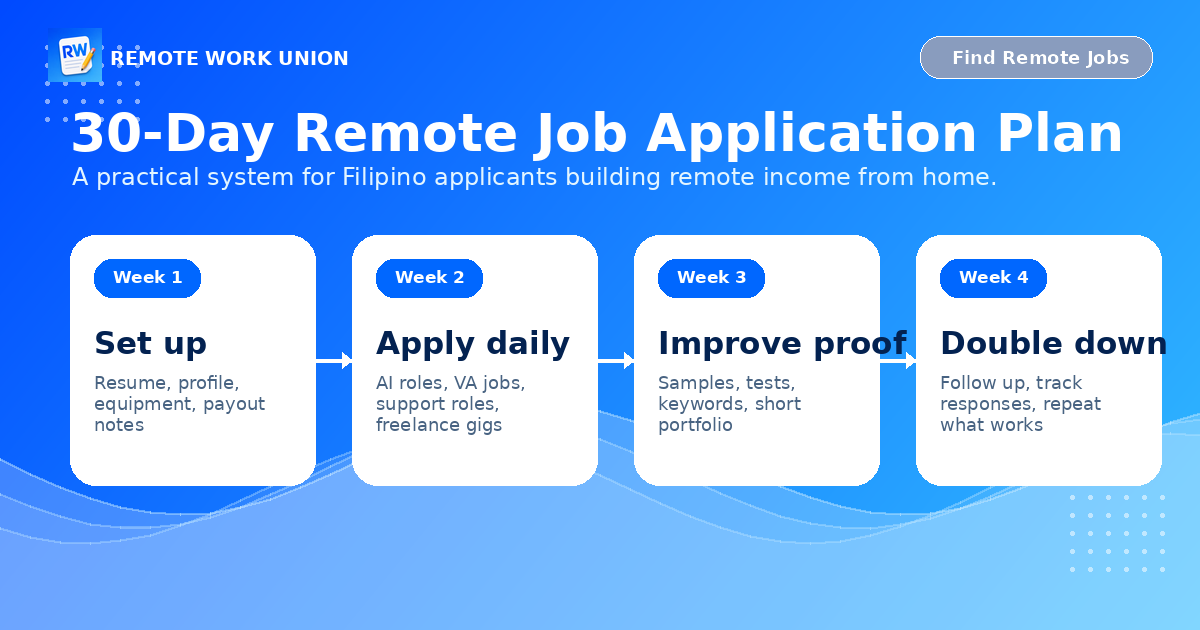
Use the first week to set up. Create your resume, platform profiles, simple portfolio, spreadsheet tracker, and application templates. Decide which roles you are targeting: AI training, virtual assistant, customer support, bookkeeping, writing, research, or a combination.
Use the second week to apply daily. Apply across Remote Work Union, AI training platforms, Philippines-focused job boards, freelance marketplaces, LinkedIn, and direct company pages. Do not spend the whole week perfecting one profile. You need market feedback.
Use the third week to improve based on responses. If you get views but no replies, improve your headline and first paragraph. If you get assessments but fail them, slow down and study the instructions. If you get interviews but no offers, prepare better answers around availability, tools, and work samples.
Use the fourth week to double down. Keep the platforms that respond. Remove the ones full of scams. Create stronger samples. Follow up politely. Apply to more specific roles. By the end of 30 days, you should know which remote job category is most realistic for you.
Bottom line
Remote work from the Philippines is real, but the best path is not random applying. Focus on roles where Filipino applicants can compete: AI training, data annotation, virtual assistant work, customer support, bookkeeping, writing, research, and operations support. Apply across multiple platforms, build a profile with proof, check country eligibility, avoid fees, and track every application.
Frequently Asked Questions
What are the best remote work jobs for Filipino applicants?
AI training, data annotation, virtual assistant work, customer support, bookkeeping, writing and editing, and research roles are the strongest remote job categories for Filipino applicants because they reward communication, organization, and skill over physical presence.
Where should I apply for remote work from the Philippines?
Apply across multiple channels — Remote Work Union, AI training platforms (micro1, TELUS Digital AI, Appen, RWS, Outlier), Philippines-focused boards (OnlineJobs.ph, VirtualStaff.ph), international freelance marketplaces (Upwork, Fiverr), and LinkedIn. Using multiple platforms gives you more opportunities.
Do remote AI training jobs hire applicants from the Philippines?
Many AI training and data annotation platforms accept applicants from the Philippines, though availability depends on the platform, project language, skill set, and country eligibility. Always check location requirements before applying, and apply to several platforms rather than waiting on one.
How do I avoid remote work scams in the Philippines?
Never pay to start. Legitimate remote employers do not ask for registration fees, training fees, equipment deposits, crypto payments, or gift cards before hiring. Verify the company independently, confirm the job posting exists on official channels, and be cautious with any recruiter who communicates only through Telegram or WhatsApp.