Remote work jobs in Nigeria are real, but they are not evenly distributed. The strongest applicants are not usually the people who apply to the most jobs. They are the people who present one clear skill set, apply to platforms that actually accept remote workers, and make it easy for a company to trust them with online work.
For Nigerian applicants, the opportunity is especially strong in roles where work can be judged through output: writing, editing, research, customer support, AI training, data annotation, virtual assistance, social media, design, transcription, translation, bookkeeping, and other online services. You do not need to live in the United States to be useful to a remote company. You do need a credible profile, reliable internet, strong communication, and a payment setup that matches the platform you are applying to.
This guide is built for people in Nigeria who want legitimate work from home jobs, not survey apps, fake WhatsApp schemes, or low-quality gigs that never turn into real income. It explains what types of remote jobs are worth applying to, how to build a profile, how to pass early screening, and how to get paid from home once you start earning.
Why remote work in Nigeria is possible
Remote work favors applicants who can produce a clear deliverable. A company does not need you to sit in an office if it can evaluate your output online. That is why Nigerian applicants can compete for roles like AI model evaluator, content writer, research assistant, virtual assistant, online customer support representative, data annotation worker, SEO assistant, and freelance designer.
The important distinction is that remote work is not one market. It is several markets. A customer service job may require fixed hours and strong spoken English. A writing job may require samples and SEO knowledge. A remote AI training job may require careful reasoning, fact-checking, or subject matter expertise. A virtual assistant role may require calendar management, spreadsheets, email, and attention to detail.
Do not apply as a generic beginner to every remote job you see. Apply as a specific kind of remote worker. A stronger headline is not "I need online work." A stronger headline is "Research assistant with strong English writing skills," "AI model evaluator and fact-checker," "Virtual assistant for admin and customer support," or "SEO content writer for business and technology topics."
The best remote work jobs in Nigeria to target
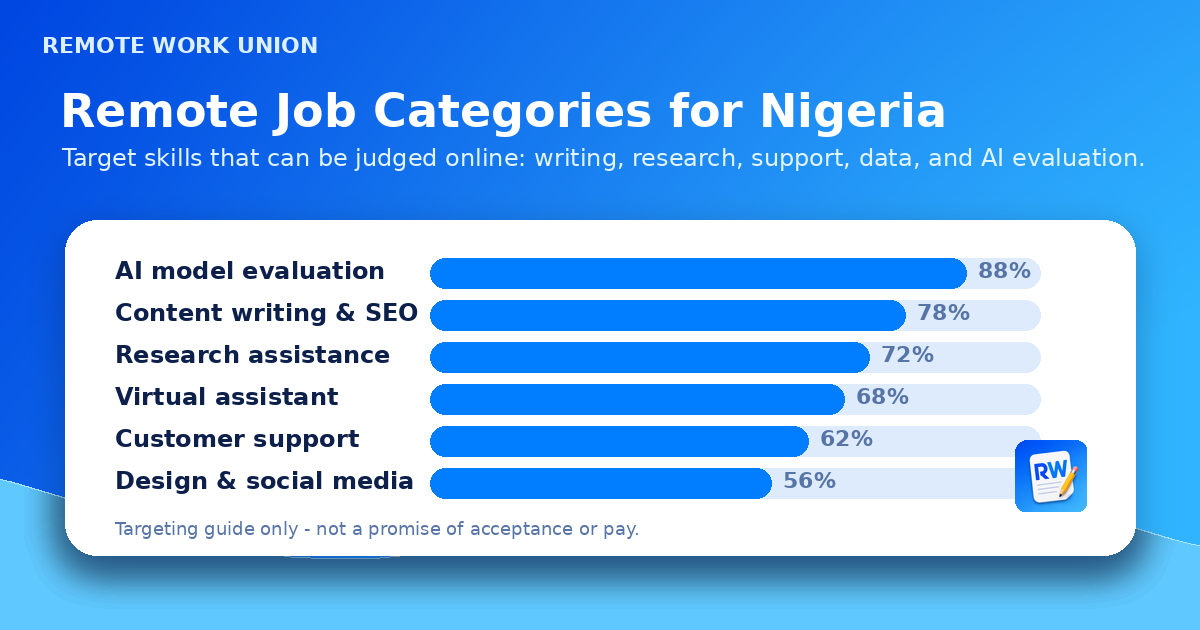
1. Remote AI training and AI model evaluation
AI training work is one of the most important remote work categories because it rewards judgment, writing, reasoning, and domain knowledge. These jobs may involve rating AI responses, comparing two model outputs, checking facts, writing ideal answers, labeling data, testing instructions, or helping companies improve AI systems.
Relevant search terms include remote AI jobs, AI training jobs, AI model evaluation, data annotation jobs, AI response rating, prompt evaluation, AI research assistant, machine learning data jobs, and human feedback jobs. Major AI companies such as OpenAI, Anthropic, Google, Meta, and xAI/Grok rely on high-quality human feedback in different ways, and many contractors reach this work through platforms, vendors, research programs, or specialist marketplaces.
Platforms and marketplaces change over time, but Nigerian applicants often look at companies and platforms such as micro1, Mercor, Handshake AI, Outlier, DataAnnotation-style platforms, freelance AI projects, and remote research roles. The key is to check eligibility, country support, payment methods, and project availability before assuming a platform will work for you.
AI training is not only for coders. Some projects need software engineers, but many projects need people who can write, reason, research, detect mistakes, compare answers, or explain why one response is better than another. If you are strong in English, law, finance, medicine, education, STEM, business, writing, translation, or local knowledge, you may qualify for more than basic labeling tasks.
2. Content writing, copywriting, and SEO
Writing remains one of the most accessible work from home jobs in Nigeria because it can be done asynchronously and judged by samples. Good writing roles include blog writing, SEO content, landing page copy, email copy, product descriptions, editing, proofreading, script writing, and technical documentation.
The problem is that the lowest level of writing work is crowded. To stand out, Nigerian applicants should create samples in specific categories. Instead of saying "I can write anything," create samples like "remote work article," "finance blog post," "SaaS landing page," "product review," "YouTube script," "email newsletter," or "SEO comparison article."
A simple writing portfolio can be a Google Doc, Notion page, PDF, or personal site. Each sample should show a clean headline, clear structure, short paragraphs, and an understanding of the target reader. For SEO jobs, include keywords naturally instead of stuffing them. Employers want content that can rank, but they also want writing that sounds useful to humans.
3. Virtual assistant and admin support
Virtual assistant jobs can be a strong fit for applicants with organization skills. Common tasks include email management, scheduling, data entry, CRM updates, travel planning, spreadsheet cleanup, online research, lead list building, customer follow-up, and document formatting.
A good VA profile should mention tools such as Google Workspace, Microsoft Office, Excel, Google Sheets, Canva, Slack, Notion, Trello, Asana, Airtable, HubSpot, or other business tools you actually know how to use. Do not list tools you cannot operate. Remote employers will test your ability quickly.
The best VA applicants make the employer feel that work will become easier, not harder. Your profile should show that you can follow instructions, ask clear questions, protect confidential information, and return organized work without constant supervision.
4. Customer support and customer success
Customer support is one of the most common remote job categories, but not every support role is a good fit for every applicant. Some jobs require phone calls, fixed shifts, accent requirements, or support coverage in another time zone. Others are chat-based or email-based and may be more flexible.
Search terms include remote customer support, chat support, email support, customer success associate, support specialist, help desk assistant, and technical support representative. If you want no-phone work, include keywords like chat support, email support, ticket support, and non-phone customer service.
To stand out, create a short sample response to a fictional angry customer. Show empathy, clarity, and problem-solving. Customer support hiring teams often care less about your degree and more about whether you can communicate calmly and solve problems without escalating everything.
5. Research, fact-checking, and data work
Research jobs are a good fit for people who are careful, curious, and good at verifying information. These roles can overlap with AI training, content, market research, lead generation, academic support, and business intelligence.
Useful search terms include research assistant, online researcher, data researcher, fact-checker, market research assistant, lead generation specialist, web research, and data annotation. Your application should show how you search, verify, organize, and cite information. A sample spreadsheet or research memo can be more valuable than a long resume.
6. Design, social media, and video support
Design and social media roles can work well for Nigerian applicants who understand online content. Roles include Canva designer, social media assistant, short-form video editor, thumbnail designer, community assistant, content scheduler, and brand asset organizer.
Do not rely only on saying you are creative. Show examples. Create sample Instagram posts, X graphics, LinkedIn carousels, YouTube thumbnails, short captions, and content calendars. Remote clients hire faster when they can see the work.
7. Translation, transcription, and local language projects
Nigeria has valuable language and cultural knowledge. Translation and transcription roles may involve English, Nigerian Pidgin, Yoruba, Hausa, Igbo, and other languages. These opportunities are not always constant, but they can be useful when AI companies, media companies, or research teams need language data.
For these jobs, accuracy matters. Do not overstate language fluency. Mention the languages you can confidently write, speak, understand, or translate. If you can handle audio quality issues, accents, timestamps, or transcript formatting, include that in your profile.
How to apply for remote work from Nigeria
The biggest mistake is applying before your profile is ready. Remote hiring is fast. Recruiters and platforms usually scan for signals: your skill, your location, your English ability, your work samples, your tool knowledge, your availability, and whether your profile looks trustworthy.
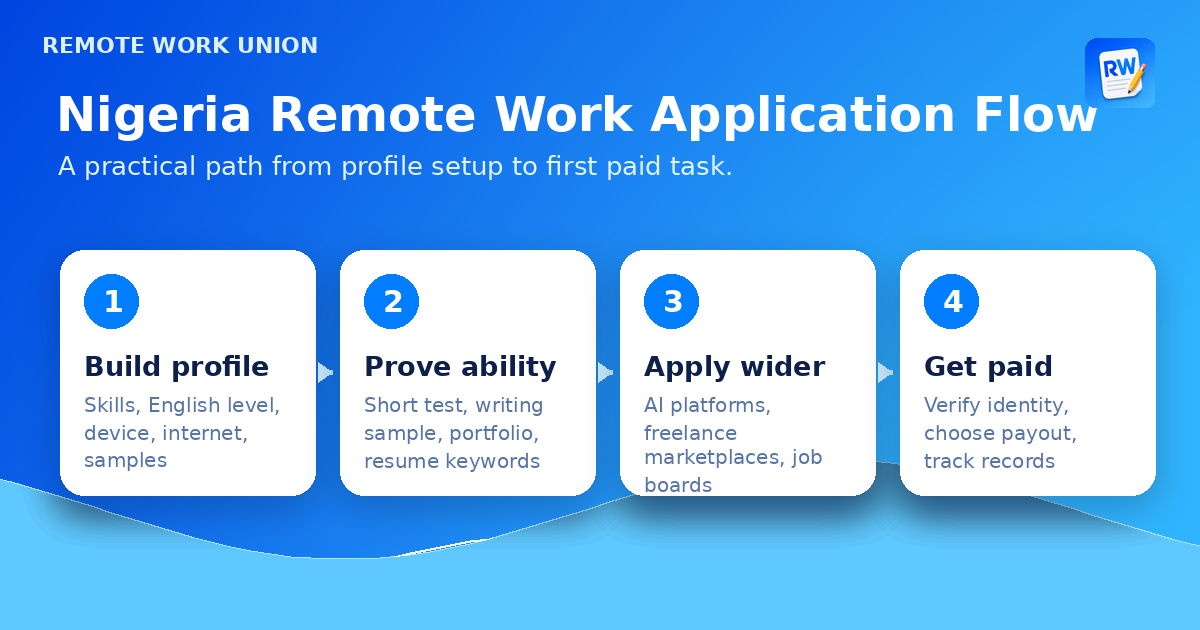
Start with one target category. Pick the remote job type that matches your strongest current skill. Then prepare a profile around that category.
A basic remote work profile should include: a clear headline that names the role you want; a short summary focused on the employer's problem; three to six tools you actually know how to use; two to four work samples or proof points; a resume that uses relevant remote work keywords; a professional email address and consistent name across platforms; a realistic availability statement; and a payment method you can use if accepted.
For example, a weak profile says: "I am hardworking and need online work." A stronger profile says: "Remote research assistant with strong English writing, spreadsheet organization, fact-checking, and AI evaluation experience. I can summarize sources, compare information, clean data, and follow detailed instructions." That second version gives the platform something to match you with.
What to put on your remote work resume
A remote work resume should be simple. Do not overload it with unrelated details. Use one page if you are early career and two pages if you have substantial experience.
Include these sections: name, email, country, and LinkedIn or portfolio link; headline for the remote role you are targeting; a summary of two to three lines about your strongest skills; skills covering tools, writing, research, customer support, data, AI evaluation, or role-specific skills; experience including jobs, projects, volunteer work, freelance work, school projects, or self-built samples; a portfolio with links to writing samples, spreadsheets, designs, or case studies; and education and certifications if relevant.
Use keywords naturally. If you are applying for AI training jobs, include terms such as AI model evaluation, prompt evaluation, data annotation, response rating, fact-checking, research, reasoning, writing, and quality review. If you are applying for VA roles, include admin support, email management, scheduling, CRM, Google Sheets, Excel, documentation, and client communication.
How to build proof if you have no remote experience
No experience does not mean no proof. You can create proof before anyone hires you.
For writing, create three polished samples in your target niche. For research, create a one-page research memo and a clean spreadsheet. For customer support, write sample replies to common support problems. For virtual assistance, create a sample weekly schedule, travel plan, or CRM cleanup sheet. For AI training, practice comparing two answers and explaining which one is more accurate, useful, and safe.
The proof should look like paid work. Format it cleanly. Use headings. Remove typos. Make it easy to open. Do not send a messy file and expect the employer to imagine your potential. A strong beginner portfolio can be built in one weekend. It does not have to be fancy. It has to show that you can do the job.
Nigerian applicants who build a specific profile and prepare proof can compete for real remote roles. Find legitimate opportunities hiring now.
Find Roles Hiring Now →Where to find remote work jobs in Nigeria
Use multiple channels instead of depending on one platform.
Start with AI training and evaluation platforms if you have strong English, reasoning, research, or domain expertise. Search for platforms that support your country and check whether they have active projects. Then apply to freelance marketplaces where Nigerian workers can create profiles and bid or receive invitations. Also search remote job boards for roles that mention worldwide, EMEA, Africa, Nigeria, remote, contractor, freelance, or asynchronous work.
Useful search phrases include: remote work jobs in Nigeria; work from home jobs in Nigeria; online jobs in Nigeria that pay in dollars; remote AI jobs Nigeria; AI training jobs Nigeria; data annotation jobs Nigeria; remote research assistant Nigeria; virtual assistant jobs Nigeria; remote writing jobs Nigeria; chat support jobs Nigeria; no phone remote customer service jobs; worldwide remote jobs no degree; and freelance jobs for Nigerians.
Do not assume every listing is legitimate just because it says remote. Read the job post carefully. Check the company domain. Avoid listings that require upfront fees, cryptocurrency deposits, training payments, equipment payments, or private payments to a recruiter.
How to get paid from home in Nigeria
Payment setup is one of the most important parts of remote work. Before applying widely, check the payout methods supported by each platform. Some platforms pay through direct local bank transfer, some use Payoneer or similar global payment services, some use wire transfer, some use digital wallets, and some require a bank account that can receive foreign currency.
Do not assume a payment method works in Nigeria just because someone in another country uses it. Confirm inside the platform's official payout settings or help center.
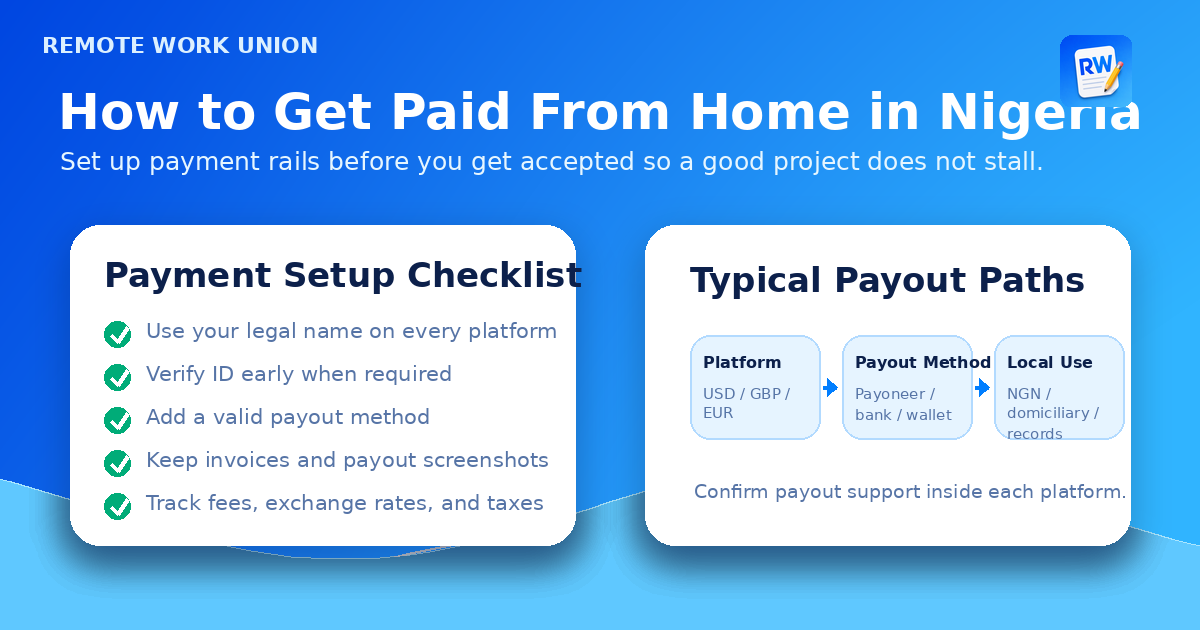
A practical setup usually includes: a bank account in your legal name; a payment account or payout method accepted by the platform; government ID for verification if required; matching names across your platform, bank, and payment accounts; a spreadsheet to track project dates, platform, gross pay, fees, exchange rate, and net amount received; and a folder for invoices, payout screenshots, and contracts.
Some freelancers also use a domiciliary account or a global receiving account when supported. Others withdraw to local bank in naira. The best method depends on the platform, fees, timing, currency, and your bank.
Keep records from the beginning. Remote workers and freelancers are responsible for understanding their own tax and reporting obligations. This article is not tax advice, but you should treat remote income like real income. If your earnings grow, speak with a qualified local tax professional or check official Nigerian tax guidance.
How to avoid remote work scams
Remote work scams target people who urgently need income. That is why the best defense is a simple rule: never pay to get a job.
Be careful with any listing that asks for an application fee, training fee, account activation fee, equipment fee, certificate fee, crypto deposit, or refund arrangement. Legitimate platforms may require identity verification or skills tests, but they do not ask you to send money before you can earn.
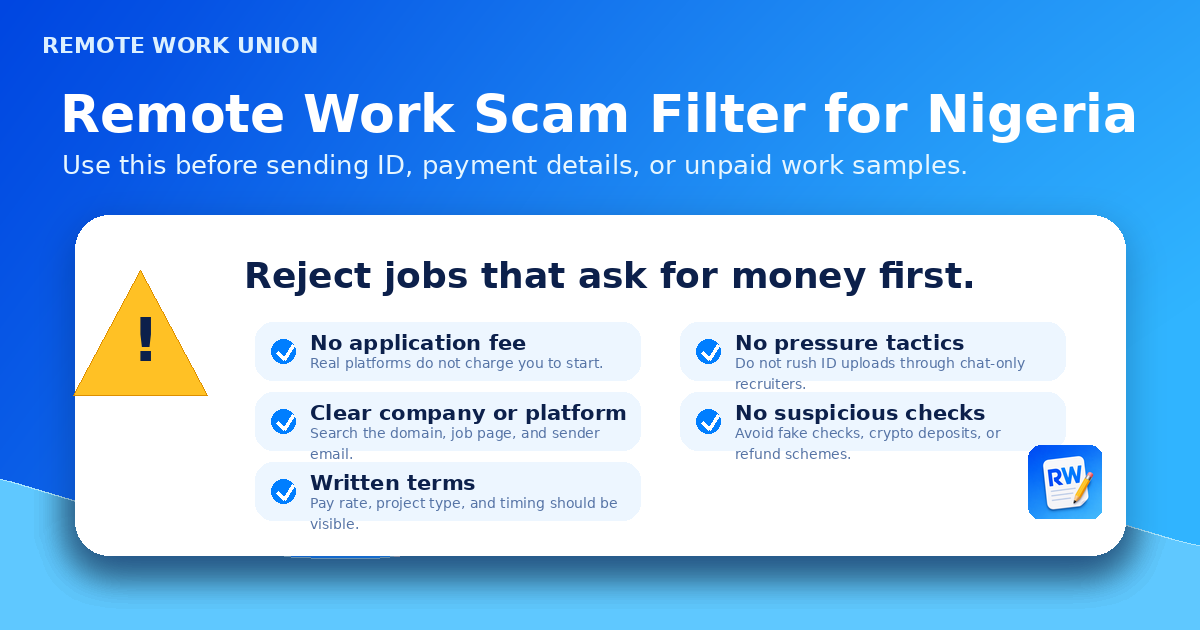
Warning signs include: the company uses a free email address instead of a real domain; the recruiter refuses to share the company website; the job promises high pay for almost no work; the interview happens only on WhatsApp or Telegram; the employer asks for your banking details before giving a contract; you are told to buy equipment from a specific vendor; you receive a check and are told to send some money back; or the listing has many spelling errors and no clear job duties.
A real remote job should have a clear role, clear expectations, a verifiable company or platform, and a realistic payment process.
A 30-day plan to get started
Use a focused plan instead of applying randomly.
Days 1 to 3: Pick one remote work category. Choose AI training, writing, research, virtual assistance, support, design, translation, or data work. Do not build ten different profiles at once.
Days 4 to 7: Build proof. Create two to four work samples that match your category. Make them clean, simple, and easy to open.
Days 8 to 10: Prepare your resume and profile. Add keywords, tools, samples, and a clear headline. Remove vague language.
Days 11 to 20: Apply to platforms and roles. Track every application in a spreadsheet. Include the company, platform, role, date, payout method, status, and follow-up date.
Days 21 to 25: Improve based on results. If you get no responses, update your headline, resume keywords, and samples. If you fail assessments, practice the task type.
Days 26 to 30: Expand to a second channel. Add another platform, job board, or freelance marketplace. Keep your core profile consistent.
Remote work is not always instant. The goal is to become more matchable every week.
Common reasons Nigerian applicants do not get accepted
Many applicants fail because their profile looks too generic. They use the same summary for every job, list too many unrelated skills, or provide no proof. Others apply to platforms that do not support their country or have no active projects available.
Other common issues include weak English samples, inconsistent names across accounts, missing ID verification, poor internet reliability, unrealistic pay expectations, and incomplete applications.
A rejection does not always mean you are unqualified. Sometimes the platform has no project for your location, skill, language, or availability. That is why you should apply to multiple legitimate platforms instead of waiting forever on one account.
Final advice
The best remote work strategy in Nigeria is simple: choose a lane, build proof, apply to legitimate platforms, track every application, and prepare your payment setup before you need it. Remote work is competitive, but Nigerian applicants who write clearly, follow instructions, verify information, and present their skills professionally can compete for real online jobs.
Frequently Asked Questions
Can I get remote work in Nigeria with no degree?
Yes, some remote jobs do not require a degree. Writing, virtual assistance, customer support, data annotation, AI model evaluation, design, transcription, and freelance research often care more about proof of ability than formal education. A degree can help for expert roles, but it is not the only path.
Can Nigerians get paid in dollars from remote work?
Many remote workers in Nigeria earn from international clients or platforms, but the exact currency and payout method depend on the platform. Some pay in dollars or other foreign currency before withdrawal. Others convert to local currency. Always confirm fees, timing, and country support before relying on a platform.
What remote AI jobs can Nigerians do?
Possible categories include AI response rating, prompt evaluation, data annotation, fact-checking, writing evaluation, research tasks, language tasks, coding review, and subject matter expert review. Availability depends on the platform and project.
What is the easiest remote job to start from Nigeria?
The easiest job depends on your skill. For strong writers, SEO writing or AI evaluation may be easier. For organized people, virtual assistance or data entry may be easier. For strong communicators, chat support may be easier. For bilingual applicants, translation or transcription may be easier.
Should I apply to micro1, Mercor, Handshake AI, and other AI platforms at the same time?
Using multiple platforms can help because project availability changes. Do not depend on one platform. Keep your profiles consistent, apply carefully, and track where you applied. Never misrepresent your skills or create duplicate accounts if a platform prohibits it.