Human feedback jobs in AI sit between ordinary remote work and the fast-moving world of artificial intelligence. The job is not to build a chatbot from scratch. The job is to help a model become more useful by reviewing answers, comparing responses, checking facts, flagging problems, and explaining what a better answer should look like.
That makes human feedback work especially attractive for remote workers who can read carefully, write clearly, make consistent judgments, and follow detailed instructions. You do not always need to be a software engineer. Many projects need writers, researchers, teachers, analysts, bilingual workers, coders, legal professionals, finance specialists, healthcare experts, and generalists with strong judgment. These roles often appear under different names — human feedback jobs, AI training jobs, AI model trainer jobs, AI rater jobs, AI response reviewer jobs, chatbot evaluator jobs, prompt evaluation jobs, RLHF jobs, data annotation jobs, and remote AI evaluation jobs — but the core idea is similar: real people review AI behavior so chatbots can become more accurate, helpful, safe, and easier to use.
What Human Feedback Jobs in AI Actually Are
A human feedback job is a remote role where a person evaluates AI output and gives structured feedback. That feedback may be used to improve chatbot behavior, measure quality, train future systems, or help AI teams understand where their models are succeeding and where they are failing.
In a typical task, you may see a user prompt and one or more AI responses. Your job is to decide whether the answer followed instructions, addressed the user request, avoided false claims, used the right tone, handled safety issues correctly, and delivered a genuinely useful result. Some tasks ask for a simple rating. Others ask for detailed written feedback, rewritten answers, labels, rankings, citations, or step-by-step reasoning about why one response is better than another. The work can feel like editing, research, quality assurance, tutoring, product testing, and policy review all at once.
Why Chatbots Need Human Review
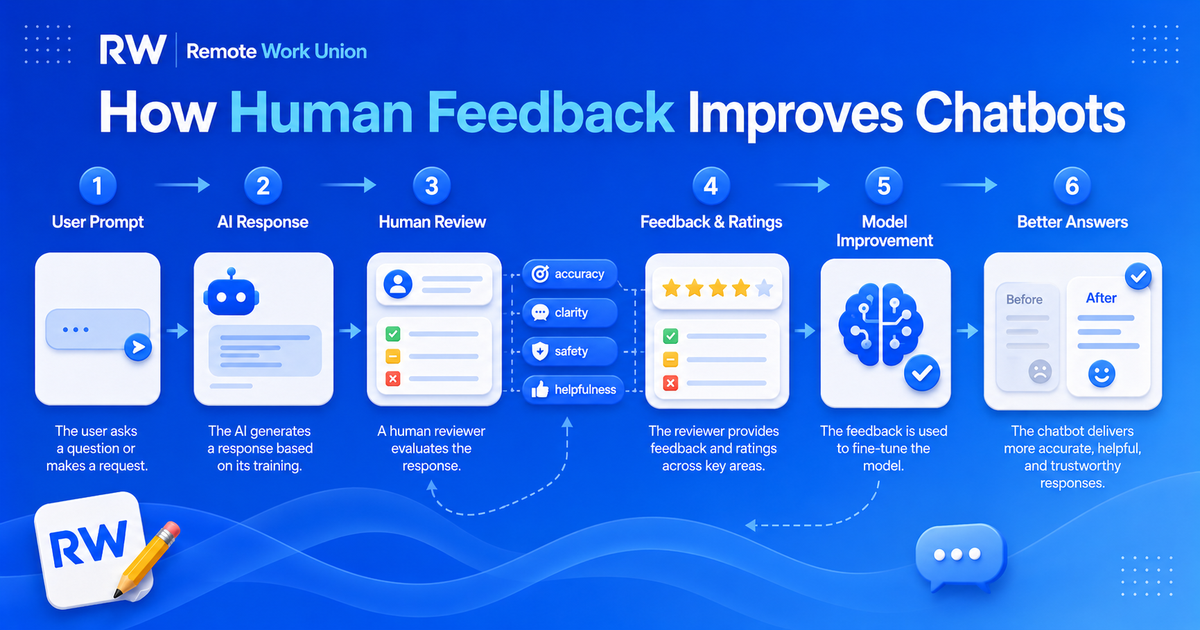
Modern chatbots can produce impressive answers, but they still need human judgment. AI systems can misunderstand intent, overstate certainty, miss key details, make subtle reasoning errors, write in the wrong tone, or give answers that look confident while being incomplete. Human reviewers help identify these failure patterns.
Human feedback is valuable because people understand context. A model may know the words in a question, but a human reviewer can notice whether the answer is practical, clear, and aligned with the user's actual goal. Reviewers can tell when an answer is technically correct but not useful, when a response sounds helpful but ignores a constraint, or when a safer answer should set boundaries instead of pretending to know something. This is why human feedback matters across major AI ecosystems — ChatGPT jobs, Claude AI training jobs, Gemini AI evaluation work, Grok AI review roles, Microsoft AI jobs, Google AI training jobs, Meta AI work, Amazon AI roles, and Apple AI-related evaluation opportunities are often looking for versions of the same work: helping AI systems respond better to real users.
Common Human Feedback Tasks
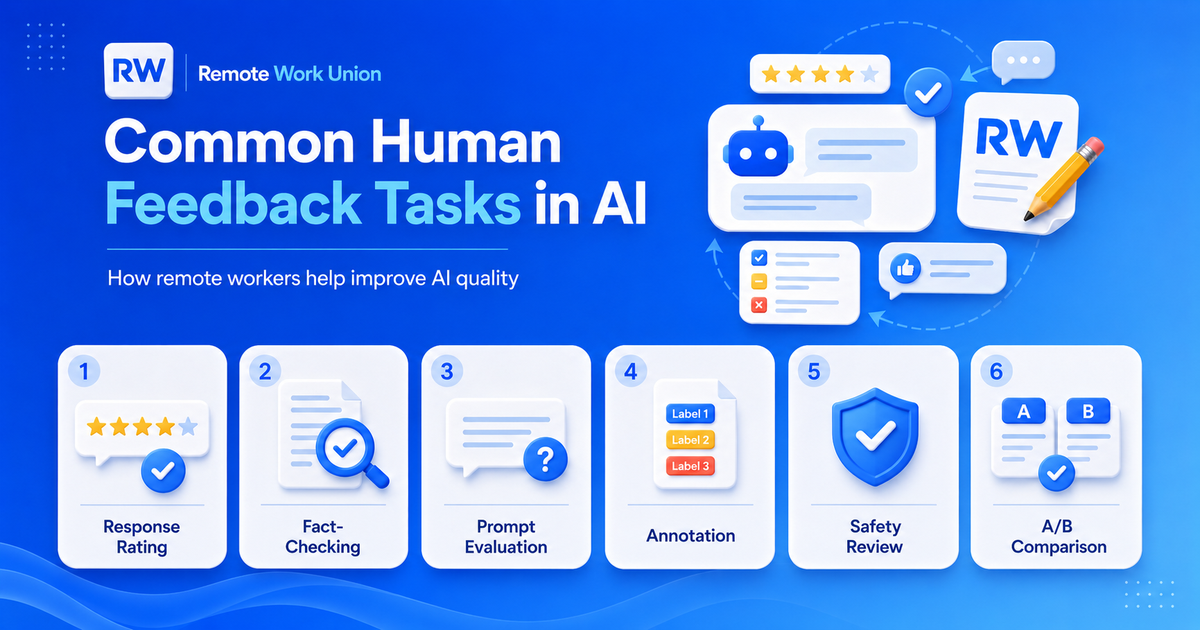
Response rating. You score an AI answer across criteria such as accuracy, completeness, clarity, helpfulness, instruction-following, tone, and safety.
A/B comparison. You compare two or more model responses and choose the better answer, often with a short explanation of why one response wins.
Prompt evaluation. You review the user's prompt, identify what the prompt is asking for, and judge whether the answer satisfied the task.
Fact-checking. You verify claims, spot unsupported statements, identify missing context, and flag answers that should not present guesses as facts.
Annotation and labeling. You tag text, classify intent, mark errors, label safety categories, or identify whether a response meets a project-specific rubric.
Rewriting and correction. You improve a weak model answer by making it more accurate, clearer, more complete, more concise, or better aligned with a user's request.
Safety review. You identify content that needs refusal, caution, escalation, or careful framing — medical, legal, financial, privacy, or harmful-instruction scenarios.
Domain expert review. You evaluate answers in a specific area such as law, finance, medicine, coding, education, science, writing, marketing, language, or business operations.
What a Remote Human Feedback Workday Can Look Like
A remote AI feedback workday usually starts with project instructions. You read the rubric, review examples, and make sure you understand the rating scale before touching live tasks. The best workers do not rush this stage. After that, you work through assignments inside a platform. A task might show a prompt, an AI response, and a set of rating questions. Another task might show two AI responses and ask which one is better. A more advanced task might ask you to fact-check an answer, rewrite it, and explain the changes you made.
The work is often flexible, but it is not casual. Good reviewers maintain focus, track edge cases, and keep their feedback concise. They avoid personal preferences when the rubric gives a clear standard. They also know when to slow down, because one careless rating can reduce the value of the dataset.
Skills That Make Someone Good at Human Feedback Jobs
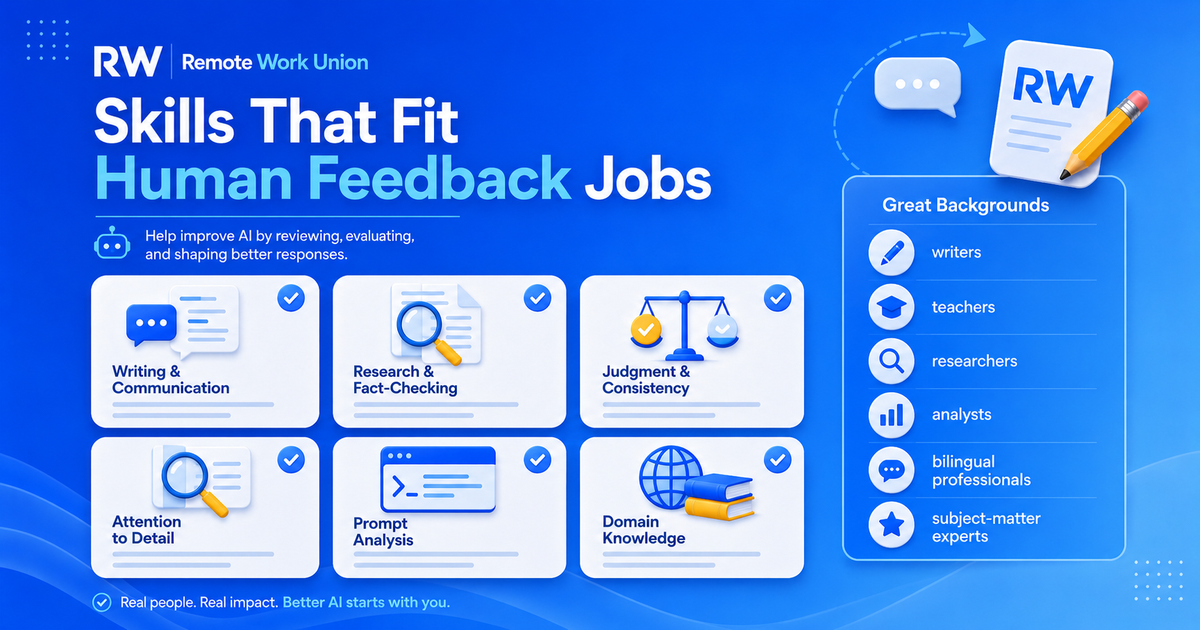
Clear writing. Many projects care less about fancy writing and more about precise, useful notes that explain quality issues in plain language.
Reading comprehension. You must understand the prompt, the rubric, and the model response before rating anything. Missing a small constraint can change the correct answer.
Research ability. Fact-checking work rewards people who know how to verify claims, compare sources, and separate evidence from assumption.
Consistent judgment. The best reviewers apply the same standard across similar tasks — they do not rate based on mood, personal taste, or how polished an answer sounds at first glance.
Attention to detail. AI errors can be subtle. A response may follow the prompt generally but fail one important instruction, omit a requested format, or invent a detail.
Domain knowledge. Subject-matter expertise can unlock higher-value projects. Lawyers, nurses, teachers, accountants, engineers, coders, translators, researchers, and business analysts may qualify for specialized review work.
Who These Jobs Fit Best
Human feedback jobs can fit people who like thoughtful, text-based work. Writers may enjoy judging tone, structure, and clarity. Researchers may enjoy fact-checking and source evaluation. Teachers may be strong at explaining why an answer is incomplete. Analysts may be good at scoring responses against a rubric. Bilingual workers may be valuable for language quality, translation review, localization, and cultural nuance. These jobs can also fit people who want remote work without phone calls — many AI evaluation tasks are asynchronous, written, and platform-based.
The role may not fit people who dislike instructions, rush through repetitive tasks, or want every assignment to be creative. Some projects are highly structured. You may need to follow a rubric even when you would personally phrase something differently.
Remote Work Union connects you to legitimate human feedback and chatbot evaluation roles. Apply for free.
Find Roles Hiring Now →How Human Feedback Connects to RLHF
You will often see the term RLHF, which stands for reinforcement learning from human feedback. In practical job-search language, RLHF jobs are usually roles where people rank, rate, edit, or evaluate AI outputs so model teams can learn which responses humans prefer. Not every human feedback job is technically an RLHF job, and applicants do not need to overuse the term. But understanding it helps you recognize related listings: response ranking, preference data, model evaluation, prompt-response pairs, evaluation rubrics, chatbot quality, or AI answer review may all be part of the broader human feedback ecosystem.
How to Search for These Roles
Use multiple search terms because platforms do not name these jobs consistently. Try human feedback jobs in AI, remote AI trainer jobs, AI model trainer jobs, chatbot evaluator jobs, AI rater jobs, prompt evaluator jobs, AI response reviewer jobs, RLHF jobs, data annotation jobs from home, AI data annotation jobs, model evaluation jobs, AI fact-checking jobs, and remote AI writing evaluator jobs.
Add your background to the search: a teacher might search for education AI evaluator jobs, a lawyer for legal AI reviewer jobs, a coder for coding AI evaluator or code review AI training jobs, a bilingual worker for bilingual AI rater jobs or language model evaluator jobs. Platform and company searches can also be useful starting points: Mercor AI jobs, Handshake AI, Surge AI, micro1 AI, Stellar AI, Google AI training jobs, OpenAI-related evaluation work, Anthropic-related AI safety work, Claude AI training jobs, Gemini AI jobs, and ChatGPT jobs. Treat those as research starting points — always read each listing carefully and verify the actual employer, project type, pay structure, and requirements.
How to Make Your Application Stronger
Your application should prove that you can evaluate quality, not just say that you like AI. Replace vague claims with concrete evidence. A strong profile can include skills such as rubric-based evaluation, annotation, A/B comparison, fact-checking, prompt analysis, response ranking, content quality review, research, editing, domain review, and written feedback. If you have a specialized background, make it obvious — AI projects often need experts, not just general remote workers.
When a platform gives a screening test, slow down. Many applicants fail because they rush, ignore the rubric, or choose the answer that sounds smoother instead of the answer that best satisfies the task. Read every instruction, look for hidden constraints, and explain your reasoning clearly when asked.
Red Flags to Avoid
Remote AI work attracts real opportunities, but it also attracts low-quality listings and scams. Be careful with any job that promises instant high income with no screening, asks you to pay to apply, avoids naming the company, pushes you into a suspicious messaging app, or asks for sensitive personal information before a legitimate hiring process. Also be realistic about workload and availability — some projects have steady queues, others are inconsistent. Treat AI feedback work like contract work: useful, flexible, and potentially valuable, but still dependent on project availability and quality standards.
Frequently Asked Questions
What are human feedback jobs in AI?
Human feedback jobs in AI are remote roles where people evaluate AI output and give structured feedback. That feedback may be used to improve chatbot behavior, measure quality, train future systems, or help AI teams understand where their models are succeeding and where they are failing.
Do human feedback jobs require coding?
Not always. Many human feedback jobs focus on writing, research, judgment, and domain expertise rather than software development. Coding skills can unlock specialized technical evaluation projects, but they are not required for most roles.
What is the connection between human feedback jobs and RLHF?
RLHF stands for reinforcement learning from human feedback. In practical job-search language, RLHF jobs are usually roles where people rank, rate, edit, or evaluate AI outputs so model teams can learn which responses humans prefer. Human feedback jobs and RLHF jobs overlap significantly.
How do I make my application stand out for human feedback jobs in AI?
Replace vague claims with concrete evidence. Instead of writing "I am good at ChatGPT," explain that you have experience comparing AI responses, checking factual accuracy, rewriting unclear answers, following rubrics, or reviewing technical material. Use specific resume phrases: rubric-based evaluation, A/B comparison, fact-checking, response ranking, domain review, and written feedback.
What should I search to find human feedback jobs in AI?
Search for human feedback jobs in AI, remote AI trainer jobs, AI model trainer jobs, chatbot evaluator jobs, AI rater jobs, prompt evaluator jobs, AI response reviewer jobs, RLHF jobs, data annotation jobs from home, model evaluation jobs, AI fact-checking jobs, and remote AI writing evaluator jobs.