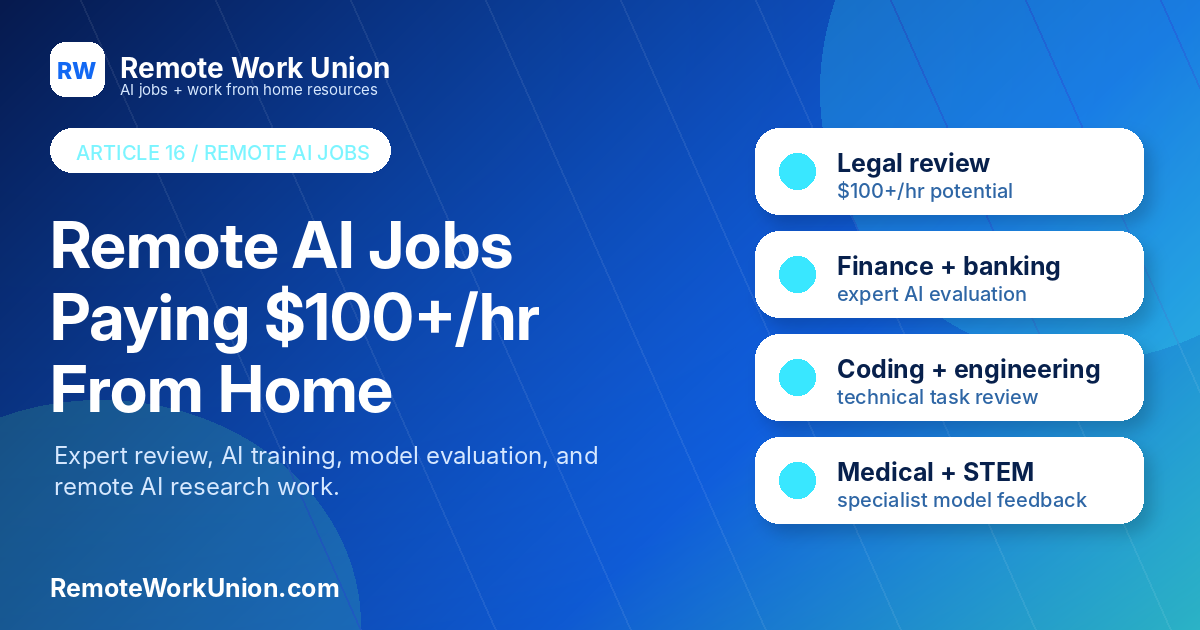
Remote AI jobs can pay $100+/hr, but the important detail is this: the higher-paying work is usually not basic data entry, surveys, or generic clicking tasks. The jobs that reach that range usually involve expert judgment. Companies building AI systems need people who can review answers, write better prompts, evaluate reasoning, catch mistakes, compare model outputs, and create high-quality examples in fields where accuracy matters.
That is why remote AI work has become interesting for writers, lawyers, finance professionals, engineers, doctors, researchers, marketers, teachers, creatives, accountants, and other people with real-world experience. The best opportunities are not always listed as normal jobs. They may be called AI training jobs, AI trainer roles, AI evaluator roles, model evaluation projects, expert review, AI research, human feedback work, prompt engineering, data annotation, RLHF, or AI content review.
The biggest mistake is assuming every remote AI job pays the same. It does not. General work may pay like normal freelance work. Specialized work can pay much more. The difference usually comes down to the domain, the difficulty of the screening test, and how valuable your professional background is to the AI company or platform.
The Short Answer: $100+/hr Remote AI Jobs Are Usually Expert Review Jobs
When people talk about remote AI jobs that pay $100+/hr, they are usually talking about one of three categories: expert AI training, technical model evaluation, or specialized AI research support. These are remote work from home jobs where your value is not that you can use ChatGPT. Your value is that you know whether the answer is good, bad, incomplete, risky, legally wrong, financially unrealistic, medically unsafe, badly coded, poorly reasoned, or not useful for the end user.
AI companies and AI training platforms need humans because models still make errors. They can hallucinate facts, misunderstand instructions, overstate confidence, miss edge cases, write insecure code, make flawed legal arguments, produce weak analysis, or generate answers that sound convincing but fail under professional review. A specialist can catch those problems faster and more reliably than a generalist.
That is where the higher rates come from. If a project needs a lawyer to evaluate legal reasoning, a former investment banker to review financial modeling logic, a software engineer to test code, a physician to assess clinical explanations, or a PhD to judge research quality, the talent pool gets smaller. Scarcity pushes rates up.
The Remote AI Pay Ladder
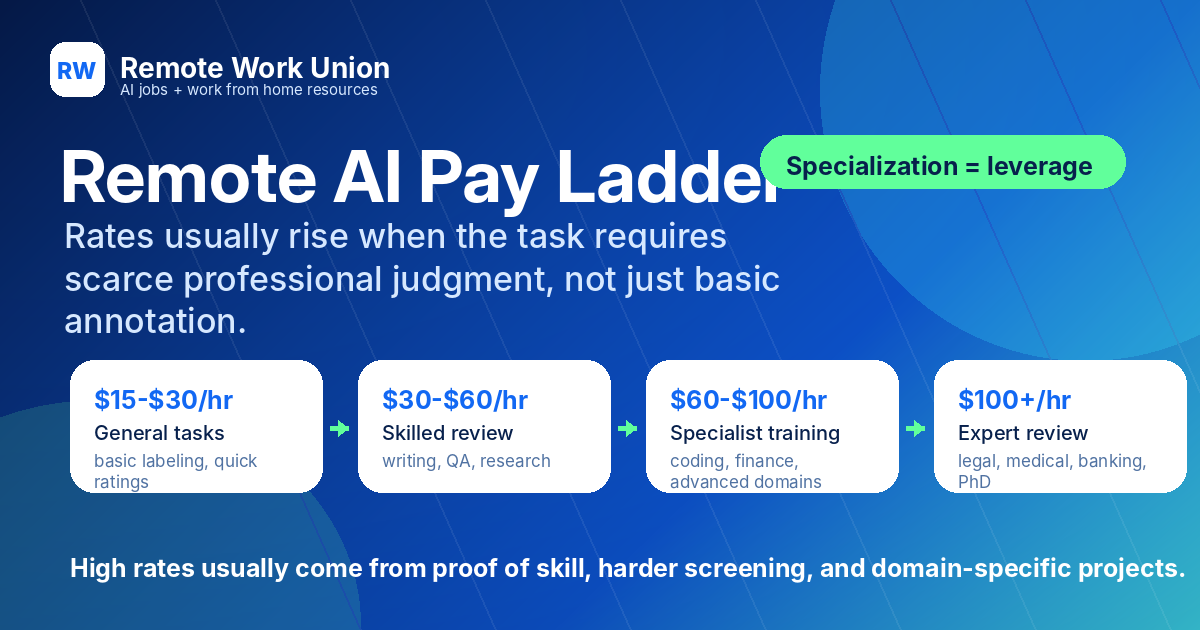
Not every AI training job is a $100/hr opportunity. The market has rough tiers. These are not guarantees, but they are useful for understanding where you fit.
- General AI tasks: basic answer rating, simple labeling, simple search quality work, and low-complexity data annotation. These are usually the lowest-paying roles.
- Skilled AI training: writing, editing, search evaluation, language review, customer support simulation, marketing review, education content, and basic prompt writing. These can pay better when the work requires judgment.
- Specialist AI evaluation: finance, accounting, legal, software engineering, math, medicine, cybersecurity, scientific research, advanced writing, and technical QA. This is where higher rates become more realistic.
- Elite expert review: senior legal, banking, quant, medical, PhD-level STEM, security, advanced coding, and research-heavy projects. These are the roles most likely to advertise or negotiate $100+/hr rates.
Remote AI Jobs That Can Pay $100+/hr
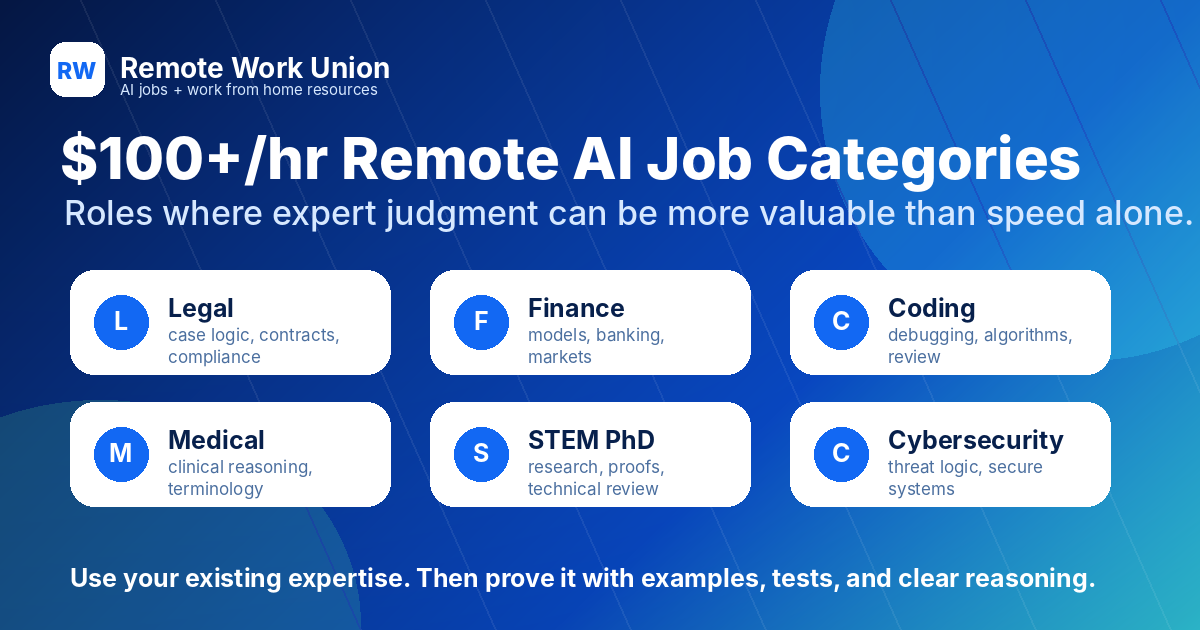
The following categories are the strongest candidates for $100+/hr remote AI work. Some will be true freelance AI training projects. Others will be remote AI research jobs, AI product roles, AI quality roles, or expert contractor projects that support companies building models.
1. Legal AI Evaluator and Legal AI Trainer Roles
Legal work is one of the clearest examples of high-value AI evaluation. AI systems are increasingly asked to summarize contracts, explain legal concepts, compare arguments, analyze policies, draft clauses, and reason through jurisdiction-specific questions. A general reviewer cannot reliably judge whether that output is accurate. A lawyer, paralegal, compliance professional, or legal researcher can.
Legal AI trainer jobs may involve reviewing legal answers, comparing model responses, writing ideal responses, identifying missing caveats, testing legal reasoning, and flagging risky or overconfident advice. Higher-paying legal projects usually require credentials, work history, or a screening test that proves you understand legal reasoning. These roles are often remote and contract-based, but they can be selective.
2. Finance, Accounting, and Investment Banking AI Roles
Finance is another category where expert review can command higher pay. AI companies need people who understand financial statements, accounting logic, valuation, private equity, M&A, capital markets, FP&A, tax, crypto, trading, credit analysis, and business strategy. A model can produce financial language that sounds professional while still getting the logic wrong. That is exactly why humans are needed.
Remote AI finance roles may include rating financial answers, building example analyses, checking spreadsheet reasoning, reviewing model-generated investment explanations, testing accounting answers, or training AI systems to handle business cases. People with banking, consulting, accounting, corporate finance, venture, startup, or crypto experience can often position themselves well here.
3. Coding, Software Engineering, and Technical AI Evaluation
Coding is one of the strongest categories for high-paying remote AI work because code can be tested, reviewed, broken, and improved. AI coding projects need people who can evaluate whether an answer compiles, whether the solution is efficient, whether the code is secure, whether the explanation is correct, and whether the model solved the actual problem.
These jobs may be listed as AI coding evaluator, software engineer AI trainer, code reviewer, prompt engineer, model evaluator, AI data specialist, or technical reviewer. The strongest candidates can explain bugs clearly, compare multiple solutions, write tests, and reason through edge cases. You do not always need to be a full-time machine learning engineer. You do need enough technical skill to pass coding evaluations and write clear feedback.
4. Medical, Healthcare, and Clinical Review Roles
Medical and healthcare AI roles can be valuable because the cost of a bad answer is high. AI models may be asked to explain symptoms, summarize medical literature, help with patient communication, organize clinical notes, or answer healthcare questions. These projects require careful reviewers who understand terminology, limitations, risk, and accuracy.
Doctors, nurses, pharmacists, medical researchers, therapists, healthcare administrators, and other qualified professionals may find AI training projects that use their expertise. The higher-paying work usually requires clear credentials and may involve strict guidelines. These roles are not just writing jobs. They are professional judgment jobs.
5. PhD, STEM, Math, and Research-Heavy AI Jobs
AI systems are increasingly tested on complex math, science, engineering, and research tasks. That creates demand for people who can evaluate proofs, check scientific reasoning, review technical explanations, design hard prompts, and identify subtle mistakes. A strong STEM background can matter a lot here.
Projects may involve physics, chemistry, biology, math, economics, statistics, engineering, linguistics, or academic research. The work can include writing high-quality questions, creating answer keys, reviewing model outputs, ranking answers, and explaining why one response is better than another. For advanced projects, degrees and published research can help, but the screening test often matters most.
6. Cybersecurity and Technical Risk Evaluation
Cybersecurity is a high-value AI category because model behavior can create real risk. AI tools may be used to explain vulnerabilities, write scripts, interpret logs, analyze threats, or support secure software development. AI companies need reviewers who can understand both usefulness and safety.
Remote AI cybersecurity roles may involve identifying insecure recommendations, testing model behavior, reviewing defensive security explanations, writing secure alternatives, or evaluating whether a response crosses safety boundaries. Experience in security engineering, cloud security, network security, incident response, or application security can make a candidate more competitive.
7. Advanced Writing, Editing, and Creative Evaluation
Writing work can pay well when it goes beyond generic content. Basic AI writing tasks may be crowded, but advanced writing, editorial judgment, brand voice, technical communication, fiction evaluation, script analysis, and professional content review can be more valuable. The strongest writers can explain why a response works, why it fails, and how to improve it.
This category can include AI writing evaluator, AI content reviewer, prompt writer, editor, creative writing expert, search quality evaluator, and language model trainer roles. Writers with strong portfolios, niche expertise, or editorial experience can stand out. The $100+/hr range is less common for general writing, but it becomes more realistic when the work requires rare expertise, speed, taste, and judgment.
8. Business, Marketing, Sales, and Strategy AI Review
Business professionals can also find remote AI training work, especially when projects need practical judgment. AI systems are asked to write sales emails, build marketing plans, analyze customer objections, evaluate business ideas, generate social media strategy, summarize market research, and create operational plans. A model can produce a polished answer that still would not work in the real world.
Marketers, sales leaders, founders, operators, consultants, product managers, and agency owners can position themselves as business reviewers. The key is to avoid sounding like a generic prompt user. Show the actual judgment you bring: campaign strategy, conversion thinking, audience psychology, pricing, analytics, brand voice, negotiation, or go-to-market experience.
Why AI Companies Pay Humans This Much
AI companies are not paying high rates because they are being generous. They pay because expert feedback improves the product. A model trained only on generic feedback can become generic. A model trained with expert feedback can become more useful, more accurate, and safer in difficult domains.
Human reviewers help with several important parts of AI development:
- Rating model answers so the system learns which responses are better.
- Writing ideal answers that show the model what high-quality work looks like.
- Creating difficult prompts that expose weaknesses in reasoning.
- Checking factual accuracy, completeness, tone, and usefulness.
- Finding safety problems, hallucinations, legal risks, and technical errors.
- Improving rubrics so other reviewers can grade consistently.
- Testing agentic AI systems that browse, use tools, write code, or complete workflows.
This is why remote AI jobs are not only for machine learning engineers. The AI industry needs subject-matter experts. OpenAI, Anthropic, Google, Meta, xAI, and other major AI companies all compete on model quality. Platforms that support AI training and expert review help supply the human feedback and domain knowledge that make these systems better.
What Does the Work Actually Look Like?
Most remote AI training jobs are more structured than people expect. You may receive a prompt, two model answers, a rubric, and a task asking you to decide which answer is better. You may be asked to rewrite a bad answer into a great answer. You may be asked to explain your rating. You may be asked to create examples that test a model in your domain.
In technical projects, you might review code, run tests, create edge cases, or judge whether an explanation is correct. In legal or finance projects, you might check reasoning and flag missing assumptions. In writing projects, you might evaluate clarity, tone, originality, structure, and usefulness. In medical projects, you might assess whether an answer is appropriately careful and accurate.
The work is usually remote, asynchronous, and project-based. That can be a major benefit, but it also means task availability may change. Some weeks may be strong. Other weeks may be slow. For most people, remote AI training is better treated as a flexible income stream or career bridge than as a guaranteed full-time job unless the role is explicitly full-time.
What Makes Someone Qualify for $100+/hr Remote AI Work?
The most important qualification is not always AI experience. Many platforms are looking for professional expertise that can be applied to AI training. That means your existing background may already be useful if you package it correctly.
A strong candidate usually has at least one of these advantages:
- A professional domain: law, finance, accounting, medicine, engineering, coding, education, research, cybersecurity, or business strategy.
- Proof of expertise: resume history, portfolio work, credentials, degrees, licenses, published work, GitHub, writing samples, client work, or measurable outcomes.
- Clear reasoning: the ability to explain why an answer is right, wrong, risky, incomplete, or better than another answer.
- Strong written communication: most AI training work rewards people who can be precise, concise, and consistent.
- Patience with rubrics: high-paying AI evaluation work often requires following instructions exactly, not just having opinions.
- Screening performance: platforms often care more about how you perform on tests than how impressive you sound.
How to Position Yourself for Higher-Paying AI Jobs
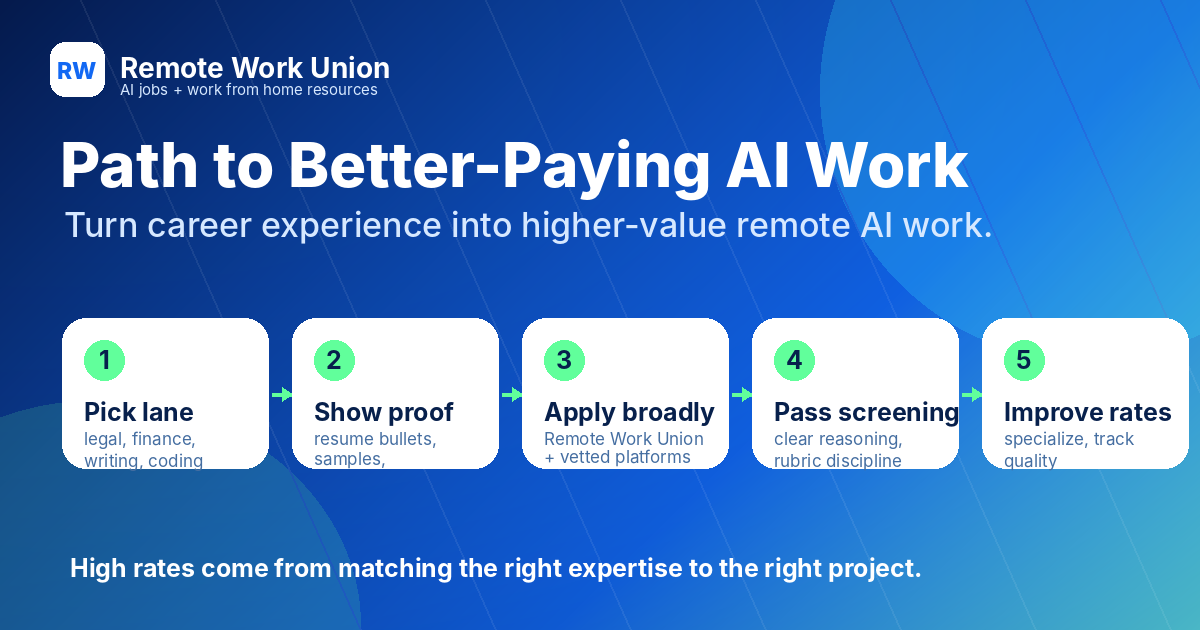
If you want the higher-paying side of remote AI work, do not market yourself as someone who wants easy online jobs from home. Market yourself as someone with a specific skill set that can improve AI model quality.
A good positioning statement is simple:
Examples:
- I help evaluate AI-generated finance answers using experience in accounting, valuation, and financial analysis.
- I help improve AI writing outputs using professional content strategy, editing, and brand voice experience.
- I help review AI-generated code using software engineering experience in Python, JavaScript, APIs, and testing.
- I help evaluate legal AI outputs using experience in contracts, compliance, and legal research.
- I help review AI-generated healthcare explanations using clinical terminology and patient communication experience.
This matters because AI platforms are matching candidates to projects. If your profile is vague, you look like a generalist. If your profile is specific, you are easier to match to higher-value work.
Where to Find Remote AI Jobs That Can Pay More
The best strategy is to apply through multiple channels instead of waiting for one platform to send steady tasks. Remote AI work is fragmented. Different platforms specialize in different project types, and availability changes. A platform that is slow for one person may be strong for another because of their domain.
Look for roles and platforms using keywords like: AI trainer jobs, remote AI training jobs, AI evaluator, AI model evaluator, AI expert reviewer, AI research jobs remote, RLHF contractor, human feedback AI jobs, prompt evaluation jobs, data annotation expert, AI coding evaluator, legal AI trainer, finance AI evaluator, and remote AI contractor jobs.
Tip: Platforms such as Mercor, Outlier AI, Handshake AI, Mindrift, and similar AI training marketplaces can be useful, especially for project-based work. Remote Work Union can also help workers find roles, referrals, and opportunities without wasting time on random low-paying listings.
The key is to avoid building your entire plan around one platform. Apply broadly. Keep your profile sharp. Save your best screening answers as practice examples. Track which domains produce the best rates. Treat each application as a data point.
How to Avoid Low-Paying Remote AI Traps
Remote AI work attracts a lot of attention, which means there are also low-quality listings. Some jobs use AI language to make ordinary data entry sound more advanced than it is. Others advertise high rates but offer inconsistent tasks, unpaid screening, vague payment rules, or generic work that never reaches the advertised range.
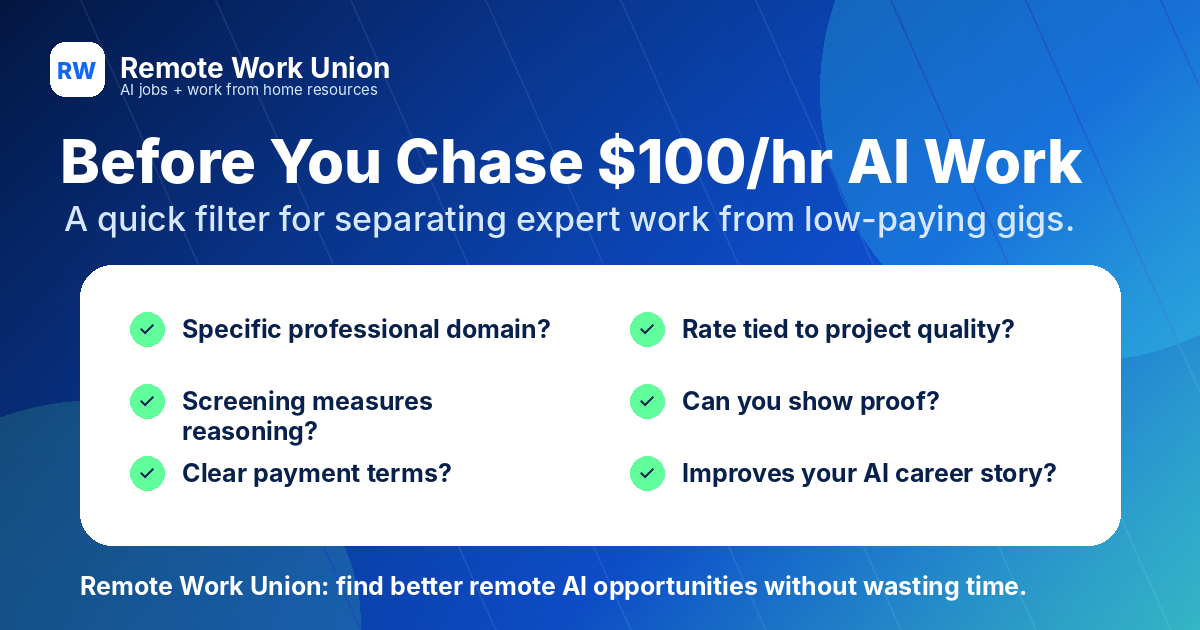
Before spending serious time applying, ask:
- Does the role require a specific skill or domain, or is it just generic clicking?
- Is the pay rate clear before you start the task?
- Are screening tests reasonable, or are they asking for too much unpaid labor?
- Does the platform explain payment timing and task availability?
- Does the work match your background, or are you competing with everyone?
- Can this experience strengthen your resume, portfolio, or AI career story?
The lowest-value opportunities usually feel like surveys, data entry, or random task apps. The better opportunities feel like professional review work. They ask for clear thinking. They test your judgment. They reward accuracy.
Can Beginners Get $100+/hr AI Jobs?
A total beginner with no professional domain should not expect $100+/hr immediately. That does not mean remote AI work is closed to beginners. It means the beginner path is different. Start with general AI training, writing evaluation, search quality, basic prompt tasks, or lower-rate projects. Build task history. Learn how rubrics work. Improve your screening performance. Then move toward a niche.
The faster path is to bring an existing skill into AI. A beginner in AI may still be an expert in law, finance, teaching, marketing, healthcare, coding, operations, writing, or research. That person should not present as an AI beginner. They should present as a domain expert applying their skill to AI model evaluation.
Best-Fit Backgrounds for $100+/hr Remote AI Work
The strongest backgrounds tend to be people who can judge complex answers better than the average person. That includes:
- Lawyers, paralegals, compliance workers, and legal researchers.
- Finance professionals, accountants, bankers, analysts, consultants, and crypto professionals.
- Software engineers, data analysts, QA testers, cybersecurity professionals, and technical founders.
- Doctors, nurses, pharmacists, therapists, medical researchers, and healthcare specialists.
- PhD students, researchers, professors, engineers, and advanced STEM professionals.
- Professional writers, editors, content strategists, journalists, teachers, and curriculum designers.
- Sales, marketing, business strategy, operations, and product professionals who can judge real-world usefulness.
The common thread is judgment. AI companies do not just need people who can produce content. They need people who can tell whether content is correct, useful, safe, and high-quality.
How to Apply Without Wasting Time
A simple application system works best:
- Create one AI-focused resume version that highlights your domain expertise, writing ability, analytical work, and remote work reliability.
- Write a short profile summary that clearly states your expert lane.
- Prepare 2–3 work samples or proof points that show your judgment.
- Apply to multiple AI training platforms and remote AI job boards.
- Use the same core keywords from the job listing in your application, but do not keyword-stuff.
- Take screening tests seriously. Read the rubric twice. Explain your reasoning clearly.
- Track applications, rates, task availability, and response quality so you know where to focus.
For example, a finance professional should not apply with a generic resume that says "hard worker" and "AI enthusiast." They should highlight financial modeling, valuation, accounting, forecasting, deal analysis, or investment research. A writer should highlight editing, long-form content, style matching, research, SEO, brand voice, and fact-checking. A software engineer should highlight languages, testing, debugging, code review, architecture, and security.
Remote AI Jobs vs Normal Remote Jobs
Remote AI jobs are different from traditional remote work from home jobs because the work is often task-based, project-based, and quality-scored. A normal remote job may have a stable salary, manager, benefits, and schedule. AI training work may offer flexibility and strong hourly rates, but less stability.
That tradeoff matters. Someone who wants predictable income may prefer full-time remote AI roles in product, operations, research, QA, support, marketing, or engineering. Someone who wants flexible side income may prefer AI training platforms and expert review projects. Both can be useful. The right choice depends on whether you value stability, flexibility, or upside.
The Realistic Takeaway
$100+/hr remote AI jobs are real, but they are not the default. The default remote AI job is often lower-paying general work. The higher-paying opportunities usually belong to people who bring scarce expertise, pass selective screening, and match into specialized projects.
If you already have professional experience, the opportunity is not to become an AI expert overnight. The opportunity is to turn what you already know into AI model evaluation work. That is the angle most people miss.
The people who do best are usually not the ones chasing every listing. They are the ones who know exactly what kind of expert work they should be applying for.