In This Article
- What these platforms have in common
- Quick answer: which platform should you try first?
- Mercor: best for professionals and subject matter experts
- Outlier: best for broad task variety and flexible AI trainer work
- Handshake AI: best for students, recent graduates, and fellowship-style entry
- micro1: best for AI-interview-matched technical and specialist work
- Side-by-side comparison
- Which platform fits your background?
- How to improve your odds on any platform
- Suggested application order
- Final verdict
- Frequently asked questions
What these platforms have in common
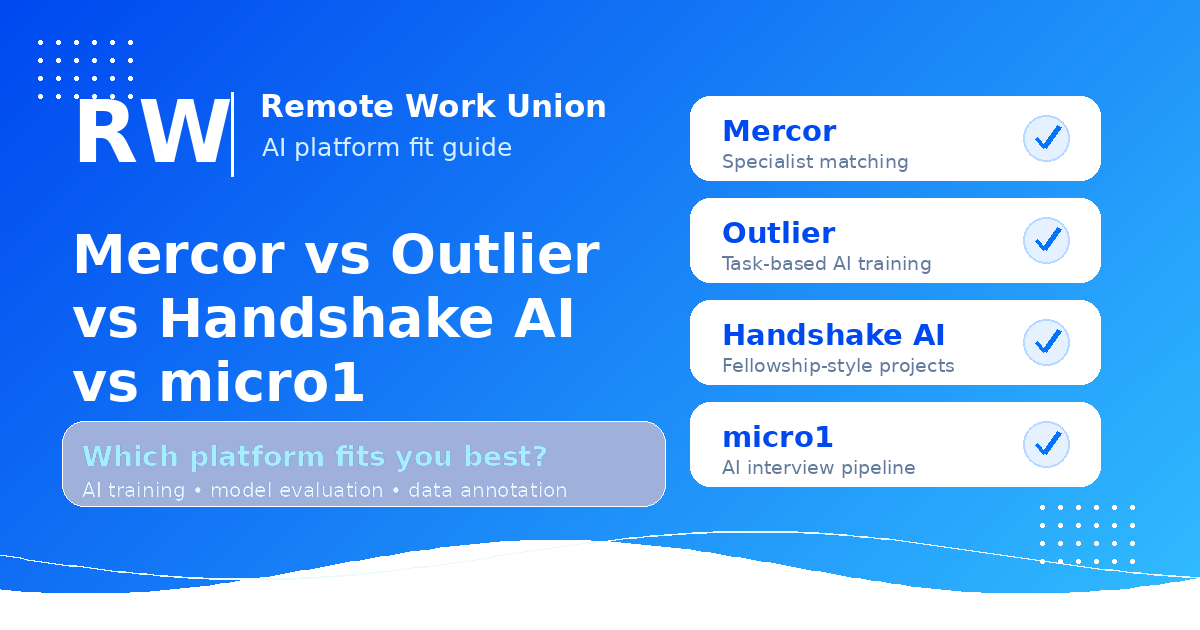
Mercor, Outlier, Handshake AI, and micro1 all sit in the same broad category: remote AI training work. They connect people with projects where human judgment helps improve large language models, chatbots, AI assistants, search systems, coding models, tutoring models, and other generative AI tools. The work can include evaluating AI-generated answers, writing prompts, ranking responses, checking factual accuracy, editing model output, annotating datasets, or applying professional expertise to complex tasks.
That does not mean the four platforms feel the same for applicants. A marketing manager, sales professional, MBA, finance professional, business consultant, customer service lead, data analyst, teacher, software engineer, lawyer, doctor, undergraduate student, or generalist writer may have very different odds depending on which platform they choose first. The best choice is usually not the platform with the loudest online discussion. The best choice is the platform where your background creates the clearest match.
This guide compares Mercor, Outlier, Handshake AI, and micro1 from the perspective of a remote AI job seeker. The goal is not to crown a universal winner. The goal is to help you decide where to apply first, how to position your profile, and how to avoid waiting on one platform when project demand is inconsistent.
All four platforms are part of the larger remote AI work category. This category includes AI training jobs, model evaluation jobs, AI response rating, data annotation, RLHF rating, prompt writing, search quality evaluation, coding evaluation, domain expert review, and AI fact-checking work. The exact tasks can change by project, but the underlying need is stable: AI companies need skilled humans to help models reason, write, code, answer, refuse unsafe requests, follow instructions, and perform reliably in specialized fields.
Major AI companies and AI labs — including organizations associated with OpenAI, Anthropic, Google, Meta, Microsoft, xAI, and other frontier model builders — create demand for this type of work directly and indirectly. Many applicants search for terms like ChatGPT jobs, Claude AI training jobs, Gemini AI jobs, Google AI training jobs, Meta AI jobs, or OpenAI evaluator jobs. In practice, a large amount of this work appears through contractor platforms, staffing partners, data vendors, fellowships, job boards, and expert marketplaces rather than through a single public job posting from the lab itself.
The work is usually remote, flexible, and project-based. That is the appeal. It is also the risk. Project availability can change quickly. You may pass an assessment and still wait. You may work heavily for a period and then see fewer tasks. You may qualify for one project but not another. For that reason, applicants should treat these platforms as serious opportunities, but not as guaranteed full-time employment.
Quick answer: which platform should you try first?
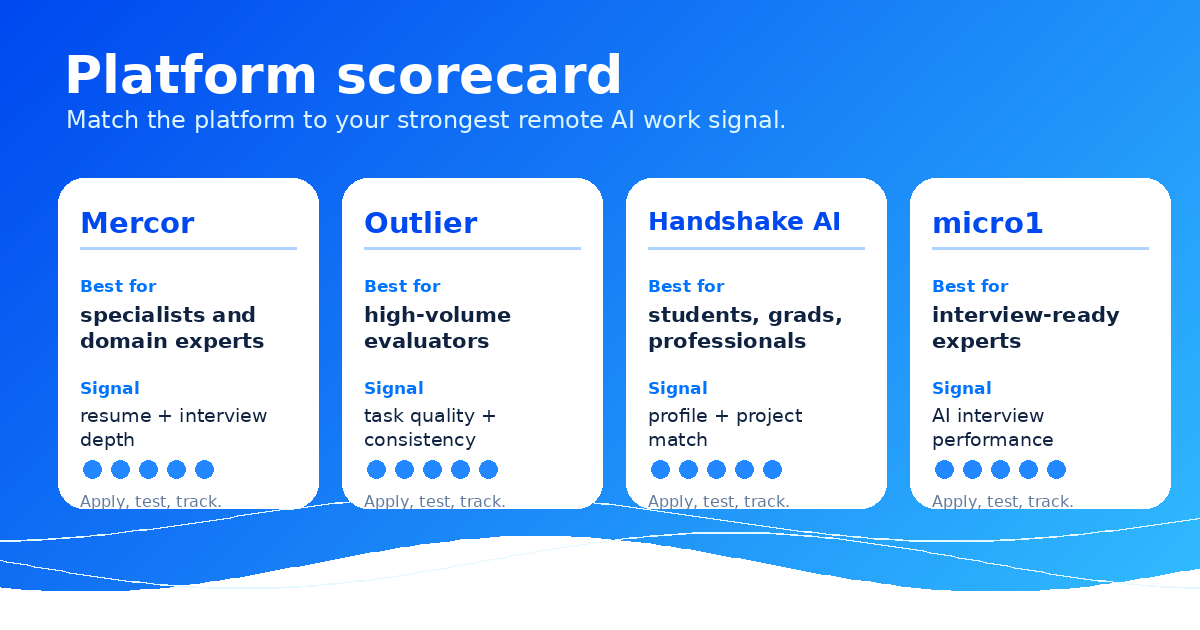
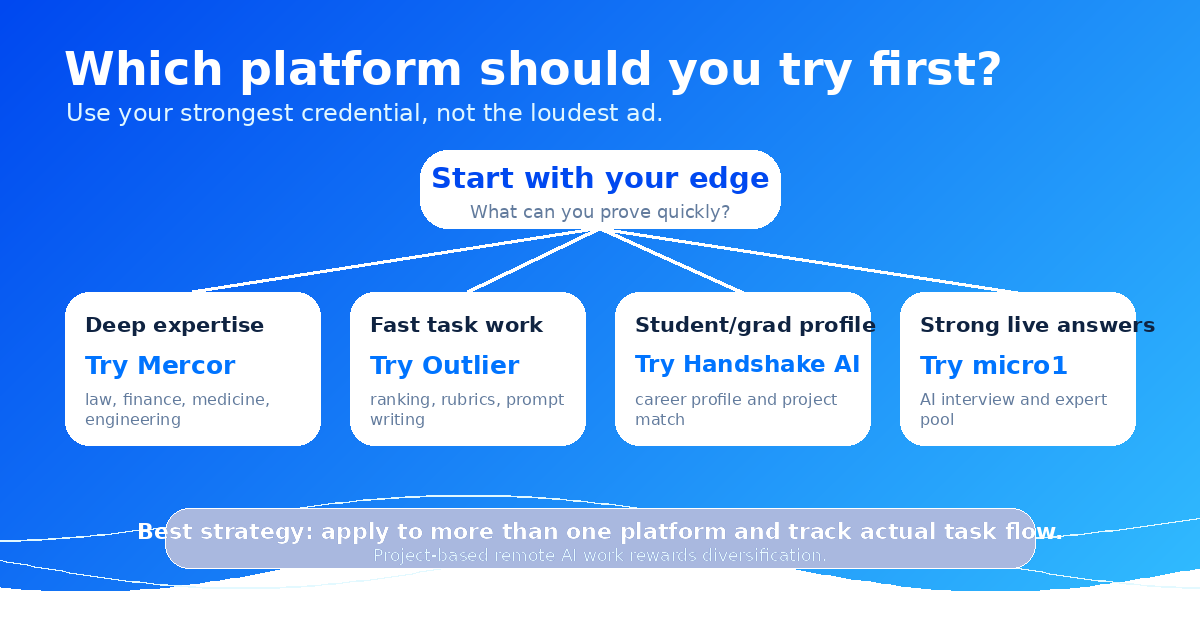
If you have strong professional expertise, Mercor is often the first platform to prioritize. It is especially relevant for applicants with clear domain authority in areas like law, finance, healthcare, engineering, consulting, operations, strategy, coding, academic research, creative direction, or advanced technical work. Your edge is not simply that you can write. Your edge is that you can review AI outputs using standards from a real field.
If you want broad flexible AI training tasks, Outlier is often the first platform to test. Outlier positions itself around AI trainer work, flexible remote participation, and tasks across coding, STEM, language, writing, and general evaluation. It can fit people who want task variety and are willing to qualify into projects as demand changes.
If you are a student, recent graduate, or early-career applicant, Handshake AI may be a better first stop than a traditional expert marketplace. Its fellowship-style positioning is built around using human judgment and subject-matter strengths to improve AI systems, with a more beginner-friendly framing than many expert-only postings. Applicants should still check current eligibility, location, and work authorization rules before applying.
If you have strong technical or specialized expertise and want higher-rate work matched through an AI interview, micro1 is often worth prioritizing. It vets contributors with an AI interview and leans toward expert and technical projects, with rates that can reach $50–$200/hr for qualified applicants.
Platform stack strategy: The strongest approach for most serious applicants is not Mercor or Outlier or Handshake AI or micro1 — it is a platform stack. Apply to the best-fit platform first, build one or two backup profiles, keep your resume targeted, and track which roles actually respond.
Mercor: best for professionals and subject matter experts
Mercor is usually the most attractive option for applicants who can prove valuable expertise. If your resume has a strong signal — a law degree, medical background, finance experience, consulting background, engineering work, software experience, research credentials, graduate education, business operations experience, or specialized creative expertise — Mercor may give you a cleaner way to market that background to AI training projects.
The platform is especially relevant when the work requires more than general writing ability. An AI model can produce confident but flawed answers in law, medicine, finance, math, accounting, statistics, engineering, cybersecurity, coding, product strategy, or business analysis. Human reviewers with real knowledge can identify subtle mistakes, improve reasoning, create better examples, and evaluate whether an answer meets professional standards.
A strong Mercor profile should read like an expert marketplace profile, not a generic remote-work application. Lead with your highest-value domain. Mention your degree, certifications, industries, tools, writing ability, analytical work, review experience, and any proof that you can judge complex outputs. A business analyst should mention financial modeling, Excel, SQL, dashboards, process improvement, operations, or strategy. A lawyer should mention legal research, litigation, contracts, regulatory work, writing, and issue spotting. A software engineer should mention languages, frameworks, code review, debugging, algorithms, and technical documentation.
Mercor may be a weaker first choice for applicants who have no clear domain signal and no strong writing sample. That does not mean beginners should ignore it forever. It means they may need to build a better profile, gain AI evaluation experience elsewhere, and come back with stronger positioning.
Outlier: best for broad task variety and flexible AI trainer work
Outlier is often a strong fit for people who want exposure to many kinds of AI trainer tasks. The platform has public-facing positioning around AI trainers, expert contributors, remote work, flexible schedules, and subject areas such as coding, STEM, languages, and general evaluation. Depending on the project, tasks may involve writing prompts, evaluating AI responses, ranking outputs, checking reasoning, improving answers, or completing domain-specific work.
Outlier can be appealing because the entry points may feel broader than a pure expert marketplace. A strong writer, math tutor, coder, bilingual applicant, teacher, science graduate, data analyst, or detail-oriented generalist may find roles that match their skills. The platform is also relevant for people searching for AI data annotation jobs, AI rating jobs, AI trainer jobs, AI model evaluation work, and remote side hustles that are more analytical than basic data entry.
The main tradeoff is consistency. Flexible task platforms can be unpredictable. Applicants often care about questions like: Why do I have no Outlier projects? Why did I pass an assessment but not get tasks? Why did my project disappear? These are common issues in project-based AI work generally. A lack of tasks does not always mean a bad applicant. It can mean the platform has no active project that matches your location, language, expertise, quality history, or current client demand.
A strong Outlier profile should prove that you can follow instructions, write clearly, reason carefully, and evaluate details. Mention coding languages, STEM subjects, writing/editing experience, tutoring, research, languages, domain knowledge, and any AI tools you can use responsibly. For assessments, slow down. Many applicants fail because they rush, ignore rubrics, over-explain, under-explain, or assume the task is easier than it is.
Handshake AI: best for students, recent graduates, and fellowship-style entry
Handshake AI is positioned differently because it connects to the student and early-career ecosystem. The official program materials describe flexible, project-based opportunities that use human judgment and expertise to improve large language models. Typical work can include reviewing and editing AI-generated content, annotating datasets, suggesting improvements to model outputs, and helping shape how AI tools perform in realistic scenarios.
That makes Handshake AI especially relevant for students, recent graduates, early-career professionals, and people who want AI experience without presenting themselves as senior industry experts. It may fit English majors, business students, computer science students, STEM students, graduate students, liberal arts graduates, research assistants, tutors, editors, and people with strong writing and reasoning skills.
The biggest advantage is positioning. Many beginners struggle because they search for expert AI training roles before they have a credible expert profile. Handshake AI gives those applicants a more natural story: I am early in my career, I can write clearly, I can reason carefully, I can follow instructions, and I want project-based AI experience. That story may be more coherent than pretending to be a high-level consultant or specialist.
The main limitation is eligibility. Applicants should check current location and work authorization rules before assuming they qualify. They should also remember that fellowship-style access does not guarantee projects, hours, or acceptance. Treat it as one entry point into remote AI work, not the only path.
micro1: best for AI-interview-matched technical and specialist work
micro1 vets contributors with an AI interview and matches them to expert AI training and evaluation projects. It leans toward higher-skill technical and professional work, which makes it a strong fit for engineers, researchers, data and quantitative specialists, and domain experts who can demonstrate verifiable expertise. Qualified experts can earn around $50–$200/hr.
The defining feature is the AI interview, often referred to as "Zara." Instead of a long manual review, you talk through your reasoning, and the match favors people who can explain their thinking clearly and concisely in their field. Prepare for it like a real technical or professional interview, not a survey or a sign-up form.
A strong micro1 profile leads with verifiable depth: languages and frameworks for engineers, methods and publications for researchers, models and tooling for data specialists, or the specific decisions you are qualified to review in your domain. micro1 may be a weaker first choice for pure beginners with no clear specialty — those applicants are usually better served starting on Outlier or Handshake AI and returning once they can prove a niche.
Side-by-side comparison
Mercor is best when your resume already explains why you should review difficult AI answers. Outlier is best when you want a broader AI trainer platform with many possible task categories. Handshake AI is best when you are closer to the student, graduate, or early-career side of the market. micro1 is best when you have strong technical or specialist depth and want higher-rate projects matched through an AI interview.
For pay expectations, avoid making decisions from screenshots alone. Rates vary by platform, project, domain, location, task difficulty, and client demand. Specialized legal, medical, finance, coding, math, statistics, engineering, or consulting projects can pay much more than general evaluation work, but they are also more selective. General AI evaluator tasks can be easier to access, but may have lower rates or less consistent volume. Always read the current project details before starting.
For application difficulty, Mercor may be most selective when the role requires deep professional expertise. Outlier may be easier to enter in some categories, but still requires assessments and project matching. Handshake AI may be friendlier to students and recent graduates, but eligibility and demand still matter.
For long-term value, the best platform is the one that helps you build proof. AI training work becomes more valuable when you can say you have evaluated model outputs, followed rubrics, written high-quality prompts, checked factuality, reviewed reasoning, worked in specialized domains, and maintained quality over time.
Looking for AI training jobs, model evaluation roles, or expert review work? RemoteWorkUnion.com tracks roles hiring across top remote AI platforms.
Find Roles Hiring Now →Which platform fits your background?
For lawyers, law students, paralegals, and legal researchers, start with Mercor if you have a strong legal profile. Add Outlier if you see legal, writing, or reasoning projects. Handshake AI can still be useful for law students or recent graduates who fit its eligibility rules.
For finance, accounting, consulting, MBA, and business analyst applicants, Mercor may be the strongest first platform because business judgment and domain review can be valuable. Outlier can be a useful backup for quantitative, writing, spreadsheet, or reasoning tasks.
For software engineers and technical reviewers, apply to Mercor, micro1, and Outlier. micro1's AI interview is built to surface real technical depth, so it is especially worth prioritizing for engineers. Coding evaluation, debugging, technical prompt writing, and model reasoning review can appear across multiple platforms. Emphasize languages, frameworks, code review, tests, algorithms, documentation, and examples of technical judgment.
For teachers, tutors, professors, researchers, and PhD students, all four can make sense. Mercor may fit advanced subject matter expertise. Outlier may fit education, STEM, language, and explanation tasks. Handshake AI may fit students and recent graduates who want a structured entry point. micro1 may fit researchers and technical specialists who can demonstrate depth through its AI interview.
For writers, editors, journalists, and English-language applicants, Outlier and Handshake AI may be strong first choices if you do not have a specialized expert profile. Mercor can still fit if your writing experience connects to a higher-value domain, such as legal editing, medical writing, finance content, technical documentation, policy, research, or product strategy.
For generalists without a degree or obvious niche, start by building evidence. Create a simple resume for AI evaluator work. Highlight writing, research, customer judgment, attention to detail, tools, Excel, Google Workspace, ChatGPT, Claude, Gemini, prompt writing, fact-checking, and careful review. Apply broadly, but do not send the same weak profile everywhere.
How to improve your odds on any platform
First, make your resume specific to AI training work. A generic remote-work resume often underperforms because it hides the skills that matter. Add keywords like AI model evaluation, AI response rating, prompt writing, factual accuracy, rubric-based review, research, editing, data annotation, content quality, reasoning, domain expertise, and written feedback where they are accurate.
Second, lead with the strongest proof. If you are a finance professional, do not start with general remote-work interest. Start with finance. If you are a teacher, lead with explanation, grading, curriculum, assessment, and subject expertise. If you are a coder, lead with code review, debugging, languages, technical writing, and problem solving.
Third, treat assessments like paid work. Read every instruction. Use concise reasoning. Do not hallucinate. Do not pad answers. Do not assume that a polished answer is accurate. In AI evaluation, your job is often to notice when an answer sounds good but fails the task.
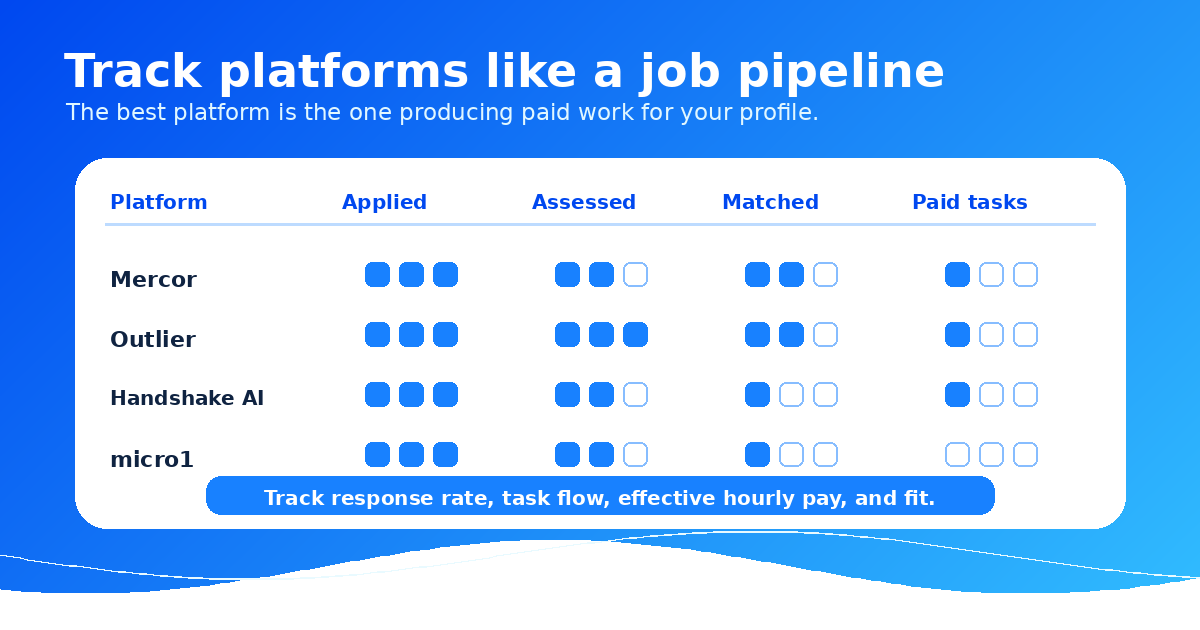
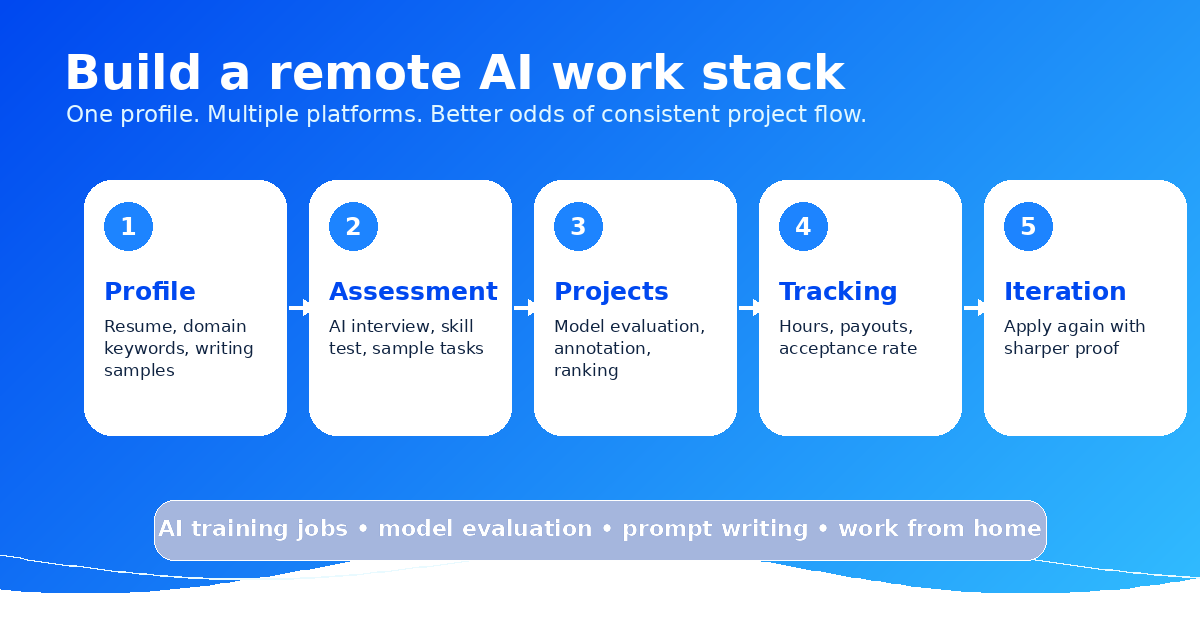
Fourth, keep applying while you wait. A common mistake is to apply to one platform, refresh the dashboard, and assume silence means failure. Project-based AI work does not move like a normal job application. Build a tracker with platform name, date applied, role, assessment status, response, rate, project type, and next action.
Fifth, protect yourself. Do not submit confidential employer material, private client files, copyrighted assets you do not own, sensitive personal data, or anything that violates an NDA. The fastest way to damage a professional profile is to treat AI training work casually when it involves real data or regulated fields.
Suggested application order
If you are an expert, apply to Mercor and micro1 first, then Outlier, then Handshake AI if eligible. Your main asset is domain knowledge, so start where expertise is easiest to explain — and micro1's AI interview is built to surface exactly that.
If you are a broad evaluator, writer, editor, tutor, or detail-oriented generalist, apply to Outlier and Handshake AI first if eligible, then build a stronger Mercor profile around any credible niche.
If you are a student or recent graduate, apply to Handshake AI first, then Outlier, then Mercor once you can show a clearer subject area. Your goal is to turn school, projects, research, writing, tutoring, and internships into a clean AI training profile.
If you are a coder, apply to Outlier, Mercor, and micro1 at the same time. Coding tasks can pay well, but they also require careful assessments — and micro1's AI interview rewards engineers who can reason through technical tradeoffs out loud. Prepare to explain why one solution is better than another, not just write code that runs.
Final verdict
Mercor fits applicants who can sell expertise. Outlier fits applicants who want flexible AI trainer work across a broader range of tasks. Handshake AI fits students, recent graduates, and early-career applicants who want a fellowship-style path into AI work. micro1 fits technical and specialist experts who want higher-rate projects matched through an AI interview.
The best platform is the one where your background makes the review task obvious. AI companies need humans who can judge quality, not just people who want remote work. That is the mindset shift. You are not applying to click buttons from home. You are applying to help AI systems become more accurate, useful, safe, and aligned with professional standards.
Frequently Asked Questions
Which platform should I try first — Mercor, Outlier, Handshake AI, or micro1?
It depends on your background. If you have strong professional expertise in marketing, sales, finance, business operations, consulting, law, healthcare, engineering, or research, start with Mercor. If you want broad AI trainer tasks across writing, STEM, and coding, try Outlier first. If you are a student or recent graduate, Handshake AI may offer a more accessible entry point. If you have strong technical or specialized expertise and want AI-interview-matched projects, try micro1. Most serious applicants build a platform stack across all four rather than waiting on one.
Can I use all four platforms at the same time?
Yes. Applying to multiple platforms simultaneously is standard practice for remote AI work. Mercor, Outlier, Handshake AI, and micro1 serve different project types and applicant profiles. Keeping active profiles on all four increases your chances of being matched to tasks when project demand is active.
Do I need professional expertise to get accepted on these platforms?
Not always. Mercor tends to favor domain experts, but Outlier and Handshake AI have pathways for strong writers, researchers, STEM students, and detail-oriented generalists. The key is presenting your background specifically — not as generic remote-work interest, but as evaluator-relevant skills like writing, research, fact-checking, or careful analysis.
How do beginners get started on AI training platforms?
Beginners should start by cleaning up their resume to highlight writing, research, analysis, editing, and AI tool familiarity. Apply to Outlier or Handshake AI first if you lack a clear expert niche. Practice evaluating AI responses before assessments. Avoid vague profiles and treat each application as a job application, not a sign-up form.
Why do I get accepted but see no tasks on these platforms?
Task availability on project-based AI platforms depends on active client demand, your location, your language, your expertise match, and your quality history. Acceptance does not guarantee immediate work. This is normal across Mercor, Outlier, Handshake AI, and micro1. The best response is to apply to additional platforms, keep your profile updated, and check back regularly rather than waiting passively.