If you applied to Mercor and did not get matched, did not hear back, failed an interview, or feel like your profile is too weak, the best next move is usually not to apply to every opening again immediately. The better move is to improve the signal your profile sends.
Mercor and similar AI training platforms are crowded because remote AI work is one of the few online job categories where strong writing, professional judgment, research ability, coding skill, finance knowledge, legal reasoning, medical expertise, teaching experience, or business analysis can matter more than traditional job titles. That also means your profile has to communicate expertise fast.
A strong Mercor profile should answer four questions clearly: What are you genuinely qualified to review? What proof supports that expertise? Can you explain your reasoning in a clean way? Are you applying to projects that actually match your background?
This guide is for applicants who want to improve their Mercor profile before applying again. It applies whether you are targeting AI training jobs, AI model evaluation work, prompt response writing, data annotation, RLHF rating, AI fact-checking, expert review, or remote contract work around large language models.
Why Your Mercor Profile Matters More Than You Think
Remote AI training platforms do not always evaluate applicants the same way a traditional employer does. A normal job application may be built around a resume, recruiter screen, and hiring manager interview. AI training platforms often need to quickly match many contractors to specialized projects. That makes your profile, resume, assessment answers, and AI interview performance especially important.
Your Mercor profile is not just a biography. It is a matching document. It helps the platform understand which projects might fit you: legal reasoning, finance modeling, software engineering, medical writing, education, business strategy, creative writing, content editing, search quality evaluation, or general expert review.
A weak profile makes you look interchangeable. A strong profile makes you easier to place.
For example, "I have experience in marketing and operations" is not useless, but it is broad. "I can evaluate AI responses about growth marketing, paid social strategy, CRM workflows, landing page copy, funnel analysis, and startup operations" is much more useful for AI evaluator work. It tells a reviewer or matching system what kind of model outputs you can judge.
Start by Picking One Clear Expertise Lane
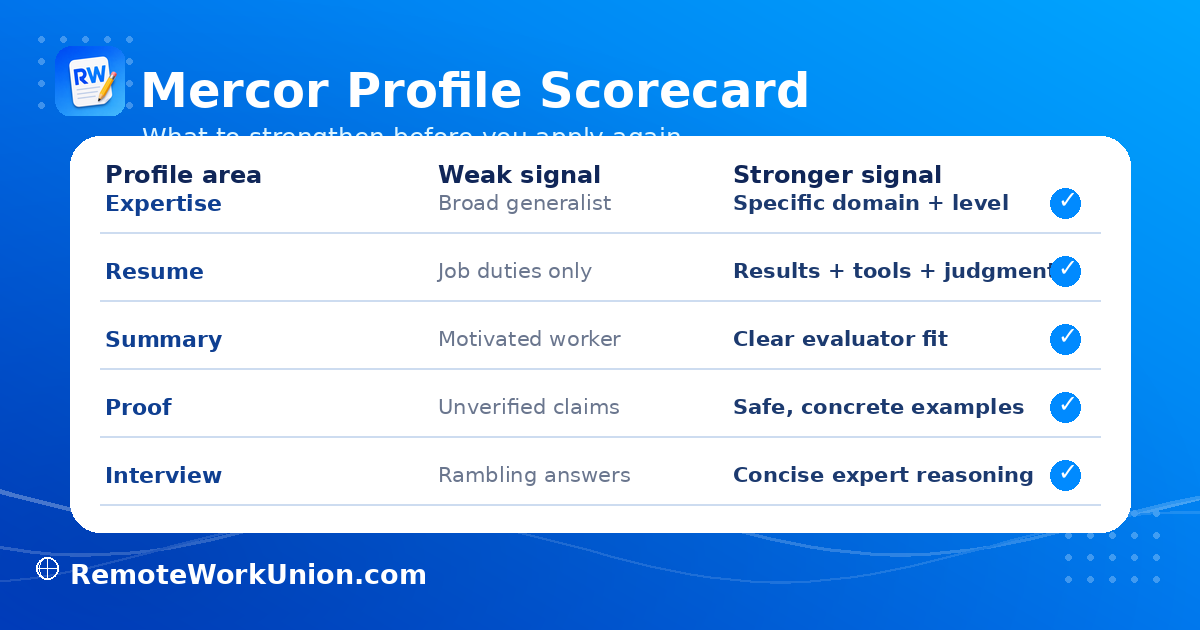
Before you edit your profile, choose the lane you want Mercor to understand first. Many applicants make the mistake of presenting every skill equally. They list writing, sales, customer service, Excel, management, social media, research, AI tools, and general business experience all at once. That can make the profile feel unfocused.
Instead, choose a primary lane and one or two secondary lanes.
- A lawyer might lead with legal analysis, contract review, litigation research, compliance, or regulatory writing.
- A finance applicant might lead with financial modeling, accounting, equity research, FP&A, private equity, or business analysis.
- A teacher might lead with curriculum review, tutoring, grading rubrics, educational content, or student feedback.
- A writer might lead with editing, content quality, tone, grammar, SEO, or factual accuracy.
- A coder might lead with Python, JavaScript, debugging, technical explanation, data structures, or code review.
Your profile should make that lane obvious within the first few seconds. If someone has to read five paragraphs to figure out what you are best at, your profile is probably too broad.
Rewrite Your Profile Summary for AI Training Work
Your profile summary should not read like a generic resume objective. Avoid lines like "hardworking professional seeking a flexible remote opportunity." That may be true, but it does not help Mercor understand what you can evaluate.
A better summary explains your domain, your judgment, and your relevance to AI model evaluation.
Weak example: "I am a motivated professional with experience in business, writing, and customer service. I am looking for remote work and can learn quickly."
Stronger example: "I have experience in business operations, marketing strategy, and written analysis. I can evaluate AI responses for clarity, factual accuracy, reasoning quality, practical usefulness, and whether the answer fits a real business context. I am especially comfortable reviewing prompts related to growth strategy, customer acquisition, content quality, startup workflows, and professional communication."
The stronger version uses the language of AI training jobs: evaluate, responses, accuracy, reasoning, usefulness, prompts, review, professional communication. It also tells the platform where the applicant fits.
You can adapt the same structure for any background:
"I have experience in [domain]. I can evaluate AI responses about [specific topics]. I am comfortable reviewing for [quality standards]. My strongest fit is [role type or project type]."
Make Your Resume Match the Work You Want
Your Mercor profile and resume should reinforce each other. If your profile says you are a strong AI writing evaluator but your resume only lists job titles and duties, the profile may not feel fully supported.
A resume for AI training work should highlight judgment-based skills. That does not mean rewriting your entire career around AI. It means surfacing the parts of your background that matter for model evaluation.
Useful resume signals include:
- Writing, editing, research, or documentation experience
- Subject matter expertise in law, healthcare, finance, education, coding, science, business, marketing, or operations
- Experience reviewing work, grading work, giving feedback, auditing quality, or checking accuracy
- Comfort with tools such as Microsoft Excel, Google Sheets, SQL, Python, ChatGPT, Claude, Gemini, Perplexity, Notion, Airtable, Salesforce, HubSpot, or project management software
- Examples of clear communication, structured analysis, and quality control
The best bullet points often combine subject matter, task type, and result. Compare these before-and-after examples:
Instead of: "Managed marketing campaigns."
Try: "Reviewed campaign performance across paid social, email, and landing pages; identified messaging issues, analyzed conversion data, and wrote recommendations for clearer customer acquisition strategy."
Instead of: "Tutored students."
Try: "Explained complex math and writing concepts to students, evaluated written work against clear rubrics, and gave actionable feedback to improve reasoning and accuracy."
Instead of: "Worked with Excel."
Try: "Built and reviewed spreadsheet models, checked formulas for accuracy, summarized trends, and communicated findings to non-technical stakeholders."
These revisions are still truthful, but they map better to AI model evaluation, prompt response review, and expert feedback tasks.
Add Keywords Without Sounding Fake
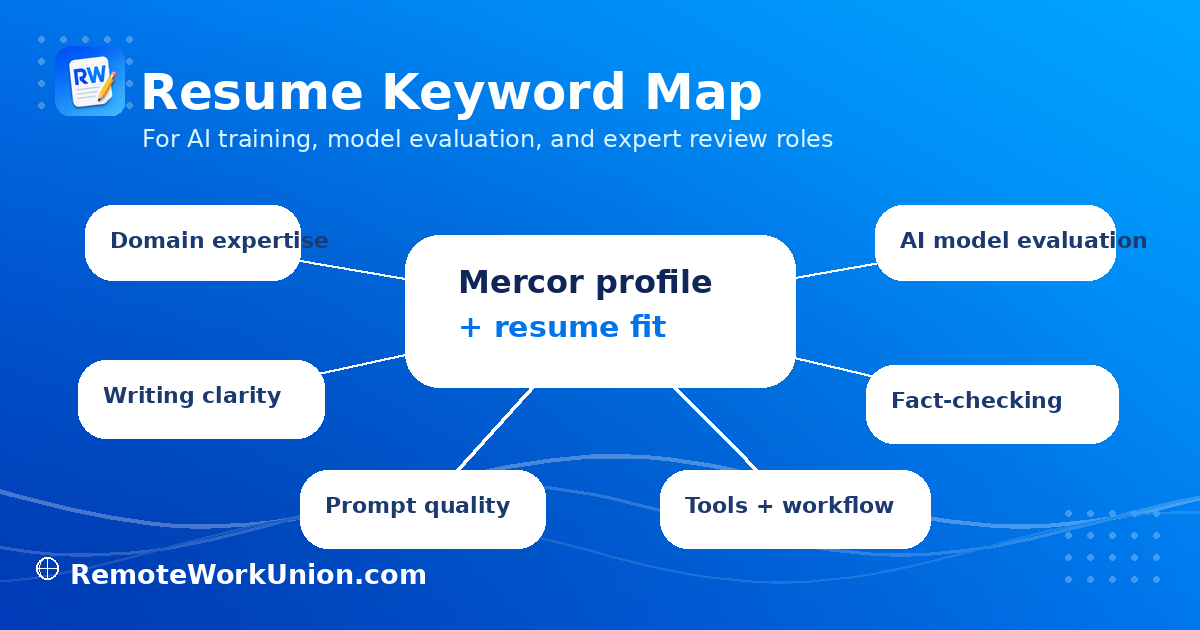
Keywords help, but keyword stuffing makes a profile look low quality. The goal is to use relevant terms naturally.
For Mercor, Outlier, Handshake AI, Surge AI, micro1, Stellar AI, and other remote AI work platforms, relevant language may include AI training, AI model evaluation, AI evaluator, prompt writing, response ranking, RLHF, data annotation, human feedback, model improvement, chatbot evaluation, factual accuracy, helpfulness, safety, reasoning quality, domain expertise, search quality, and expert review.
You do not need every keyword. Use the ones that match your actual background:
- Legal: legal research, contract analysis, litigation, compliance, regulatory review, citation checking, reasoning quality, factual accuracy, risk analysis
- Finance: financial modeling, equity research, valuation, FP&A, accounting, Excel, due diligence, market analysis, data interpretation
- Writing: editing, grammar, tone, SEO, content quality, copywriting, fact-checking, style guidelines, response clarity
- Technical: code review, debugging, Python, JavaScript, SQL, software engineering, algorithms, technical documentation, test cases
- Healthcare: medical writing, clinical reasoning, patient education, health content review, terminology accuracy, evidence-based explanation
Good keyword use should feel like a clear description of what you can judge. Bad keyword use feels like a list of trendy terms pasted into a profile.
Remote Work Union connects you to legitimate Mercor-style AI training and evaluation roles. Apply for free and see what is hiring now.
Find Roles Hiring Now →Show Proof, But Do Not Upload Private or Confidential Work
A stronger profile often includes proof: projects, credentials, portfolio samples, writing clips, published work, GitHub repositories, certifications, degrees, licenses, or examples of professional work. But you should be careful with private material.
Do not upload or share confidential employer documents, proprietary client work, unreleased content, protected data, private customer information, patient information, source code you do not own, or anything covered by an NDA. AI training work can involve sensitive evaluation standards, and platforms may have their own confidentiality rules. Treat your application materials the same way.
Safe proof can include public writing samples, anonymized summaries, portfolio pages, public GitHub projects, personal case studies, degrees, certifications, published articles, open-source contributions, or short explanations of work you completed without exposing private information.
A good proof statement might look like this:
Example: "I have written and edited long-form educational content, reviewed drafts for factual accuracy and tone, and built editorial checklists for consistent quality. Public writing samples are available on request."
Example: "I have experience building financial models in Excel and reviewing assumptions for consistency. I can discuss the structure of these models without sharing confidential files."
This gives the platform confidence without creating unnecessary risk.
Prepare for the AI Interview Like an Expert Reviewer
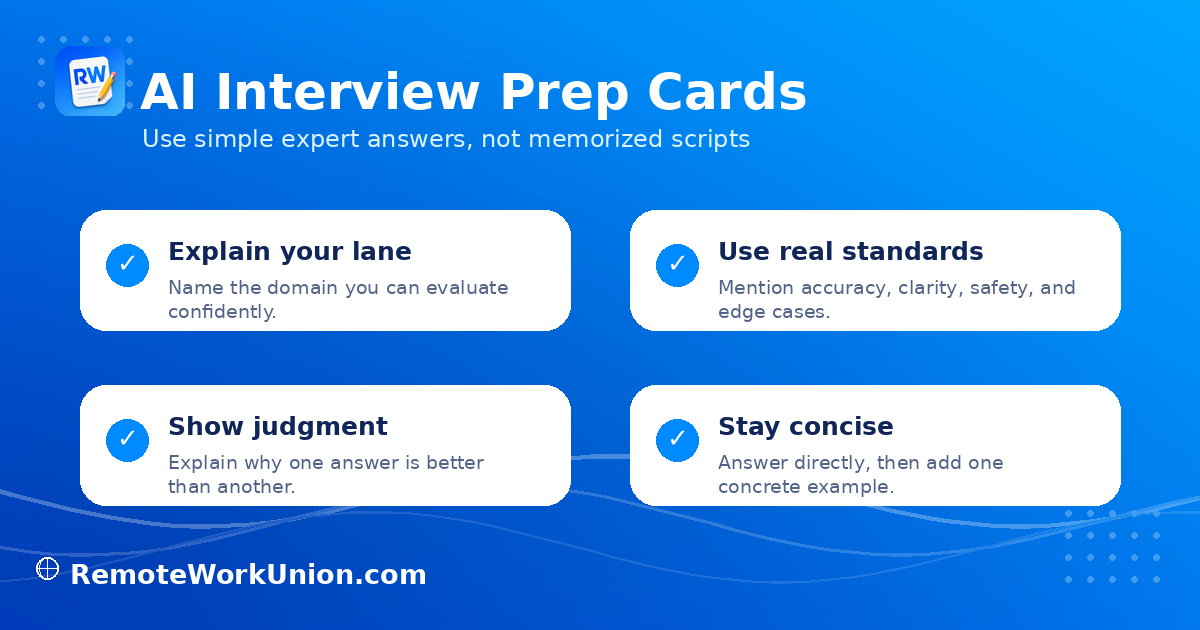
If you get another AI interview, treat it like a chance to demonstrate how you think. Many applicants prepare by memorizing a personal pitch. That is less useful than practicing concise explanations of your expertise.
You should be ready to answer questions like:
- What area are you most qualified to evaluate?
- What makes you credible in that area?
- How would you judge whether an AI response is accurate?
- How would you compare two answers on the same prompt?
- What would make an answer helpful but incomplete?
- What kinds of mistakes do non-experts make in your field?
- How do you explain complex ideas clearly?
The strongest answers are usually specific, calm, and structured. You do not need to sound like a professor. You need to show that you can evaluate quality.
Use a simple answer structure:
- State the standard.
- Explain why it matters.
- Give a quick example.
For example: "When I evaluate a business strategy answer, I look for whether the recommendation matches the company stage, budget, audience, and channel. A generic answer might say 'run paid ads,' but a better answer explains which channel fits the customer, how to test it, and what metrics would show whether it is working." That type of answer shows domain judgment and sounds directly relevant to AI training work.
Fix the Most Common Weak Signals
If your profile is not working, look for weak signals first. Most applicants do not need a total reinvention. They need to remove confusion.
Common weak signals include:
- A profile summary that is too generic
- A resume that does not support the claimed expertise
- Too many unrelated skills listed with no clear priority
- No proof of writing, analysis, research, or domain knowledge
- Applying to expert roles that do not match the resume
- Interview answers that are long but not specific
- Overclaiming AI experience instead of explaining real expertise
- Using trendy keywords without substance
- Not explaining what kind of AI outputs you can evaluate
The fix is to make every part of the profile point in the same direction. If you are applying for finance AI training jobs, your summary, resume bullets, proof, and interview examples should all support finance judgment. If you are applying for writing evaluator jobs, your profile should show editing ability, clarity, factual review, and strong written feedback. If you are applying for coding evaluator jobs, your profile should show technical reasoning, code review, debugging, and communication ability.
Apply to Better-Fit Roles Instead of More Roles
After you improve your Mercor profile, be more selective. Applying to every role can make sense emotionally when you want work quickly, but it is not always the best strategy.
Prioritize roles where your profile has obvious evidence. If you have a law background, legal AI review is stronger than generalist work. If you have Excel-heavy business experience, data analysis, finance, operations, or business reasoning projects may be stronger than creative writing. If you have teaching experience, education content review, tutoring simulations, grading rubrics, and student feedback tasks may be stronger than coding projects.
Remote AI job platforms can include a wide range of work: AI writing evaluator, AI data annotator, AI trainer, search quality rater, prompt response reviewer, RLHF rater, chatbot evaluator, AI fact-checker, domain expert, coding reviewer, and subject matter expert. The best role is not always the highest advertised rate. The best role is the one where your background makes selection easier.
A Simple Mercor Profile Improvement Checklist
Before applying again, run through this checklist:
- Can a reader identify your strongest expertise lane in five seconds?
- Does your summary explain what kind of AI responses you can evaluate?
- Does your resume support the same expertise you claim in your profile?
- Are your strongest keywords relevant and natural?
- Do your bullet points show judgment, analysis, feedback, accuracy, or quality review?
- Have you removed vague claims like "hard worker" or "fast learner" unless they are supported by evidence?
- Do you have safe proof of your work that does not violate confidentiality?
- Can you explain your domain expertise clearly in an AI interview?
- Are you applying to roles that match your actual background?
- Have you checked for typos, unclear dates, broken links, and inconsistent job titles?
Tip: If the answer to several of these is no, improve the profile before submitting more applications. Each improvement compounds — a sharper summary makes the resume more credible, which makes proof statements more persuasive, which makes interview answers land harder.
Example: Before and After Profile Positioning
Before:
"I have experience in sales, writing, customer service, and marketing. I am interested in AI and remote work. I am a fast learner and can work independently."
After:
"I have experience in marketing, sales communication, and customer-facing writing. I can evaluate AI responses related to customer acquisition, email copy, landing page messaging, CRM workflows, sales objections, and brand tone. I am comfortable reviewing answers for clarity, usefulness, factual accuracy, persuasive quality, and whether the recommendation would make sense in a real business setting."
The improved version is better because it is specific. It does not just say the applicant wants remote work. It shows what the applicant can evaluate.
You can create the same before-and-after for any background:
- General: "I have healthcare experience." → Specific: "I can evaluate patient education content, medical terminology, clinical reasoning, and whether health explanations are clear, cautious, and appropriate for a non-expert audience."
- General: "I know coding." → Specific: "I can review Python and JavaScript answers for correctness, edge cases, readability, debugging logic, and whether the explanation would help a developer solve the issue."
- General: "I worked in finance." → Specific: "I can evaluate AI responses about financial statements, Excel modeling, valuation assumptions, accounting logic, market research, and business analysis."
Frequently Asked Questions
Can I apply to Mercor again after rejection or no response?
Platform rules can change, and each role may work differently. In general, do not assume that submitting the same weak profile repeatedly will help. Improve the profile, make sure it matches the role, and follow the platform's current instructions before reapplying.
Should I say I have AI experience if I have used ChatGPT, Claude, or Gemini?
You can mention AI tools if you actually use them, but do not make that the whole profile. Platforms usually care more about whether you can apply human judgment to model outputs. AI tool familiarity helps, but domain expertise, writing clarity, accuracy, and feedback quality matter more.
What if I do not have an advanced degree?
Some expert roles favor advanced degrees or deep professional experience, but not all AI training jobs require the same background. Strong writers, editors, researchers, coders, analysts, teachers, and operators may still find relevant remote AI work. The key is applying to roles where your proof matches the work.
Should my profile be long?
Long is not the goal. Clear is the goal. A concise profile with specific expertise, relevant keywords, and proof is better than a long profile full of vague claims.
What is the biggest mistake applicants make?
The biggest mistake is sounding like a generic remote job seeker instead of a credible evaluator. AI training jobs reward clear judgment. Your profile should make that judgment visible by explaining exactly what kind of AI outputs you are qualified to evaluate.
Final Takeaway
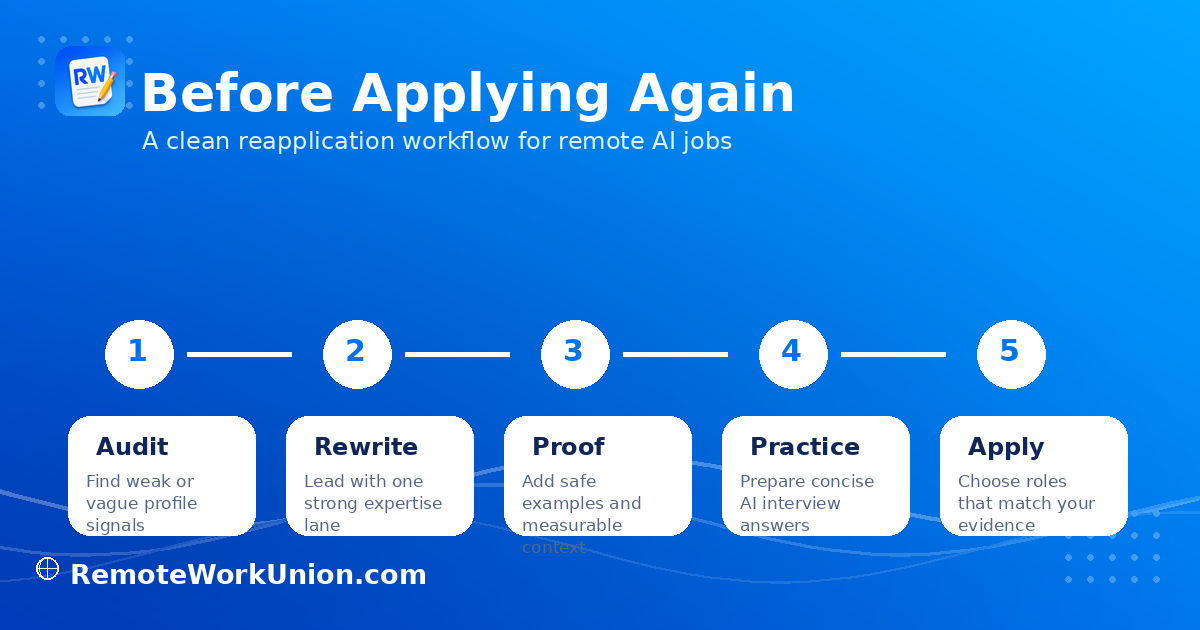
Improving your Mercor profile before applying again is mostly about clarity. Pick a lane. Rewrite your summary around AI evaluation work. Make your resume prove the same expertise. Use keywords naturally. Prepare for the AI interview by practicing expert reasoning, not memorized speeches. Apply to roles where your background makes sense.
Mercor, Outlier, Handshake AI, Surge AI, micro1, and other AI training platforms are part of a larger shift in remote work. Companies building AI systems need people who can judge whether model outputs are accurate, helpful, safe, and useful. That work can involve OpenAI-style AI evaluation, Anthropic-style helpfulness and safety review, Google Gemini-style answer quality, Meta AI research workflows, Microsoft Copilot-style productivity tasks, coding review, data annotation, prompt writing, search quality, and expert feedback. Your profile should show where you fit into that ecosystem.