People search for Microsoft AI training jobs because Microsoft is one of the most visible companies in artificial intelligence. Copilot is built into productivity tools, Bing, Windows, GitHub, Azure, and enterprise workflows. That visibility creates a reasonable question for job seekers: if Microsoft is building and improving AI products, where do humans fit into the process?
The answer is more practical than the search phrase sounds. Most remote AI evaluation work is not posted with one clean title like Microsoft AI Trainer. It can appear as AI evaluator, LLM response reviewer, search quality rater, data annotation specialist, prompt response evaluator, AI safety tester, content quality analyst, user research contractor, or subject matter expert reviewer. Some roles are direct jobs at Microsoft. Many others are contract or vendor roles connected to large AI ecosystems where the end client may not be named publicly.
This guide explains how to search for Microsoft-related AI training work without wasting time on vague listings, scammy posts, or titles that sound bigger than the actual job. It is written for remote workers, strong writers, business professionals, researchers, educators, lawyers, healthcare workers, finance people, coders, and other applicants who want to understand where AI evaluation jobs actually show up.
What people usually mean by Microsoft AI training jobs
The phrase Microsoft AI training jobs can mean several different things. Some job seekers mean full-time technical jobs at Microsoft AI, Microsoft Research, Azure AI, GitHub, LinkedIn, or Copilot teams. Those roles may involve machine learning, data engineering, evaluations engineering, applied science, model safety, user research, or product work. They are usually competitive, specialized, and not always remote.
Other job seekers mean flexible online work where humans review AI answers, compare chatbot outputs, check search results, write ideal responses, label data, test prompts, or explain why one model answer is better than another. This second category is closer to what most people call AI training, RLHF, model evaluation, AI data annotation, or AI feedback work.
The key distinction is direct employer versus ecosystem work. A direct Microsoft role is listed by Microsoft and has Microsoft as the employer. Ecosystem work may involve AI products, Microsoft-related tools, Bing-style search quality, Copilot-style answer review, Azure AI workflows, or large-model evaluation projects, but the employer may be a contractor, staffing firm, research vendor, or AI training platform.
Why Microsoft-related AI work is bigger than one job board
Microsoft AI touches several major product areas. A person may use Microsoft Copilot to draft emails, summarize meetings, search the web, analyze documents, write code, work inside Microsoft 365, operate cloud infrastructure, or get answers from enterprise knowledge bases. Each of those product areas creates different evaluation needs.
A search product needs people who can judge whether answers are accurate, useful, sourced, and relevant. A writing assistant needs reviewers who understand tone, clarity, hallucinations, instruction-following, and factual support. A coding assistant needs technical reviewers who can test whether suggested code works. A business AI product needs evaluators who understand spreadsheets, presentations, policies, documents, sales workflows, customer support, and real workplace tasks.
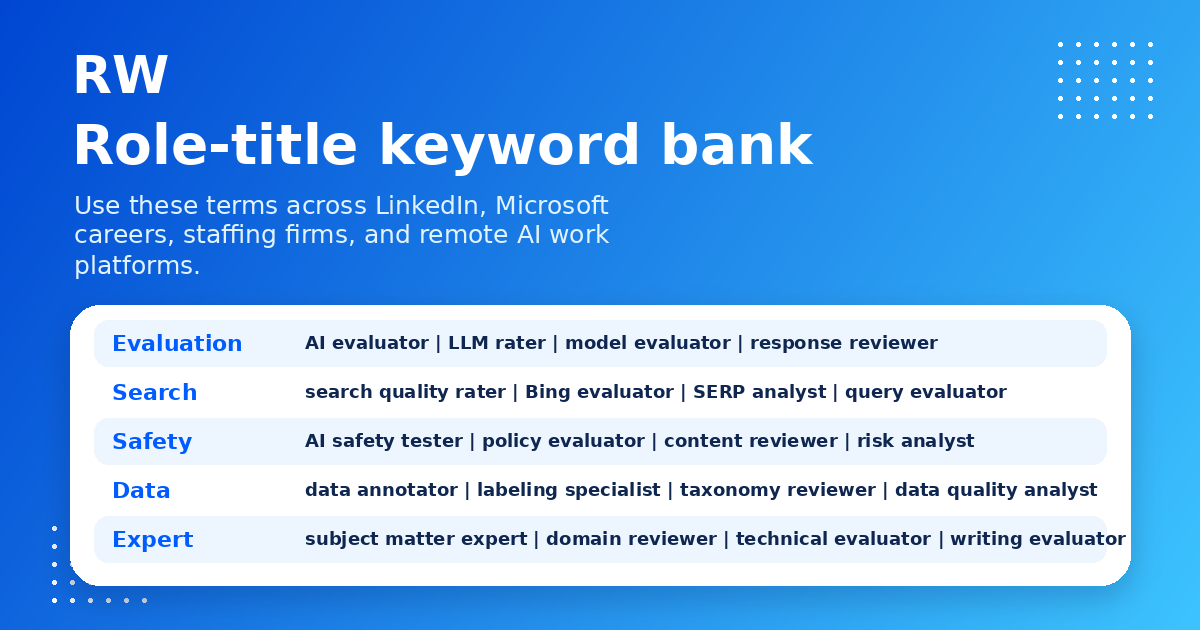
That is why the best search strategy is not to look only for the exact phrase Microsoft AI training jobs. The better approach is to search around the task: AI evaluation, LLM rating, search quality, Copilot, Bing, model feedback, response comparison, prompt evaluation, safety testing, and data quality.
Start with official Microsoft job searches, but do not stop there
The first place to check is Microsoft Careers and Microsoft AI Careers. Search broad AI terms first, then narrow by location, remote options, and discipline. Useful searches include AI, Copilot, evaluation, evaluations, responsible AI, AI safety, data, applied scientist, user research, search, Bing, Azure AI, machine learning, post-training, and data engineering.
Direct Microsoft jobs are usually the most structured path, but they are not always the easiest path into remote AI evaluation. Many direct roles require advanced technical experience, full-time availability, hybrid location requirements, or product-specific experience. That does not mean non-technical applicants are locked out of AI work. It means they should search both direct roles and adjacent contract roles.
A good rule: use official Microsoft pages to understand the language Microsoft uses, then use that language across LinkedIn, staffing firms, remote job boards, and AI training platforms. If Microsoft uses terms like evaluations, AI safety, data research, user research, or machine learning, those terms can also help you find related work elsewhere.
Search terms that work better than Microsoft AI trainer
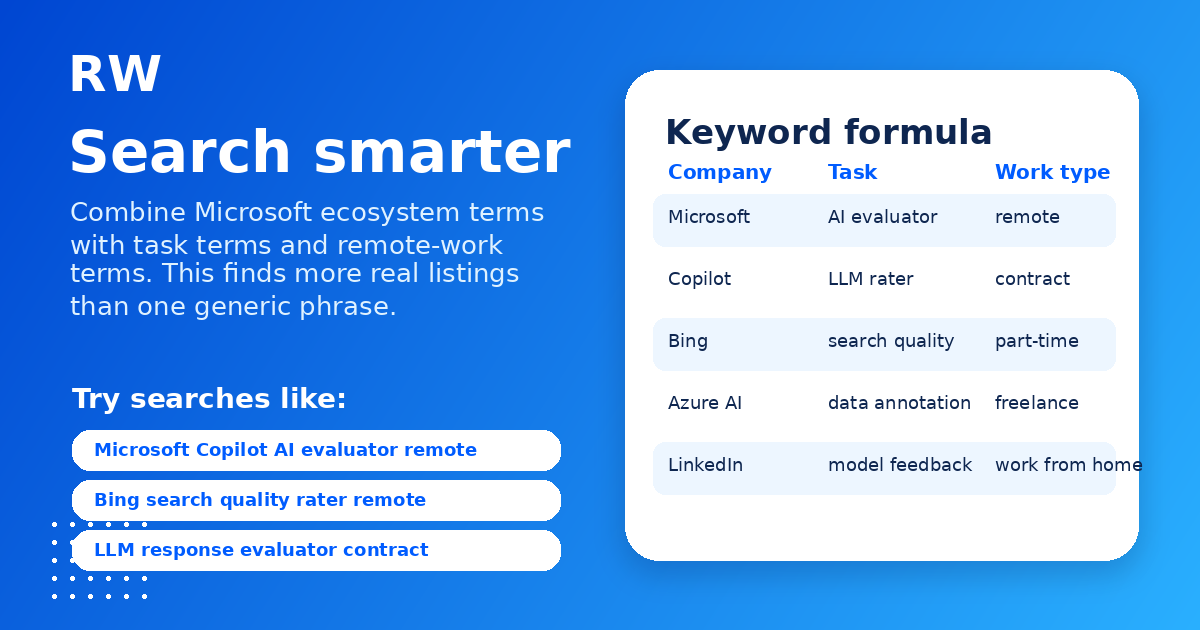
A common mistake is searching only one obvious phrase. The best searches combine three parts: the ecosystem term, the task term, and the work arrangement.
Examples:
- Microsoft Copilot AI evaluator remote
- Copilot response evaluator contract
- Bing search quality rater remote
- Microsoft AI data annotation contractor
- Azure AI evaluator part-time
- LLM evaluator remote contract
- AI response reviewer Microsoft vendor
- AI safety evaluator Copilot
- Search quality analyst Bing AI
- Prompt evaluator remote AI job
- Model response rater freelance
- RLHF evaluator business writing
You can also search without Microsoft in the phrase. Many relevant listings will not include the client name. Try AI evaluator, LLM evaluator, AI model evaluator, search quality rater, prompt response evaluator, data annotation specialist, AI content reviewer, machine learning data associate, human feedback evaluator, and subject matter expert AI trainer.
The main types of remote AI evaluation work to look for
The most relevant roles usually fall into a few categories.
AI response evaluation. You compare two AI answers and decide which is better. The job may ask you to rate helpfulness, factuality, instruction-following, safety, tone, and completeness. Strong writers, editors, teachers, researchers, consultants, and business professionals can be competitive for this work.
Prompt response writing. Instead of only rating answers, you may write the ideal answer yourself. These roles reward clarity, structure, accuracy, and the ability to follow detailed instructions.
Search quality evaluation. This is especially relevant for Bing-style and AI search products. You may judge whether a result answers the query, whether sources are trustworthy, whether summaries are accurate, and whether the answer matches user intent.
AI safety evaluation. You test whether an AI system responds safely to sensitive or risky prompts. This can involve policy reading, red-team-style testing, and careful written explanations.
Data annotation and labeling. You tag, classify, clean, or structure data so a model or search system can learn from it. This can be text, images, code, documents, audio, or domain-specific datasets.
Domain expert review. This is higher-value work where a lawyer, doctor, nurse, finance professional, scientist, teacher, coder, or business specialist reviews outputs in their field. The work can pay more because the model needs expert judgment, not just general writing ability.
Remote Work Union tracks legitimate remote AI training roles across top platforms. Find opportunities that match your background without sorting through scam listings.
Find Roles Hiring Now →How Microsoft Copilot changes the keyword strategy
Copilot is an important keyword because it connects AI to workplace tasks. A Copilot-style evaluator is not only judging whether an answer sounds fluent. They may be judging whether the answer is useful inside a real workflow: drafting a professional email, summarizing a meeting, explaining a spreadsheet, creating a project plan, analyzing a policy, writing code, or helping a customer support agent.
That matters for applicants because many non-coders have valuable experience. A business professional can evaluate whether a sales email is useful. A writer can evaluate tone and clarity. A teacher can evaluate explanations. A lawyer can evaluate legal reasoning within strict boundaries. A nurse can review health communication quality. A finance professional can assess spreadsheet logic and business assumptions. A coder can test code and debugging steps.
When you search, include both AI keywords and ordinary work keywords. For example: Copilot business evaluator, AI writing evaluator, spreadsheet AI evaluator, customer support AI reviewer, AI meeting summary evaluator, AI coding evaluator, legal AI reviewer, healthcare AI data reviewer, finance AI evaluator, and enterprise AI response reviewer.
How to spot real opportunities versus vague or risky listings
Remote AI work attracts legitimate companies, but it also attracts low-quality posts and scams. Be careful with any listing that uses a famous company name to create trust but does not clearly identify the employer, pay structure, work platform, or application process.
A real listing usually explains the task, qualifications, location restrictions, pay range or pay method, assessment process, privacy expectations, and whether the role is contractor or employee. It may still be confidential about the end client, but the company hiring you should be clear.
Be cautious if a recruiter claims you are being hired by Microsoft but sends you to an unrelated form, asks for payment, requests banking information before an offer, pressures you to move off-platform, or cannot provide a legitimate company domain. Big AI companies and their vendors do not need applicants to pay fees to apply.
Also watch for title inflation. A listing may say software engineer, AI researcher, or Microsoft AI project, but the actual task may be annotation, rating, or data review. That is not automatically bad. It can still be paid remote work. The problem is when the title misleads you about pay, status, or long-term stability.
How to position your resume for Microsoft-style AI evaluation work
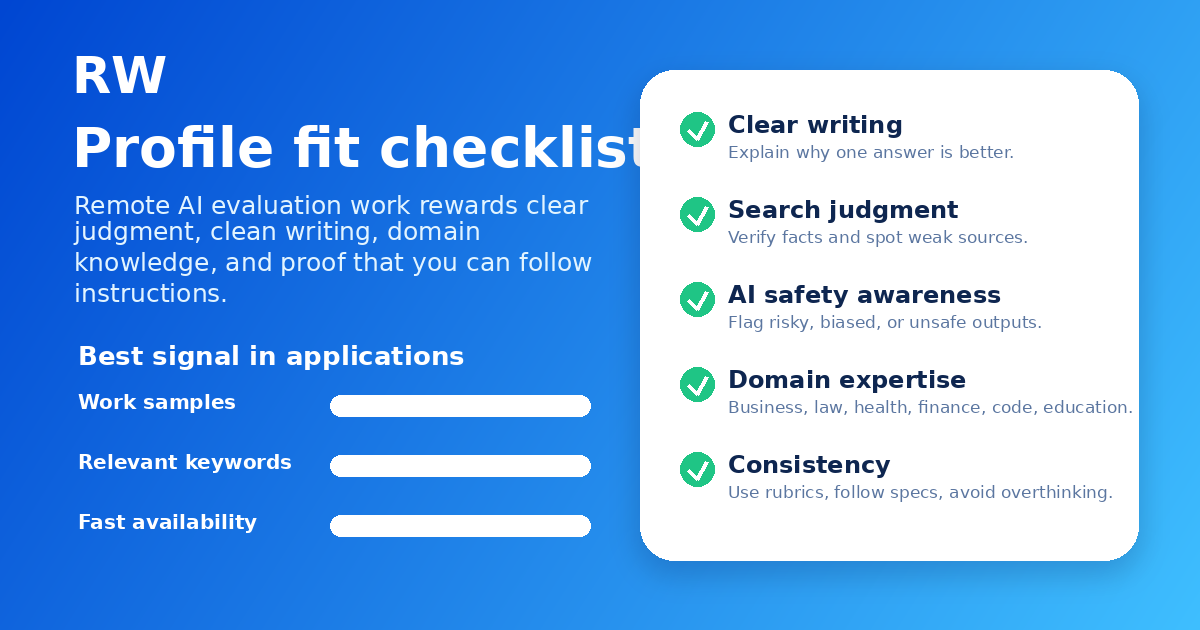
Your resume should not only say that you are interested in AI. It should show that you can evaluate information, follow instructions, and produce reliable written feedback.
Use a skills section with relevant keywords: AI evaluation, LLM evaluation, response rating, prompt writing, fact-checking, data annotation, search quality, content review, rubric-based evaluation, quality assurance, research, editing, technical writing, spreadsheet analysis, policy review, and domain expertise.
Then add evidence. If you are a writer, mention editing, research, content quality, and audience judgment. If you are a business professional, mention analysis, documentation, client communication, operations, strategy, and structured decision-making. If you are a teacher, mention curriculum, assessment, feedback, and explanations. If you are a lawyer, mention legal research, issue spotting, precision, and compliance. If you are in healthcare, mention patient education, documentation, safety, and accuracy. If you code, mention debugging, code review, tests, documentation, and reproducibility.
For many AI evaluation roles, a short work sample can matter as much as a long resume. Create one or two examples where you compare two AI answers, explain the better one, identify factual issues, and rewrite the response more clearly. That sample proves you understand the work.
The best applicants treat this like quality assurance, not casual chatbot use
The people who do well in AI evaluation are usually not the people who simply use AI the most. They are the people who can slow down, read the instructions, apply a rubric, notice missing details, and explain their judgment.
Most evaluation tasks are about consistency. If a task asks you to rate accuracy, do not rate style. If it asks you to compare instruction-following, do not reward a response just because it is longer. If it asks you to check sources, do not rely on confidence or tone. If it asks for safety judgment, do not ignore policy language because the answer sounds helpful.
This is especially important for large AI companies. Microsoft, OpenAI, Anthropic, Google, Meta, and other AI organizations all need models that are not only impressive, but reliable, safe, useful, and aligned with user intent. Human reviewers help define those quality signals.
Where to search besides Microsoft Careers
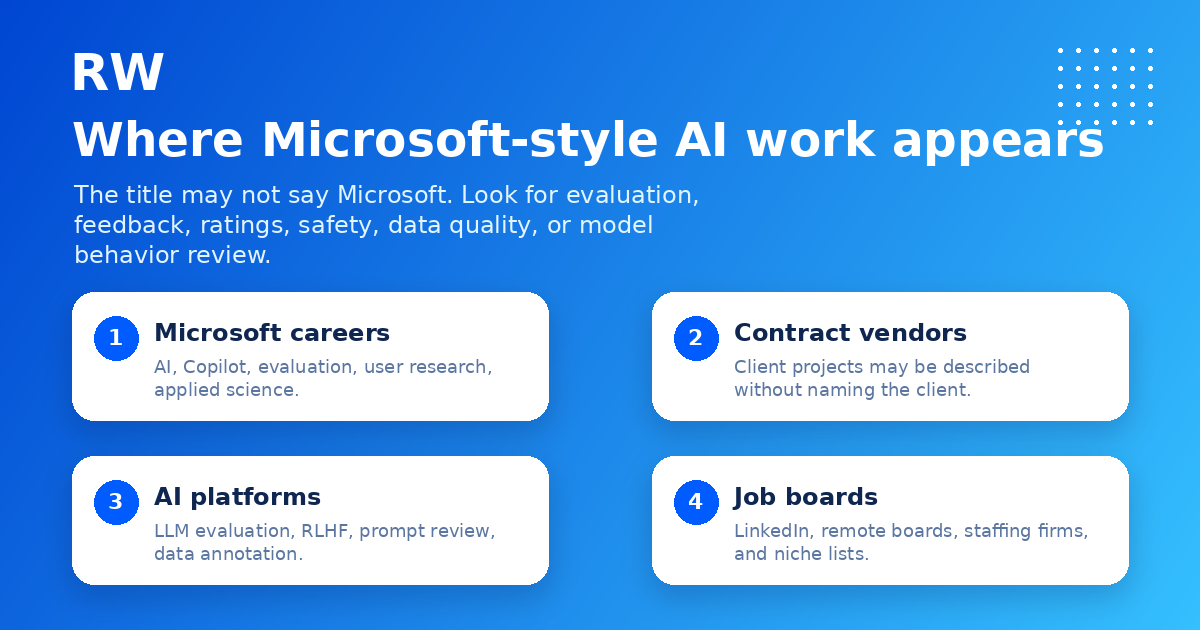
Use Microsoft Careers as one source, not your only source. Also search:
- LinkedIn, using combinations of AI evaluator, LLM evaluator, Copilot, Bing, search quality, Microsoft vendor, and remote contract.
- Staffing firms and consulting firms that hire contractors for large technology clients.
- AI training platforms that post projects for writers, coders, researchers, and subject matter experts.
- Remote job boards that separate real remote contract work from generic work-from-home listings.
- Company career pages for vendors that specialize in data annotation, search relevance, safety testing, localization, and AI model evaluation.
Keep a simple tracker with company, role title, link, pay, location eligibility, application date, assessment status, and follow-up date. AI training work can be inconsistent, so applying to multiple legitimate platforms is usually smarter than waiting on one application.
What pay and stability can look like
Pay varies widely. General data annotation and search rating work may pay less than expert evaluation work. Writing-heavy AI evaluation can pay more if it requires strong English, research ability, or long-form explanations. Technical evaluation, legal review, healthcare review, finance review, and advanced coding tasks may pay more because the applicant pool is smaller and the judgment required is more specialized.
The tradeoff is consistency. Remote AI evaluation work can come in waves. You may pass an assessment and still wait for tasks. A project may fill quickly. A platform may have work one week and nothing the next. A client may restrict work by country, language, education level, or professional background.
That is why the best strategy is to build a stack: one or two direct job searches, several AI training platforms, relevant staffing firms, and a steady habit of checking new listings. Treat it like a pipeline, not a single application.
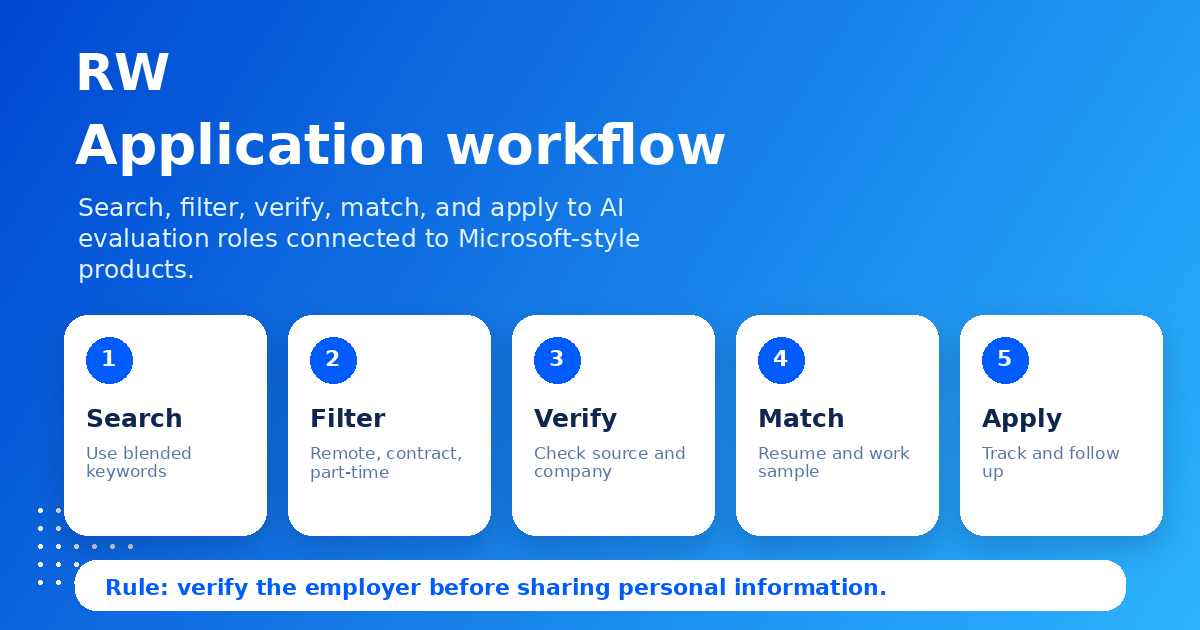
A practical search plan for this week
Here is a simple plan.
Day one: Update your resume for AI evaluation keywords. Add a short summary that connects your background to judgment, writing, research, quality control, or domain expertise.
Day two: Search Microsoft Careers and Microsoft AI Careers for AI, evaluation, Copilot, user research, responsible AI, search, data, and machine learning. Save relevant roles even if you are not ready to apply. The goal is to learn the language.
Day three: Search LinkedIn and remote job boards using blended keywords like Copilot AI evaluator remote, Bing search quality rater, Microsoft AI data annotation contractor, LLM evaluator remote, and AI safety evaluator contract.
Day four: Apply to AI training platforms that match your background. Do not apply as a generic remote worker if you have stronger positioning as a writer, business professional, teacher, researcher, analyst, lawyer, healthcare worker, finance expert, or coder.
Day five: Create one short AI evaluation sample. Compare two AI answers, identify the stronger one, explain the reason, flag any hallucinations, and rewrite the weaker answer. Keep it clean and professional.
Day six and seven: Follow up, track responses, and keep applying. The applicants who win are often not the ones who found one perfect listing. They are the ones who understood the market and kept a disciplined pipeline.
Bottom line
Microsoft AI training jobs are real in the broad sense, but the phrase is too narrow by itself. The better opportunity is remote AI evaluation work connected to the kinds of products Microsoft and other major AI companies are building: Copilot-style assistants, AI search, enterprise AI, code assistants, safety systems, and data-driven model improvement.
Search for the work, not just the brand. Use Microsoft as a keyword, but also use Copilot, Bing, Azure AI, LLM evaluator, search quality rater, AI response reviewer, prompt evaluator, data annotation, AI safety, RLHF, and subject matter expert review. Verify the employer, avoid vague recruiter claims, and position your resume around the quality signals these jobs actually need.
Tip: Use the platform comparison guide to find which AI training platforms match your specific background before applying.
Frequently Asked Questions
What do people usually mean by Microsoft AI training jobs?
The phrase covers two main categories. The first is direct jobs at Microsoft, Microsoft AI, Azure AI, GitHub, LinkedIn, or Copilot teams — roles in machine learning, safety, data, user research, or product. The second is flexible remote AI evaluation work connected to Microsoft's AI ecosystem: Copilot-style answer evaluation, Bing search quality work, LLM response rating, data annotation, AI safety testing, and expert review projects. Many of the latter roles appear through vendor companies, staffing firms, or AI training platforms rather than directly through Microsoft.
What role titles should I search for Microsoft-related AI evaluation work?
Instead of only "Microsoft AI trainer," search for AI evaluator, LLM evaluator, Copilot response evaluator, Bing search quality rater, AI response reviewer, data annotation specialist, RLHF evaluator, AI safety evaluator, prompt evaluator, and subject matter expert AI reviewer. Adding "remote" and "contract" to these searches often produces more relevant results.
Can non-technical professionals qualify for Microsoft-related AI training work?
Yes. Many AI evaluation roles value writing, business judgment, domain expertise, research, and clear feedback over coding skills. Business analysts, writers, teachers, lawyers, healthcare workers, finance professionals, and scientists can all qualify for various AI evaluator roles. Copilot-style evaluation is especially relevant for business professionals who understand workplace communication, documents, spreadsheets, and productivity tasks.
How do I find remote AI evaluation work connected to Microsoft without applying directly to Microsoft?
Search remote job boards and AI training platforms using task-based keywords: AI evaluator, LLM evaluator, search quality rater, Copilot AI evaluator, Bing AI evaluator, data annotation, RLHF evaluator, and AI safety evaluator. Also check LinkedIn for contractor and vendor postings. Staffing firms and data annotation companies often post these roles without mentioning the end client by name.