Many people search for remote jobs and find the same categories over and over: customer support, sales development, virtual assistant work, appointment setting, and entry-level data entry. Those jobs can be legitimate, but they are not the only path. A different category of remote work pays for judgment, subject matter knowledge, clear writing, research ability, and professional experience.
That is the opportunity behind expertise-based remote jobs. Instead of answering a support queue, you may review AI-generated answers, compare two model responses, fact-check a claim, evaluate whether a technical explanation is correct, edit training examples, or help a platform understand what a good answer looks like in a specialized field.
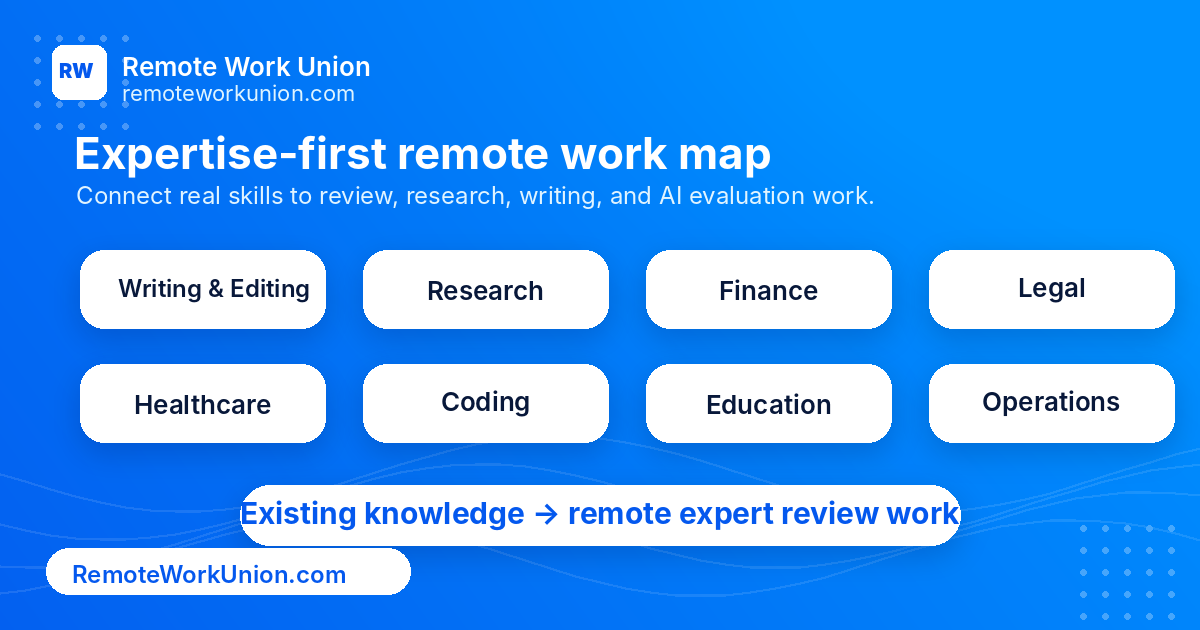
This type of work is especially relevant for educated professionals, strong writers, researchers, analysts, teachers, legal workers, healthcare workers, finance professionals, software engineers, editors, and operators who want flexible work from home without spending the day on phone calls.
What an expertise-based remote job actually is
An expertise-based remote job is work where the main value is not speed on a phone queue. The value is the quality of your thinking. The company needs someone who can read carefully, judge accuracy, explain the difference between good and weak answers, and apply real-world context.
In traditional remote work, many entry-level jobs are built around availability. A company pays you to be online from a set time to a set time so you can handle tickets, chats, calls, or administrative requests. Expertise-based work is more often built around output. You may still have deadlines, quality checks, and project rules, but the core question is whether your judgment improves the final product.
AI training and AI model evaluation have made this category much more visible. AI systems need human reviewers who can evaluate accuracy, helpfulness, safety, reasoning, tone, and domain-specific correctness. That creates remote opportunities for people who can bring expertise to model outputs.
Why this is different from customer support
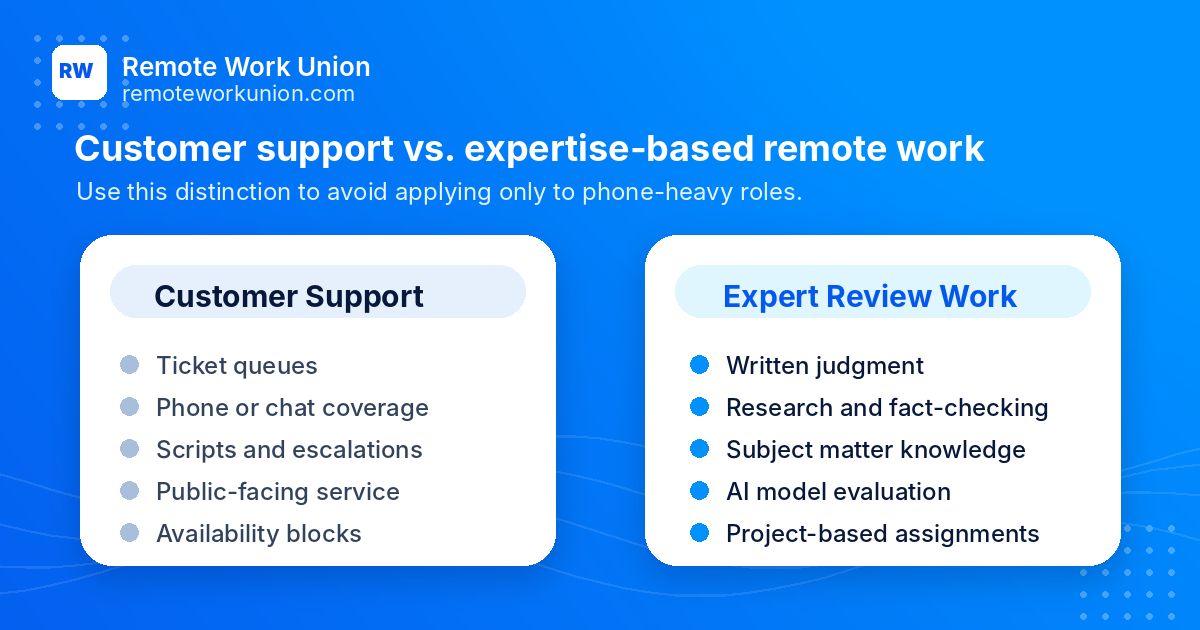
Customer support work usually means helping a user solve a specific problem. You may follow scripts, escalate issues, document tickets, or keep response times low. Expertise-based remote work is different. You are often reviewing information, making comparisons, correcting mistakes, writing feedback, or deciding which answer is better.
- Customer support is usually user-facing. Expert review work is usually internal.
- Customer support often rewards speed and coverage. Expert review work rewards accuracy and judgment.
- Customer support may require phone, chat, or ticket volume. Expert work often requires reading, writing, research, and structured evaluation.
- Customer support usually trains you on company policy. Expert work asks you to bring knowledge from your field.
- Customer support can be repetitive. Expert review work can vary by prompt, subject, project, and evaluation type.
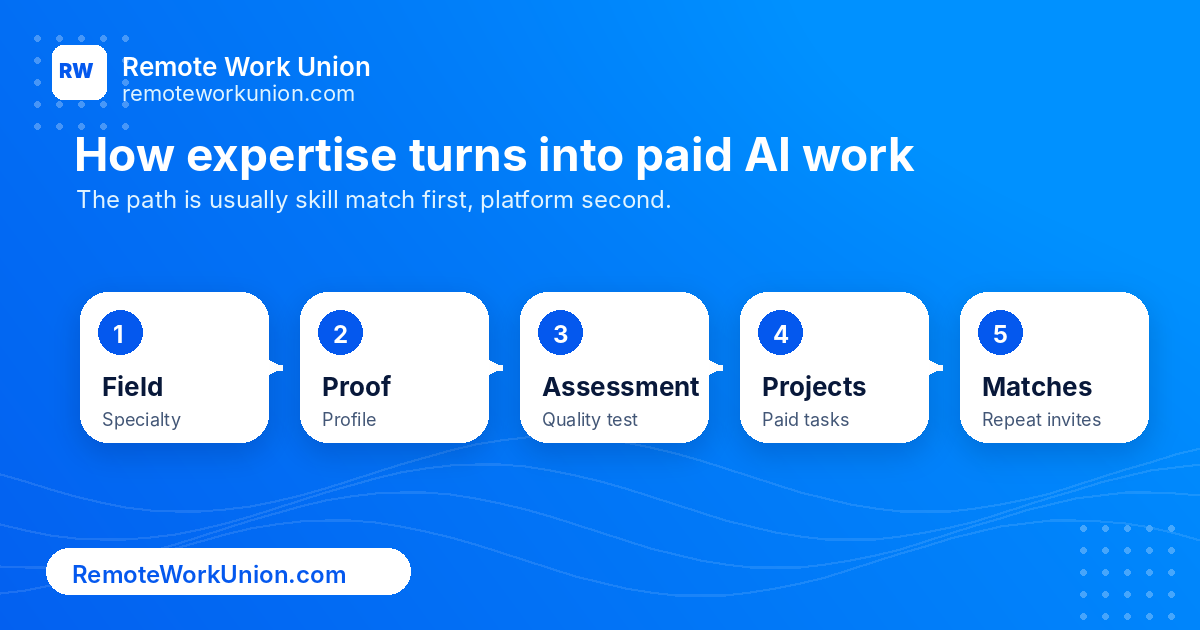
This does not mean expertise-based work is easy. It can be detail-heavy. It can be inconsistent. Some platforms require assessments before paid tasks are available. Some projects move quickly, pause unexpectedly, or require high quality scores to stay active. The advantage is that your existing knowledge can matter.
The biggest category: remote AI evaluation work
Remote AI evaluation work is one of the clearest examples of a job category that pays for expertise. In these roles, human reviewers help improve AI systems by judging model outputs. The work can include ranking two responses, identifying hallucinations, checking whether an answer follows instructions, rewriting weak answers, or explaining why one response is more useful than another.
People search for these jobs using terms like AI evaluator, AI model evaluator, AI trainer, AI training jobs, data annotation, prompt evaluator, RLHF, chatbot evaluator, AI response reviewer, search quality rater, and subject matter expert reviewer.
Large AI companies and AI-adjacent platforms are frequently part of the search landscape. Job seekers often look for opportunities connected to OpenAI, Anthropic, Google, Meta, Microsoft, Amazon, Apple, xAI, Perplexity, Nvidia, and other companies building or supporting AI systems. Some roles are direct company jobs, while many are contract roles through staffing partners, AI training platforms, research vendors, or data annotation companies.
Tip: When searching for AI evaluation roles, do not limit yourself to the biggest AI company names. Many of the most consistent projects come through specialized AI training platforms, research contractors, and expert networks that operate across multiple AI labs simultaneously.
Examples of remote jobs that pay for expertise
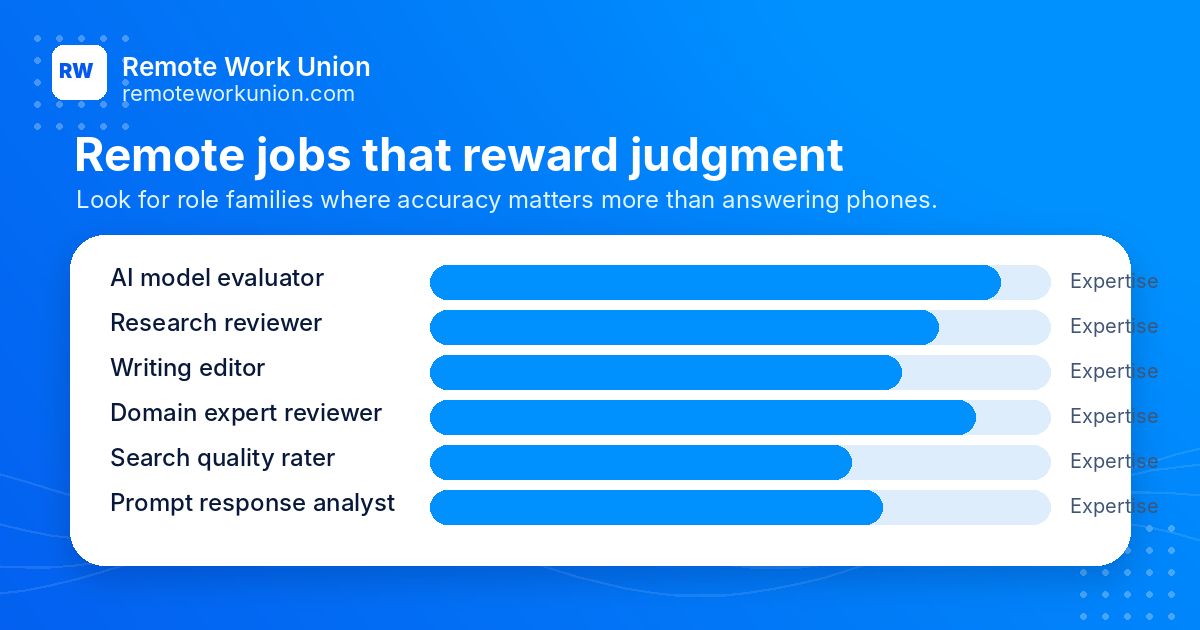
1. AI model evaluator
An AI model evaluator reviews AI-generated answers and decides whether they are accurate, helpful, complete, and safe. This can be general writing work or specialized work in law, medicine, finance, coding, education, science, business, or another subject. See the Mercor guide for one example of how these matches are made on a specialist platform.
2. Subject matter expert reviewer
A subject matter expert reviewer uses professional knowledge to judge content in a specific field. A finance reviewer may evaluate investment explanations or accounting logic. A legal reviewer may examine reasoning, definitions, and risk-sensitive language. A healthcare reviewer may judge medical clarity and whether an answer avoids unsafe advice.
3. AI writing evaluator
A writing evaluator reviews tone, structure, clarity, originality, helpfulness, and instruction-following. Strong writers, editors, journalists, copywriters, teachers, and content strategists can often translate their skills into this kind of work.
4. Research and fact-checking reviewer
Research review roles pay people to verify claims, compare sources, catch weak reasoning, and identify when an answer sounds confident but lacks support. These roles fit people who are comfortable with careful reading, source checking, and clear explanation.
5. Coding and technical evaluator
Software engineers and technical reviewers may evaluate code correctness, debug model responses, compare solutions, improve explanations, or test whether an answer actually solves a programming task. This can appeal to coders who want flexible project work instead of a full-time engineering role.
6. Search quality and content quality rater
Search quality work usually involves rating whether results or answers match user intent. This can overlap with AI search, chatbot evaluation, content moderation standards, and user experience review. The work rewards attention to detail and the ability to apply guidelines consistently.
7. Curriculum, education, and assessment reviewer
Teachers, tutors, professors, test prep specialists, and curriculum writers may find remote work reviewing educational explanations, grading rubrics, learning content, student-style prompts, or AI-generated tutoring responses.
Your expertise is an asset in the AI economy. Remote Work Union helps professionals find legitimate evaluation and expert review roles that match their specific background.
Find Roles Hiring Now →Who is a strong fit for expertise-based remote work?
The best fit is not always the person with the longest resume. It is usually the person who can connect their background to a specific evaluation need. A company does not simply want someone who says they are smart. It wants someone who can show a clear area of knowledge, follow instructions, write concise feedback, and make consistent judgments.
- Writers and editors can emphasize clarity, tone, grammar, structure, and content quality.
- Researchers can emphasize source evaluation, fact-checking, citation habits, and analytical judgment.
- Finance and business professionals can emphasize accounting, markets, operations, strategy, Excel, and quantitative reasoning.
- Legal professionals can emphasize reasoning, precision, risk awareness, and document review experience.
- Healthcare professionals can emphasize safety, patient-friendly explanation, terminology, and clinical context.
- Teachers can emphasize instruction, feedback, rubric use, and curriculum review.
- Coders can emphasize debugging, code review, technical explanation, and testing.
How to position yourself for these roles
Your resume and profile should make your expertise obvious quickly. Many applicants undersell themselves because they describe only job titles. Expertise-based remote jobs need clearer signals: what you know, what you can review, what tools you use, and how you make judgments.
Use a clear expertise headline
Instead of writing a generic headline like "Remote Worker" or "Customer Service Professional," use a headline that connects your background to evaluation work. Examples include "Finance Analyst with AI Evaluation and Research Experience," "Editor and Writing Evaluator," "Legal Researcher for AI Model Review," or "Software Engineer for Code Evaluation Projects."
Add keywords without stuffing
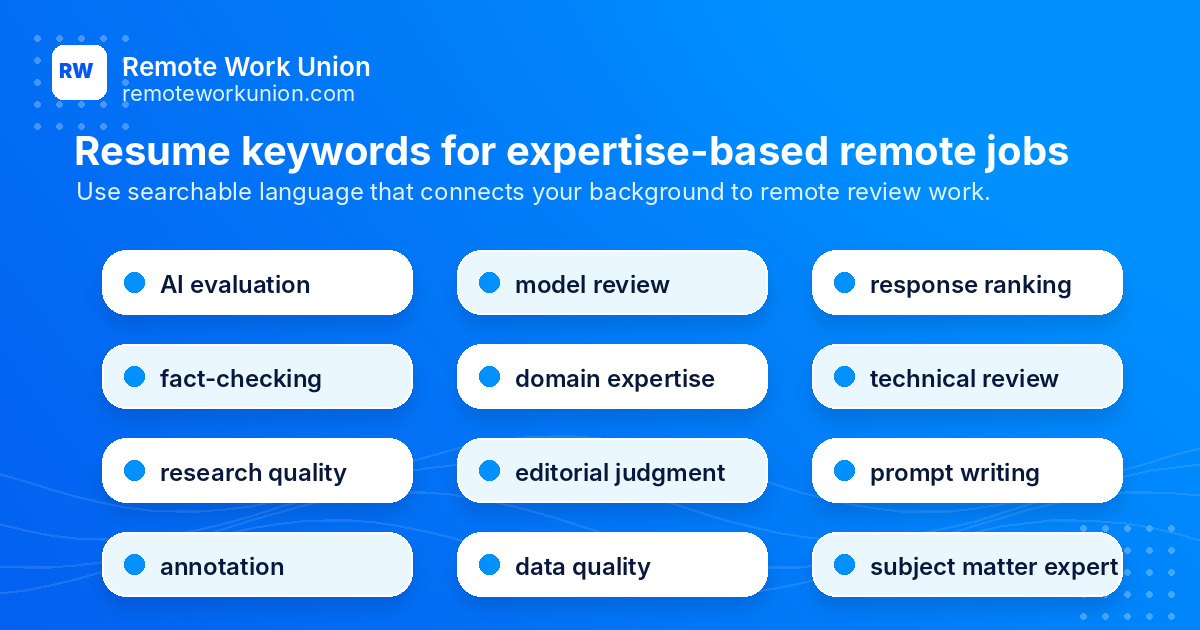
Use searchable phrases naturally throughout your profile: AI model evaluation, prompt evaluation, response ranking, fact-checking, data annotation, domain expertise, content quality, technical review, writing evaluation, research review, and subject matter expert.
Show proof of judgment
Proof does not always need to be a portfolio website. It can be a concise resume bullet showing that you reviewed complex information, improved quality, audited content, evaluated outputs, edited documents, trained teammates, analyzed data, built reports, or created standards. The remote work resume guide has more on structuring these bullets effectively.
How to search for remote jobs that are not customer support
A better search starts with the type of work you want, not just the word remote. Searching only for remote jobs will surface huge volumes of customer support and sales roles. Add expertise keywords to filter toward better matches.
- Search AI evaluator, AI model evaluator, AI trainer, AI response reviewer, and prompt evaluator.
- Search subject matter expert plus your field, such as finance, legal, healthcare, education, coding, writing, or research.
- Search data annotation, RLHF, chatbot evaluator, search quality rater, and content quality analyst.
- Search remote editor, research analyst, fact-checker, assessment reviewer, and technical reviewer.
- Search by platform names and company names, but read each listing carefully to confirm whether it is direct employment, contract work, or a third-party project.
Do not ignore contract roles. Many AI evaluation and expert review opportunities are contract-based, project-based, or part-time. For some people, that flexibility is the point. For others, it is a reason to stack multiple platforms and keep a more stable job search running in parallel. See the full platform comparison for where to start. For a deeper look at getting matched faster, read how to get accepted for remote AI training jobs faster.
What to watch out for
Expertise-based remote work still requires caution. Real remote jobs do not require you to pay to apply. Be careful with vague listings that promise unusually high income without explaining the work. Be careful with platforms that ask for sensitive personal information too early. Read the agreement, understand whether you are a contractor or employee, and track your own income for taxes if the role is contract-based.
Also remember that AI training work can be inconsistent. Passing an assessment does not always mean tasks will be available immediately. A project may need your skill one week and pause the next. Treat each platform as one channel, not your entire career plan. For a broader look at applying across multiple platforms, see the AI training side hustles guide.
Tip: Keep a simple tracking spreadsheet from day one — platform name, application date, assessment status, task volume, hourly rate, and payment schedule. As you build across multiple sources, this becomes invaluable for knowing where to invest time and where to reduce effort.
The best mindset: sell your judgment, not your availability
The strongest applicants do not simply say they are looking for remote work. They explain the kind of problems they can judge. They show the field they understand. They write clearly. They follow instructions. They can compare two answers and explain the difference in plain language.
That is the shift: instead of applying only for jobs that need someone online, apply for remote roles that need someone accurate. Instead of competing only on availability, compete on expertise.
For professionals who do not want to spend the day handling customer support tickets, this is a better lane to explore. AI model evaluation, subject matter expert review, research work, writing evaluation, content quality review, and technical assessment roles can all turn existing knowledge into remote income.
Frequently Asked Questions
What kinds of work count as expertise-based remote jobs?
Expertise-based remote jobs include AI model evaluation, subject matter expert review, AI writing evaluation, research and fact-checking, coding and technical review, search quality rating, and curriculum or assessment review. The common thread is that the value you bring is judgment and domain knowledge, not availability on a phone queue.
Do remote jobs that pay for expertise require advanced degrees?
Not necessarily. Degrees can strengthen an application, especially for specialized fields like law, medicine, or finance. But many platforms weight demonstrated skill over credentials. Writers, editors, researchers, coders, and analysts with strong track records often qualify without advanced degrees. The key is being able to connect your background to a specific evaluation task and show consistent, clear judgment.
How do I find remote jobs that are not customer support?
Add expertise keywords to your search instead of searching only for "remote jobs." Try terms like AI evaluator, AI model evaluator, AI trainer, subject matter expert reviewer, fact-checker, research analyst, writing evaluator, prompt evaluator, RLHF, and data annotation. Combine these with your professional field — for example "legal AI training" or "finance remote evaluator" — to filter out support and sales roles.
What is the difference between customer support remote jobs and expert review work?
Customer support work is usually user-facing, availability-based, and built around ticket or call volume. Expert review work is usually internal, output-based, and built around the quality of your judgment. Customer support trains you on company policy. Expert review asks you to bring knowledge from your own field. Expert review work can also vary more in subject matter, project type, and evaluation format.
How do I position my professional background for AI evaluation work?
Start with a clear expertise headline that names your field and connects it to evaluation work, such as "Finance Analyst with AI Evaluation Experience" or "Legal Researcher for AI Model Review." Add searchable phrases like AI model evaluation, fact-checking, domain expertise, and response ranking throughout your profile. Show proof of judgment through resume bullets that describe reviewing, auditing, grading, editing, or improving quality in past roles.