AI training side hustles are a strong fit for educated professionals because the work often rewards judgment, writing, research, domain knowledge, and careful comparison. Many remote side hustles are built around speed, customer support, sales calls, or repetitive data entry. AI training work can be different. The better projects usually need people who can read carefully, evaluate an answer, explain what is wrong, and apply a rubric with consistency.
That is why consultants, MBAs, lawyers, paralegals, nurses, doctors, medical writers, finance professionals, accountants, data analysts, teachers, tutors, professors, software engineers, editors, journalists, researchers, and graduate students often search for AI evaluator jobs. They are not always looking for a full-time job. Many are looking for flexible online work that can be done from home, at night, on weekends, or between larger contracts.
This guide explains how AI training side hustles work, which educated professionals tend to fit them best, what skills to highlight, where to search, and how to avoid wasting time on low-quality opportunities.
What is an AI training side hustle?
An AI training side hustle is paid remote work that helps improve AI systems. The exact task varies by platform and project. Some tasks are simple. Others require advanced subject matter expertise. In many cases, the worker reviews model outputs from tools similar to ChatGPT, Claude, Gemini, Grok, Copilot, or other AI assistants and then provides structured feedback.
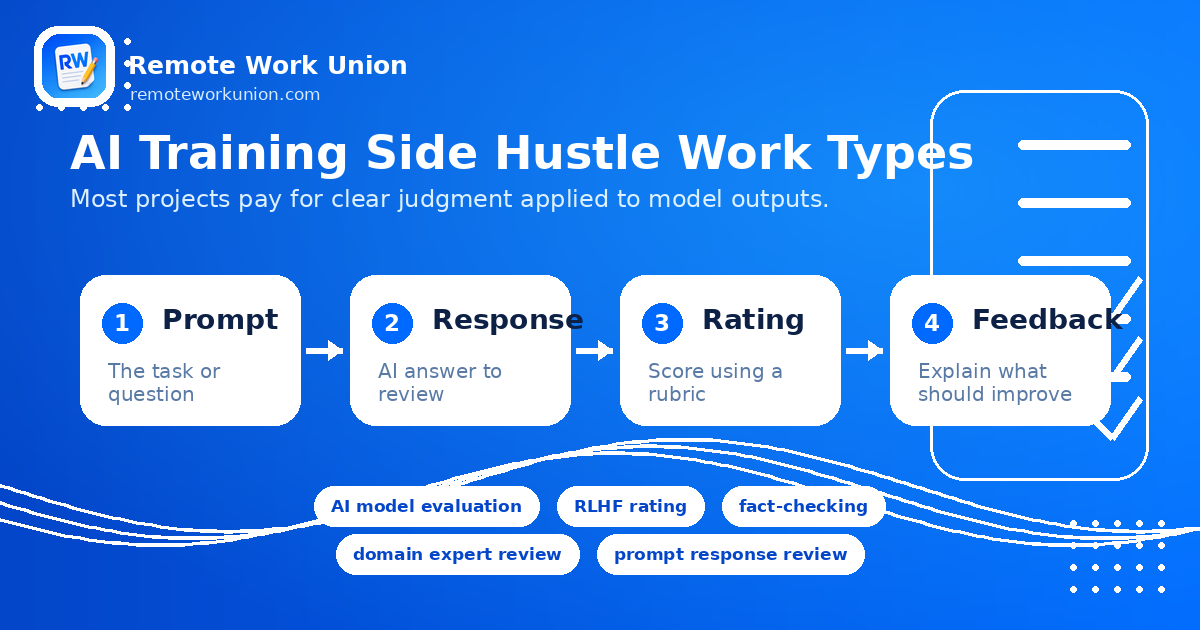
Common task types include:
- AI model evaluation: comparing two AI answers and choosing the better one.
- Prompt response review: checking whether an AI answer follows the user's instructions.
- RLHF rating: using a rubric to score helpfulness, accuracy, safety, clarity, and completeness.
- Fact-checking: verifying claims, sources, calculations, dates, names, or reasoning steps.
- Domain expert review: judging answers in law, medicine, finance, business, education, software, data analysis, science, or technical writing.
- Data annotation: labeling examples so a model can learn patterns.
- AI writing evaluation: reviewing tone, structure, grammar, relevance, and usefulness.
- Safety evaluation: testing whether an AI answer handles sensitive or risky topics properly.
The phrase "AI training" can sound technical, but a large portion of the work is not programming. Some projects do need coders, data scientists, or machine learning specialists. Many others need strong readers, writers, researchers, analysts, and specialists who can explain why one answer is better than another.
Why educated professionals are a strong fit
The most valuable AI training tasks usually require more than clicking boxes. They require judgment. A model might produce an answer that sounds polished but is legally incomplete, medically vague, financially misleading, mathematically wrong, or poorly supported by evidence. An experienced professional is more likely to catch those problems.
Educated professionals often bring four advantages:
- Domain context. They understand the field well enough to notice subtle errors.
- Writing ability. They can explain feedback clearly and concisely.
- Research habits. They know how to verify claims instead of trusting the first result.
- Professional judgment. They can separate a plausible answer from a reliable answer.
This is why AI model evaluation can be a practical side hustle for professionals who already spend their workdays reviewing documents, checking analysis, teaching concepts, evaluating arguments, editing writing, building spreadsheets, researching questions, or making decisions based on incomplete information.
Best professional backgrounds for AI training side hustles
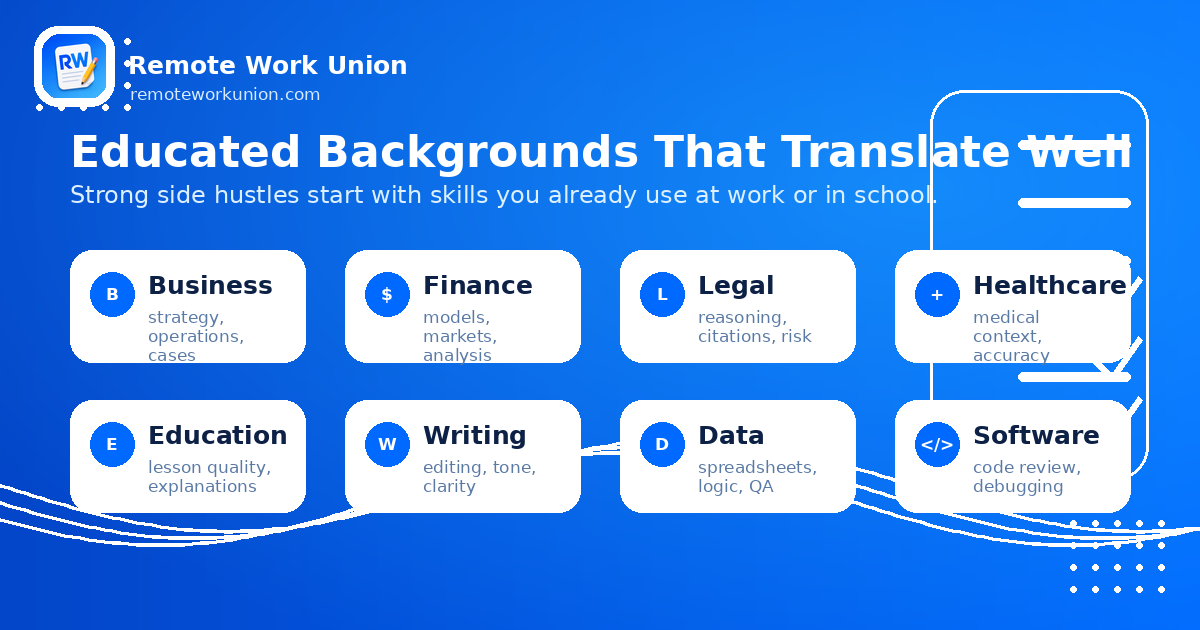
There is no single perfect background. The best fit depends on the project. Still, several categories show up repeatedly in remote AI work.
Business professionals, consultants, and MBAs
Business-focused AI training projects may involve strategy, operations, market research, case analysis, product thinking, business writing, or spreadsheet logic. Consultants and MBAs can be useful because they are trained to structure messy problems, compare options, and explain tradeoffs. Relevant keywords include business analyst, strategy consultant, operations, product strategy, startup operator, project manager, go-to-market, market research, competitive analysis, business writing, and expert review.
Finance, accounting, and data professionals
Finance and accounting professionals may fit projects that involve financial reasoning, spreadsheet review, investment concepts, accounting principles, tax-adjacent explanations, budgeting, business math, or chart interpretation. Data analysts and Excel experts may also find tasks involving tables, formulas, summaries, and quality checks. Useful profile keywords include finance, accounting, FP&A, Excel, Google Sheets, data analysis, SQL, quantitative reasoning, valuation, modeling, audit, reconciliation, and financial writing.
Lawyers, paralegals, and legal researchers
Legal AI evaluation requires caution. Many tasks do not ask contractors to provide legal advice. Instead, they may ask reviewers to evaluate whether a model answer is careful, well-structured, jurisdiction-aware, and appropriately limited. Legal professionals can be valuable because they understand precision, citations, risk, definitions, and the difference between general information and advice. Relevant keywords include legal research, litigation support, contract review, compliance, regulatory research, case law, legal writing, risk review, policy, and citation checking.
Healthcare professionals and medical writers
Healthcare-related AI tasks can require experienced judgment because low-quality medical answers can be risky. Doctors, nurses, pharmacists, medical writers, public health professionals, and healthcare administrators may fit tasks involving patient education, clinical terminology, medical writing quality, safety framing, and factual accuracy. Useful keywords include healthcare, nursing, medical writing, clinical research, patient education, evidence-based review, pharmacy, public health, safety evaluation, and medical terminology.
Teachers, tutors, professors, and academic researchers
Education professionals are often good at evaluating explanations. A model might answer a question correctly but teach it poorly. Teachers and professors can judge whether an answer is age-appropriate, clear, accurate, and pedagogically useful. Relevant keywords include teaching, tutoring, curriculum, assessment, academic writing, instructional design, student feedback, research methods, grading, and explanation quality.
Writers, editors, journalists, and content professionals
Many AI systems produce written answers. That creates demand for people who can evaluate clarity, voice, accuracy, structure, completeness, and audience fit. Editors and journalists can also be strong at checking whether a statement is supported, whether the framing is misleading, and whether an answer buries the most important point. Useful keywords include writing, editing, copyediting, journalism, fact-checking, content strategy, SEO, research, grammar, style, tone, and AI writing evaluator.
Software engineers and technical reviewers
Some of the highest-skill AI evaluation work involves code. These projects may ask reviewers to test code, explain bugs, compare two programming answers, review algorithms, or evaluate whether an answer follows technical instructions. Software professionals who do not want a full-time engineering role may still want coding side projects that pay for focused review. Relevant keywords include Python, JavaScript, SQL, React, data structures, debugging, code review, software engineering, technical writing, QA, and programming assessment.
Skills that matter more than AI hype
Educated professionals sometimes assume they need machine learning experience to get paid training AI models. For some roles, that helps. For many evaluator roles, the core requirement is not building a model. It is evaluating the model's output.
Clear writing
Most projects require short explanations. The best feedback is specific, direct, and evidence-based. Instead of writing "Answer B is better," a strong evaluator explains that Answer B follows the prompt, includes the missing constraint, avoids an unsupported claim, and uses a clearer structure.
Research and verification
AI answers can sound confident while being wrong. Fact-checking skills matter. Reviewers should know how to verify a claim, compare sources, check a calculation, and recognize when a model is overreaching.
Domain judgment
A generalist may not notice that a finance answer confuses revenue with profit, a legal answer ignores jurisdiction, a medical answer gives unsafe certainty, or a coding answer fails on edge cases. Domain knowledge is one of the main reasons expert AI training jobs can pay more than basic labeling work.
Rubric discipline
AI evaluation work is usually rubric-based. You may need to score helpfulness, accuracy, safety, instruction-following, depth, tone, formatting, and completeness. Good reviewers do not invent new standards for every task. They apply the same standards consistently.
Comfort with AI tools
You do not need to be obsessed with AI to qualify for many projects, but you should be comfortable with the category. Familiarity with ChatGPT, Claude, Gemini, Grok, Copilot, and other AI assistants can help you understand how model answers differ. It also helps to know common AI problems such as hallucinations, vague answers, shallow reasoning, unsupported citations, and overconfident summaries.
Tip: Before applying, spend a few sessions using ChatGPT or Claude to answer questions in your own field. Notice where the model sounds confident but is wrong or incomplete. That same critical eye is exactly what AI evaluation platforms are paying for.
Ready to put your expertise to work? Remote Work Union helps professionals find legitimate AI evaluation and expert review roles that match their background.
Find Roles Hiring Now →Where to find AI training side hustles
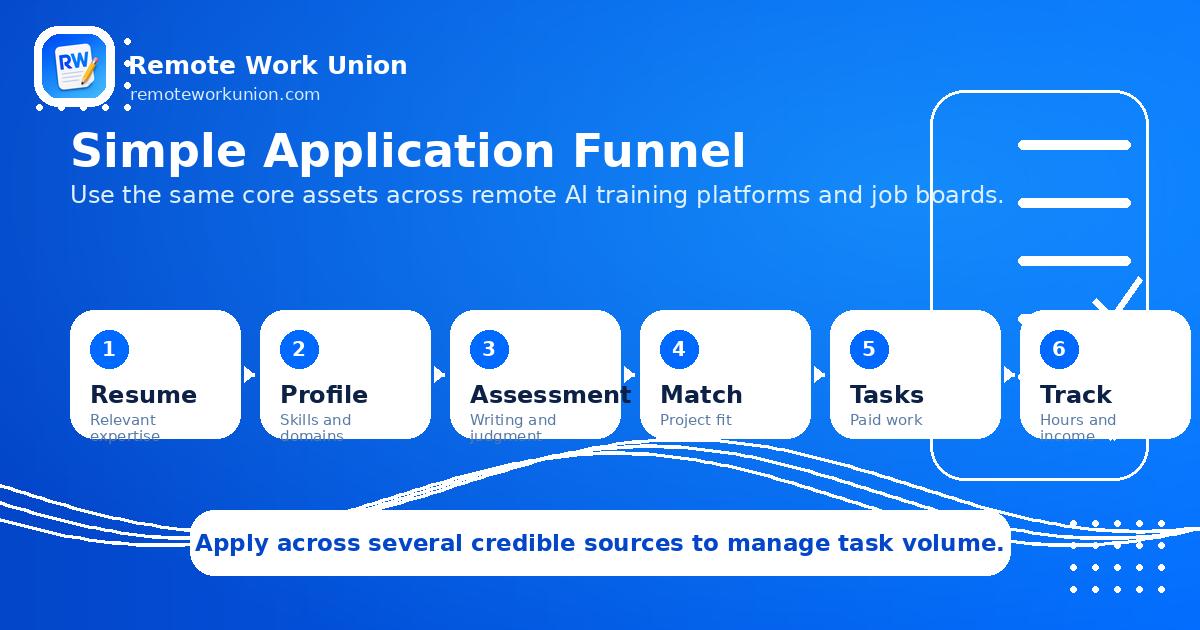
Educated professionals should search broadly. Task volume can change. A platform that is busy one month may be quiet the next. A realistic side hustle strategy usually involves several credible sources, not one application.
Places to search include:
- Remote AI work platforms such as Mercor, Outlier AI, Handshake AI, micro1, Surge AI, Stellar AI, and similar expert networks.
- General job boards with searches like "AI evaluator," "AI trainer," "AI model evaluation," "AI data annotation," "RLHF," "prompt evaluator," "AI content reviewer," and "AI fact checker."
- LinkedIn searches for remote AI evaluation roles, contract AI roles, and domain expert AI work.
- Company career pages and vendor networks connected to major AI ecosystems, including OpenAI, Anthropic, Google, Meta, Microsoft, xAI, and other AI labs or contractors.
- Freelance marketplaces such as Upwork for project-based AI review, writing evaluation, prompt testing, or research support.
- Niche communities for writers, researchers, coders, tutors, healthcare professionals, legal researchers, and data analysts.
When searching, combine the AI keyword with your professional background. For example:
- "finance AI evaluator remote"
- "legal AI training jobs"
- "medical AI reviewer contract"
- "teacher AI evaluator jobs"
- "coding AI evaluation Python"
- "AI writing evaluator remote"
- "RLHF expert reviewer"
- "data annotation domain expert"
This is often more effective than searching only for "remote jobs" or "work from home jobs." See the full platform comparison guide for a deeper look at where to apply first.
How to position your resume and profile
Your resume should not read like a generic job history. It should make your evaluator skills obvious. AI training platforms and hiring teams need to understand what kinds of tasks you can judge well.
A strong profile usually includes:
- Your professional domain: law, finance, healthcare, education, software, business, writing, research, data, or another specialty.
- Tools you use: Excel, Google Sheets, SQL, Python, legal research tools, medical databases, CMS tools, ChatGPT, Claude, Gemini, Copilot, or other relevant software.
- Evaluation skills: editing, fact-checking, quality assurance, audit, grading, review, rubric scoring, research verification, and explanation writing.
- Work format: remote, contract, part-time, project-based, asynchronous, or flexible availability.
- Evidence of clear writing: publications, reports, policy memos, documentation, lesson plans, research summaries, briefs, analyses, or portfolio samples.
For example, a finance professional should not only say "financial analyst." They might say they review spreadsheet models, check assumptions, explain financial concepts clearly, compare scenarios, and catch inconsistencies in business analysis. The goal is to make your profile searchable for remote AI jobs and credible for expert review tasks. The remote work resume guide walks through this positioning in more detail.
What a good AI evaluator task response looks like
A good evaluator response is short, specific, and tied to the rubric. It does not ramble. It does not insult the model. It does not rely on vague preferences.
Weak feedback: "Answer A is better because it sounds more professional."
Stronger feedback: "Answer A is better because it directly answers all three parts of the prompt, includes the requested comparison, and avoids the unsupported claim that appears in Answer B. Answer B is easier to read, but it misses the user's budget constraint, so it is less helpful overall."
That kind of explanation shows judgment. It also shows why educated professionals can be valuable in this market. The work is not only about finding errors. It is about explaining the error in a way that can improve future model behavior.
Tip: Practice writing structured feedback before your first paid task. Pick any AI-generated answer in your field and write a two-to-three sentence critique that names what is good, what is missing, and which rubric dimension it affects. This builds the pattern before you need it under time pressure.
How much time should you commit?
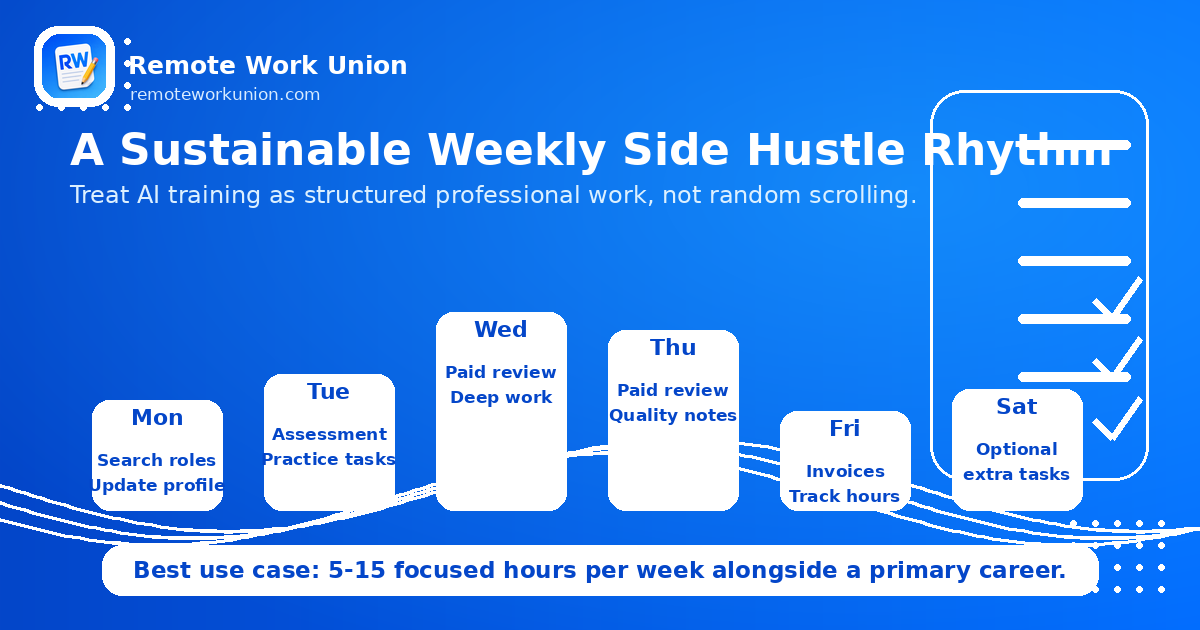
AI training can work well as a side hustle because many projects are remote, asynchronous, and task-based. But it should be treated like real work. A practical starting target is 5 to 10 focused hours per week. Some professionals may scale higher when task volume is available, but it is safer to build gradually.
A reasonable weekly rhythm might look like this:
- One session to search and apply for roles.
- One session to complete assessments or practice tasks.
- Two or three focused sessions for paid task work.
- One short session to track hours, invoices, taxes, and platform updates.
This structure matters because AI training income can be inconsistent. Projects can pause. Assessments can take time. Work volume may depend on your domain, quality score, country, availability, and platform demand. Treat it as a flexible income stream, not a guaranteed replacement for a full-time job unless you have stable volume across multiple sources.
How to avoid scams and low-quality opportunities
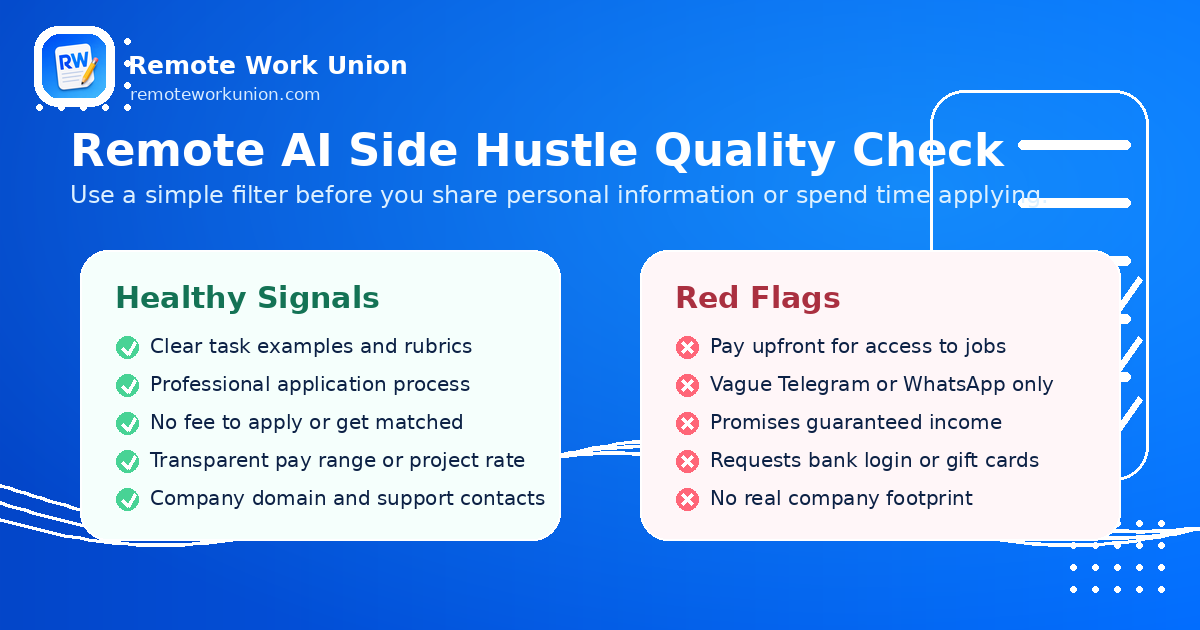
The growth of remote AI work has also created vague offers, copied job posts, and scams. Educated professionals should use a basic filter before applying.
Healthy signals include:
- A real company website and professional domain.
- Clear description of tasks and qualifications.
- No fee to apply, interview, or access jobs.
- A normal application process.
- Written terms, pay details, or project expectations.
- Professional communication through email or a known platform.
Red flags include:
- Paying upfront for access to jobs.
- Promises of guaranteed income with no assessment.
- Requests for bank login information, gift cards, crypto transfers, or suspicious checks.
- Vague messages on Telegram or WhatsApp with no company footprint.
- Job posts that copy the names of major AI companies without linking to a real hiring source.
It is fine to search for OpenAI jobs, Anthropic jobs, Google AI jobs, Meta AI jobs, Microsoft AI jobs, xAI jobs, Gemini AI jobs, Claude AI training jobs, or ChatGPT evaluator jobs. Just remember that many legitimate AI training roles are offered through vendors, contractors, research platforms, or expert networks rather than directly through the most recognizable AI lab. Verify the source before sharing sensitive information.
Application checklist for educated professionals
Before applying to AI training side hustles, prepare a small application kit:
- A one-page or two-page resume focused on relevant expertise.
- A short professional bio that names your domain and evaluator strengths.
- A list of tools, platforms, and technical skills.
- Two or three writing samples or work samples, if available.
- A clear availability window, such as 5 to 10 hours per week.
- A simple spreadsheet to track applications, assessments, task volume, pay rates, and follow-ups.
- A saved list of search terms for AI evaluator jobs, AI model evaluation, RLHF jobs, prompt response review, expert AI training, AI writing evaluator, data annotation, and remote AI jobs.
Apply to more than one platform. Do not overbuild the perfect profile for a single company before testing the market. The fastest way to learn where you fit is to apply, take assessments seriously, track responses, and improve your profile based on what seems to convert. For platform-specific tips, see the guide to getting accepted faster.
The best way to think about the opportunity
AI training side hustles are not magic internet money. They are also not only for engineers. The strongest opportunity is for professionals who can apply real expertise to model outputs and communicate feedback clearly.
For educated professionals, the advantage is not just having a degree. The advantage is being able to evaluate quality. A lawyer can spot risky legal phrasing. A nurse can notice unsafe medical certainty. A teacher can identify a confusing explanation. A finance analyst can catch a flawed assumption. A writer can improve clarity and tone. A software engineer can test whether code actually works.
That is the value AI companies and AI training platforms are trying to capture: human judgment at scale. If you approach the category with realistic expectations, a strong profile, and a willingness to apply across multiple sources, AI training can become a serious remote side hustle. Start with your existing expertise, learn the evaluator format, avoid low-quality offers, and keep building a pipeline of credible opportunities.
For a related perspective on remote expert work that goes beyond customer support, see Remote Jobs That Pay for Expertise Instead of Customer Support.
Frequently Asked Questions
Do I need a machine learning background for AI training side hustles?
No. Many AI training side hustles do not require machine learning experience. The most common tasks involve evaluating model outputs, writing feedback, fact-checking claims, and applying domain knowledge. Professionals with writing, research, legal, finance, healthcare, education, or coding backgrounds often qualify without any technical AI background.
How much can educated professionals earn from AI training side hustles?
Pay varies by platform, project type, and domain. General evaluation tasks often pay in the range of $20–$40 per hour, while specialized expert review work in fields like medicine, law, finance, or software engineering reaches up to $50–$200/hr. Income can also be inconsistent depending on task volume and project availability, so it is best treated as a flexible supplement rather than a fixed salary.
Which professional backgrounds are strongest for AI model evaluation?
Strong backgrounds include law, medicine and healthcare, finance and accounting, software engineering, education and academic research, writing and editing, journalism, and data analysis. Domain specialists tend to qualify for more nuanced projects that pay better than general annotation work. The key is being able to explain why an AI answer is or is not correct in your specific field.
How do I avoid scams when looking for AI training side hustles?
Look for real company websites, clear task descriptions, and no upfront fees. Avoid any offer that asks you to pay to access jobs, sends vague messages on Telegram or WhatsApp, or promises guaranteed income without an assessment. Verify the platform or company source before sharing personal or financial information. Legitimate platforms use professional email communication and clearly describe their work and pay structure.
Can I do AI training side hustles while working full-time?
Yes. Many AI training projects are remote, asynchronous, and task-based, which makes them compatible with a full-time schedule. A practical starting rhythm is 5 to 10 focused hours per week, spread across evenings or weekends. Build gradually to test whether task volume and platform fit matches your availability, and keep income expectations realistic until you have a consistent track record with one or more platforms.