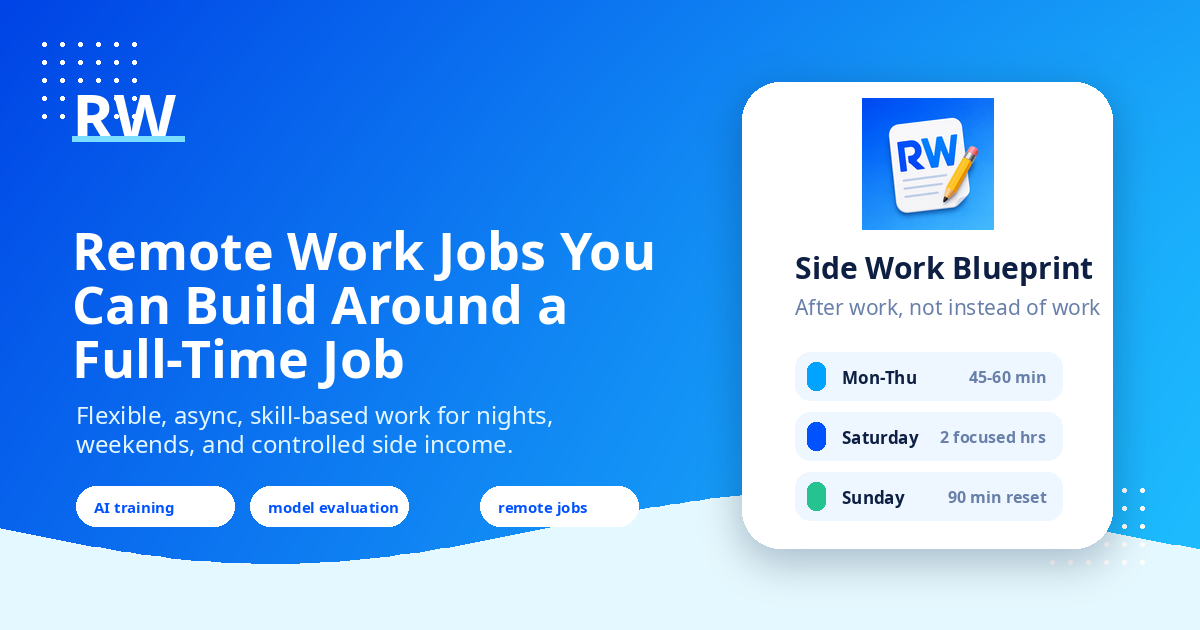
A full-time job does not automatically disqualify you from remote work. It does change the type of remote work you should target. The wrong role will create conflict with meetings, shifts, response-time expectations, and burnout. The right role can be built into early mornings, evenings, weekends, lunch breaks, or a few focused blocks each week.
The key is to look for remote work jobs that are asynchronous, task-based, skill-based, and flexible. In practical terms, that means work where you can log in, complete a defined task, submit an output, and leave without needing to be live on a phone line or in meetings all day. This is why many people with full-time jobs look at AI training jobs, model evaluation, AI data annotation, prompt writing, AI research, editing, proofreading, search evaluation, and other flexible work from home jobs.
This guide is for people who want to build remote income around a job they already have. The goal is not to pretend you have unlimited time. The goal is to choose work that fits your actual schedule, protects your main income, and gives you a realistic path to more remote options over time.
The rule: choose output-based work, not availability-based work
Most remote work falls into two categories: availability-based work and output-based work. Availability-based jobs pay you to be present during a certain window. Customer support phones, live chat coverage, appointment setting, virtual reception, and scheduled sales development roles often work this way. They can be legitimate remote jobs, but they are hard to combine with a separate full-time job because they require fixed hours and immediate responses.
Output-based work is different. You are judged by the task you complete, not by whether you are online for eight straight hours. A model evaluation task may ask you to compare two AI answers and explain which one is better. A prompt writing project may ask you to create realistic prompts for a chatbot. A research task may ask you to verify facts using reliable sources. An editing task may ask you to clean up a document or review content for clarity. These jobs are better candidates for side work because they can often be completed in blocks.
When you are applying, look for words like async, flexible schedule, project-based, task-based, contractor, part-time, remote reviewer, AI evaluator, data annotator, content quality analyst, research contributor, or prompt evaluator. Be careful with listings that emphasize live coverage, phone queue, daily standup, urgent availability, constant Slack response, or scheduled shifts.
The best remote work jobs to build around a full-time job
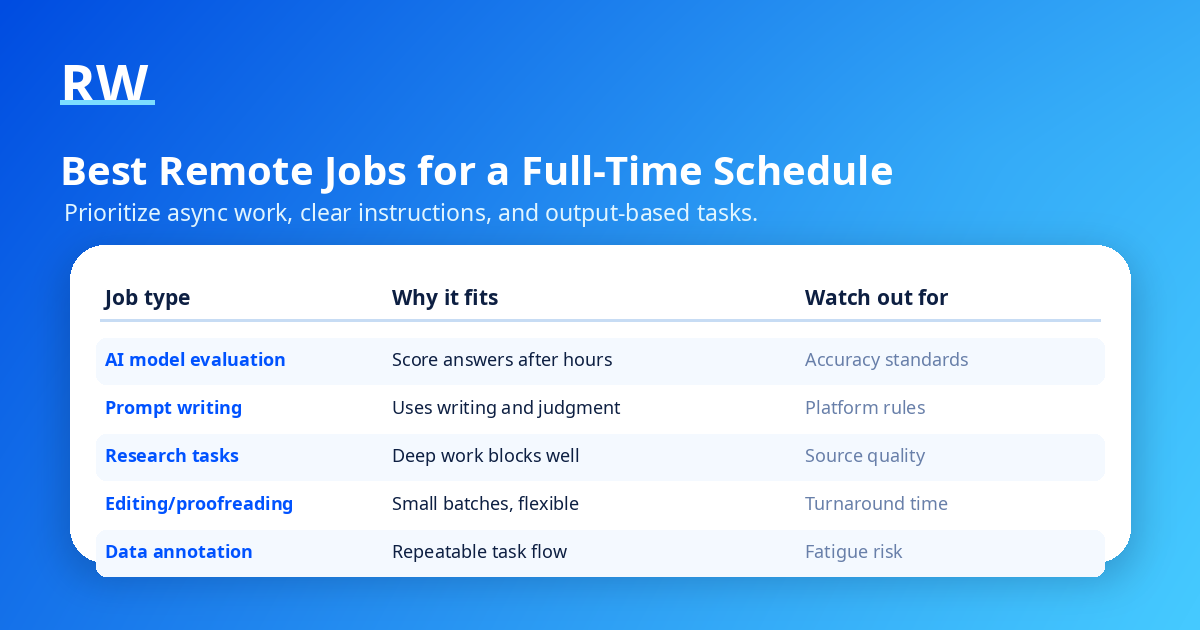
The strongest options are usually jobs where your value comes from judgment, writing, accuracy, subject knowledge, or careful review. You do not need to be a coder for many of these roles. Coding can help for some expert projects, but many AI training and remote reviewer jobs need people who can read carefully, explain decisions, spot mistakes, follow instructions, and use real-world knowledge.
AI model evaluation is one of the most common fits. In these roles, you may compare AI responses, rate the quality of an answer, test whether a model followed instructions, check for factual problems, or explain why one answer is better than another. The work can involve general knowledge, writing, law, finance, science, education, medicine, engineering, marketing, customer service, or other domains depending on the project.
AI data annotation is another flexible category. Annotation can include labeling text, classifying responses, tagging examples, reviewing search results, identifying unsafe content, or helping prepare datasets used in AI systems. Some annotation jobs are repetitive and lower paid, while others require sharper judgment and pay more. The best ones for a full-time worker are the ones with clear task queues and no fixed shift requirement.
Prompt writing and prompt evaluation can also fit well. These jobs use writing skill, creativity, scenario design, and instruction-following. A prompt writer may create examples for an AI model to answer. A prompt evaluator may judge whether the model handled the prompt correctly. People with backgrounds in writing, marketing, teaching, research, operations, legal work, finance, or technical documentation can often position themselves well for this category.
AI research and fact-checking roles can be strong side options because they reward patience and source quality. Instead of rushing through a shift, you are often paid to verify information, compare claims, or produce clear explanations. This kind of work is especially relevant as companies working on AI search, assistants, and model reliability need human reviewers who can tell whether an answer is actually correct.
Editing, proofreading, and content review remain useful work from home categories. These jobs can overlap with AI content review because many companies need humans to check clarity, tone, accuracy, grammar, style, and brand safety. If you already write or edit at work, this can be one of the easiest skill bridges into remote side work.
Why AI training work is especially relevant for side schedules
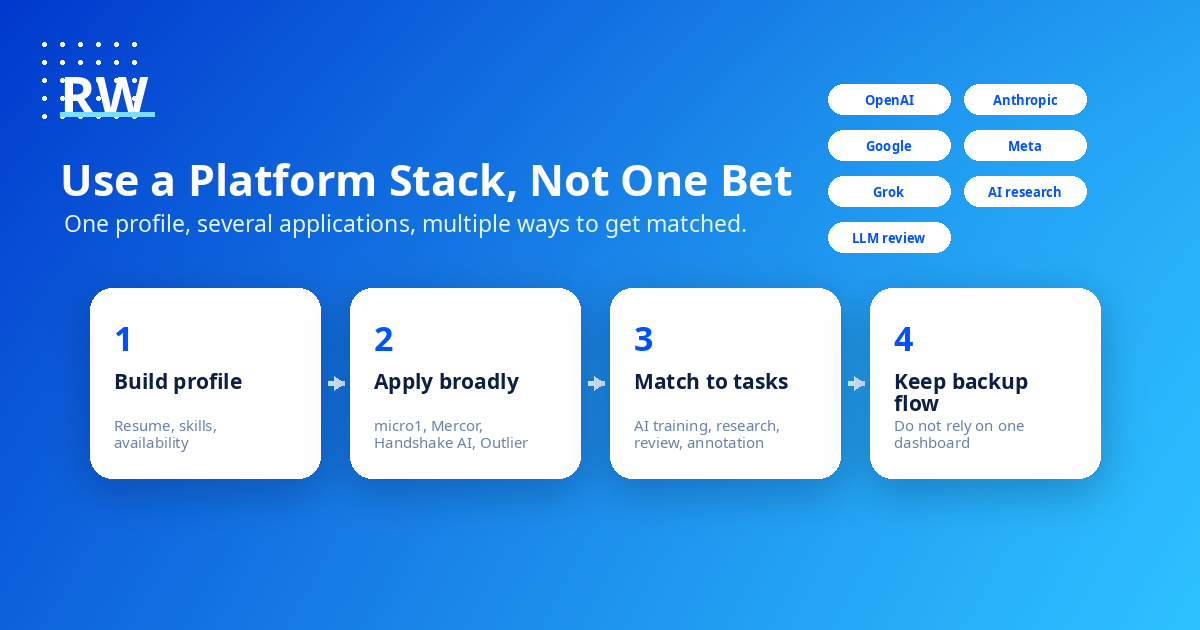
AI training work has become one of the most visible remote work categories because it converts human judgment into structured feedback. Large AI companies and AI labs such as OpenAI, Anthropic, Google, Meta, and Grok have made terms like model evaluation, AI safety review, reinforcement feedback, prompt testing, and response ranking more familiar across the job market. Many workers do not work directly for those companies. They often apply through contractor platforms, vendors, staffing networks, or AI training marketplaces.
Platforms and marketplaces such as micro1, Mercor, Handshake AI, Outlier, and similar services are attractive to side workers because they often screen for skills first, then match workers to projects. A person may apply with writing experience, legal knowledge, finance experience, customer support experience, coding ability, research ability, or broad general knowledge. If accepted, they may receive projects that fit their profile.
The main advantage is flexibility. The main risk is inconsistency. AI training projects can come and go. A dashboard may have tasks one week and very few the next. A full-time worker should treat this as a portfolio of opportunities, not a guaranteed paycheck from one site. The goal is to build a platform stack: several profiles, several applications, several task categories, and a system for checking where work is available.
Remote jobs that usually do not fit well around a full-time job
Some remote jobs look flexible because they are online, but they are not realistic if you already have a full-time schedule. Phone-based customer service is the clearest example. Even if the job is remote, it often requires a quiet environment, fixed shifts, scheduled breaks, and live attendance. That can conflict with your primary job quickly.
Live chat support can have the same problem. It may sound easier than phones, but many chat roles require constant queue coverage and immediate responses. If your main job has meetings, calls, or unpredictable demands, live chat can become impossible.
Sales development, appointment setting, and cold calling are also hard to combine with a full-time job. They often require daytime outreach, fast follow-up, CRM updates, and live conversations. They can pay well, but they are usually not the best starting point for someone trying to build remote work quietly in off-hours.
Virtual assistant jobs vary. Some are flexible and task-based. Others are essentially part-time executive assistant jobs that require same-day responses, calendar management, inbox monitoring, and daytime availability. If you want VA work around a full-time job, target project-based admin, data cleanup, document formatting, research, or content operations rather than live availability support.
Low-paid surveys and gig apps are another trap. They are flexible, but flexibility alone is not enough. The work also has to pay enough to justify your limited time. A full-time worker with five to seven side hours per week should avoid spending those hours on tasks that cannot realistically scale beyond a few dollars.
How to build a weekly schedule that actually works
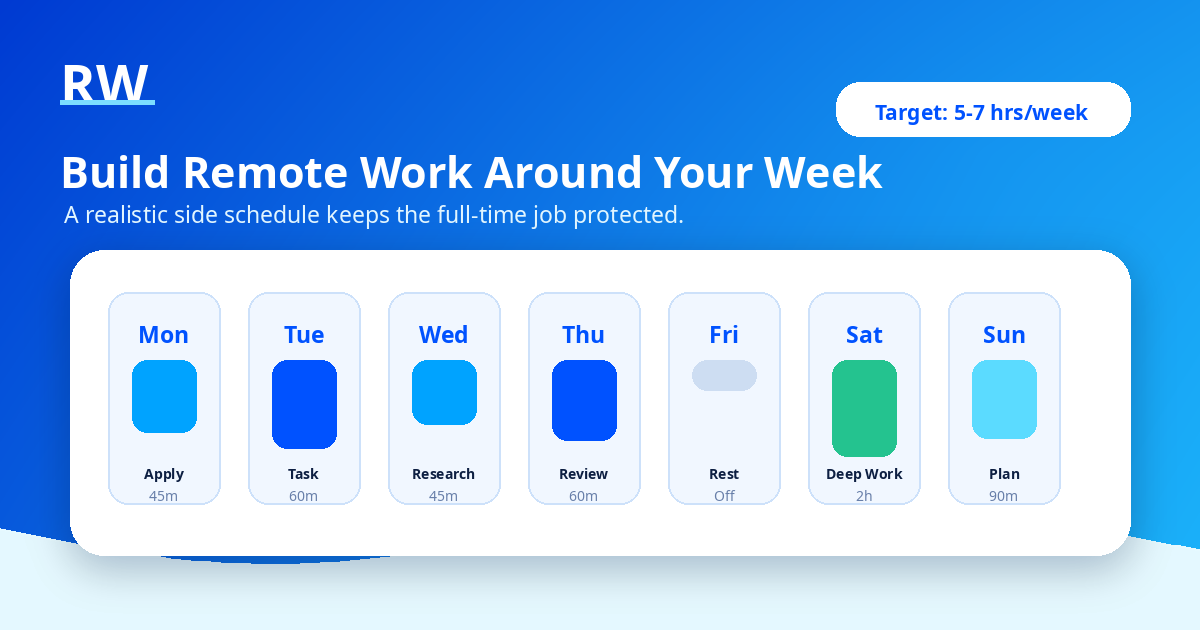
The biggest mistake is trying to work every night. That may work for one week, but it is hard to sustain. A better plan is to create a controlled weekly rhythm. For example, use Monday through Thursday for 45 to 60 minutes of applications, small tasks, profile updates, or tests. Keep Friday open. Use Saturday for a two-hour deep work block. Use Sunday for a 60 to 90 minute reset where you review platforms, check messages, and plan the next week.
This kind of schedule gives you five to seven focused hours without turning every day into a second job. It also protects your energy for your main work. If your full-time job is intense, reduce the weekday blocks and keep one longer weekend session. The goal is consistency, not punishment.
Use different blocks for different kinds of work. Applications require a different mindset than paid tasks. Research tasks require more focus than profile updates. Interview practice requires more energy than checking dashboards. Group similar work together so you are not switching constantly. A simple system could be: Monday for applications, Tuesday for profile improvements, Wednesday for tests, Thursday for task work, Saturday for deep work, Sunday for review.
Track your time honestly. If a platform takes three hours to apply and never responds, that matters. If another platform gives you a test within two days, that matters. If a task pays well but drains you so badly that it hurts your main job, that also matters. Side remote work should be measured by net value, not just hourly rate.
How to apply when you have limited availability
Do not hide that you have limited availability, but do not lead with it in a way that makes you sound unavailable. The stronger message is that you are seeking remote, flexible, task-based work and can complete high-quality assignments in scheduled blocks. Many contractor platforms are designed for people who are not traditional employees, so limited availability is not automatically a problem.
Your profile should emphasize skills that matter for async work: written communication, accuracy, independent work, research, instruction-following, editing, analysis, domain knowledge, and reliability. If you have experience in marketing, law, finance, operations, customer support, HR, real estate, education, software, healthcare, or another field, translate it into task language. For example, a customer support background becomes issue diagnosis, user empathy, policy interpretation, and clear written communication. A marketing background becomes content review, audience analysis, copy evaluation, and prompt design. A finance background becomes numerical reasoning, spreadsheet literacy, business analysis, and risk awareness.
For AI training roles, include keywords that match the work: AI model evaluation, AI response rating, prompt writing, prompt evaluation, data annotation, LLM review, fact-checking, AI research, content quality review, rubric-based scoring, search evaluation, and domain expertise. These terms help platforms and recruiters understand what you are trying to do.
Ready to find flexible remote work that fits around your schedule? Explore AI training, model evaluation, and other async remote opportunities hiring now.
Find Roles Hiring Now →Build a platform stack instead of relying on one site
The safest way to build remote side income is to avoid depending on one platform. One marketplace may pause applications. Another may accept you but have no projects. Another may have work for two weeks and then slow down. A fourth may be slower to accept you but better once you are in. This is normal in contractor remote work.
A practical stack might include two AI training platforms, one research or evaluation platform, one editing or writing marketplace, and one backup category such as virtual admin, bookkeeping support, or content operations. The exact mix depends on your skills. A writer may lean toward prompt writing and editing. A lawyer or paralegal may look for legal AI evaluation. A finance professional may look for business, accounting, spreadsheet, or financial reasoning tasks. A generalist may start with broad AI evaluator and data annotation roles.
Use a simple tracking sheet with columns for platform, application date, role type, pay range, test status, response status, project status, and next action. This prevents you from repeatedly checking the same dashboard with no plan. It also helps you identify which applications are actually producing movement.
Do not treat rejection or silence from one platform as a final verdict. Remote AI work is fragmented. Different platforms screen for different skills, countries, time zones, education levels, language needs, and project requirements. The person who gets no response from one site may be a good fit somewhere else.
Protect your full-time job
Side remote work should not put your main job at risk. Use your own device when required. Follow your employer policies. Do not use confidential information from your job in any outside application, test, prompt, writing sample, or AI training task. Do not complete side work during your employer paid time. Do not accept outside work that creates a conflict of interest.
Also protect your attention. A side platform that constantly interrupts your day may not be worth it. Turn off nonessential notifications during work hours. Check dashboards at set times. Keep task work in blocks. If a side role requires daytime responsiveness, treat that as a sign it may not fit your current life.
The best side remote work makes you more financially flexible without damaging the job that currently pays your bills. The purpose is optionality. Over time, the side work may become a bridge to more remote income, better contract opportunities, or a fully remote career. But the bridge only works if it is stable.
A 30-day plan to start
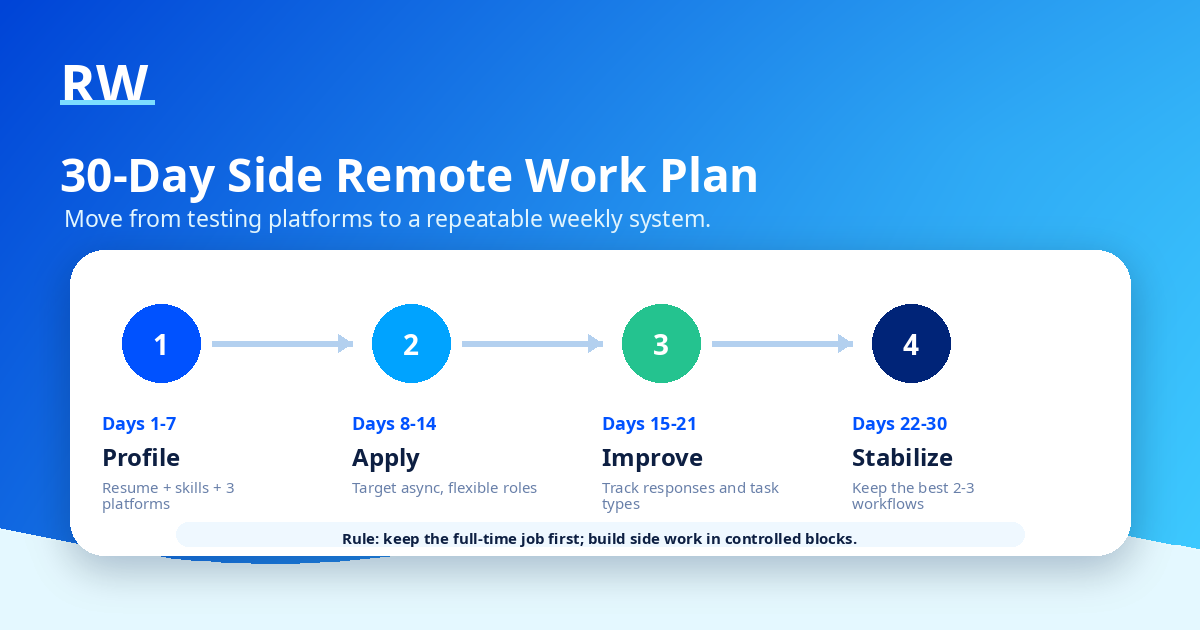
Days 1 through 7 should be profile week. Update your resume for remote work. Add keywords for AI training, model evaluation, research, editing, prompt writing, data annotation, and any domain expertise you have. Create a short profile summary that explains what you are good at and what type of remote work you want. Apply to three to five platforms or roles that appear compatible with async work.
Days 8 through 14 should be application week. Keep applying, but begin customizing. If a role mentions AI model evaluation, your application should discuss judgment, rubric-following, and written explanations. If a role mentions research, emphasize source quality and accuracy. If a role mentions prompt writing, emphasize clear instructions, creativity, and testing edge cases.
Days 15 through 21 should be improvement week. Review what happened. Which platforms responded? Which tests were difficult? Which applications went nowhere? Improve your profile based on the roles you want more of. Add better examples. Tighten your summary. Remove vague language.
Days 22 through 30 should be stabilization week. Decide which two or three platforms deserve your regular attention. Set a weekly schedule. Track time spent, tasks completed, pay received, and next steps. Your goal by the end of the first month is not guaranteed income. Your goal is a repeatable system that can produce opportunities without taking over your life.
Final takeaway
Remote work around a full-time job is possible, but only if you choose the right category. Do not chase every work from home listing. Target flexible remote work that pays for judgment, writing, research, accuracy, domain expertise, and careful review. Build a platform stack. Track your results. Protect your main job. Use small blocks consistently instead of trying to turn every night into another shift.
AI training, model evaluation, prompt writing, data annotation, research, editing, and content review are some of the strongest categories to test first because they can be more compatible with asynchronous schedules. They also let you use skills you may already have from your current career.
Frequently Asked Questions
What kinds of remote work jobs fit around a full-time schedule?
Asynchronous, output-based work like AI model evaluation, data annotation, prompt writing, editing, and research are the strongest fits because you can complete tasks in scheduled blocks rather than requiring fixed hours or live availability.
Can I do AI training work as a side job?
Yes. Many AI training platforms match workers to task-based projects that can be completed outside of normal business hours. The main requirement is accuracy and consistency, not a fixed schedule.
What platforms should I try first?
Platforms like micro1, Mercor, Handshake AI, and Outlier are worth applying to if you have writing, research, analysis, legal, finance, or domain expertise. Apply to several so you are not dependent on one account.
How many hours per week is realistic?
Five to seven focused hours per week is a sustainable starting point for most full-time workers. That is enough to apply, complete tests, and do paid tasks without burning out.
What should I avoid when looking for remote side work?
Avoid remote jobs that require live phone coverage, fixed shifts, constant Slack presence, or daytime availability windows that overlap with your main job. These are hard to sustain alongside full-time work.