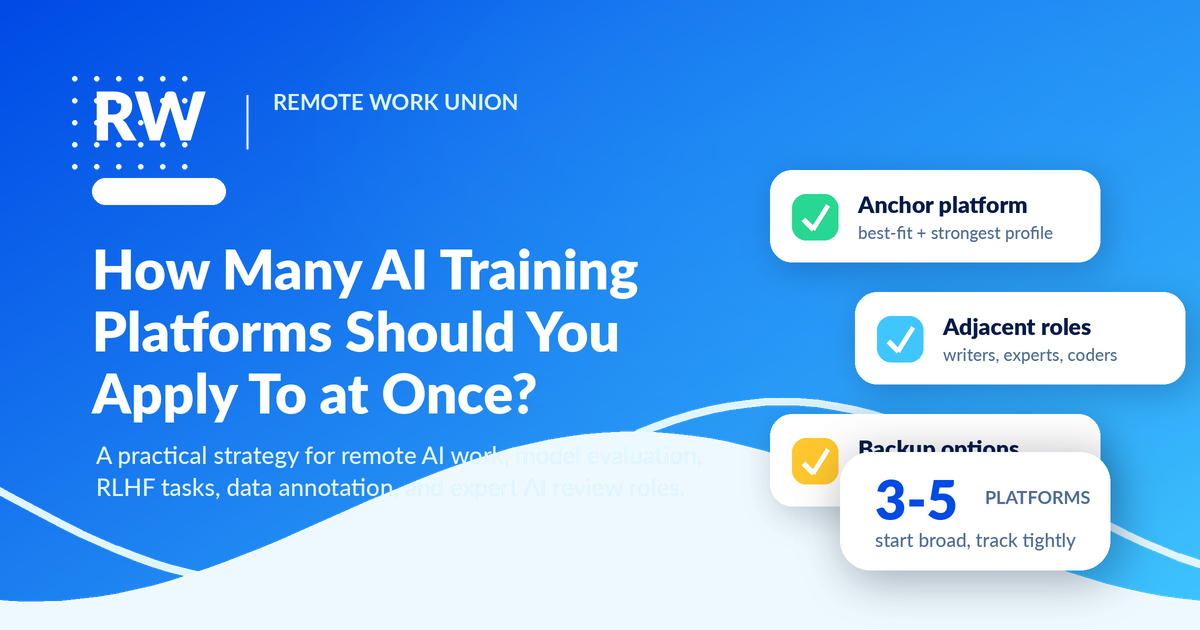
The number one question remote workers ask when they start exploring AI training jobs is also the most practical one: how many platforms should I apply to at the same time? Apply to too few and you are dependent on one platform's availability. Apply to too many and you end up with weak profiles everywhere, lost assessment deadlines, and no clear picture of what is working.
The answer for most people is three to five platforms. That number is large enough to give you real pipeline diversity and small enough to let you actually complete each application with care. This guide explains how to choose which platforms to include, how to stagger applications, how to track everything, and how to build the kind of multi-platform AI work pipeline that holds up over time.
The Core Answer: 3–5 Platforms Is a Reasonable Starting Target
Remote AI training work is project-based. That means a platform might have ten roles for your skill set this week and none next month. No single platform can guarantee consistent volume, and most platforms will tell you this openly. Building a pipeline across three to five platforms protects you against that unpredictability without creating so much overhead that you cannot manage the applications properly.
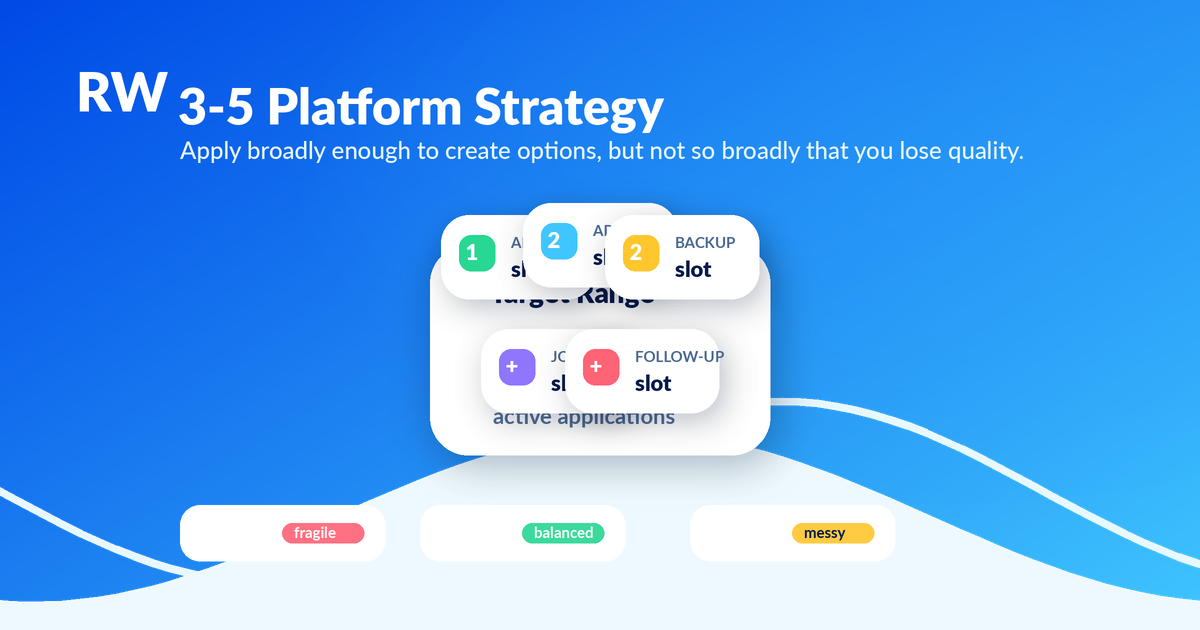
Three platforms is the minimum for real pipeline diversity. Five is about the maximum most people can manage while still completing each application well. If you apply to more than five simultaneously, you will almost certainly start cutting corners on profiles, assessments, and follow-ups. The platforms notice this. A weak assessment is worse than no application at all because it can affect how the platform weights future submissions.
Key principle: The goal is not to cover the most ground. The goal is to build strong enough standing on multiple platforms that you always have work available somewhere. Three strong profiles beat ten weak ones every time.
Why Applying to Just One Platform Is a Mistake
The most common mistake new remote AI workers make is applying to one platform — usually the one they heard about first — and waiting. The problem is that AI training work is not structured like a traditional job. There is no guaranteed weekly workload. Projects open and close. Platforms onboard contractors in batches. Your skill set may be a perfect fit for a project that does not exist yet.
When you rely on a single platform, you have no leverage. If that platform pauses intake, ends a project you were working on, or simply does not need your skill set this week, your income drops to zero. You also have no data. With one application, you cannot tell if a slow response is a problem with your profile, a platform-wide slowdown, or just the normal rhythm of contractor work.
Single-platform dependence also misses a real opportunity. The evaluator skills you build on one platform — reading carefully, comparing AI responses, writing clear rationale, following rubrics — transfer directly to every other AI training platform. The work you do to qualify for one platform essentially qualifies you for others. There is no good reason not to use that leverage.
Why Applying to Too Many at Once Creates Problems
The opposite mistake is just as common. Some remote workers, after reading that multi-platform strategies are important, apply to every AI training platform they can find in a single week. This creates a cluster of problems that is hard to unwind.
First, profile quality drops. Each AI training platform has its own profile fields, assessment formats, and matching logic. A profile that works on Mercor may need adjustments for Handshake AI or micro1. When you are rushing through fifteen applications, every profile ends up generic — and generic profiles match poorly.
Second, you lose track of assessments. Most platforms require a timed or time-sensitive qualification assessment. If you have six assessments outstanding simultaneously, you will almost certainly miss deadlines, rush answers, or confuse which rubric applies to which platform. A failed assessment on a platform you were not ready for can delay your standing there by weeks.
Third, branding becomes inconsistent. Different profiles using different skill framing, different experience descriptions, and different availability ranges create a confusing picture if a recruiter ever checks across platforms. Consistency is a trust signal.
The practical limit is five active applications at any one time, and for most people starting out, three is a better number to start with before expanding.
How to Choose Which Platforms to Apply To
Not all AI training platforms are the same. Some focus on generalist evaluation work. Some require deep domain expertise. Some pay higher rates for narrower skill sets. The right starting mix depends on your background.
The core platforms for most applicants:
- Mercor — Expert-matched AI training work. Mercor uses an AI interview to match you to projects in your domain. Strong fit for writers, researchers, finance professionals, legal experts, engineers, and domain specialists. Pay tends to reflect expertise.
- Handshake AI — Fellowship-style remote AI work. Strong for recent graduates and students, but also open to professionals. Uses a referral and fellowship model that can accelerate your placement.
- micro1 — Expert AI evaluation platform with a focus on higher-skill technical and professional roles. Strong for engineers, researchers, and domain specialists. Pays $50–$200/hr for qualified applicants.
- Outlier AI — One of the most established AI training platforms. Strong generalist and specialist tracks, with a wide range of task types including writing evaluation, coding, math, and research. Available in many countries.
Additional options worth considering:
- Surge AI — Data annotation and AI training tasks. Good for high-volume task work and entry-level evaluation roles.
- Stellar AI — Newer platform with evaluation opportunities in emerging AI domains. Worth monitoring and applying to if your skill set fits announced projects.
Supplemental channels:
- LinkedIn AI jobs — Search for "AI evaluator," "AI trainer," "prompt evaluator," or "model reviewer." Direct-hire and contract roles appear here that never show up on the major platforms.
- Company career pages — AI companies like Anthropic, Scale AI, Appen, Lionbridge AI, and DataAnnotation post contractor and evaluator roles directly. Check quarterly.
Your starting mix should lead with the two or three platforms that best match your strongest skill lane. If you are a writer or researcher, Outlier AI and Mercor are natural first choices. If you are a recent graduate, Handshake AI should be in your first batch. If you have deep technical expertise, micro1 deserves priority consideration.
How to Stagger Your Applications
The most effective approach is not to apply to all platforms simultaneously. Stagger your applications in a deliberate sequence that lets you learn from each one before launching the next.
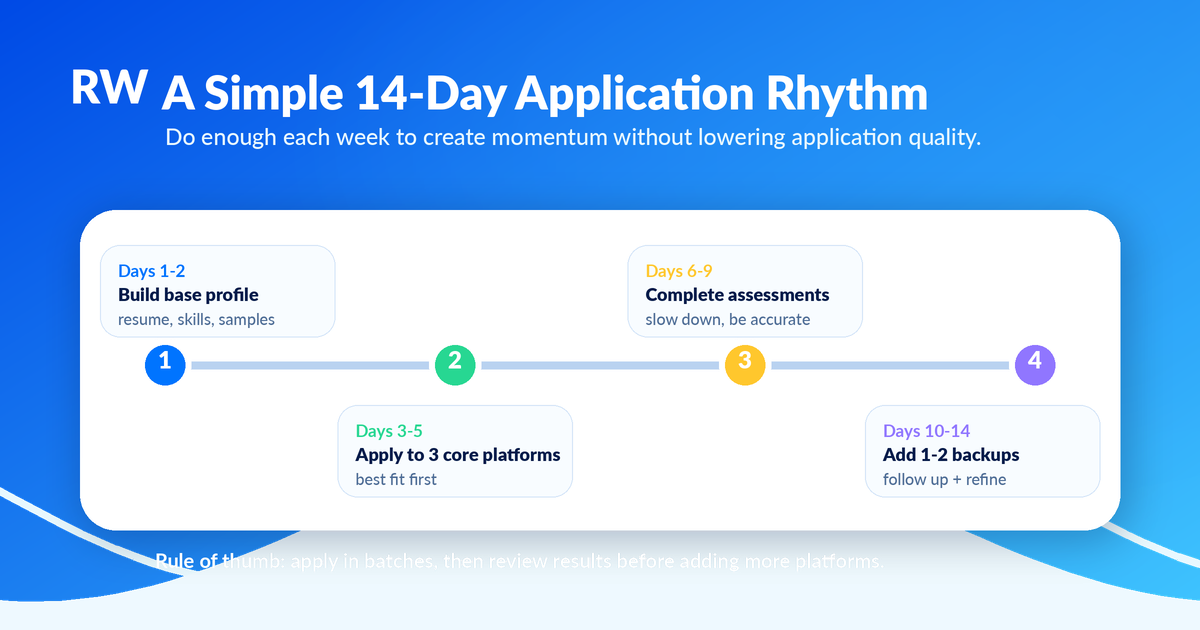
Start with the platform where you have the strongest fit. Complete that profile fully, prepare a good assessment, and submit it. Use the first week to see how the platform responds. If you pass the assessment quickly and are placed in a project, you have a working version of your profile. Use that version — with minor adjustments — when you apply to the second and third platforms.
If the first platform does not move within a week, do not wait. Apply to your second platform in parallel. By the end of week two you should have two to three active applications at various stages. Each subsequent platform benefits from the signal data you collected from earlier ones. Which skill framing got matched? Which assessment format tripped you up? What availability range did the platform prefer?
How to Track Multiple Applications
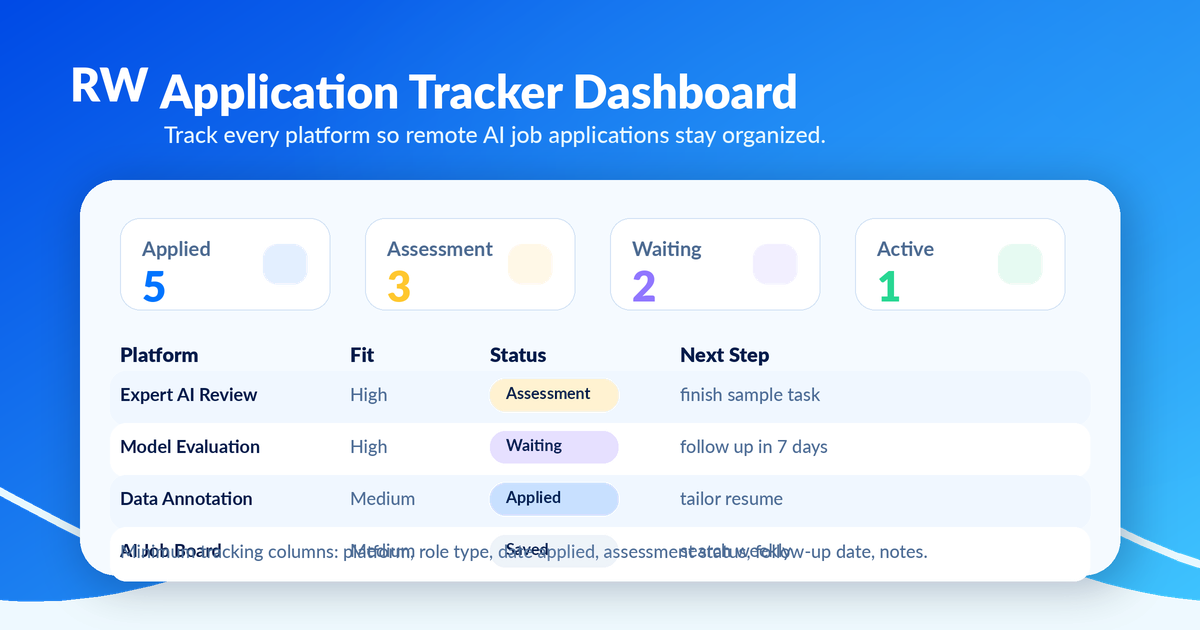
Once you have two or more active applications, a simple tracker is not optional — it is necessary. Without one, you will miss assessment deadlines, send follow-ups to the wrong platform, or forget which resume version you submitted where.
A basic spreadsheet with the following columns covers most situations:
- Platform name — Mercor, Outlier AI, Handshake AI, micro1, etc.
- Role or project type — Writing evaluation, coding review, general annotation, etc.
- Date applied
- Profile version used — Note which skill framing you used (e.g., "finance lane v2")
- Assessment status — Not sent / Pending / Submitted / Passed / Failed / Waitlisted
- Assessment deadline — Many assessments are time-limited
- Follow-up date — When to check for a response if you haven't heard back
- Pay range — If known
- Notes — Any platform-specific observations
Keep the tracker simple. A spreadsheet with eight to ten columns that you actually use is more valuable than a complex project management system you abandon after three days. Update it every time something changes — a new assessment arrives, a status changes, or a platform responds.
Remote Work Union connects you to legitimate remote AI training and evaluation roles across multiple platforms. Apply for free.
Find Roles Hiring Now →What to Do When One Platform Moves and Another Doesn't
This is the normal state of multi-platform applications, not an exception. Platforms operate on different timelines, have different project cycles, and match differently. One platform may respond within three days while another takes three weeks. A third may never respond to a particular profile at all.
When one platform advances you and others are quiet, do not abandon the quiet ones. Keep the tracker active and continue checking. Many applicants get placed on Mercor three months after applying because a project opened that matched their skill set exactly. Patience combined with continued applications is the right approach.
When a platform advances you into paid work, prioritize quality on that platform. High-quality work on one platform often generates referrals, repeat projects, and better matching on future tasks. Inconsistent performance on a platform that is paying you because you are juggling too many other applications is a mistake that compounds over time.
If a platform has been quiet for four to six weeks despite follow-ups, move it to a lower-priority tier in your tracker and focus your energy elsewhere. Do not delete it. AI training project availability changes, and a platform that has no work for your profile today may have a perfect project in two months.
Assessment Quality: The Same Core Skills Transfer Across Platforms
One of the advantages of the multi-platform approach that most applicants miss is that the assessment skills you develop are not platform-specific. The core competencies that AI training platforms evaluate — reading carefully, following instructions, comparing responses accurately, writing clear rationale, and applying consistent judgment — are the same across Mercor, Outlier AI, Handshake AI, micro1, Surge AI, and most other legitimate AI training platforms.
This means that preparing a strong assessment for one platform makes you better at every subsequent one. If you practice writing structured evaluation rationale for Outlier AI, that same skill improves your performance on Mercor assessments. If you learn how to identify instruction-following failures on one platform, that pattern recognition transfers directly.
The practical implication is that you should treat every assessment as professional development, not just a qualification hurdle. The more assessments you complete well, the better you get at the underlying skill, and the more consistently you pass across platforms. Applicants who treat assessments as checkbox exercises plateau quickly. Applicants who study their results and improve their evaluation approach build compound advantages over time.
A Practical 30-Day Plan
The following four-week approach is designed for someone starting from scratch or restarting a stalled pipeline. Adjust based on how quickly platforms respond in your skill lane.
Week 1 — Launch your first two applications: Choose your two strongest platform fits. Complete one profile fully — bio, skills, availability, proof. Submit the application and any required assessment. Set a tracker entry for each. Spend the remaining time in the week researching the second platform and building a profile for it. Submit by the end of the week.
Week 2 — Assess results and add one or two more: Check the status of your first two applications. If an assessment result is back, analyze it. What worked? What was weak? Use that information to adjust your profile framing. Add one or two more platforms based on what you learned. If your writing lane performed well, consider adding another platform that uses writing evaluation heavily. If a domain-specific framing landed, lean into it further.
Weeks 3 and 4 — Focus on converting and keeping the pipeline active: By week three, you should have three to five platforms in some stage of your pipeline. Focus your energy on the platforms that are showing movement — completing assessments promptly, responding to messages within hours, and delivering high-quality work if you have been placed. Keep adding to quiet platforms only if your total active count drops below three. Maintain your tracker daily.
Tip: The 30-day plan is a starting point, not a one-time project. AI training work pipelines are maintained, not built once. Keep one slot in your tracker reserved for a new platform you are researching at any given time.
Final Takeaway
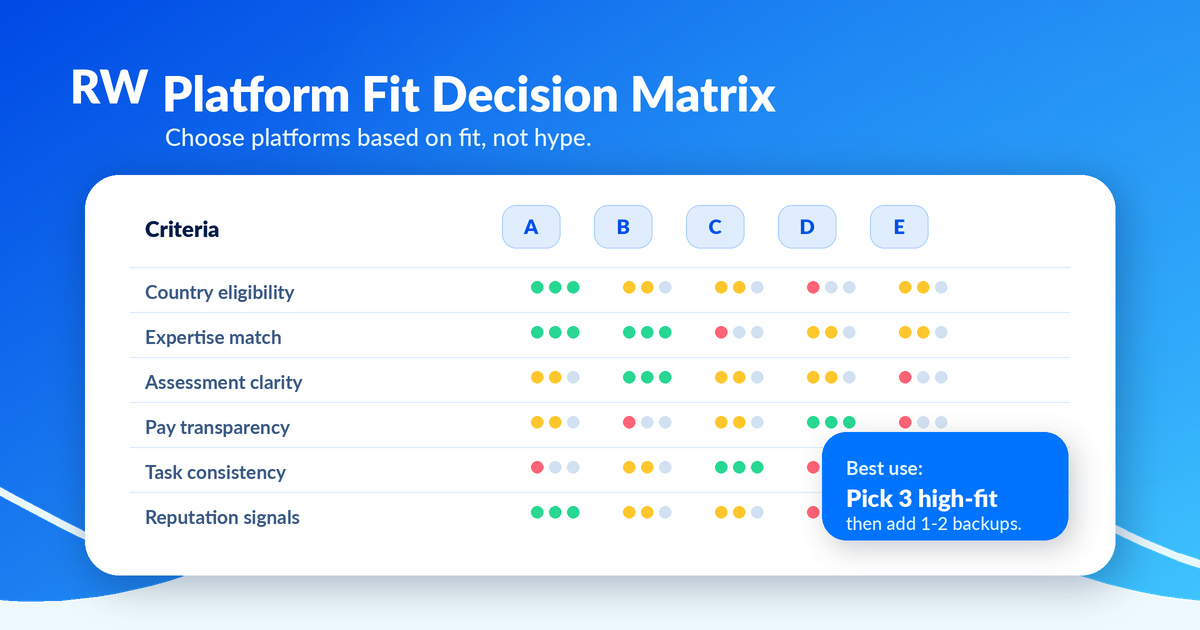
Three to five platforms is the right target for most remote AI workers building a sustainable pipeline. One platform is too fragile. More than five at once is too much to manage well. The goal is not maximum coverage — it is deep enough standing on enough platforms that you always have work available somewhere.
Choose your platforms based on your strongest skill lane. Stagger applications so each one benefits from what you learned in the previous one. Track everything in a simple spreadsheet. Prioritize quality on platforms that give you paid work. Keep quiet platforms in your tracker without abandoning them. And treat every assessment as skill-building, because the evaluator skills you develop on any one platform make every future one easier.
Frequently Asked Questions
How many AI training platforms should you apply to at once?
3 to 5 is a practical starting range. Enough to build pipeline diversity without making each application too weak to stand out. Starting with 2 and expanding as you learn from early results is a solid approach for most people.
Should you apply to Outlier AI and Mercor at the same time?
Yes. The core evaluator skills transfer across both, and having active applications on multiple platforms reduces dependence on one platform's project availability. The core platforms — Handshake AI, Mercor, micro1, and Outlier AI — are worth applying to as a group over your first two to three weeks.
How do you manage multiple AI training platform applications?
Use a simple tracker with platform, role, date applied, assessment status, and follow-up date. Keep one focused version of your resume per skill lane. Update the tracker every time something changes, and set a follow-up date for any platform that has been quiet for more than two weeks.
What is the best AI training platform to apply to first?
Apply first to the platform that best matches your strongest skill lane. For writers and researchers, Outlier AI or Mercor are common starting points. For students and recent graduates, Handshake AI is worth trying early. For technical experts and engineers, micro1 offers higher pay for the right profiles.