Remote work is changing. The easiest online tasks are getting easier to automate, but the work that requires judgment is becoming more important. AI can draft, summarize, classify, translate, and suggest. It can also make mistakes with confidence, miss context, misunderstand intent, overlook risk, or produce an answer that sounds polished but is not actually useful.
That gap creates a practical category of remote work built around human evaluation. Companies need people who can read an AI response and decide whether it is accurate, helpful, safe, complete, clear, fair, and appropriate for the situation. They need reviewers who can compare two outputs, explain which one is better, catch subtle mistakes, and apply real-world experience to edge cases.
This is why remote AI training jobs, AI evaluator jobs, model evaluation roles, search quality work, content quality review, research fact-checking, and subject matter expert review attract so many applicants. These roles do not just pay for being online. They pay for careful thinking.
What human judgment means in remote AI work
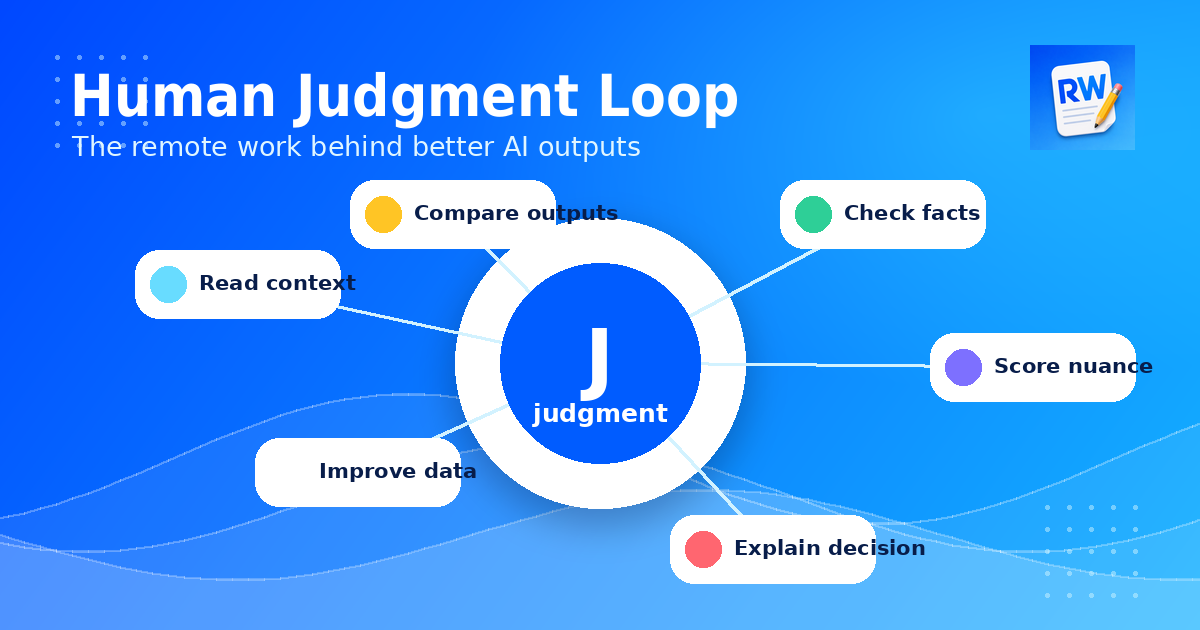
In remote AI work, judgment means making decisions that cannot be reduced to a simple yes or no. A basic task might ask whether an image contains a bicycle. A judgment-based task asks whether an AI answer fully satisfies the user, whether the reasoning is sound, whether the tone fits the situation, or whether the model missed something important.
The difference matters. Simple labeling rewards speed and consistency. Judgment-based work rewards context, caution, explanation, and taste. You may still follow detailed guidelines, but the guidelines often leave room for interpretation. The platform wants to know how you think, not only whether you can click the right box.
For example, an AI model might answer a career question with a list of remote jobs. The answer may be grammatically correct, but a human reviewer can see whether the list is realistic, whether the advice fits the applicant's experience, whether it overpromises income, whether it includes scam-like platforms, and whether it gives a practical next step. That is judgment.
Why AI companies need human reviewers
AI systems improve through feedback. A model can produce thousands of answers, but someone still has to decide which answers are better. That decision process is one reason companies use human evaluators, data annotators, prompt reviewers, quality analysts, and expert raters.
People often search for remote AI jobs connected to companies and ecosystems like OpenAI, Anthropic, Google, Meta, Grok, and other AI labs. They also search for platforms such as micro1, Mercor, Handshake AI, Outlier, and similar remote work marketplaces. The specific platforms change over time, but the underlying need remains the same: AI systems need high-quality human feedback.
A technically correct response can still be unhelpful. A confident response can still be false. A polite response can still avoid the main question. A long response can still miss the point. Human judgment catches those failures.
Remote jobs that pay for judgment
Judgment-based remote work appears under many titles. Some roles are directly related to AI training. Others are traditional work from home jobs that have become more valuable because companies need people who can think clearly, review information, and make decisions without constant supervision.
- AI response evaluator — compares model outputs and rates accuracy, helpfulness, reasoning, safety, and tone.
- Prompt reviewer — tests prompts, identifies weak instructions, and evaluates whether the AI followed the task.
- Search quality rater — judges whether search results match user intent and whether sources are relevant.
- AI content editor — improves AI-assisted writing, checks factual claims, and makes responses clearer.
- Research fact-checker — verifies details, compares sources, and flags unsupported claims.
- Subject matter expert reviewer — evaluates AI outputs in areas such as law, finance, medicine, coding, education, marketing, or business strategy.
- Policy and safety reviewer — identifies risky, misleading, harmful, or inappropriate outputs.
- Quality assurance analyst — reviews completed tasks, finds reviewer mistakes, and helps improve standards.
These roles may be listed as AI training, AI data annotation, model evaluation, LLM evaluation, AI research, remote reviewer, content quality analyst, or expert contributor. The job titles are not always consistent. The common thread is that the work asks you to evaluate something and explain your decision.
Judgment is different from availability
Many work from home jobs pay mainly for availability. Customer support, phone work, chat support, scheduling, and virtual assistant roles can be legitimate, but they often require fixed shifts. The company pays because someone needs to be present.
Judgment-based work is different. The company is not only buying your time. It is buying your ability to notice problems, make tradeoffs, and apply standards. That is why some remote AI jobs pay more than basic gig work or survey apps — expert-tier work can reach $50–$200/hr. It is also why the best opportunities are more selective.
This does not mean every AI training role pays a high hourly rate. Many entry-level tasks are more modest, but general AI evaluation work typically starts above $20/hr. Pay depends on the platform, project, country, expertise, task difficulty, and current demand. But the long-term direction is clear: the more the work depends on strong judgment, the more valuable your profile becomes.
The skills that make you valuable
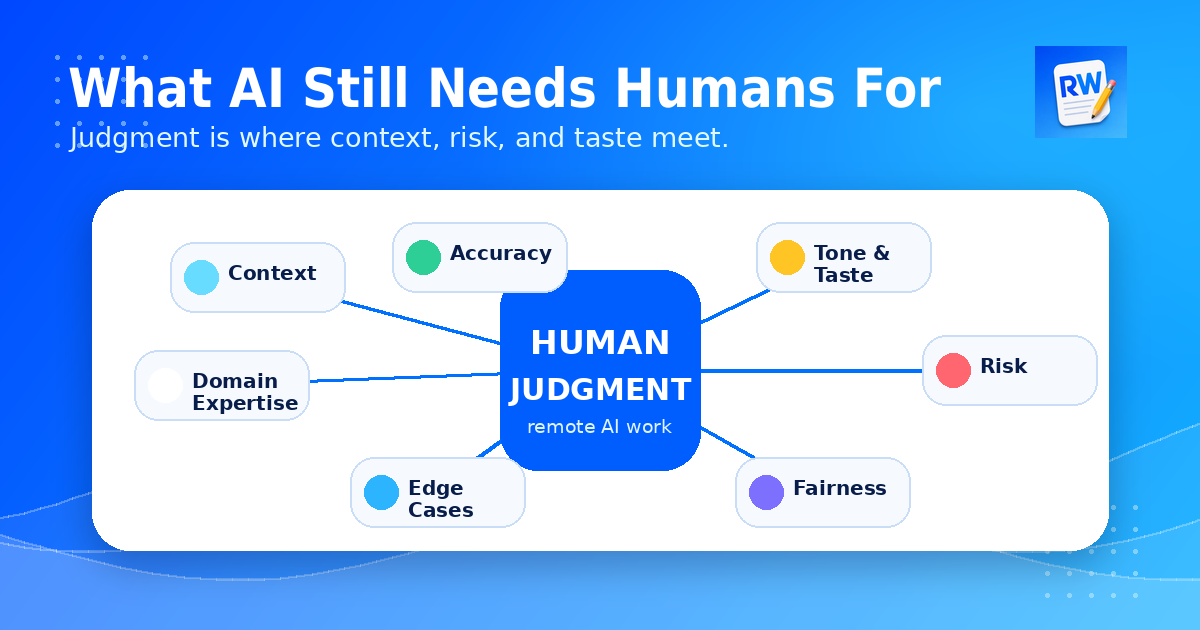
You do not need to be a coder to qualify for many remote AI evaluator jobs. Coding can help for technical projects, but many roles need writing ability, research skill, domain knowledge, careful reading, and strong explanations. The most valuable applicants can show that they understand both the task and the user.
- Reading comprehension — understanding exactly what the user asked, including hidden constraints.
- Fact-checking — verifying claims instead of trusting a polished answer.
- Comparative judgment — choosing the better of two imperfect responses.
- Clear writing — explaining ratings in short, specific language.
- Domain expertise — applying real knowledge from law, finance, medicine, engineering, education, sales, marketing, operations, or another field.
- Taste and tone — knowing when an answer sounds natural, professional, too vague, too casual, or overconfident.
- Risk awareness — spotting harmful advice, privacy issues, biased framing, or unsupported claims.
- Consistency — applying guidelines the same way across many tasks.
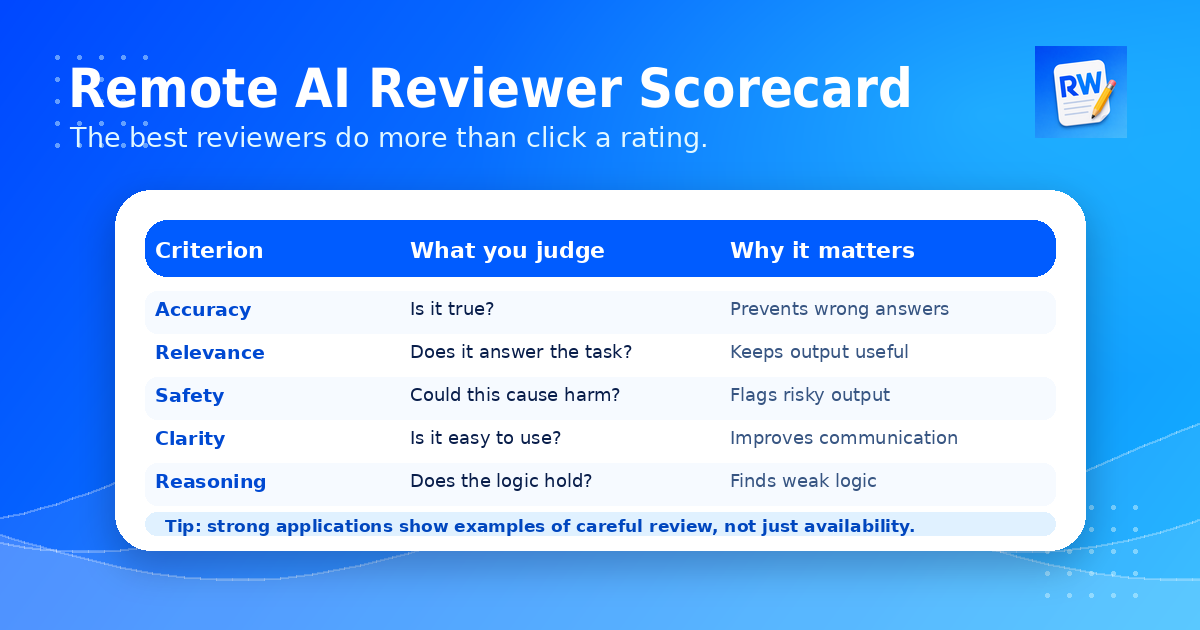
A strong remote AI worker is not just opinionated. The strongest reviewers are disciplined. They can explain why one answer is better, cite the exact issue, and follow the platform's rubric even when the task is subjective.
How to show judgment in your application
Most applicants say they are detail-oriented. That phrase is too common to carry much weight by itself. A better application shows specific evidence of judgment. Instead of saying you are a strong writer, show that you can compare outputs, improve unclear language, or verify claims. Instead of saying you are analytical, show that you can break a messy problem into criteria.
Your profile should make it easy for a platform to match you to the right work. Include your industries, tools, writing experience, research experience, editing experience, and any professional background that gives you useful judgment. A teacher can evaluate educational explanations. A paralegal can review legal-style reasoning. A bookkeeper can catch finance mistakes. A marketer can judge persuasive copy. A customer success professional can evaluate whether an answer actually solves the user's problem.
Profile tip: "I evaluate AI-generated responses for accuracy, clarity, relevance, and user intent. I have experience writing, editing, researching, and explaining decisions in a structured way." That is stronger than: "I am looking for remote work and I learn fast."
Examples of judgment-based tasks
A remote AI evaluator might be asked to read a prompt and compare two model answers. Both answers may look acceptable at first. One may be more accurate, one may be better organized, and one may avoid a direct question. The reviewer has to decide which one is better overall and explain the tradeoff.
A research reviewer might check whether an answer about a company, product, legal concept, medical topic, or financial idea is supported. The task is not to rewrite the whole response. The task is to identify what is wrong, missing, or unsupported.
A prompt writer might create test questions designed to reveal whether a model can reason, follow instructions, handle ambiguity, or avoid unsafe advice. This is still judgment work because the prompt must be realistic and the evaluation must be meaningful.
A subject matter expert might review outputs in a specialized field. A finance professional may evaluate investment explanations. A lawyer or paralegal may evaluate legal reasoning. A software engineer may evaluate code. A nurse or healthcare professional may evaluate patient-friendly medical explanations. These projects are more selective because the reviewer brings knowledge the average applicant does not have.
Writers, researchers, educators, operators, and domain experts are all strong candidates for remote judgment-based AI work. Find roles that match your background.
Find Roles Hiring Now →Why generalists can still qualify
You do not need a narrow niche to start. Generalists can be useful because many AI tasks involve everyday reasoning, writing, research, and communication. A strong generalist can evaluate whether an answer is clear, complete, and grounded. That is valuable for broad AI assistant projects, content review, search quality work, and customer-facing response evaluation.
The key is to avoid presenting yourself as someone with no direction. A generalist profile should still highlight specific strengths: writing, research, editing, communication, operations, customer experience, marketing, teaching, analysis, or quality control. The more clearly you define your judgment, the easier it is for a platform to route you to appropriate tasks.
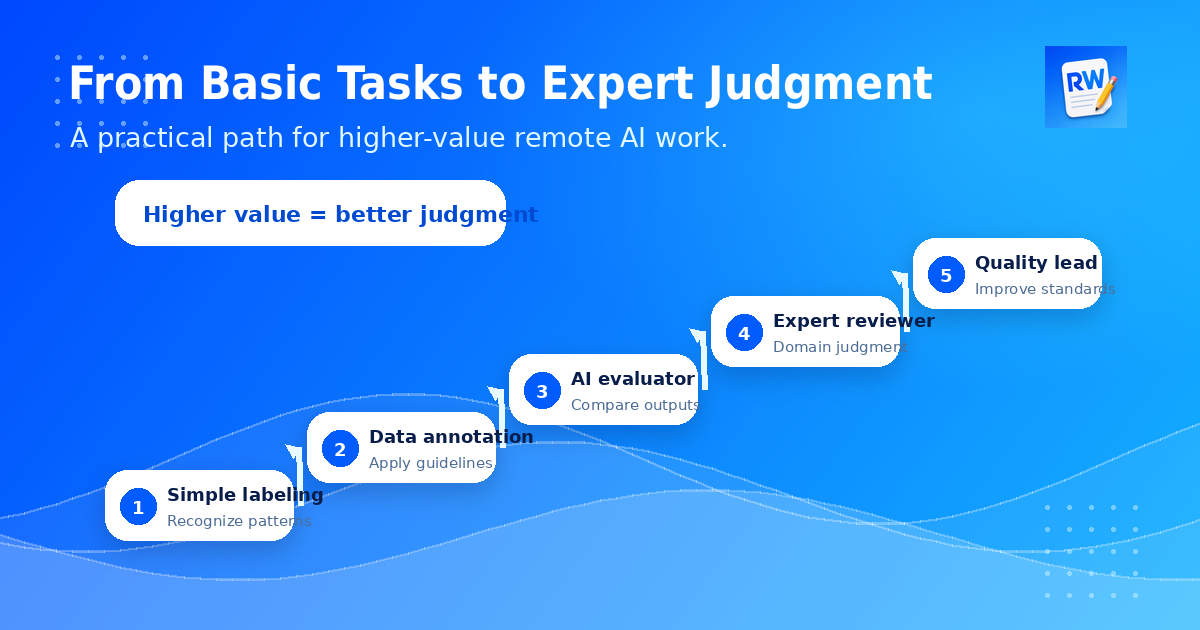
How to move from basic tasks to better work
Most people should expect to start with whatever they can qualify for, then build a record of accuracy and consistency. The first goal is not to find the highest-paying project immediately. The first goal is to get accepted, complete tasks well, understand the standards, and avoid careless mistakes that damage your account.
Once you have experience, you can apply for more specific projects. A beginner may start with general AI response rating. Later, that same person may move into prompt writing, expert review, editing, search quality, or quality assurance. Over time, your value comes from being reliable on tasks where the platform cannot rely on automation alone.
- Start with broad remote AI evaluator or data annotation roles.
- Read instructions carefully before optimizing for speed.
- Write clear explanations when the task allows it.
- Track which projects match your strengths.
- Add evidence of completed remote work, research, editing, or domain experience to your profile.
- Apply to multiple legitimate platforms instead of depending on one account.
What to avoid
Judgment-based remote work is attractive, so scams and low-quality listings often copy the same language. Be careful with any platform that charges you to start, promises guaranteed income, asks for unusual payment methods, or avoids explaining the actual work. Real remote work platforms may have assessments, onboarding, project availability changes, and quality checks, but they should not require you to buy access to a job.
Also avoid rushing through evaluation tasks. Many applicants fail because they treat AI review like a survey. These projects are not asking for random opinions. They are asking for structured decisions. If you cannot explain why one answer is better, your rating is weaker.
The future belongs to people who can evaluate AI
AI will keep improving. That does not remove the need for human judgment. In many cases, better AI creates more demand for better evaluation. As models become more capable, the mistakes become more subtle. The work shifts from simple labeling to careful review, testing, comparison, and quality control.
That is good news for remote workers who can think clearly. The best opportunities will not always go to the person who applies fastest. They will go to people who can prove they understand context, communicate clearly, catch mistakes, and make decisions that improve the final output.
Remote work that pays for judgment is not passive income. It is not a shortcut. It is skilled online work. But for writers, researchers, editors, analysts, teachers, operators, customer success professionals, subject matter experts, and strong generalists, it may be one of the most realistic ways to turn existing skills into flexible remote income.
Frequently Asked Questions
Do I need coding experience for judgment-based AI work?
No. Coding helps for technical projects, but many remote AI jobs need writing, research, editing, evaluation, domain expertise, and strong communication. Non-technical professionals can qualify for many AI response evaluation and content quality roles.
Is this the same as data annotation?
It can overlap. Data annotation is a broad category. Some annotation is simple labeling. Other annotation requires complex judgment, written explanations, source checking, or domain expertise. The more interpretation a task requires, the more it depends on human judgment.
Can beginners apply?
Yes, but beginners should start with broad remote evaluator, AI training, and data annotation roles. The strongest beginner applications show writing ability, careful reasoning, and practical examples of reviewing information.
Which backgrounds are useful?
Writing, editing, research, teaching, law, finance, healthcare, coding, marketing, sales, operations, customer support, quality assurance, and consulting can all translate into judgment-based remote work. The value is not only the job title — it is the decision-making skill behind it.
How do I avoid scams?
Avoid platforms that charge application fees, promise guaranteed income, pressure you to pay for training before work, or refuse to explain the task. Legitimate remote work should have clear applications, assessments, project rules, and payment terms.