The widespread assumption that all AI work requires coding is wrong. A significant and growing portion of remote AI jobs reward writing, domain knowledge, research, editorial judgment, annotation consistency, and careful analysis. These roles are not entry-level filler — they are essential to how AI systems are trained, evaluated, and improved.
Companies building AI need humans who can judge whether an AI answer is accurate, safe, useful, and well-written. That task requires judgment and domain knowledge, not necessarily code. If you can read carefully, compare quality, explain your reasoning, and apply a rubric consistently — you may qualify for a wide range of remote AI jobs without writing a single line of code.
Why So Many Remote AI Jobs Do Not Require Coding
AI development is not only an engineering problem. It is also an evaluation problem, a writing problem, a safety problem, and a quality problem. The companies training large language models need thousands of contributors who can assess whether model outputs are accurate, helpful, safe, and well-structured. They cannot do that assessment with code alone — they need human judgment at scale.
That is why the AI training industry has built an entire category of work designed for non-coders. Response evaluators, prompt writers, fact-checkers, domain experts, research assistants, content quality reviewers, annotation specialists, safety reviewers, and expert reviewers all play active roles in model improvement. Many of these roles are explicitly designed to recruit people with writing, research, academic, professional, or domain expertise backgrounds.
The AI systems you use every day — ChatGPT, Claude, Gemini, Grok, Copilot — were shaped in part by people who never wrote a line of code for those projects. They wrote evaluations, comparisons, corrections, and examples. They flagged errors, ranked responses, and explained their reasoning. That human feedback is the training signal that makes AI useful.
Important distinction: "No coding required" does not mean low-skill. The best non-coding AI roles require careful reading, precise judgment, clear writing, and consistent application of evaluation criteria. They reward expertise — just not technical expertise.
The Best No-Code AI Job Categories
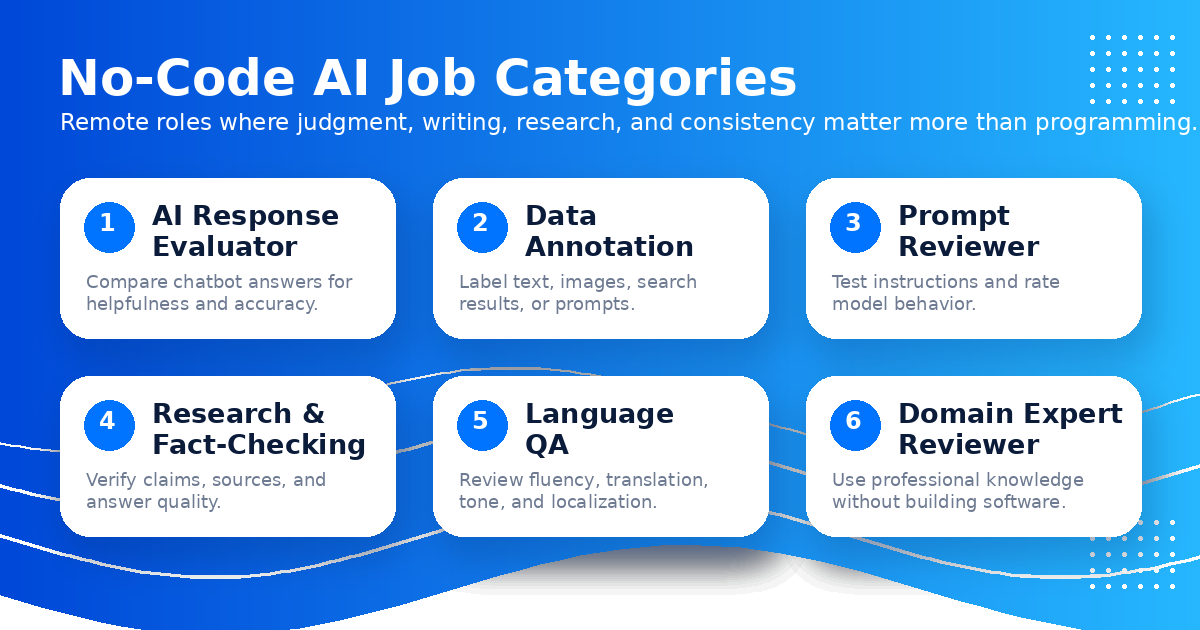
Eight categories of remote AI work are consistently accessible without coding experience. Each rewards different combinations of writing, research, domain knowledge, and analytical judgment.
1. AI Response Evaluation
Compare, rank, and score AI-generated answers using structured rubrics. You read two or more responses to the same prompt and decide which is better — then explain why. This is one of the most widely available no-code AI roles and is accessible to strong writers, researchers, and careful readers across many fields.
2. Prompt Writing and Testing
Create prompts that test AI reasoning, instruction-following, creativity, or factual accuracy. Evaluate how well the model responded to each prompt. This role fits people who are good at designing tests, writing clear instructions, and identifying edge cases in how a question can be interpreted.
3. Expert Domain Review
Review AI-generated content in a specialized field — law, finance, medicine, science, education — using professional credentials or deep domain knowledge. This category tends to offer the highest pay rates in no-code AI work. A legal professional reviewing AI legal explanations, a financial analyst reviewing AI investment content, or a clinician reviewing AI medical summaries is doing expert review work.
4. Research and Fact-Checking
Verify claims made by AI-generated content, check sources, identify hallucinations, and flag unsupported statements. This role requires familiarity with how to find, evaluate, and cite sources. Strong fit for people with academic, journalism, library science, or research backgrounds.
5. Content Quality Review
Check AI outputs for tone, clarity, safety, instruction-following, and policy compliance. You evaluate whether a response meets quality standards — not just whether the information is correct, but whether it is useful, appropriately framed, and free of harmful content.
6. AI Training Writing
Write ideal answers to prompts that AI systems use as training examples. Improve weak model outputs so they become genuinely useful responses. This is the most writing-intensive no-code AI role and rewards people who can control structure, tone, and plain language precisely.
7. Data Annotation and Labeling
Categorize text, label intent, classify quality, tag sentiment, or identify content types. Tasks are structured and repetitive, which rewards consistency and accuracy. Annotation is a reliable entry point into AI work that does not require strong writing ability — it requires careful attention to guidelines.
8. Safety and Policy Review
Identify harmful, misleading, policy-violating, or otherwise problematic AI-generated content. This role requires judgment about what crosses a line and why. Strong fit for people with backgrounds in policy, law, content moderation, ethics, or journalism.
No-Code vs Coding AI Work: What Each Actually Requires
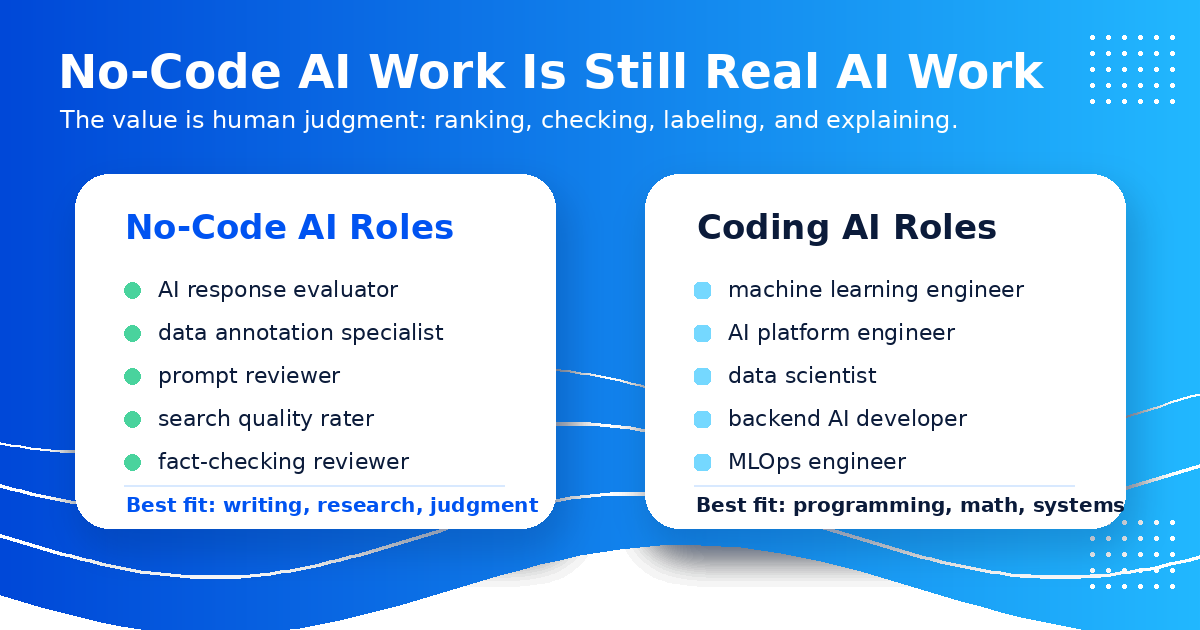
Understanding what coding AI work actually requires helps clarify why no-code work is a genuine alternative — not a lesser version of the same thing.
Coding AI work includes tasks like code review and debugging evaluation, algorithm explanation assessment, test case generation, code generation quality scoring, and technical reasoning evaluation. These roles require you to understand and evaluate code — either written by an AI or alongside AI suggestions. Technical background is necessary.
No-code AI work includes writing evaluation, response ranking, factual review, prompt evaluation, expert domain review, annotation and labeling, safety review, and research verification. These roles require careful reading, clear writing, domain knowledge, rubric-based judgment, and consistent evaluation. Technical background is not required.
Both categories are legitimate. Many contributors eventually work across both. But the path into no-code AI work is accessible without any technical prerequisites — and the demand for it is large. AI companies need many more response evaluators, fact-checkers, and domain experts than they need code reviewers.
The Skills That Matter Most Without Coding
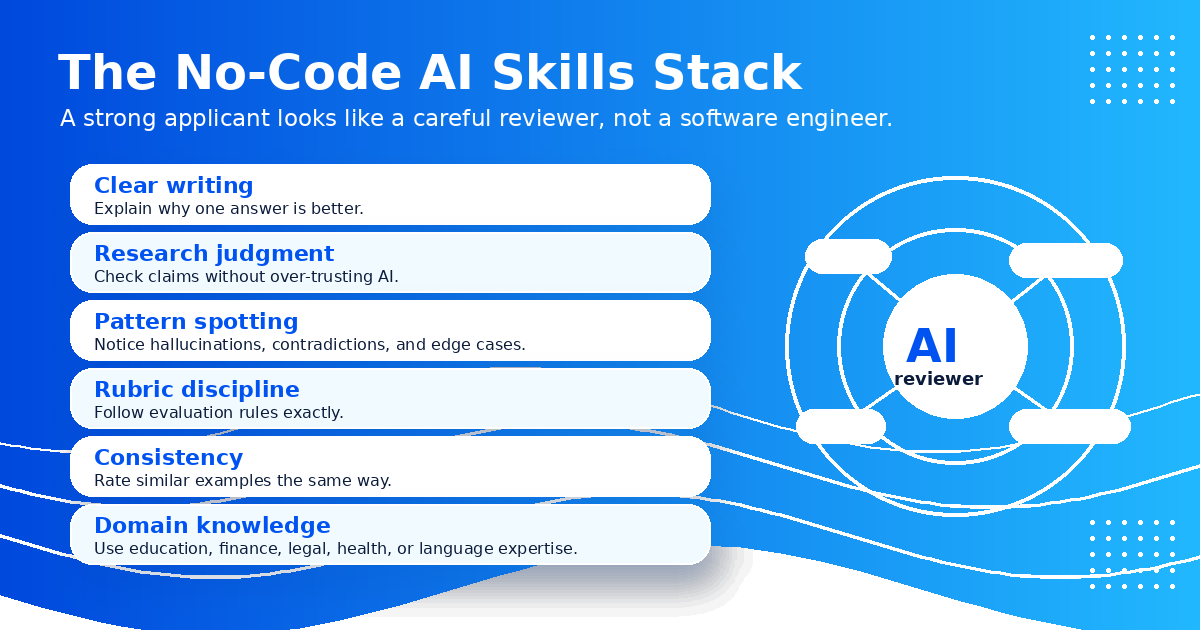
The skill stack that makes non-coders effective in AI work is different from what most people expect. It is not about learning new tools or platforms — it is about applying skills you may already have in a structured evaluation context.
Writing clarity and precision. The ability to write a response that is specific, complete, and useful — and to recognize when an AI response fails to meet that standard — is the most consistently valuable skill in no-code AI work. Vague writing produces vague evaluations. Clear writing produces evaluations that improve AI systems.
Careful reading and instruction-following. AI training tasks always come with guidelines. The ability to read a rubric, understand what it requires, and apply it consistently across many similar tasks determines your quality score on almost every platform.
Research and source verification. Fact-checking, identifying hallucinations, and evaluating whether claims are supported all require the ability to search for information, evaluate source quality, and distinguish verified facts from uncertain claims.
Domain expertise. Law, finance, medicine, science, languages, education, and other specialized fields create high-value no-code opportunities. If you have professional knowledge in any of these areas, you can often command higher rates on expert review projects.
Rubric-based judgment. The ability to apply evaluation criteria consistently — not just intuitively — separates average reviewers from excellent ones. Good AI evaluators can explain their judgment using the same language the rubric uses, making their feedback directly useful.
Explaining quality differences in writing. Choosing the better of two responses is only half the task. Explaining specifically why one is better — using evaluation language rather than vague impressions — is the part that produces training signal. "Response A is better because it directly addresses the specific constraint in the prompt that Response B ignores" is useful. "Response A is better because it seems clearer" is not.
How to Position Yourself Effectively
The most common positioning mistake is leading with a general statement of availability: "I can do anything, I'm a fast learner." That is not useful for an AI training platform trying to match you to a specific project. Lead with your strongest evaluable skill instead.
Effective positioning examples:
- "AI writing evaluator for editorial quality, tone, and instruction compliance" — for writers and editors.
- "Legal research specialist for AI legal reasoning review and citation accuracy" — for legal professionals.
- "Finance and business analyst for AI financial explanation review and spreadsheet logic" — for finance backgrounds.
- "Medical content reviewer for patient-facing AI health information accuracy and safety" — for healthcare professionals.
- "Research assistant and fact-checker for AI-generated claims, source quality, and hallucination detection" — for academic or journalism backgrounds.
- "Data annotator for text classification, intent labeling, and quality scoring" — for detail-oriented people new to AI work.
Connect your existing skills to evaluation terms. Do not describe your background in its own language and expect a recruiter to translate it. Do the translation yourself — map your experience directly to what the platform needs.
Remote Work Union connects writers, researchers, and domain experts to legitimate remote AI jobs that don't require coding. Apply for free.
Find Roles Hiring Now →How to Search for No-Code Remote AI Jobs
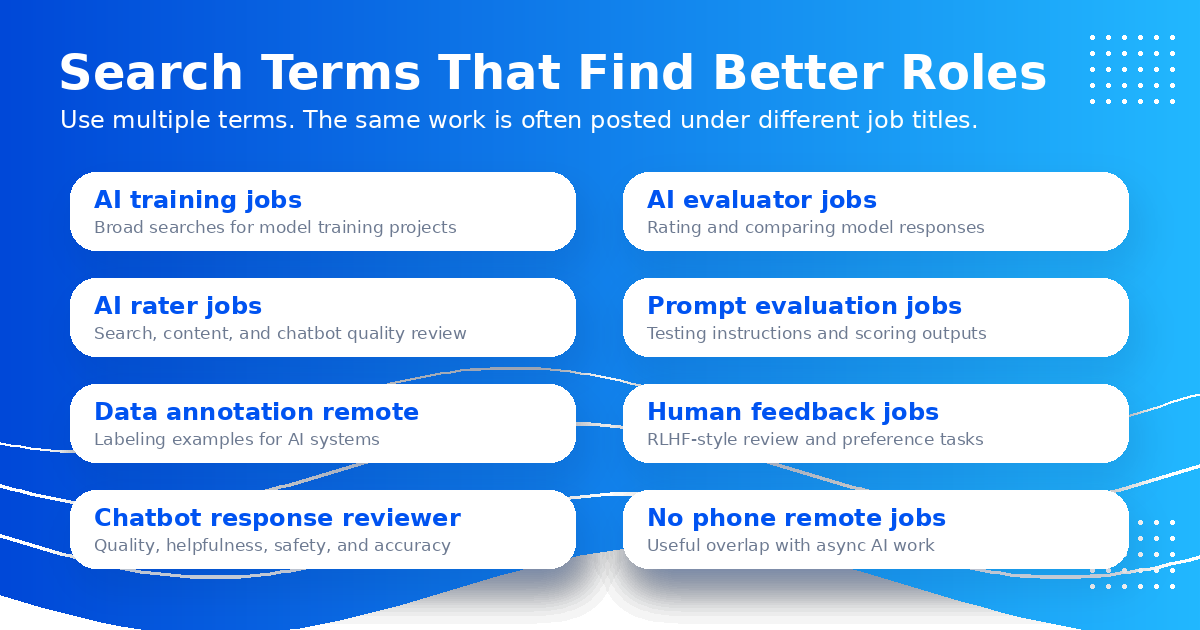
General searches for "remote AI jobs" return a mix of engineering, research science, and product roles that all require technical backgrounds. Use specific phrases that target no-code evaluation work instead.
Effective search terms for no-code AI jobs:
- No code AI jobs remote, remote AI training jobs no programming
- AI writing evaluator remote, AI response reviewer jobs from home
- RLHF evaluator jobs, human feedback jobs remote, AI rater jobs
- Data annotation jobs remote, AI data labeling jobs work from home
- Expert review AI jobs, AI domain expert jobs
- Research quality reviewer remote, AI fact checker jobs
- AI editor jobs remote, content quality reviewer AI
- Search quality evaluator, AI safety reviewer remote
- Chatbot trainer jobs, AI annotation specialist
Apply across multiple platforms rather than depending on one. AI training work is often project-based, and project availability changes quickly. A platform that has no openings today may launch a new project next week. Track your applications in a simple spreadsheet and follow up on each one systematically.
How to Apply and Pass Assessments Without a Technical Background
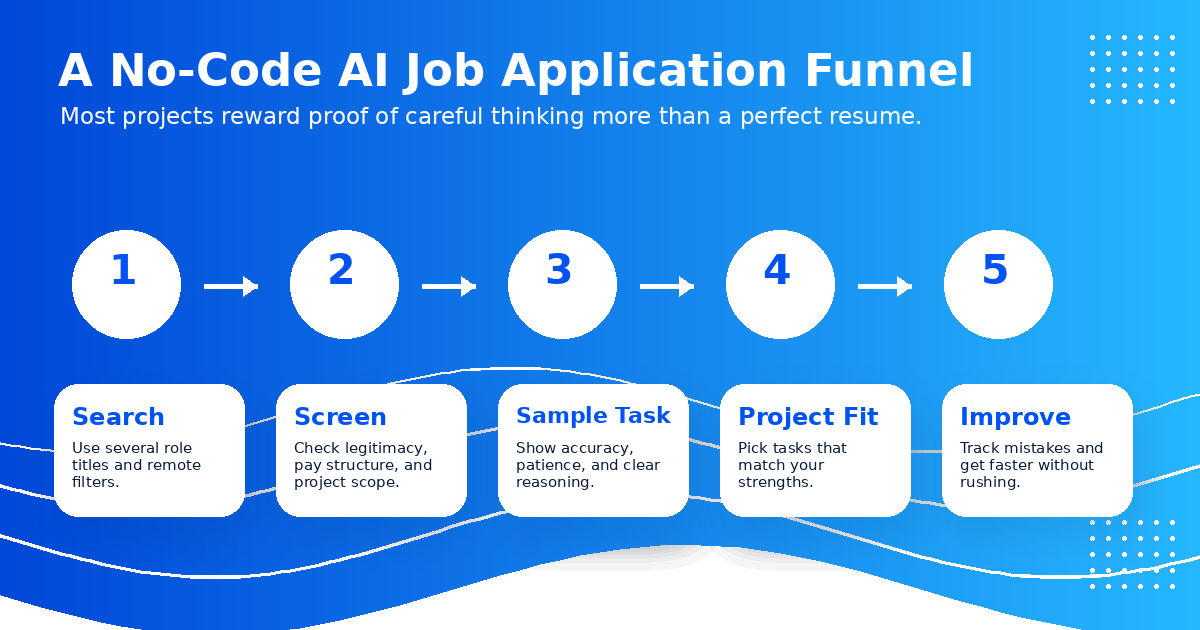
Applying without a technical background is a positioning challenge, not a disqualification. The key is to lead with what you can do rather than starting by explaining what you cannot do.
Do not apologize for not coding. Many platforms actively recruit non-coders for specific project types. Your profile should demonstrate what you bring, not preemptively address what you lack. If the role requires coding, you will be filtered out at the matching stage — no apology needed. If it does not, your technical background is irrelevant.
Lead with your strongest evaluation skill. Your profile headline and summary should name the specific type of AI work you are qualified for and the domain in which you can do it. One clear, accurate sentence is better than five vague paragraphs about your versatility.
Prepare one or two writing samples that show analytical judgment. The most useful samples are: a before-and-after comparison showing how you improved a weak AI response, or a rubric-based review of an AI answer that evaluates it across multiple quality criteria. Short is better. One well-constructed page demonstrates more than a long, unfocused portfolio.
If you have professional credentials, mention them specifically. Do not just say "I have a law degree." Say "I have a law degree and can evaluate AI legal explanations for accuracy, completeness, appropriate hedging, and citation quality." Connect the credential to the task.
Take assessments seriously. Slow down at the start. Read every instruction before beginning. Identify the specific rubric criteria being applied. Complete the task, then review it before submitting — checking for vague explanations, missed instructions, and unsupported claims. The assessment is the most important part of the application process for no-code AI roles.
Assessment tip: In a comparison task, never choose a response just because it is longer or sounds more authoritative. The correct choice depends on which response better addresses the specific prompt — check instruction-following, accuracy, and completeness before choosing.
Frequently Asked Questions
Can I really get a remote AI job without coding experience?
Yes. Many remote AI jobs specifically need non-coders. Response evaluation, writing quality review, expert domain review, fact-checking, data annotation, safety review, and prompt evaluation are all roles that reward writing, research, and domain knowledge rather than programming ability. These roles are a large and growing segment of AI training work.
What pays more — coding or non-coding AI work?
Specialized expert review in law, medicine, finance, and science can pay well even without coding. Coding-focused AI projects often pay more for deep technical work. But the highest-paid non-coding roles — expert legal review, medical reasoning evaluation, financial analysis review — are competitive with many technical roles. Pay depends on the depth of your domain knowledge, not just whether you can code.
Do I need a degree to get a no-code remote AI job?
Some expert review projects prefer or require professional credentials, especially for medical, legal, or financial roles. Many annotation and evaluation roles focus on demonstrated skill rather than formal credentials. Strong writing samples, professional experience, and a track record of accurate work matter more than a specific degree on many platforms.
How do I prove my skills without a technical background?
Use writing samples, professional credentials, portfolio pieces, and prior research or editorial work. A well-edited writing sample that shows clear reasoning is more useful than a resume full of vague claims. If you have professional credentials in law, finance, medicine, or another field, list them specifically alongside the evaluation tasks they qualify you to perform.
What is the difference between AI training work and regular content writing?
AI training work is structured around evaluation, comparison, labeling, and improvement of AI-generated outputs — not just producing original content. You may write ideal answers, compare two AI responses and explain which is better, label content by category or quality, or rewrite weak outputs. The work follows rubrics and guidelines rather than creative direction, and quality is measured by how accurately you apply evaluation criteria.
How do I find no-code remote AI jobs that are legitimate?
Use specific search terms: remote AI training jobs no coding, AI writing evaluator remote, RLHF evaluator jobs, data annotation jobs from home, AI response reviewer jobs, expert review AI jobs. Look for platforms that describe a clear evaluation task, a qualification process, and transparent pay structures. Avoid postings that promise unusually high pay with no qualification requirements.
Final Takeaway
The remote AI job market needs writers, researchers, domain experts, educators, and careful thinkers at every stage of model improvement. You do not need to write code to contribute meaningfully — you need to read carefully, judge honestly, and explain your reasoning clearly.
That combination of skills is not rare, but it is genuinely valuable. AI systems improve only when the humans evaluating them can identify exactly what is wrong and why. The people who can do that precisely — in plain language, using specific criteria, consistently across many tasks — are exactly who the AI training industry is looking for. If that describes you, you have more opportunity in this space than you may realize.