A lot of people search for remote work because they want freedom, but not all remote jobs are actually flexible. Some jobs let you work from home, but still control your calendar like a normal office job. You may have to be online from 9 to 5, attend meetings all day, answer live customer messages, or stay available for a manager who expects instant replies.
Remote work that lets you set your own schedule is different. It is usually based on output instead of availability. You are judged by the quality of your writing, research, reviews, analysis, annotations, edits, or deliverables — not by whether you sat at a desk for eight straight hours.
This is why flexible remote work is especially attractive to parents, students, caregivers, freelancers, creators, people with full-time jobs, people in different time zones, and anyone who wants to build income around real life instead of rearranging life around a shift.
What "Set Your Own Schedule" Really Means
A flexible remote job does not always mean you can work whenever you want with zero structure. It means the work is designed so you can choose your working windows within reasonable limits. The company or platform may still have deadlines, quality standards, project availability rules, and payment requirements.
The key difference is control. In a fixed remote job, the employer owns the calendar. In a flexible remote job, you own more of the calendar as long as the work gets done correctly and on time.
Good flexible remote work usually has three traits: it is asynchronous, it is task-based, and it is measurable. You can log in, complete a set of tasks, submit work, and move on. That is why AI training, AI evaluation, AI data annotation, writing, editing, research, design audits, bookkeeping, and project-based operations work often fit this category better than live customer service or sales roles.
The Best Flexible Remote Work Categories
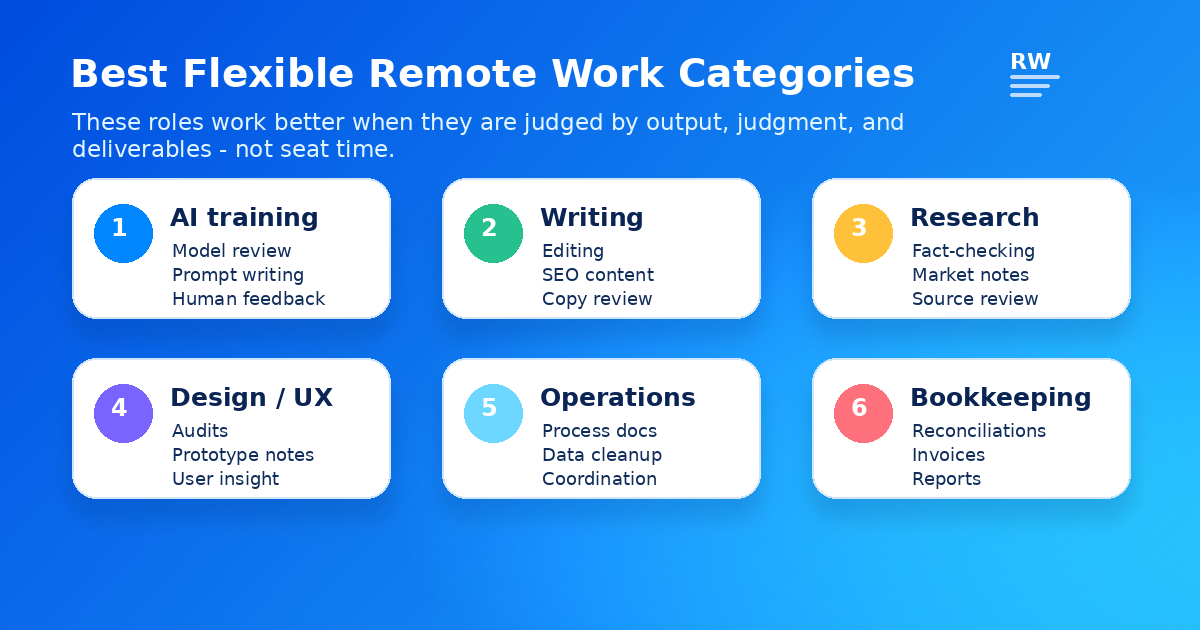
The most flexible work from home jobs tend to reward judgment, accuracy, communication, and consistency. They are not always passive, and they are not always easy, but they can give you more control over your day than a traditional job.
1. AI Training and AI Evaluation Work
Remote AI work is one of the clearest examples of schedule-flexible work. AI companies and the broader AI ecosystem need humans to review model outputs, compare responses, label data, write prompts, evaluate reasoning, check factual accuracy, and improve the quality of AI systems.
This type of work may appear under names like AI training, AI evaluation, AI data annotation, AI response rating, prompt writing, model evaluation, AI content review, human feedback, or remote reviewer work. Platforms such as micro1, Mercor, Handshake AI, and similar marketplaces often match people with projects based on their skills, writing ability, domain knowledge, or general reasoning.
The reason this work can be flexible is simple: many tasks do not require a live call. You can often complete reviews or writing tasks in focused blocks. Someone with a full-time job might work at night. A parent might work during school hours. A student might work between classes. A freelancer might use AI evaluation projects to fill gaps between client work.
Relevant keywords for this category include remote AI jobs, AI training jobs, AI evaluation jobs, AI annotation, AI data annotation, prompt writing jobs, human feedback jobs, AI reviewer, remote AI reviewer, model evaluation, and work from home AI jobs. Major AI companies such as OpenAI, Anthropic, Google, Meta, and Grok have helped make this type of human-in-the-loop work more visible, even when the actual roles are offered through platforms, vendors, or project marketplaces.
2. Writing, Editing, and Content Review
Writing work is often flexible because the final product matters more than the exact hour it was produced. This includes blog writing, SEO content, technical writing, copywriting, newsletter writing, editing, proofreading, transcript cleanup, and content quality review.
For beginners, editing and proofreading can be easier to position than pure copywriting because the task is clear: improve accuracy, clarity, structure, grammar, or factual quality. For experienced writers, remote AI projects can also overlap with writing work because many model evaluation tasks require comparing responses, rewriting answers, or identifying which answer is more useful.
The best writing work still has deadlines. Flexible does not mean careless. It means you can choose whether to write at 7 a.m., 2 p.m., or 10 p.m. as long as the deliverable is strong.
3. Research and Fact-Checking Work
Research is another strong fit for people who want remote work that lets them set their own schedule. Companies need help finding sources, checking claims, summarizing markets, comparing products, reviewing documents, organizing information, and turning messy data into clear conclusions.
This category is especially relevant for people who are curious, detail-oriented, and comfortable reading carefully. AI evaluation projects also need research skills because many tasks involve checking whether an answer is accurate, complete, up to date, or supported by reliable sources.
Research work can be done in quiet blocks of time, which makes it useful for people who do not want phone calls or constant meetings.
Want to find task-based remote work you can do on your own time? Find opportunities hiring now.
Find Roles Hiring Now →4. Design, UX, and Creative Review
Not all flexible remote work is text-based. Designers, UX researchers, visual reviewers, and creative professionals can find project-based work that does not require a fixed daily schedule. Examples include website audits, app reviews, usability notes, image quality review, brand feedback, presentation cleanup, and creative evaluation.
As AI tools create more images, videos, interfaces, and marketing assets, human judgment becomes more valuable. Companies still need people to decide whether something looks right, makes sense, matches a brand, or feels trustworthy to a user.
5. Bookkeeping, Operations, and Admin Projects
Some administrative work is flexible, especially when it is not tied to live inbox coverage or phone support. Bookkeeping, invoice review, spreadsheet cleanup, CRM updates, data entry, documentation, process mapping, and project coordination can often be done asynchronously.
The important distinction is whether the role is task-based or availability-based. A virtual assistant job that requires you to be online all day is not truly flexible. A project role where you clean up a spreadsheet, prepare a report, organize files, or update systems by a deadline can be much more flexible.
Remote Jobs That Usually Are Not Fully Flexible
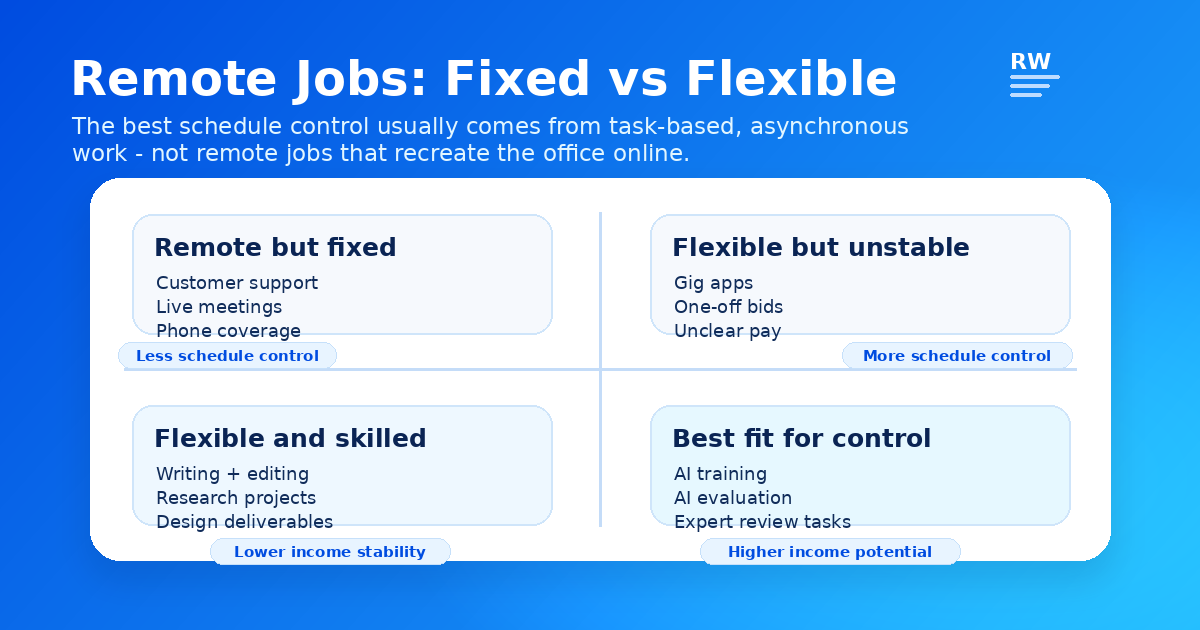
Some jobs are remote but still have strict schedules. Customer service phone roles, live chat support, appointment setting, sales development, call center work, executive assistant roles, and many full-time corporate positions may require fixed coverage hours.
These jobs can still be good. They may provide stable income, benefits, and predictable expectations. They are just not the best match if your main goal is setting your own schedule.
When reading a job description, watch for phrases like fixed shift, must be available during business hours, live phone support, high-volume calls, daily standups, real-time coverage, or immediate response required. Those phrases usually mean the job is remote in location but not flexible in time.
How to Tell If a Remote Job Is Actually Flexible
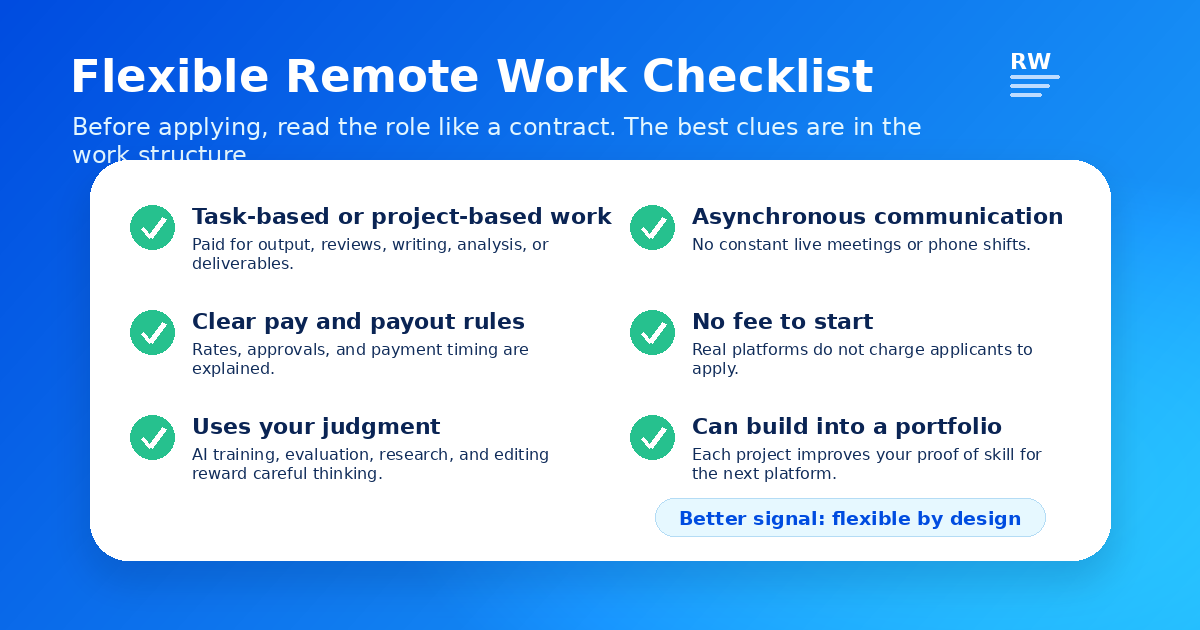
Before applying, read the job description for the structure of the work. Look for words like asynchronous, task-based, project-based, deadline-driven, flexible hours, choose your schedule, remote contractor, independent work, deliverables, review tasks, annotation tasks, or evaluation projects.
Also check how the role pays. Hourly work can be flexible if you can choose when to complete hours. Per-task work can be flexible if rates are clear and tasks are available. Project work can be flexible if deadlines are reasonable. The best setup depends on your life and income goals.
Avoid anything that asks you to pay to start. Real remote work platforms do not charge you for access to basic applications. A legitimate job may require skills tests, interviews, sample tasks, identity verification, or tax forms, but it should not require a startup fee.
How to Build a Schedule Around Flexible Remote Work
The mistake many beginners make is treating flexible work like random work. If you only log in when you feel like it, your income will probably be inconsistent. The better approach is to create your own structure.
Start by choosing two or three work blocks per week. For example, you might reserve Monday, Wednesday, and Friday mornings for AI training tasks. You might use Tuesday night for applications and profile updates. You might use Sunday afternoon to review earnings, track projects, and plan the next week.
Flexible remote work works best when you treat it seriously even though no one is standing over you. The freedom is real, but so is the responsibility.
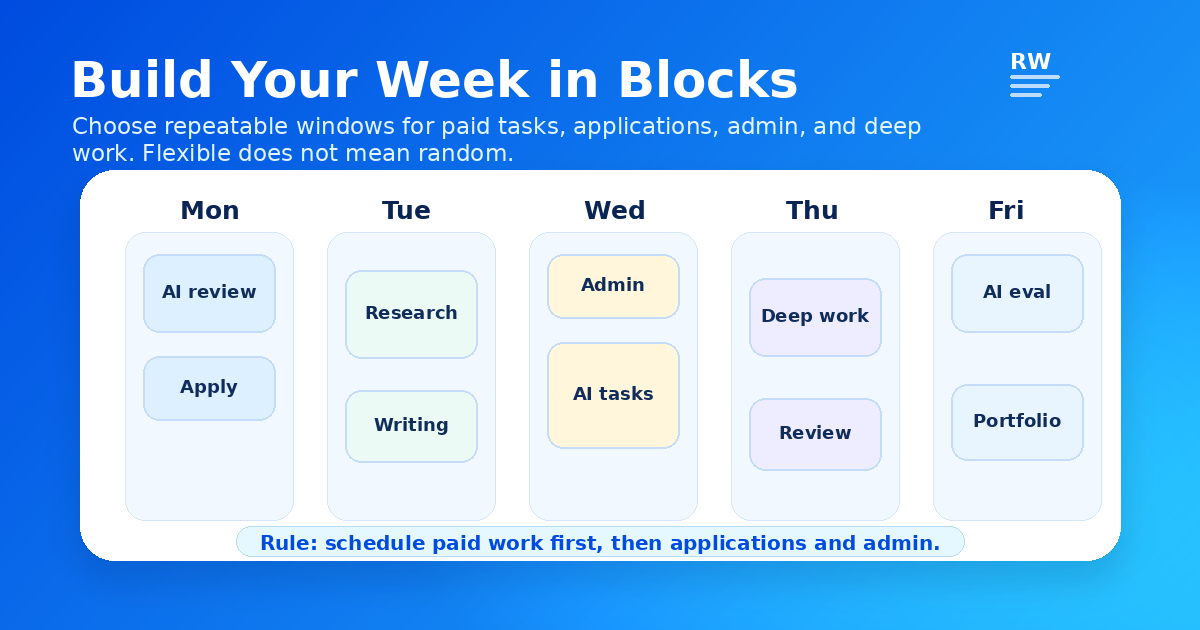
A Simple Weekly System
A beginner can use a simple system: apply to platforms, improve profiles, complete tests carefully, track every application, and reserve fixed blocks for paid work once accepted.
For someone with a full-time job, the schedule might be two weekday evenings and one weekend block. For a parent, it might be school hours. For a freelancer, it might be open time between clients. For someone outside the United States, it might be late-night or early-morning blocks depending on platform availability and payment rules.
The exact schedule matters less than consistency. A reliable five to ten hours per week can teach you which platforms, projects, and categories are worth more of your time.
Skills That Help You Get Flexible Remote Work
The most useful skills are not always technical. Many flexible remote jobs reward clear writing, careful reading, accuracy, organization, research ability, judgment, and the ability to follow instructions.
For AI training and AI evaluation work, strong general knowledge can be valuable. So can subject matter expertise in law, finance, medicine, coding, science, marketing, education, operations, or creative fields. Expert projects may pay more because they require specialized judgment, but generalist projects can still be a strong starting point.
For writing and editing roles, a clean sample matters. For research roles, show that you can find reliable sources and summarize them clearly. For operations work, show comfort with spreadsheets, documentation, and process improvement. For design or UX review, show that you can explain what works, what is confusing, and what should change.
Common Mistakes to Avoid
The first mistake is applying only to one platform. Flexible remote work is more stable when you have multiple options. A project can pause, a task queue can dry up, or an application can take longer than expected. Joining more than one platform gives you a better chance of steady work.
The second mistake is rushing skills tests. Many remote AI platforms use tests to decide whether you get matched with projects. A careless test can limit your account before you ever start earning. Take the process seriously.
The third mistake is chasing only the highest hourly rate. A $100 per hour project is not useful if you rarely get tasks. A lower-rate project with steady availability may be better while you build experience. The goal is not just a high advertised rate. The goal is reliable income that fits your schedule.
Who This Type of Work Is Best For
Schedule-flexible remote work is best for people who can manage themselves. It works well for people who like quiet, focused tasks and do not need a manager checking in every hour. It also works for people who are building a bridge from traditional employment to independent online income.
It may not be ideal for someone who needs guaranteed full-time hours immediately. Many flexible remote roles start as contract, project, or part-time opportunities. They can grow into meaningful income, but they often require patience, testing, and multiple applications.
The Bottom Line
The best remote work that lets you set your own schedule is usually not the same as a normal job done from home. It is work built around tasks, projects, reviews, writing, research, and judgment. AI training, AI evaluation, AI annotation, writing, editing, research, operations, bookkeeping, and design review can all fit this model when the role is structured correctly.
Look for asynchronous work, clear pay, no startup fees, realistic deadlines, and projects that reward quality. Avoid confusing location flexibility with schedule flexibility. A job can be remote and still control every hour of your day.
If your goal is freedom, apply for work that is designed around output. That is where remote work becomes more than working from home. It becomes a way to build income around the life you actually have.
Frequently Asked Questions
What kind of remote work lets you set your own schedule?
Task-based and project-based remote work tends to offer the most schedule flexibility. This includes AI training jobs, AI evaluation work, AI data annotation, writing, editing, research, design review, bookkeeping, and operations projects. These roles are judged by output quality rather than hours logged, so you can often choose when to complete them within a deadline window.
Is remote AI training work actually flexible?
Yes, for most tasks. AI training and evaluation work through platforms like micro1, Mercor, and Handshake AI is generally asynchronous and task-based. You log in, complete tasks, submit them, and log off. You do not usually need to be available at a fixed hour, which makes it compatible with other jobs, caregiving schedules, or different time zones.
How do I know if a remote job is truly flexible?
Read the job description for words like asynchronous, task-based, project-based, flexible hours, deadline-driven, or choose your schedule. Watch for red flags like fixed shift, must be available during business hours, live phone support, daily standups, or real-time coverage — those phrases mean the job is remote in location but not flexible in time.
Can I do flexible remote AI jobs alongside a full-time job?
Many people do. Because AI training and evaluation work is task-based and asynchronous, it is compatible with a full-time schedule. Common approaches include working two weekday evenings and one weekend block, or using early mornings or late nights depending on your availability. Consistency matters more than the exact hours you choose.
What skills do I need for flexible remote work?
The most useful skills are clear writing, careful reading, accuracy, research ability, and the ability to follow instructions. For AI evaluation work, general knowledge and strong judgment are valuable. Subject matter expertise in law, finance, medicine, coding, education, or marketing can unlock higher-paying expert projects. You do not need to be a coder to access most flexible remote AI roles.