Search quality rater and AI evaluator roles are easy to confuse because both involve human judgment, rating guidelines, and remote online work. In both jobs, you are paid to look at digital output and decide whether it is useful, accurate, safe, or relevant. The difference is the thing you are judging.
A search quality rater usually evaluates search results, web pages, user intent, and result usefulness. An AI evaluator usually evaluates model responses, chatbot answers, prompt-following, factual accuracy, reasoning quality, and written feedback. That distinction matters when you are deciding where to apply, how to write your resume, and what kind of work you can do well from home.
The Simple Difference
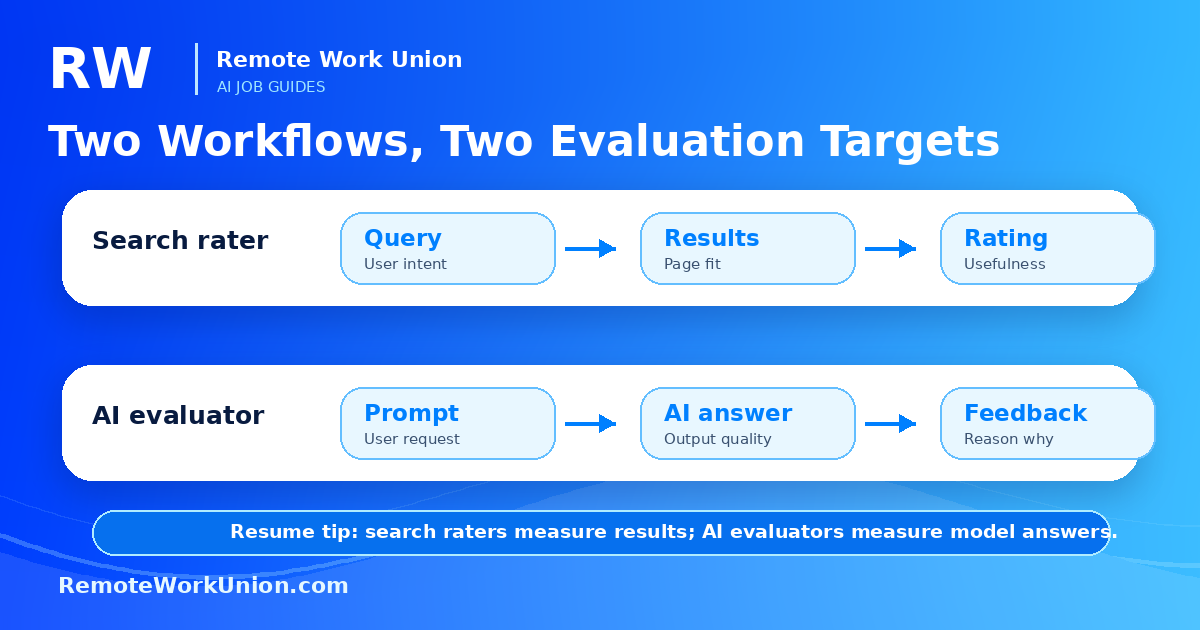
A search quality rater answers a question like: did this search result satisfy what the user was trying to find? An AI evaluator answers a question like: did this AI model produce a helpful, accurate, safe, well-written answer to the prompt?
Search quality rating is about the quality of search results. AI evaluation is about the quality of AI-generated responses. There is overlap, especially as search engines add AI answers and AI companies use web search inside model responses, but the core workflow is still different.
What a Search Quality Rater Does
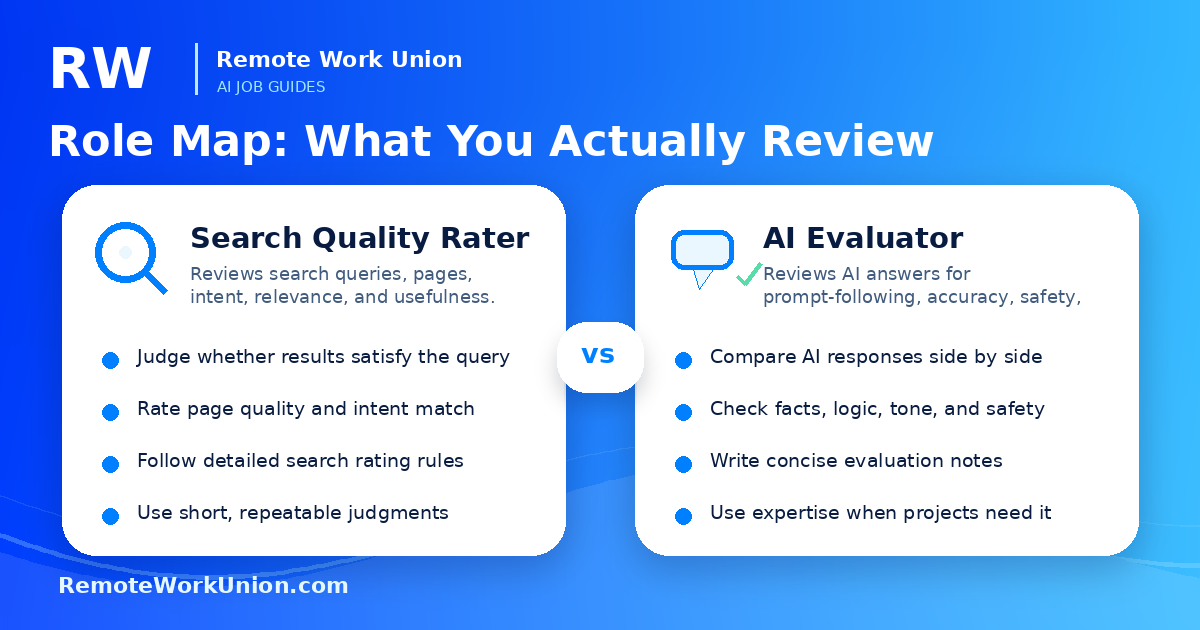
Search quality rater jobs are usually built around query intent. You may be given a search phrase, a location, a language, and one or more results. Your job is to decide whether the result is relevant, trustworthy, fresh enough, and useful for the likely user.
You may review page quality, the match between the query and the result, the reputation of a source, and whether the result appears to answer the need behind the search. A search quality rater does not usually rewrite the internet or create long content. The work is more about applying guidelines consistently across many small judgments.
Common Search Quality Rater Tasks
Common tasks include rating whether a result matches a query, deciding whether a page is high quality or low quality, checking whether a local result fits the user's location, comparing two result sets, and flagging results that are misleading, spammy, unsafe, or unhelpful. The strongest search raters are patient, consistent, and comfortable following detailed rules without overcomplicating every task.
What an AI Evaluator Does
AI evaluator jobs focus on model output. You may compare two chatbot responses, rate a single answer, fact-check a claim, identify hallucinations, score helpfulness, review tone, test safety behavior, or write a short explanation of why one response is better.
Some AI evaluator jobs are general, while others are specialized. A finance expert may review investment-related explanations. A lawyer may review legal reasoning. A medical writer may review healthcare content. A software engineer may evaluate code. A strong writer may review clarity, structure, and instruction-following.
Common AI Evaluator Tasks
Common AI evaluator work includes ranking two responses, writing rubrics, checking whether an answer follows a prompt, identifying factual errors, improving weak answers, labeling unsafe responses, and explaining ratings in concise notes. Some projects are called AI training, model evaluation, RLHF, data annotation, AI response rating, prompt response review, or human feedback work. The wording varies by platform, but the core idea is the same: a human reviewer helps improve AI output quality.
Where the Jobs Overlap
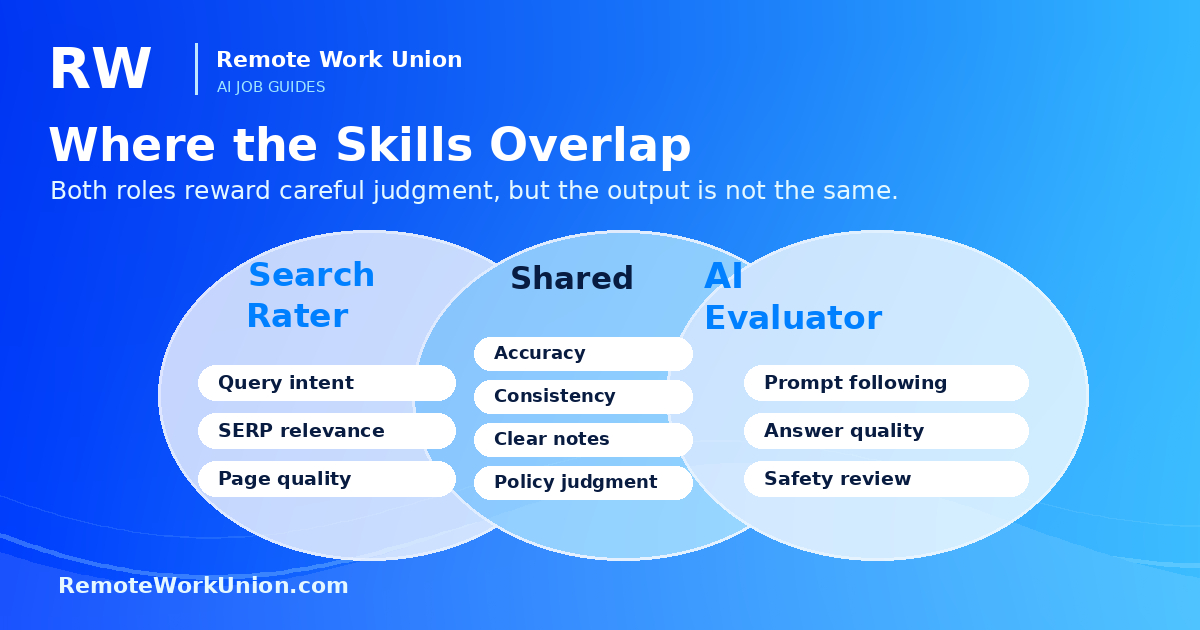
Both roles reward attention to detail, reading comprehension, judgment, and consistency. Both may involve rating guidelines, browser-based task queues, contractor-style work, and remote work from home. Both require you to slow down enough to understand the user's likely intent. Both also punish sloppy rating. The best workers in either role are not just fast. They are accurate, consistent, and able to explain their reasoning when the task requires it.
The Biggest Practical Difference for Applicants
The biggest practical difference is the amount of writing and explanation. Search quality rating can involve short judgments and structured ratings. AI evaluator work often asks for more written reasoning, especially when comparing two model responses or explaining why an answer is misleading, incomplete, unsafe, or lower quality.
If you are a strong writer, editor, teacher, researcher, analyst, lawyer, doctor, coder, or finance professional, AI evaluation may give you more ways to use your expertise. If you prefer structured rules, search quality rating may feel more predictable.
Which Role Is Easier to Start
Search quality rater roles can be easier to understand at first because the task target is familiar: someone searched for something, and the result either helps or does not. AI evaluator jobs can feel more open-ended because model answers can fail in subtle ways. An answer may sound polished but still be wrong. For beginners, the easiest starting point is whichever task type matches how you already think.
Remote Work Union connects you to legitimate remote AI evaluation and search quality rater roles. Apply for free to find roles hiring now.
Find Roles Hiring Now →Which Role Has Better Long-Term Upside
AI evaluator work may have broader upside for applicants with valuable subject matter expertise because many AI projects need reviewers who understand specialized domains. Legal, medical, finance, coding, science, writing, education, product, and business evaluation can all require more than basic internet literacy.
The better long-term strategy is not to treat the roles as enemies. Apply to both, then double down on the one where your approval rate, task availability, quality score, and hourly earnings are strongest.
Resume Keywords to Use
For search quality rater jobs, use keywords such as search evaluation, query intent, relevance rating, page quality, content quality, local search, web research, source evaluation, guideline adherence, and attention to detail.
For AI evaluator jobs, use keywords such as AI model evaluation, AI response rating, RLHF, prompt evaluation, fact-checking, hallucination detection, written feedback, model output review, safety evaluation, reasoning quality, data annotation, and subject matter expertise.
How to Search for These Jobs
Do not search only one phrase. Try search quality rater jobs, search evaluator jobs, internet rater jobs, AI evaluator jobs, AI model evaluation jobs, AI training jobs, remote AI jobs, RLHF jobs, data annotation jobs, prompt response reviewer, AI fact-checking jobs, and human feedback jobs. You can also search around major AI keywords such as OpenAI, Anthropic, Claude, Google Gemini, Meta AI, and Microsoft Copilot.
How to Choose Where to Apply First
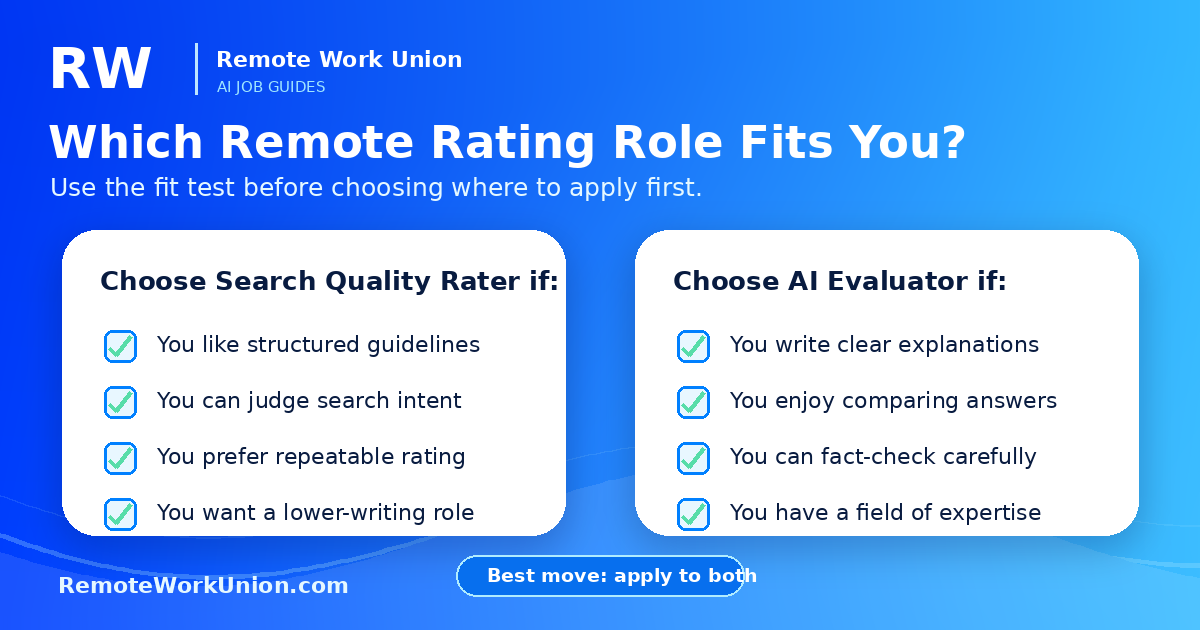
Choose search quality rater jobs first if you prefer structured tasks, shorter ratings, clear guidelines, and judging whether search results match user intent. Choose AI evaluator jobs first if you write well, can compare answers, like research, can explain quality differences, or have a professional background that helps you review specialized content. Choose both if you are serious about remote AI work.
Application Mistakes to Avoid
Do not describe yourself only as someone who wants remote work. Platforms want evidence that you can judge quality. Do not submit a generic resume with no keywords. Do not overstate technical skills you do not have. Do not assume every AI job requires coding. Do not ignore country, language, availability, and equipment requirements. Do not take assessments casually.
Tip: These jobs often use assessments to test whether you can read instructions, apply rules, and explain judgments clearly. A careless assessment is often the reason good candidates do not get placed.
Best Fit by Background
Writers and editors often fit AI evaluator roles because they can judge clarity, tone, structure, and helpfulness. Teachers and tutors can be strong because they are used to grading explanations. Researchers and analysts can be strong because they verify claims and compare evidence. Lawyers, finance professionals, healthcare workers, and engineers may fit specialized AI review projects.
Search quality rater roles may fit people who are strong web researchers, detail-oriented readers, local search users, and people who can apply rating rules consistently without needing to write long explanations.
Frequently Asked Questions
Is a search quality rater an AI evaluator?
Not exactly. A search quality rater evaluates search results and web pages. An AI evaluator evaluates AI-generated answers. Some modern search tasks may overlap with AI answers, but the role target is different.
Do AI evaluator jobs require coding?
Some do, especially code evaluation projects, but many AI evaluator jobs focus on writing, research, fact-checking, safety, education, business, legal, medical, or general response quality.
Can beginners apply for these roles?
Yes, but beginners should apply carefully. Read the task descriptions, match the resume to the role, and take assessments seriously. Strong writing, research ability, and attention to detail matter more than generic remote work interest.
Which job is better for writers?
AI evaluator jobs are often a better fit for strong writers because many tasks require written explanations and response comparison. Search quality rating can still be a fit if the writer is also good at web research and structured guidelines.
Should I apply to multiple AI training platforms?
Yes. Task availability can change, so relying on one platform is risky. Applying to several legitimate remote AI work platforms can improve your chances of finding steady projects.