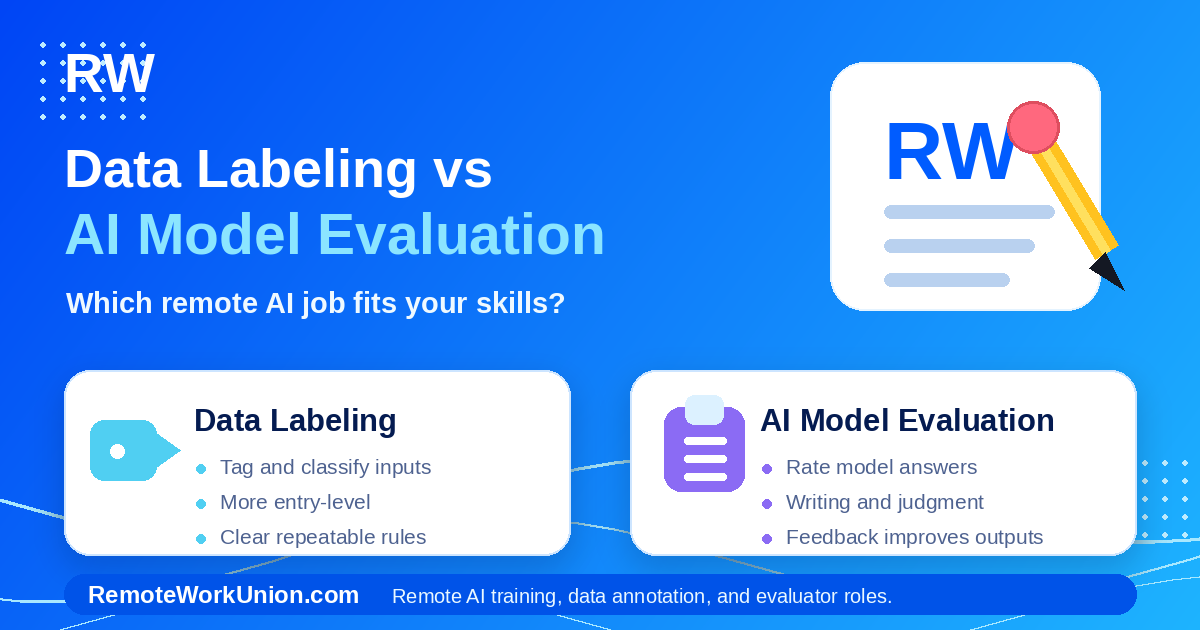
Data labeling and AI model evaluation are often grouped together under the same broad search terms: remote AI jobs, data annotation jobs, AI training jobs, AI evaluator roles, and work from home AI jobs. They are related, but they are not the same job.
Data labeling is usually about organizing raw information so an AI system can learn from it. AI model evaluation is usually about judging the answers a model already produced. One role is closer to annotation and categorization. The other is closer to editing, research, fact-checking, quality review, and expert judgment.
For remote workers, the important question is not which one sounds more technical. The better question is: which one fits your skills, schedule, and income goals?
Quick Answer: Which Remote Job Is Better?
AI model evaluation is usually the better option if you have strong writing skills, research ability, professional expertise, or the patience to explain why one answer is better than another. It is more likely to reward judgment, communication, and domain knowledge.
Data labeling is usually better if you want a simpler starting point, prefer clear instructions, and are comfortable doing repeatable detail-oriented tasks. It can be a useful entry point into AI training work, especially if you are new to remote contracting.
The strongest strategy is to understand both categories and apply to both. Data labeling can help you build experience. AI model evaluation can give you more room to use your existing skills.
What Data Labeling Jobs Actually Involve
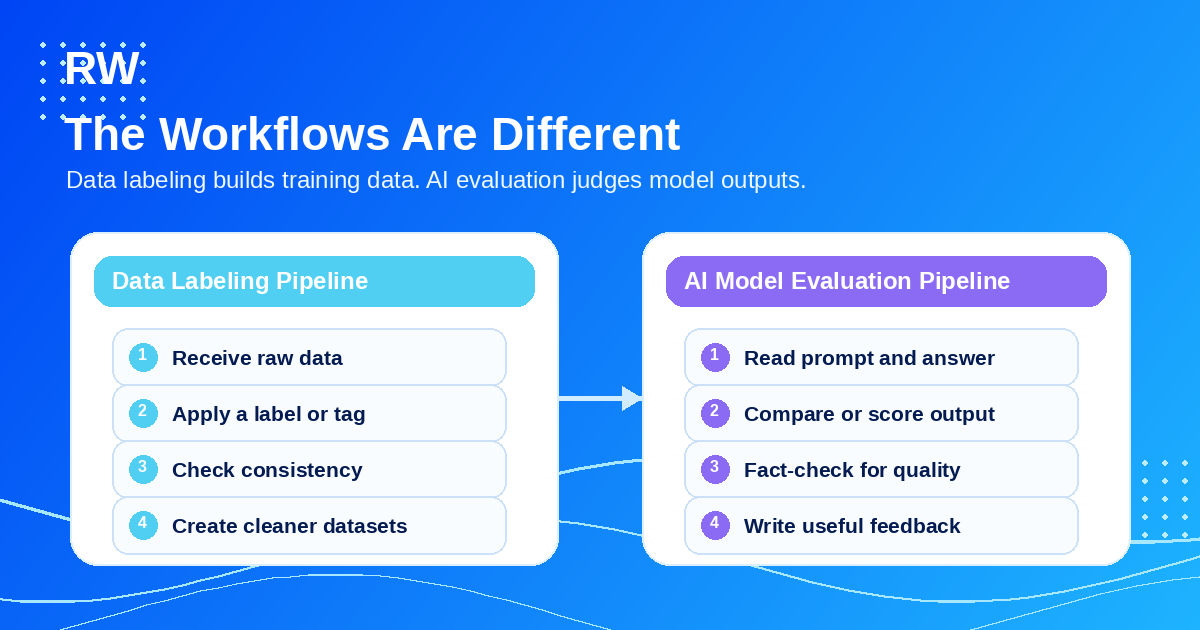
Data labeling, also called data annotation, is the process of adding structure to raw data. A company may have images, audio clips, search queries, product listings, documents, or short pieces of text that need to be categorized before they can be used to train or test AI systems.
Common data labeling tasks include:
- Choosing the correct category for a piece of text.
- Tagging objects in an image.
- Marking whether a search result matches a query.
- Labeling customer support messages by intent.
- Reviewing product listings for category accuracy.
- Transcribing or checking short audio clips.
- Identifying names, dates, locations, or other entities in text.
- Flagging unsafe, irrelevant, duplicate, or low-quality content.
In many data labeling jobs, the instructions are specific. The task may tell you exactly what each label means and how to handle edge cases. Your job is to apply the rules consistently. That makes data labeling a strong fit for people who are careful, patient, and accurate.
What AI Model Evaluation Jobs Actually Involve
AI model evaluation is different. Instead of labeling raw data, you are usually reviewing the output of an AI model. You may read a prompt, compare two model responses, rate an answer for helpfulness, check whether a claim is accurate, or write feedback explaining what the model did well and what it missed.
These jobs may appear under titles like AI evaluator, AI model reviewer, AI response evaluator, AI writing evaluator, RLHF rater, LLM evaluator, prompt response reviewer, search quality rater, AI content quality analyst, or remote AI training contractor.
People searching for work around OpenAI, Anthropic, Google, Meta, Microsoft, xAI/Grok, Gemini, Claude, ChatGPT, and other AI systems are often looking for this type of human review work. Platforms like Outlier AI, Mercor, Handshake AI, and micro1 all connect remote workers to this type of work.
The Biggest Difference: Labels vs Judgment
The simplest way to separate the two: data labeling asks "What label should this item receive?" AI model evaluation asks "How good is this AI answer, and why?"
Data labeling depends on consistency. AI model evaluation depends on judgment. Data labeling often has a smaller decision space. AI evaluation often has more gray area. That is why AI model evaluation tends to favor people who can read carefully and explain themselves.
Comparison Table
| Category | Data Labeling | AI Model Evaluation |
|---|---|---|
| Main task | Label or annotate raw data | Review, rate, compare, or critique AI outputs |
| Typical skill | Accuracy and consistency | Writing, reasoning, research, judgment |
| Best for | Beginners, detail-oriented workers, structured rules | Writers, researchers, professionals, subject matter experts |
| Task style | Repetitive and rule-based | Analytical and explanation-based |
| Examples | Image tagging, text categorization, transcription | RLHF rating, chatbot review, fact-checking, safety evaluation |
| Resume angle | Data annotation, quality control, labeling accuracy | AI evaluation, model review, prompt analysis, domain expertise |
| Upside | Good entry point into remote AI work | Better long-term match for educated or specialized applicants |
Which Is Better for Beginners?
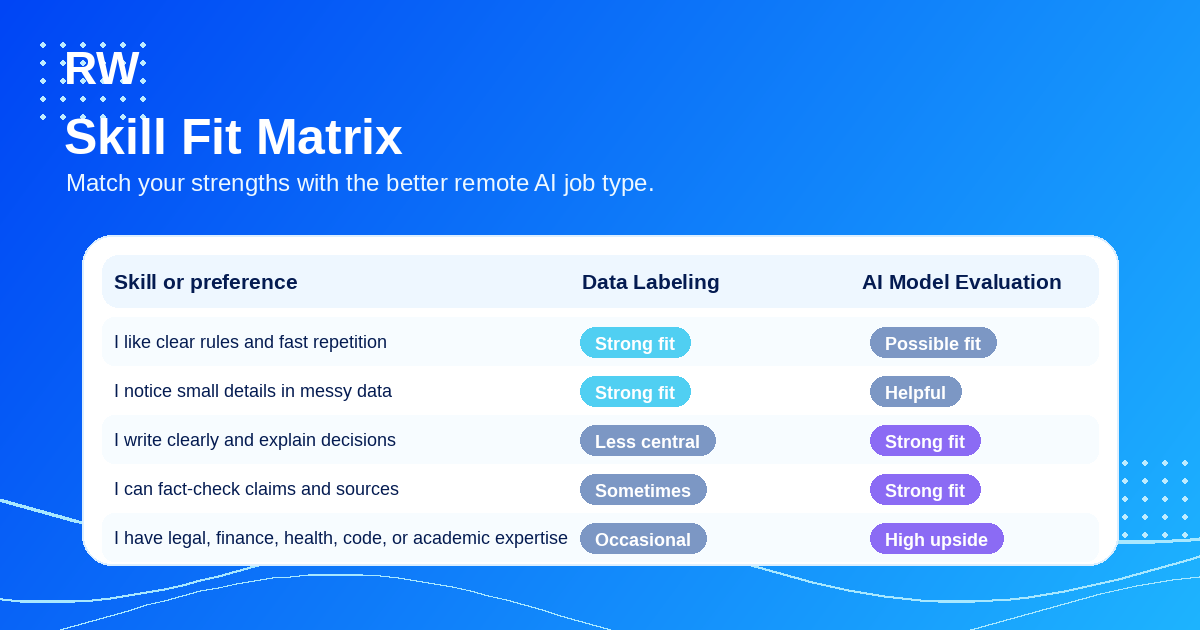
Data labeling is usually easier for beginners to understand because the task format is more direct. The instructions may be long, but the work itself is often concrete. You learn the rules, apply the labels, and try to maintain accuracy. If you are trying to break into remote AI work, data labeling can give you experience with guidelines, quality checks, and platform workflows.
Which Is Better for Writers and Editors?
AI model evaluation is usually better for writers and editors because the work often depends on language judgment. A strong writing evaluator can tell when an answer sounds polished but says very little. They can identify vague claims, weak explanations, missing caveats, poor structure, and unnatural phrasing. They can also explain those issues in a way that helps improve future outputs.
If you have experience in editing, journalism, copywriting, content strategy, teaching, grant writing, academic writing, legal writing, technical writing, or marketing, AI response evaluation may fit better than basic data labeling.
Remote Work Union connects you to legitimate remote data labeling and AI evaluation roles. Apply for free to find roles hiring now.
Find Roles Hiring Now →Which Is Better for Subject Matter Experts?
AI model evaluation is usually the stronger category for subject matter experts. General data labeling rarely needs a finance expert, lawyer, nurse, engineer, professor, or consultant. AI evaluation sometimes does.
This is where many applicants underestimate themselves. They search for "data entry jobs from home" when their real advantage is expertise. If you have professional knowledge in law, medicine, finance, coding, mathematics, business strategy, science, education, or policy, you should also search for AI evaluation jobs, AI training jobs, expert reviewer roles, and remote subject matter expert contracts.
Which Is More Stable?
Neither category should be treated as perfectly stable. Remote AI contracting can be project-based. Tasks can appear, disappear, slow down, or change depending on client demand, platform quality needs, and your performance. The practical answer is to avoid depending on one platform or one task type. Apply to several legitimate platforms, keep your profile updated, and track which projects actually produce consistent work.
Which Has Better Long-Term Upside?
AI model evaluation usually has better long-term upside for applicants who can develop strong evaluation skills. As AI systems become more capable, the quality bar rises. Companies need humans who can judge nuance, context, correctness, safety, and usefulness. Basic labeling can still matter, but many simple annotation tasks are easier to standardize over time.
Tip: The best remote AI workers learn to do more than complete tasks. They learn how to explain tradeoffs, catch hallucinations, write clear feedback, follow complex rubrics, and apply expertise without overcomplicating the task. Those skills transfer across many job titles.
How to Choose Based on Your Background
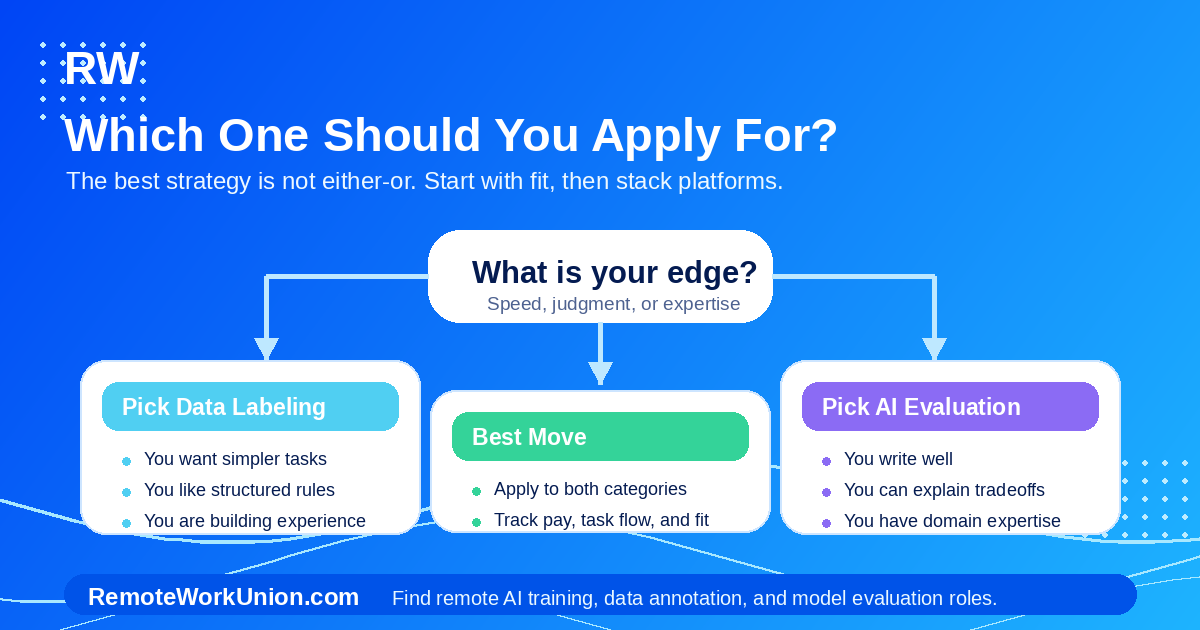
Choose data labeling if you want a straightforward entry point and are comfortable with repetitive detail work. It can be a better fit if you are new to remote work, building confidence, or trying to get your first AI training project.
Choose AI model evaluation if you have strong writing skills, enjoy comparing answers, can explain decisions clearly, and are willing to read guidelines carefully. It is also the better target if you have professional expertise that can help you evaluate specialized outputs.
Apply to both if you are serious about remote AI work. Many people use data annotation roles to build experience and AI evaluation roles to build income potential. The two categories are not enemies. They are different lanes inside the same broader AI training market.
Resume Keywords to Use
For data labeling roles: data annotation, data labeling, text classification, image annotation, quality control, attention to detail, taxonomy and categorization, search relevance, content moderation, guideline adherence.
For AI model evaluation roles: AI model evaluation, AI response review, RLHF rating, prompt evaluation, fact-checking, written feedback, comparative analysis, helpfulness and accuracy review, safety evaluation, subject matter expert review.
Search Terms to Try
Remote AI training jobs, AI evaluator jobs, AI model evaluation jobs, data annotation jobs remote, data labeling jobs from home, RLHF jobs, prompt evaluator jobs, AI response reviewer jobs, search quality rater jobs, LLM evaluator jobs, AI writing evaluator jobs, human feedback AI jobs. Combine these with your country, field, or skill set for more targeted results.
Red Flags to Avoid
Legitimate remote AI jobs should explain the work, assessment process, pay structure, and contractor terms clearly. Be careful with any listing that promises guaranteed income, asks you to pay upfront for access, hides the company name, or uses copied job descriptions. A good rule: real work should have a real task description. If you cannot tell whether you will be labeling data, evaluating AI outputs, writing feedback, or checking facts, keep looking.
Frequently Asked Questions
What is the main difference between data labeling and AI model evaluation?
Data labeling is about organizing raw data so an AI can learn from it. You apply categories, tags, or labels to text, images, audio, or other inputs. AI model evaluation is about judging AI-generated outputs. You rate responses, compare answers, fact-check claims, and write feedback explaining quality differences.
Which is better for beginners: data labeling or AI model evaluation?
Data labeling is usually easier for beginners because the task format is more direct. The instructions may be long, but the work is often concrete. AI model evaluation can feel more open-ended because model answers can fail in subtle ways that require judgment to catch.
Which is better for writers and subject matter experts?
AI model evaluation is usually the stronger choice for writers, editors, researchers, lawyers, finance professionals, healthcare workers, and other subject matter experts. The work rewards judgment, explanation, and domain knowledge rather than rule-following consistency alone.
Can I do both data labeling and AI model evaluation?
Yes. Many remote AI workers apply to both types of roles. Data annotation work can help you build experience with platform workflows and guidelines. AI evaluation work can give you more room to use your existing skills and earn more per hour over time.