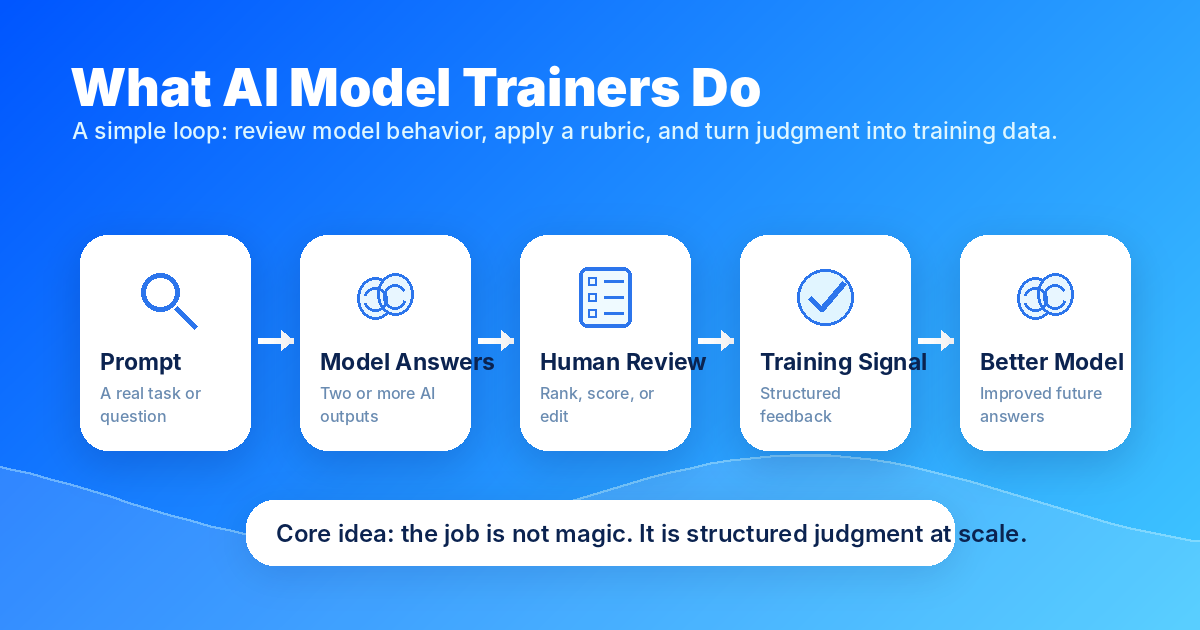
AI model trainer jobs are remote-friendly roles where people help improve artificial intelligence systems by reviewing, ranking, writing, correcting, and testing model outputs. The job can be called many things — AI trainer, AI evaluator, AI rater, data annotation specialist, prompt evaluator, LLM reviewer, AI response reviewer, or human feedback contractor — but the core idea is the same: a model produces an answer, a human judges it, and that judgment becomes useful training or evaluation data.
This work has become one of the most practical ways for strong writers, researchers, teachers, coders, bilingual workers, lawyers, healthcare experts, finance professionals, and other domain specialists to find remote AI work without taking a traditional software engineering job. The best candidates are not just people who use AI tools. The best candidates can explain why one answer is better than another, identify subtle mistakes, follow instructions consistently, and turn judgment into clear written feedback.
What Is an AI Model Trainer?
An AI model trainer is a human reviewer who helps improve AI systems by giving structured feedback on model behavior. The role sits between writing, research, quality assurance, education, and product testing. You may not be training a model in the engineering sense of building neural networks from scratch. Instead, you are creating the examples, ratings, corrections, and evaluations that AI teams use to measure and improve model quality.
For a remote worker, the job usually looks like a task queue. You log into a platform, read instructions, complete a sample or assessment, and then work through prompts, responses, rubrics, or datasets. The work may be project-based, part-time, freelance, contract, or occasionally full-time. A single task might ask you to compare two chatbot answers and choose the better one. A legal project might ask an attorney to judge whether a model applied the right standard. A coding project might ask a developer to review a bug fix or evaluate whether an answer compiles.
Common AI Model Trainer Tasks
Most AI model trainer jobs combine several task types. The exact mix depends on the platform, client, model, and your area of expertise.
- Side-by-side response rating. You compare two or more AI answers to the same prompt and decide which one is better. You may judge accuracy, helpfulness, completeness, tone, safety, formatting, and instruction-following.
- Rubric-based scoring. You grade an AI answer against a detailed rubric. This requires consistency — if the rubric says to penalize unsupported claims, you must penalize them even if the answer sounds polished.
- Writing ideal responses. Some projects ask trainers to write a gold-standard answer that shows the model what a high-quality response should look like.
- Fact-checking and source review. You may verify claims, check citations, test links, compare output against source material, or flag unsupported statements.
- Prompt creation and prompt evaluation. Some projects ask workers to write prompts that expose model weaknesses or judge whether a prompt is clear, difficult, or realistic.
- Error labeling. You identify the type of mistake: hallucination, math error, reasoning flaw, instruction miss, safety issue, formatting failure, or incomplete answer.
- Domain-specific review. Experts in medicine, law, finance, education, engineering, science, or coding review specialized outputs that a generalist should not judge.
- Coding evaluation. Technical AI trainer jobs can include code review, unit test creation, bug diagnosis, algorithm evaluation, and documentation review.
Why These Jobs Can Be Done From Home
AI model trainer jobs are usually digital, asynchronous, and task-based. You are reading prompts, reviewing outputs, writing feedback, and submitting structured judgments. That makes the work a natural fit for remote jobs, work-from-home jobs, part-time remote work, and flexible online contracts. Many projects do not require phone calls. Many do not require live meetings. Some only require a laptop, stable internet, strong English skills, and the ability to follow detailed instructions.
The remote nature of the work does not mean it is easy. Good projects often have strict quality standards. Low-quality work can lead to fewer tasks or removal from a project. The people who last are usually careful, consistent, and willing to read instructions before moving fast.
AI Model Trainer vs AI Evaluator vs Data Annotation
The job titles overlap, but there are useful differences. AI model trainer is the broadest phrase — it can include writing examples, ranking outputs, correcting answers, creating prompts, building rubrics, and reviewing model behavior. AI evaluator or AI rater usually refers to judging the quality of model outputs, often comparatively. Data annotation can include AI training work, but it is broader — it may involve labeling images, tagging text, categorizing search results, or transcribing audio. RLHF jobs are a specific kind of human feedback work where human preferences help guide model behavior.
Who Is a Good Fit for AI Model Trainer Jobs?
These roles are best for people who can combine attention to detail with clear written judgment. A strong candidate does not simply say "Answer A is better." A strong candidate explains that answer A follows the instruction, cites the relevant source, avoids unsupported claims, and gives a complete answer, while answer B misses a constraint or invents a fact.
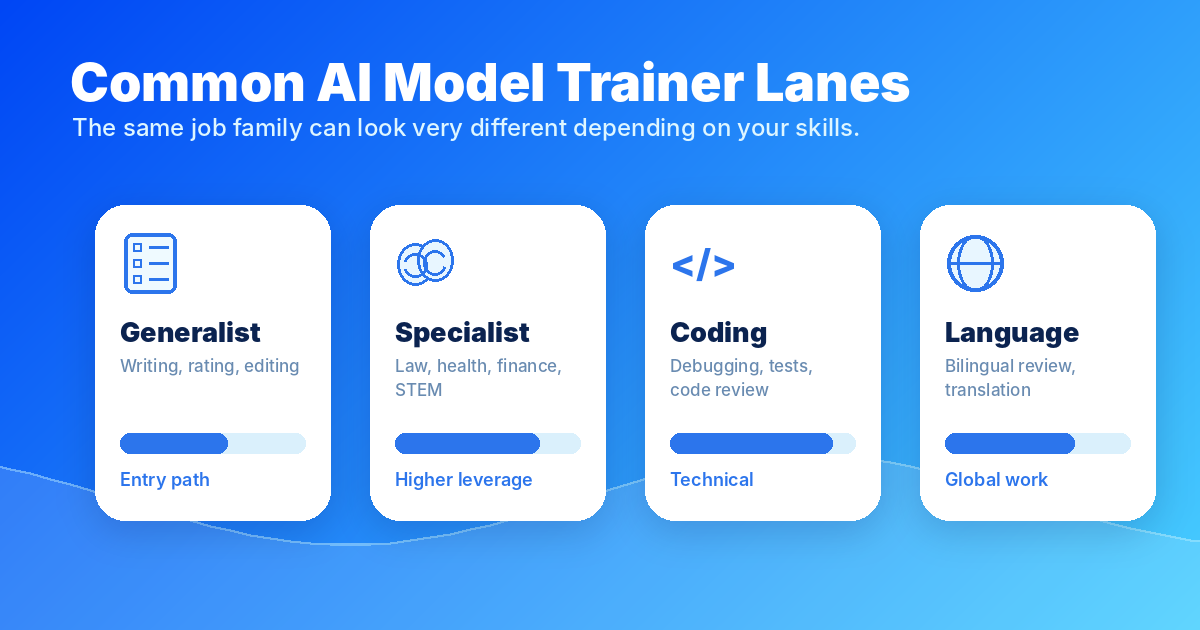
Good fits include strong writers, editors, teachers, tutors, researchers, students, graduate students, lawyers, paralegals, nurses, doctors, pharmacists, therapists, accountants, analysts, software developers, bilingual workers, translators, and subject-matter experts. You do not always need a technical background. However, technical or expert projects usually pay more attention to credentials, work samples, degrees, portfolios, coding tests, or proof of professional experience.
Skills That Help You Get Accepted
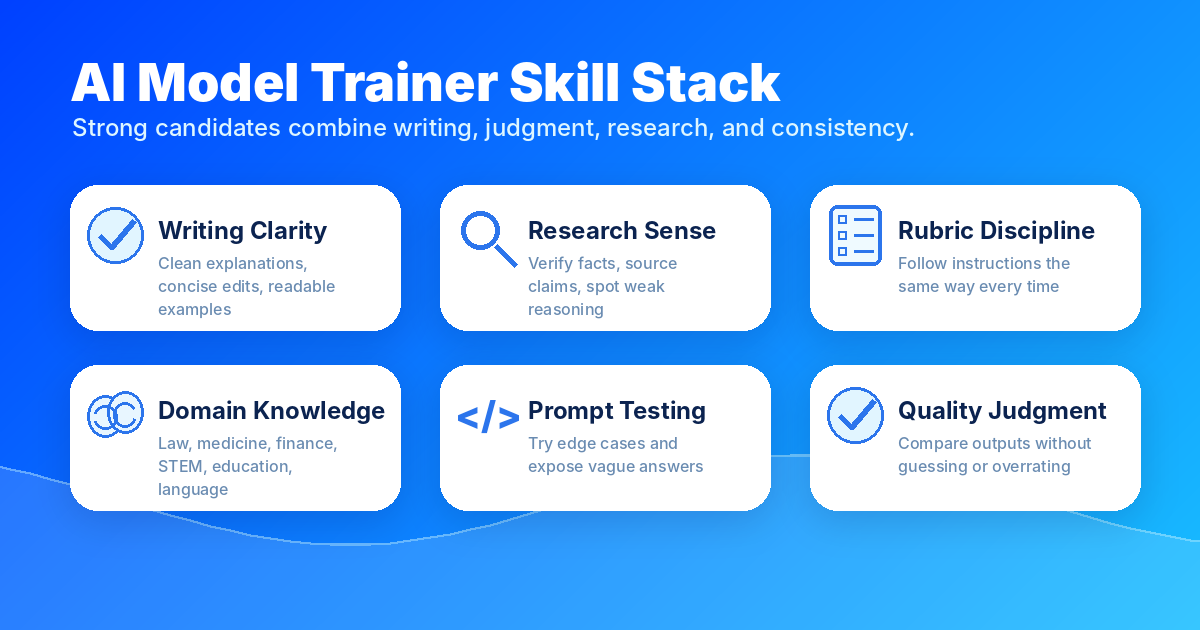
The most useful skills for AI model trainer jobs are practical rather than flashy:
- Writing clarity. You need to explain mistakes in plain language. Rambling feedback is less useful than concise, specific feedback.
- Research judgment. You should know when a claim needs verification and when an answer is relying on vague confidence.
- Instruction-following. These jobs often depend on rubrics. Ignoring the rubric because you have a personal preference is a common reason people fail assessments.
- Comparative reasoning. You need to compare answers across multiple dimensions, not just pick the one that sounds more polished.
- Consistency. A platform needs reviewers who apply standards the same way across many tasks.
- Domain expertise. Specialized knowledge in coding, law, medicine, finance, science, education, business, language, or creative fields can help you qualify for better projects.
Remote Work Union connects you to legitimate AI model trainer and evaluation roles. Apply for free.
Find Roles Hiring Now →How to Apply for AI Model Trainer Jobs From Home
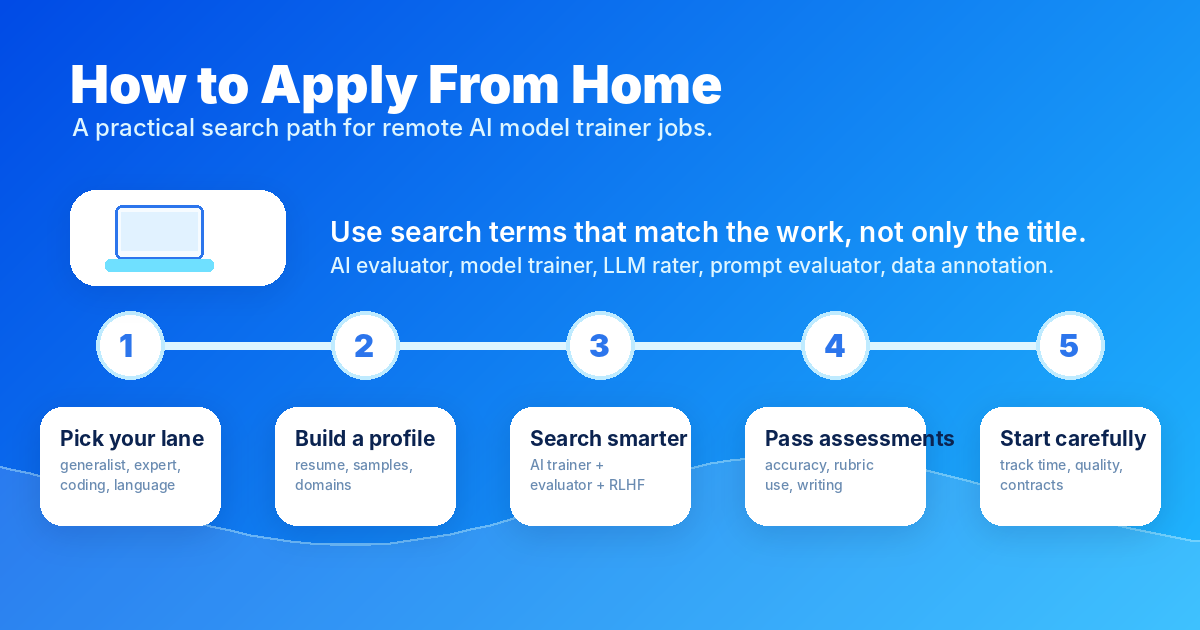
Start by choosing your lane. A generalist should search for AI trainer jobs, AI evaluator jobs, AI response reviewer jobs, data annotation jobs from home, LLM evaluator jobs, AI rater jobs, and prompt evaluation jobs. A specialist should add their domain: legal AI trainer, healthcare AI evaluator, finance AI trainer, coding AI trainer, math AI rater, bilingual AI trainer, or medical AI response reviewer.
Next, rewrite your resume or profile around the work. Highlight writing, research, editing, fact-checking, quality review, tutoring, coding, rubric design, A/B comparison, data annotation, and domain expertise. Then prepare for assessments — most platforms care less about your claims and more about whether you can complete a test task. Slow down. Read the instructions. Identify the exact scoring criteria. Show your reasoning in the format requested.
Best Search Terms to Use
Use a mix of old and new keywords: AI model trainer jobs, AI trainer jobs, remote AI training jobs, work from home AI jobs, AI evaluator jobs, AI rater jobs, AI response reviewer jobs, prompt evaluation jobs, chatbot evaluator jobs, LLM evaluator jobs, human feedback jobs, RLHF jobs, data annotation jobs from home, AI data quality specialist, AI writing evaluator, coding AI trainer, expert AI reviewer, bilingual AI trainer, search quality rater, AI model evaluation contractor.
You can also search around major AI ecosystems: OpenAI, Anthropic Claude, Google Gemini, Microsoft Copilot, Meta AI, xAI Grok, Perplexity, Scale AI, Outlier, Surge AI, Mercor, DataAnnotation, micro1, Stellar AI, and Handshake AI. Do not assume every AI lab directly hires remote contractors — many projects appear through vendors, marketplaces, staffing partners, or specialized AI training platforms.
What to Put on Your Resume or Profile
Your profile should make it easy for a reviewer to understand what you can judge. Use concrete phrases like:
- Evaluated AI-generated responses for accuracy, completeness, tone, and instruction-following.
- Compared model outputs using rubrics and selected the stronger response with written justification.
- Fact-checked claims using reliable sources and flagged unsupported or misleading statements.
- Wrote clear model-facing examples, explanations, and revised answers.
- Applied domain expertise in finance, healthcare, law, education, coding, language, or research.
Application Mistakes to Avoid
Do not apply with a generic remote-work resume. Do not rush the assessment — a small instruction miss can matter more than a beautiful writing sample. Do not exaggerate your credentials; expert projects may verify experience. Do not ignore confidentiality — never upload private project instructions, model outputs, or client data into public tools unless the contract clearly permits it. Do not chase only one platform; AI training work can be uneven, so build a pipeline.
How to Avoid Scams
Remote AI jobs attract scams because the search demand is high. Be careful with any opportunity that asks you to pay to apply, promises guaranteed income, uses only a personal messaging app, avoids written terms, asks for sensitive identity or banking information too early, or pressures you to submit unpaid work that looks like real client production. Legitimate AI model trainer jobs should have clear task instructions, clear pay terms, platform identity, worker agreement, privacy expectations, and some kind of quality process.
Frequently Asked Questions
Do AI model trainer jobs require coding?
Not always. Many generalist AI trainer and AI evaluator jobs focus on writing, research, rating, and judgment. Coding projects exist, but they are only one lane within the broader remote AI training market.
Can beginners apply for AI trainer jobs?
Yes, beginners can apply for generalist roles if they write clearly, follow instructions, and pass assessments. Specialized roles usually require stronger proof of expertise.
Are AI model trainer jobs the same as data entry?
No. Data entry is mostly transferring information. AI model training usually requires judgment: comparing answers, scoring quality, identifying errors, writing feedback, and sometimes creating ideal examples.
What equipment do I need?
Most remote AI trainer jobs require a reliable computer, stable internet, and a quiet work setup. Some projects may require specific browsers, identity verification, time tracking, or secure work environments.
What is the best way to find AI model trainer jobs?
Use multiple search terms: AI model trainer, AI evaluator, AI rater, LLM evaluator, prompt evaluator, AI response reviewer, RLHF contractor, data annotation jobs from home, and expert AI trainer.