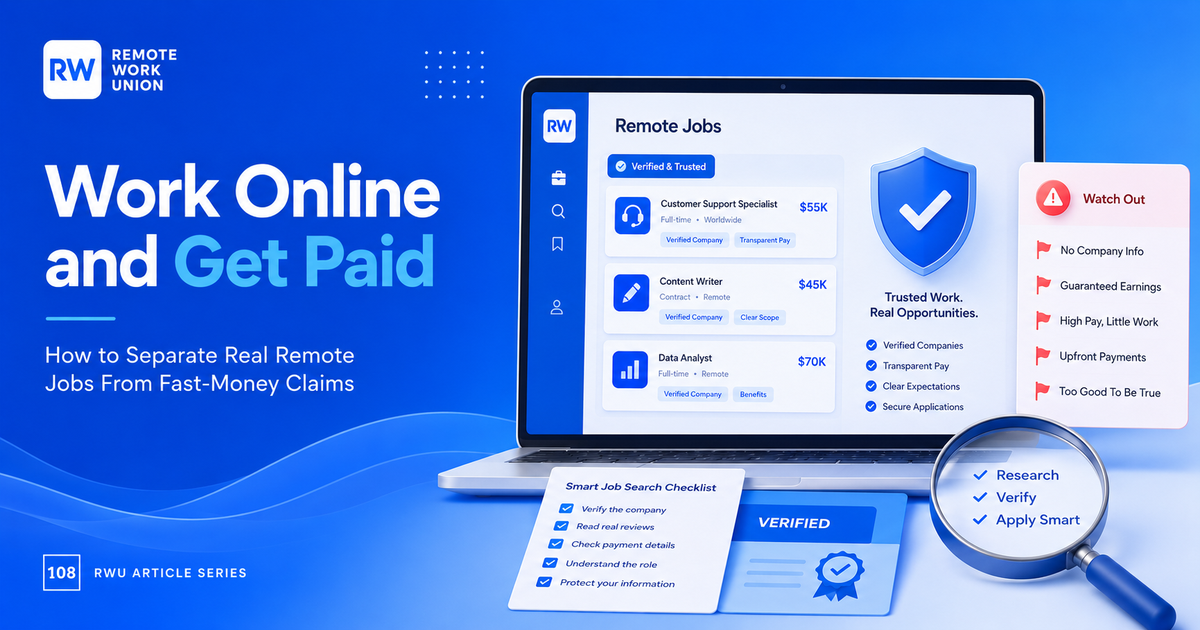
The phrase "work online and get paid" sounds simple, but it leads to two very different worlds. One world is made of legitimate remote jobs with real companies, clear responsibilities, deadlines, screening steps, contracts, and pay structures. The other world is made of fast-money claims that promise income without skills, effort, verification, or accountability.
For remote job seekers, the goal is not just to find something online. The goal is to find work that is real, safe, skill-based, and worth applying for. That could mean AI training jobs, AI data annotation jobs, AI model evaluation jobs, content writing jobs, research roles, customer support jobs, operations work, admin roles, virtual assistant projects, or flexible remote contract work. The format can vary, but legitimate online work usually has one thing in common: someone is paying for useful output, not for vague activity.
This guide explains how to separate real remote jobs from unrealistic fast-money claims, especially when you are searching for online jobs, work from home jobs, remote AI jobs, data annotation work, prompt evaluation work, AI response reviewer projects, and other flexible ways to earn from a computer.
Why "Work Online and Get Paid" Attracts Both Opportunity and Noise
Searches like "work online and get paid," "online jobs from home," "remote jobs no experience," and "get paid to use AI" attract a huge audience. That audience includes students, writers, researchers, bilingual workers, customer support applicants, software developers, analysts, teachers, nurses, legal professionals, finance specialists, and people who simply want flexible work without commuting.
Because the demand is so broad, the search results can get messy. Real companies and platforms may appear next to vague landing pages, affiliate-heavy lists, recycled job posts, social media claims, and offers that are built more around attention than actual hiring. A legitimate remote job may look quiet and specific. A weak offer may look loud, urgent, and too easy.
That is why the best approach is not to chase every headline that says "get paid online." The better approach is to learn the structure of real online work, then evaluate each role based on evidence.
What Real Online Work Usually Looks Like
Real online work is still work. It usually has a defined task, a person or system that reviews output, a contract or employment structure, a schedule or deadline, and a way to measure quality. Even flexible jobs have expectations.
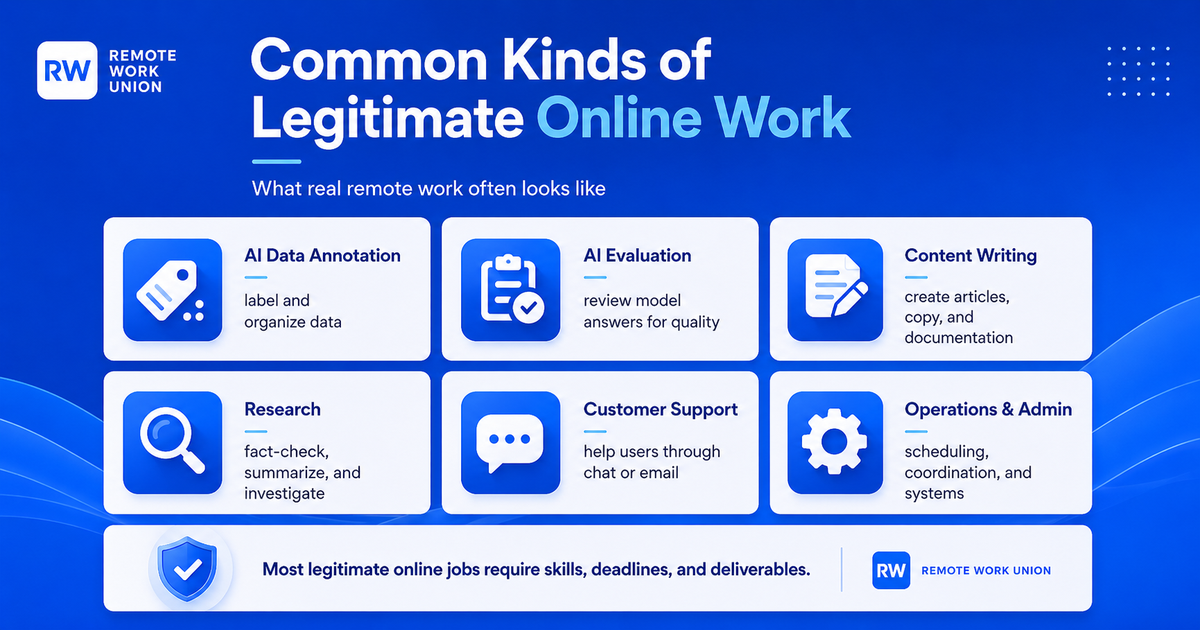
For example, a legitimate AI data annotation job may ask you to label text, categorize search results, identify unsafe content, compare model responses, or review whether an answer follows instructions. A legitimate AI model evaluation job may ask you to test chatbot answers for accuracy, helpfulness, reasoning, tone, formatting, or factual reliability. A prompt evaluation job may ask you to judge whether one AI answer is better than another. A paid AI research role may ask you to investigate a topic, check sources, summarize findings, or evaluate whether an AI system handled a complex question correctly.
Outside of AI, legitimate online work can include writing, editing, research, customer support, QA testing, community moderation, virtual assistant work, operations support, scheduling, bookkeeping, data analysis, and project coordination. These roles may be full-time, part-time, freelance, contract-based, or project-based. The important point is that the work has a real deliverable.
The Biggest Difference: Deliverables vs Promises
A real remote job pays for deliverables. A fast-money claim sells a promise.
Deliverables are concrete. They sound like: review 50 model responses, label a dataset, write a product guide, fact-check a set of claims, answer customer tickets, edit documentation, test an app workflow, or prepare a research summary. Promises sound like: earn instantly, no skills needed, guaranteed daily pay, one weird trick, passive income from your phone, or unlimited earnings with no work.
Some legitimate online jobs are beginner-friendly, but beginner-friendly does not mean effort-free. The best entry-level remote jobs still reward clarity, reliability, attention to detail, communication, and the ability to follow instructions. That is especially true in AI training and human feedback work, where companies need careful reviewers who can notice mistakes, compare outputs, and explain decisions.
Signs an Online Job Is Probably Legitimate
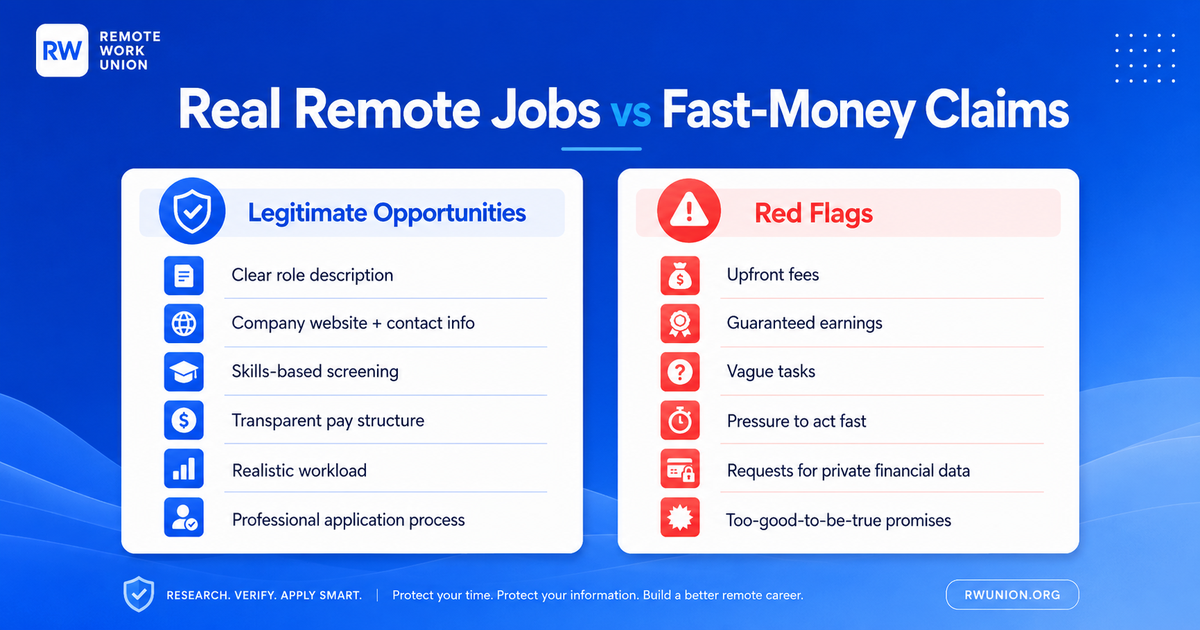
A legitimate online job should give you enough information to understand what you are applying for. The company or platform should have a visible website, a real hiring process, a role description, an explanation of required skills, a pay structure or pay range, and a normal way to apply.
Look for specifics. A strong listing explains the type of work, the tools involved, the expected schedule, the location rules, the contract type, and the application steps. It may not answer every question up front, but it should not hide the basics.
Legitimate roles also tend to screen for skill. That may be annoying, but it is a good sign. AI rater jobs, RLHF jobs, AI response reviewer jobs, data annotation jobs, research roles, and writing roles often include assessments because the work depends on judgment. A platform that asks you to complete a writing test, reasoning assessment, domain quiz, language evaluation, or sample task may be testing whether you can actually do the work.
Red Flags That Should Slow You Down
The clearest red flag is an upfront payment request. Job seekers should be cautious if a company asks them to pay a fee to unlock work, buy a starter kit, purchase software from a suspicious link, pay for training before any contract exists, or send money to receive money.
Another major warning sign is guaranteed earnings. Real remote jobs can advertise pay rates, salary ranges, or project rates, but they should not promise results that depend on acceptance, hours, quality, task availability, or client demand. Claims like "guaranteed $500 per day" or "make thousands this week with no experience" usually deserve skepticism.
Be careful with vague roles. If a listing cannot explain what you will actually do, who is hiring, how pay works, or what skills matter, it may not be worth your time. Also be cautious with pressure tactics. Real companies do not usually need you to act in the next ten minutes, move to a private messaging app, share sensitive financial information, or accept a role before reading the details.
Remote Work Union connects you to verified remote AI jobs, data annotation roles, and legitimate online work. Browse real listings today.
Find Roles Hiring Now →How AI Work Fits Into the Online Jobs Category
AI has created real demand for human review. Systems connected to ChatGPT, Claude, Gemini, search assistants, coding tools, creative tools, enterprise chatbots, and AI browsers all need better training data, better evaluation, better safety review, and better feedback. That is why job seekers see terms like AI training jobs, AI model training jobs, AI evaluator jobs, AI data annotation jobs, prompt evaluation jobs, human feedback jobs, RLHF jobs, AI rater jobs, and AI response reviewer jobs.
The strongest applicants usually connect their background to the work. Writers can evaluate clarity and tone. Teachers can review educational answers. Lawyers and paralegals can help with legal reasoning tasks where appropriate. Finance and accounting professionals can evaluate business answers. Nurses and medical writers can bring healthcare knowledge to medical writing or review projects. Coders can review code outputs, debugging steps, and technical explanations. Bilingual workers can evaluate translation, localization, and language quality.
Major AI companies and AI ecosystems — including OpenAI, Anthropic, Google, Meta, Microsoft, Amazon, Apple, xAI, NVIDIA, and other AI labs, vendors, contractors, and data platforms — make these keywords valuable for research. But the safest job search habit is to verify the actual role, company, platform, contract, and application path before assuming any search result is connected to a major brand.
A Simple Verification Process Before You Apply
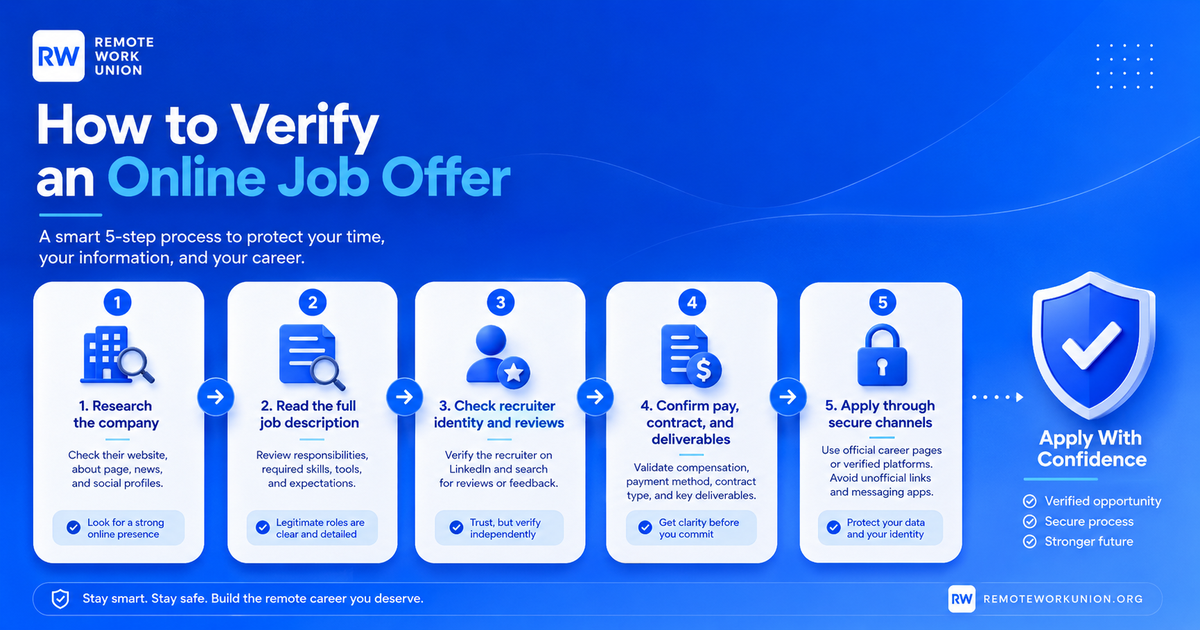
Start by researching the company. Look for an official website, careers page, LinkedIn page, leadership information, public product pages, and basic contact information. A new company can still be legitimate, but there should be some evidence that it exists beyond a single job post.
Next, read the full job description. Identify the role, tasks, tools, expected output, required skills, compensation structure, location rules, and application steps. If the job title says "AI trainer," determine whether it means data annotation, model evaluation, prompt writing, coding review, research review, safety testing, or something else.
Then check the recruiter or platform. Search for reviews, applicant discussions, payment feedback, and signs of impersonation. Be careful with fake recruiters using the names of real companies. If the application link does not match the official company domain or a known verified platform, slow down.
Before sharing private information, confirm the stage of the process. A legitimate employer may eventually need tax and payment details, but that should happen through secure systems after a real offer or contractor onboarding step. It should not happen through random forms, private messages, or suspicious file downloads.
Better Search Terms Than Broad Fast-Money Phrases
The search phrase "work online and get paid" is broad. It can help you start, but better searches usually produce better opportunities. Try searches that describe the actual work you want to do.
For AI work, use phrases like "remote AI training jobs," "AI data annotation jobs from home," "AI model evaluation jobs," "AI response reviewer jobs," "AI rater jobs," "prompt evaluation jobs," "RLHF jobs," "human feedback jobs in AI," "paid AI research jobs," "AI content editor jobs," "AI safety evaluator jobs," and "AI coding evaluator jobs."
For general online work, use terms like "remote research assistant jobs," "remote content editor jobs," "work from home writing jobs," "remote customer support chat jobs," "remote operations assistant," "virtual assistant remote jobs," "remote QA tester jobs," "remote data analyst contract," and "remote part-time jobs from home." Specific search terms help you avoid generic pages that are designed to catch every job seeker at once.
How to Make Your Application Stronger
A good application does not just say you want remote work. It proves you can produce useful output without being managed in person. That means your resume and profile should emphasize reliability, clear writing, attention to detail, independent work, research ability, domain knowledge, technical tools, and specific examples.
For AI training and AI evaluation roles, highlight skills like fact-checking, written explanation, prompt writing, comparing answers, following rubrics, editing, research, domain expertise, coding knowledge, language fluency, spreadsheet work, and quality control. Mention tools only if you can use them honestly: Microsoft Word, Excel, Google Docs, Google Sheets, Notion, Airtable, ChatGPT, Claude, Gemini, data labeling tools, content management systems, or ticketing tools.
If a role asks for writing samples, submit clean work. If it asks for a test, follow instructions exactly. If it asks why you are a fit, connect your background to the work: "I have experience researching complex topics," "I can compare two answers for accuracy and clarity," "I have reviewed customer-facing content," or "I can evaluate whether a response follows a rubric."
Common Mistakes That Waste Time
The first mistake is applying to everything with the same generic resume. Remote job searches are competitive. A resume for an AI data annotation role should not look exactly like a resume for customer support, writing, operations, or coding review. Keep the core resume clean, but adjust the skills and summary to match the role.
The second mistake is confusing flexibility with low standards. Flexible online work can still require deadlines, accuracy, professionalism, and consistent output. If you want remote work that pays fairly, treat the application seriously.
The third mistake is assuming every AI job is technical. Some AI training jobs require coding, but many involve writing, research, language review, domain expertise, legal review, finance review, education review, healthcare writing, or general reasoning. Non-technical applicants should not ignore AI work. They should look for roles where judgment, clarity, and subject knowledge matter.
What to Do If a Role Looks Questionable
If a role looks questionable, do not rush. Save the posting, search the company name, check the domain, search the recruiter, compare the application link with the official website, and look for independent feedback. If the offer asks for money, sensitive financial information, unusual downloads, or private messaging before a real hiring process, step away.
You can also compare the listing against a simple question: what useful work is the company paying for? If you cannot identify the deliverable, the buyer, the process, or the reason the task has value, the opportunity may be more marketing than work.
The best remote job seekers are not just active. They are selective. They build a list of trusted platforms, keep a tailored resume ready, apply to specific roles, avoid obvious red flags, and spend more time on applications that match their skills.
Tip: Keep a short list of verified platforms you trust. When a new opportunity appears, compare it against those known platforms. If it looks significantly different — in tone, structure, pay promises, or application process — that difference is worth investigating before you commit time to applying.
Bottom Line
You can work online and get paid, but the safest path is to search for real roles instead of chasing broad income promises. Legitimate online jobs have clear tasks, real companies or platforms, skill-based screening, transparent expectations, and secure application steps. Fast-money claims rely on urgency, vagueness, guaranteed earnings, and too-good-to-be-true language.
For many job seekers, the most promising categories include remote AI training jobs, AI data annotation jobs, AI model evaluation jobs, prompt evaluation work, paid AI research, writing and editing, support, operations, research, and other skill-based remote roles. The opportunity is real, but it belongs to applicants who research carefully, verify before sharing information, and apply with a strong, relevant profile.
Frequently Asked Questions
What is the biggest difference between a real online job and a fast-money claim?
A real online job pays for a defined deliverable — a completed task, a reviewed batch of content, a written report, or a resolved support ticket. A fast-money claim sells a promise of income without explaining the task, the employer, the output, or the quality standard. If you cannot identify what you are being paid to produce, the opportunity is worth treating with skepticism.
What are the most legitimate categories of online work?
The most legitimate categories include AI training and evaluation work (data annotation, model evaluation, RLHF, prompt evaluation, AI response review), writing and editing, research, customer support, quality assurance, virtual assistant work, operations and admin, and data analysis. All of these categories have real companies, real deliverables, and real screening processes. They may be full-time, part-time, contract-based, or project-based.
How do I verify that an online job offer is legitimate?
Start by researching the company: look for an official website, careers page, LinkedIn page, and basic contact information. Read the full job description for task details, pay structure, required skills, and application steps. Check the recruiter or platform for independent reviews. Confirm the application link matches the official company domain or a known verified platform. Never share financial details through unofficial channels or before a real offer exists.
Do AI training jobs require technical skills?
Not always. Many AI training jobs require writing, research, domain expertise, language ability, legal knowledge, medical understanding, or financial analysis — not coding. The task is often to evaluate, compare, or improve AI-generated content. Coding experience helps for coding evaluation roles, but the majority of AI data annotation, model evaluation, RLHF, and human feedback work does not require technical programming skills.
What red flags should I look for in online job listings?
The clearest red flag is an upfront payment request. Also watch for guaranteed income claims, vague role descriptions with no actual task, pressure to act immediately, requests to move to a private messaging app, and offers that require sharing sensitive financial information before a real hiring process exists. Real jobs have a deliverable, a screening step, a clear pay structure, and a legitimate application path.