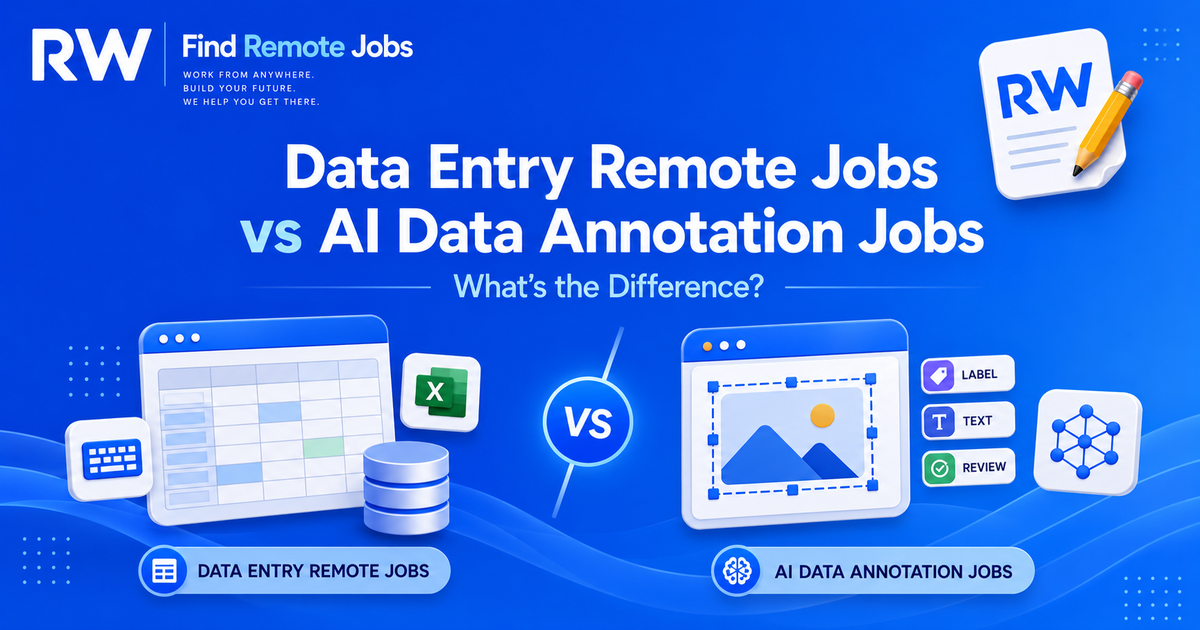
Data entry remote jobs and AI data annotation jobs can look similar from the outside. Both are often remote. Both involve information. Both may require accuracy, consistency, and patience. Both can appear on job boards under broad phrases like data jobs, online work, work from home jobs, remote data roles, or no phone remote jobs.
The difference is the purpose of the work. Traditional data entry is usually about moving information into the right place. AI data annotation is usually about turning raw content into training data that helps artificial intelligence systems learn, improve, and produce better answers. Data entry supports business records. AI annotation supports model behavior.
That distinction matters for job seekers. Someone searching for data entry remote jobs may actually be a better fit for AI data annotation jobs, AI model evaluation jobs, prompt evaluation projects, chatbot response review, search quality rating, or human feedback work. These roles often reward clear writing, careful judgment, domain knowledge, language ability, and the ability to follow detailed guidelines.
Quick Answer: The Core Difference
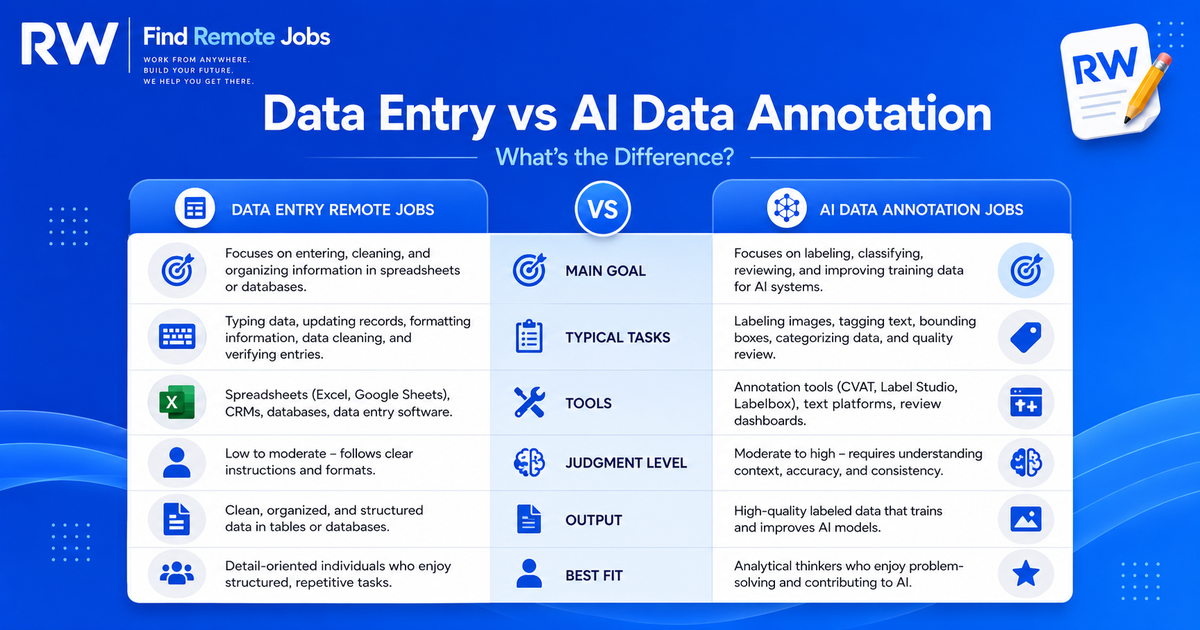
Data entry remote jobs focus on entering, cleaning, formatting, and organizing structured information. AI data annotation jobs focus on labeling, classifying, ranking, reviewing, and improving data so AI systems can understand it.
A data entry worker might update a spreadsheet, clean a product catalog, verify addresses, enter invoice details, or organize a database. An AI data annotator might label an image, tag a piece of text, classify sentiment, compare two chatbot answers, identify unsafe content, rate the helpfulness of a response, or verify whether an AI model followed instructions.
In plain terms: data entry asks, "Is the information entered correctly?" AI data annotation asks, "Can this information teach an AI system something useful, accurate, and consistent?"
What Data Entry Remote Jobs Usually Involve
Data entry is one of the oldest categories of remote administrative work. The work usually centers on structured information. Employers need clean records, searchable files, updated databases, standardized spreadsheets, and accurate internal systems.
Common data entry tasks include typing information from forms, transferring details from PDFs into spreadsheets, cleaning lists, updating CRM fields, formatting lead records, entering invoice details, checking product catalog information, deduplicating rows, tagging customer records, transcribing simple fields, and verifying that records follow a standard format.
The best data entry workers are accurate, organized, consistent, and comfortable with repetitive workflows. They usually need basic computer literacy, strong attention to detail, spreadsheet familiarity, and the ability to follow instructions without drifting from the required format.
The work can be useful for beginners because the entry barrier is often lower than specialized roles. The downside is that pure data entry can be competitive, repetitive, and easier to automate. Many listings are also low-quality or misleading, so applicants should be careful with any opportunity that promises easy money for very little work.
What AI Data Annotation Jobs Usually Involve
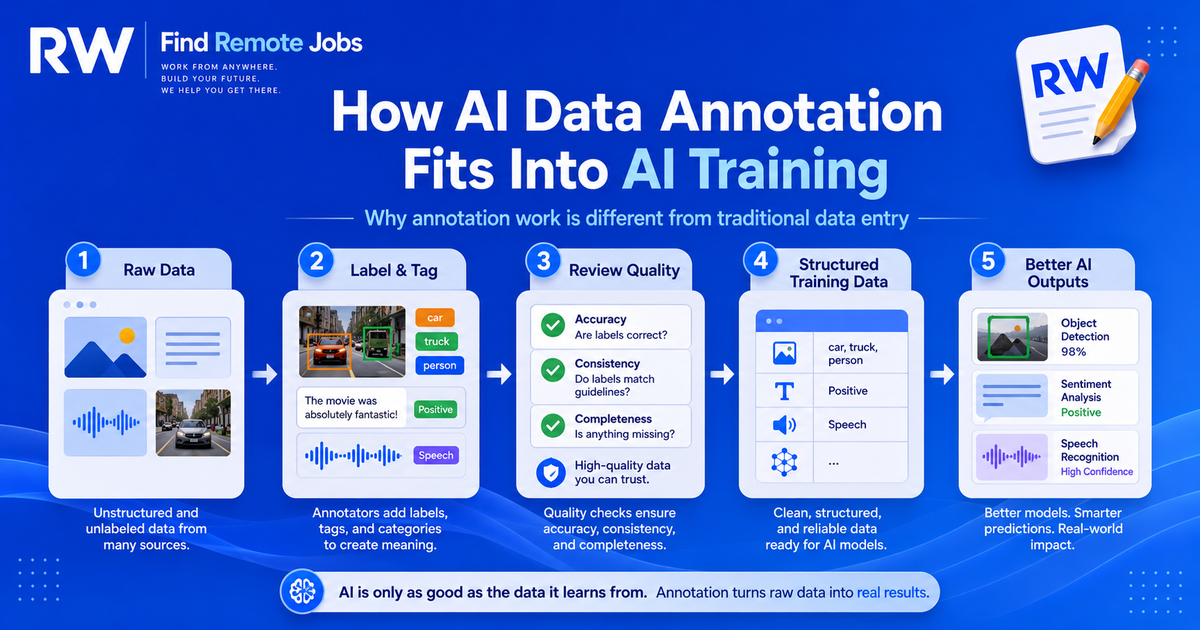
AI data annotation is a newer category of remote work connected to machine learning, large language models, computer vision, search quality, speech systems, and AI assistants. The work helps convert raw data into useful training, evaluation, or review material for AI systems.
AI annotation can include data labeling, image annotation, bounding boxes, object detection review, text classification, sentiment labeling, named entity recognition, search result evaluation, chatbot response ranking, prompt evaluation, safety review, factuality checking, audio transcription review, translation judgment, code evaluation, and expert review of model answers.
The phrase "AI data annotation jobs" often overlaps with related keywords such as AI training jobs, AI model trainer, AI evaluator, LLM evaluator, human feedback jobs, RLHF jobs, data labeling jobs, AI response reviewer, prompt evaluator, search quality rater, and model evaluation jobs.
These projects may appear through specialized AI work platforms, contractors, research vendors, or broader job boards. The end clients or ecosystems may connect to major AI companies and products such as OpenAI, Anthropic, Google, Meta, Microsoft, Amazon, Apple, xAI, Perplexity, Cohere, Mistral, ChatGPT, Claude, Gemini, and Grok. Applicants should not assume every posting is directly from a major AI lab; many real projects are handled through vendors, platforms, or contractor networks.
Why AI Annotation Is Not Just Data Entry With a New Name
Some AI annotation tasks are simple, especially when the job is basic image labeling or category tagging. But many AI annotation roles require more judgment than traditional data entry. The worker is not only moving information. They are deciding how the information should be interpreted.
For example, a data entry task might ask you to enter "Austin, Texas" into a location field. An AI annotation task might ask you to evaluate whether a chatbot gave a correct answer about Austin, whether the answer followed the prompt, whether the tone was appropriate, whether any claim needs evidence, and which of two model responses is better.
That is why strong writers, researchers, teachers, tutors, paralegals, coders, finance analysts, healthcare writers, bilingual workers, and subject-matter experts can sometimes fit AI annotation work better than basic data entry work. AI systems need human review across many domains, not just typing speed.
Task Examples: Data Entry vs AI Data Annotation
A traditional data entry role might ask you to clean a spreadsheet of customer names, move invoice numbers from PDFs into a database, update product prices, remove duplicate records, or format rows so they match a template.
An AI data annotation role might ask you to draw boxes around objects in images, label whether text is positive or negative, mark whether a search result is relevant, compare two AI-generated answers, rewrite a prompt, review if a model hallucinated facts, categorize user intent, flag unsafe content, or judge whether an answer would satisfy a real user.
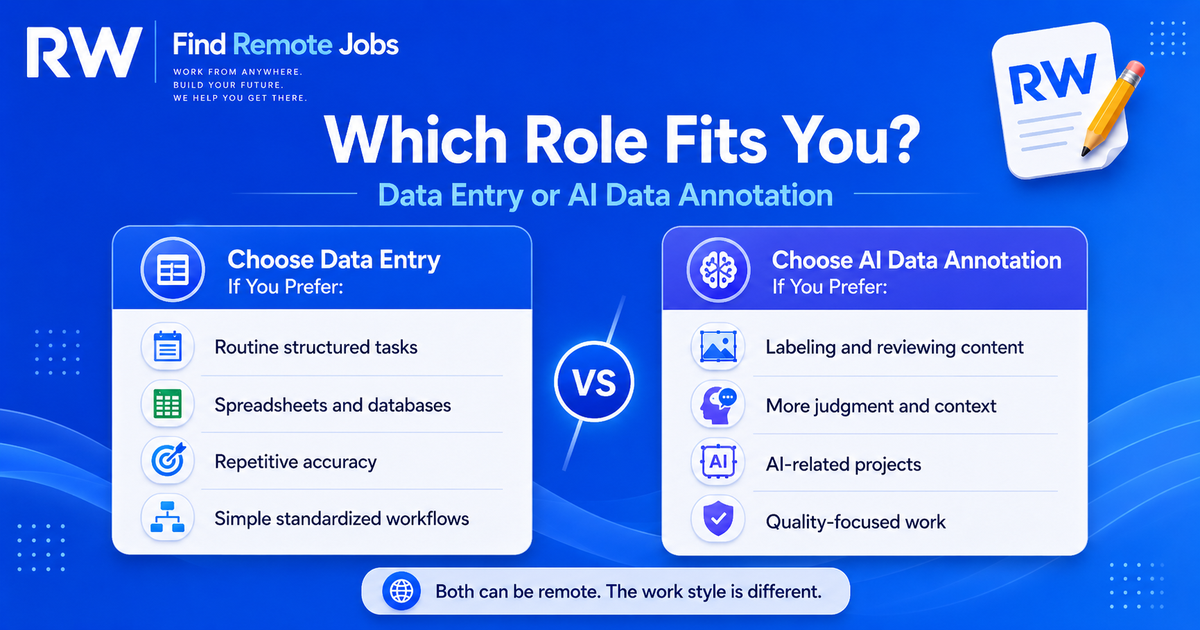
Data entry work tends to be more structured. AI annotation work tends to be more interpretive. Data entry rewards speed and consistency. AI annotation rewards accuracy, reasoning, and understanding the guideline behind the task.
Remote Work Union connects you to legitimate AI data annotation, model evaluation, and RLHF roles. Find work that matches your background.
Find Roles Hiring Now →Skills That Transfer From Data Entry to AI Annotation
Data entry experience can still be useful for AI data annotation jobs. Attention to detail, consistency, formatting discipline, spreadsheet comfort, and patience all matter. Workers who already know how to follow exact instructions may adapt well to annotation guidelines.
However, AI annotation usually adds another layer: judgment. You may need to explain why one answer is better than another, identify subtle errors, understand context, detect missing information, evaluate tone, classify intent, or decide whether an answer is truthful and useful.
For non-technical applicants, the most valuable transferable skills are clear writing, careful reading, internet research, grammar, logical comparison, fact-checking, and the ability to apply a rubric consistently. For specialists, domain knowledge can matter even more. Legal researchers, medical writers, educators, accountants, coders, scientists, and bilingual reviewers may qualify for projects that general applicants cannot do.
Tools You May See in Each Type of Work
Data entry roles commonly involve Microsoft Excel, Google Sheets, Airtable, CRMs, internal databases, form tools, product catalog systems, email software, PDF tools, and basic workflow dashboards.
AI data annotation roles may involve annotation dashboards, labeling tools, text review interfaces, prompt evaluation platforms, model comparison tools, audio review tools, and computer vision tools. Some teams use tools such as CVAT, Label Studio, Labelbox, or custom internal systems. Most applicants do not need to know every tool before applying, but they should be comfortable learning structured interfaces and following detailed project instructions.
The tool is less important than the work pattern. In data entry, the interface is often designed to store business information. In AI annotation, the interface is often designed to capture human judgment in a way a model training or evaluation pipeline can use.
Which Role Is Better for Beginners?
For a complete beginner who wants simple remote work, data entry can feel more approachable. The tasks are often easier to understand, the tools are familiar, and the job titles are easier to search. But there is a tradeoff: data entry is highly competitive and many listings are low-quality.
For a beginner who writes clearly, follows instructions well, notices mistakes quickly, and can compare answers objectively, AI data annotation may be a better target. Many AI annotation projects do not require coding. Some only require strong English, research ability, attention to detail, or subject knowledge.
The best beginner search strategy is not to choose only one phrase. Search both data entry remote jobs and AI data annotation jobs, then expand into related keywords: AI evaluator, AI model trainer, data labeling, human feedback, RLHF, prompt evaluation, LLM evaluator, search quality rater, AI response reviewer, chatbot evaluator, content quality analyst, and remote AI training jobs.
How to Search Without Wasting Time
Generic searches like "work online and get paid" or "easy remote jobs" often lead to noisy results. Better searches are specific. Use job titles that describe the actual task: data annotation jobs from home, AI data annotation jobs, remote AI evaluator jobs, prompt evaluation jobs, data labeling jobs, AI response reviewer jobs, LLM evaluator jobs, search quality rater jobs, remote data cleaning jobs, spreadsheet data entry remote jobs, and no phone remote jobs.
On LinkedIn, Indeed, company career pages, contractor platforms, AI work platforms, and remote job boards, search for both the broad category and the specific task. A role may not say "AI data annotation" in the title. It might say model evaluation, content quality analyst, search evaluator, AI trainer, language evaluator, coding evaluator, writing evaluator, or expert reviewer.
Use company and product keywords carefully. Searching for OpenAI jobs, Anthropic jobs, Google AI jobs, Meta AI jobs, Microsoft AI jobs, Gemini jobs, Claude jobs, ChatGPT jobs, or Grok jobs can help you understand the market, but many remote annotation projects are not posted directly by those companies. Also search vendors, platforms, and contractor marketplaces where the work actually appears.
How to Position Your Resume
For data entry remote jobs, emphasize accuracy, speed, spreadsheet skills, database experience, CRM updates, records management, formatting, data cleaning, administrative support, and quality control.
For AI data annotation jobs, emphasize clear writing, research, fact-checking, rubric-based review, comparison, error detection, content evaluation, language skills, domain expertise, prompt writing, AI tool familiarity, and experience using ChatGPT, Claude, Gemini, Grok, or other AI assistants responsibly.
A strong resume for AI annotation does not need to pretend you are a machine learning engineer. It should show that you can evaluate information. Use phrases like response quality review, factual accuracy, instruction following, content classification, model output evaluation, prompt testing, research-based writing, and guideline adherence. If you have specialized expertise, place it near the top. AI projects often need reviewers who understand specific fields.
Red Flags in Both Categories
Both data entry and AI annotation attract scams because many people search for flexible online work. Be cautious with roles that require an upfront training fee, promise guaranteed income without screening, avoid naming the company or platform, ask for sensitive personal information too early, communicate only through strange channels, or use vague claims like "make thousands instantly from home."
Real remote work usually has some combination of an application, assessment, project guidelines, identity verification, payment terms, and a clear work process. Flexible does not mean effortless. Good AI annotation work often requires careful reading, tests, and ongoing quality checks.
Tip: When comparing data entry and AI annotation listings side by side, check which one describes a measurable output: a completed dataset, a set of labeled responses, a reviewed batch of content. Vague listings that describe neither the task nor the quality standard are usually worth skipping, regardless of category.
Bottom Line
Data entry remote jobs and AI data annotation jobs are related, but they are not the same. Data entry is about organizing information so a business can use it. AI data annotation is about labeling, reviewing, and improving information so an AI system can learn from it.
For some remote workers, traditional data entry is still a good starting point. For others — especially people who can write clearly, research carefully, evaluate answers, or apply subject expertise — AI data annotation may be a better long-term search path.
The smartest approach is to search across both categories, learn the vocabulary employers use, avoid low-quality listings, and position your skills around the type of work you actually want: structured data work, AI review work, or a mix of both.
Frequently Asked Questions
What is the core difference between data entry and AI data annotation?
Data entry remote jobs focus on entering, cleaning, formatting, and organizing structured information for business records. AI data annotation jobs focus on labeling, classifying, ranking, reviewing, and improving data so AI systems can understand and learn from it. In plain terms: data entry asks "Is the information entered correctly?" while AI annotation asks "Can this information teach an AI system something useful, accurate, and consistent?"
Do I need coding or technical skills for AI data annotation jobs?
Not always. Many AI annotation roles require clear writing, careful reading, research, grammar, logical comparison, fact-checking, and the ability to apply a rubric consistently. Technical skills like coding help for code evaluation projects, but the majority of AI data annotation, model evaluation, and human feedback work does not require programming knowledge. Domain experts in law, medicine, finance, education, and other fields can qualify for specialized annotation projects.
Which is better for beginners: data entry or AI data annotation?
For beginners who want simple, structured work, data entry can feel more approachable because the tasks are familiar and the job titles are easy to search. For beginners who write clearly, follow instructions well, and can compare answers objectively, AI data annotation may be a better long-term path with higher earning potential. Many AI annotation projects do not require coding, and some only require strong English, research ability, or subject knowledge.
What tools are used in AI data annotation work?
AI data annotation roles may involve annotation dashboards, labeling platforms, text review interfaces, prompt evaluation systems, model comparison tools, audio review tools, and computer vision tools. Common platforms include Label Studio, CVAT, Labelbox, and custom internal systems. Most applicants do not need to know every tool before applying — the key is comfort with structured interfaces and the ability to follow detailed project guidelines.
How do I search for AI data annotation jobs without getting scam results?
Use specific task-based search terms instead of broad phrases. Try: AI data annotation jobs from home, data labeling jobs remote, AI evaluator jobs, LLM evaluator, RLHF jobs, human feedback jobs, prompt evaluation jobs, AI response reviewer, model evaluation jobs, and search quality rater. On job boards and AI platforms, look for listings with clear task descriptions, a real application process, and transparent pay structures. Avoid any listing that asks for upfront payment or promises guaranteed earnings without screening.