The United Kingdom is one of the stronger markets for remote AI training work. Many AI evaluation projects need applicants who can write in high-quality British English, apply a rigorous academic or editorial standard, research claims carefully, and judge whether an AI answer is accurate, clear, and appropriate for a UK-based user. The work is not limited to software engineers or data scientists. It is built for writers, editors, researchers, analysts, lawyers, teachers, healthcare professionals, finance experts, and anyone who can read carefully and explain why one answer is better than another.
UK applicants are particularly valuable for projects that need British spelling, British English phrasing, UK-specific cultural context, UK education system knowledge, UK legal or regulatory awareness, NHS and UK healthcare familiarity, UK financial regulation, and British consumer behavior. These factors can make UK reviewers a distinct fit rather than a generic pool.
What AI Training Work Actually Means
AI training work is the human review layer behind modern AI systems. Large AI companies build models that can write, reason, code, summarise, classify, search, and answer questions. Human reviewers help improve those systems by rating model outputs, writing better example answers, checking facts, labelling data, comparing two responses, and explaining which response is more helpful.
A remote AI contractor might read two chatbot answers and decide which one follows the instructions better. Another contractor might rewrite a weak answer into a stronger one. A subject matter expert might review a legal, medical, financial, or coding answer for quality. Strong writing matters because the job usually is not just clicking boxes — good reviewers can explain their decisions clearly, notice small errors, follow detailed guidelines, and stay consistent.
Why UK Applicants Can Be Competitive
UK applicants bring several advantages to remote AI work. Many AI products are designed for global English-speaking markets, and British English expertise is specifically valuable for models that need to produce natural, accurate, and contextually appropriate UK-facing content.
The UK also has a strong tradition of rigorous academic writing, legal analysis, policy research, journalism, and professional expertise across finance, healthcare, education, and technology. AI evaluation projects increasingly need reviewers who can apply expert judgment — not just general writing ability. A UK lawyer, accountant, nurse, teacher, scientist, or software engineer may be matched with higher-value projects that require domain-specific review.
The Main Types of AI Training Roles for UK Applicants
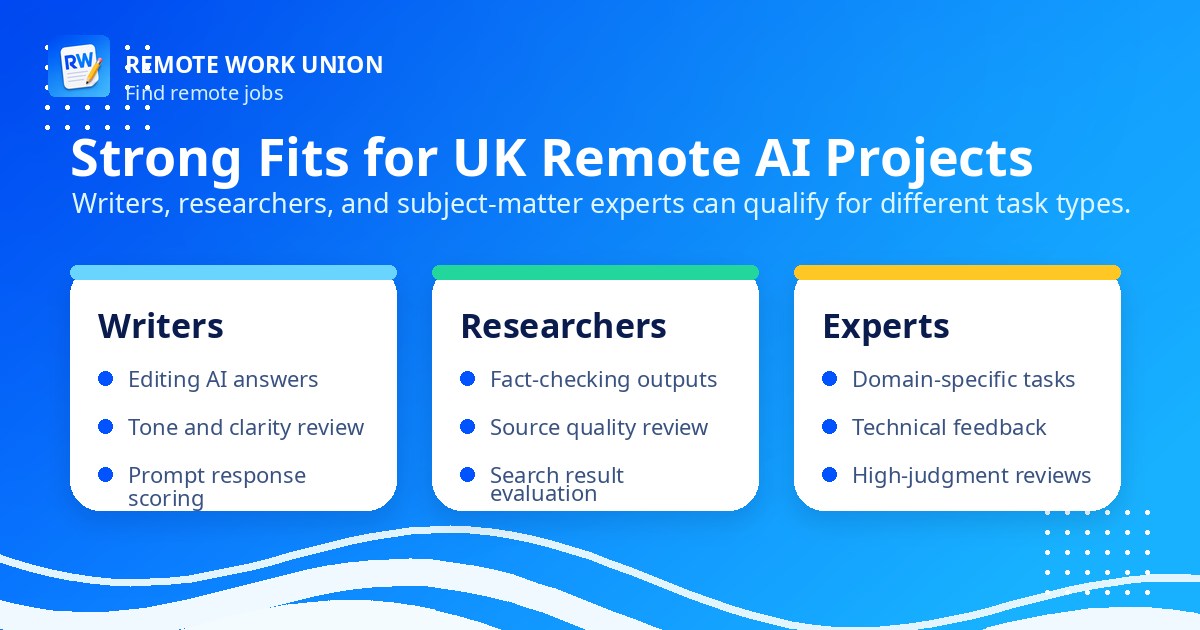
AI writing evaluation is one of the best fits for UK writers, journalists, editors, and content professionals. These roles ask you to compare two AI responses, judge which is clearer, more natural, and more accurate, and explain your reasoning. British English judgment — spelling, phrasing, tone, and register — can matter for UK-focused projects.
Research and fact-checking roles suit UK applicants with academic writing, journalism, policy research, or library science backgrounds. Tasks involve verifying whether an AI answer is supported by reliable sources, identifying hallucinations, and judging whether a model response cites evidence accurately.
Search quality evaluation involves judging whether search results or AI summaries satisfy UK user intent. UK local knowledge — British institutions, NHS services, UK government resources, UK schools and universities, UK financial products, and UK consumer context — can be directly useful.
Domain expert review is available for UK lawyers, solicitors, barristers, paralegals, accountants, financial advisers, NHS clinicians, medical writers, engineers, academics, and teachers. These projects review AI answers in specialist fields for accuracy, safety, and appropriate professional caveats.
Data annotation and labelling includes structured tasks such as categorising text, labelling intent, tagging safety issues, and reviewing AI outputs against policy guidelines. These roles can be a starting point for UK applicants new to AI evaluation work.
Remote Work Union connects you to legitimate remote AI training and evaluation roles. Apply for free and find roles hiring now.
Find Roles Hiring Now →Where to Find Legitimate UK AI Training Opportunities
Start with dedicated AI training platforms that frequently post model evaluation, data annotation, writing evaluation, and expert review work. Search platforms such as Mercor, Outlier AI, Handshake AI, micro1, Surge AI, and Stellar AI. Availability changes by project, country, language, and client needs.
Use general job boards too. LinkedIn, Indeed, Totaljobs, Remote.co, and company career pages can surface roles under less obvious titles. Search keyword combinations: UK, United Kingdom, remote, contractor, AI evaluator, model evaluation, data annotation, prompt evaluator, writing evaluator, RLHF, chatbot evaluator, and search quality rater.
Useful UK-specific search phrases include: AI training jobs UK remote, AI model evaluator UK, remote AI evaluator United Kingdom, AI writing evaluator UK, RLHF jobs UK, data annotation jobs UK, AI fact-checking jobs remote UK, search quality rater UK, and British English AI trainer jobs.
How to Tell Whether an AI Training Job Is Legitimate
Legitimate remote AI work should feel like a real application process. You should see a clear role description, basic company or platform information, written payment terms, contractor expectations, task examples, assessment steps, and communication through normal company channels.
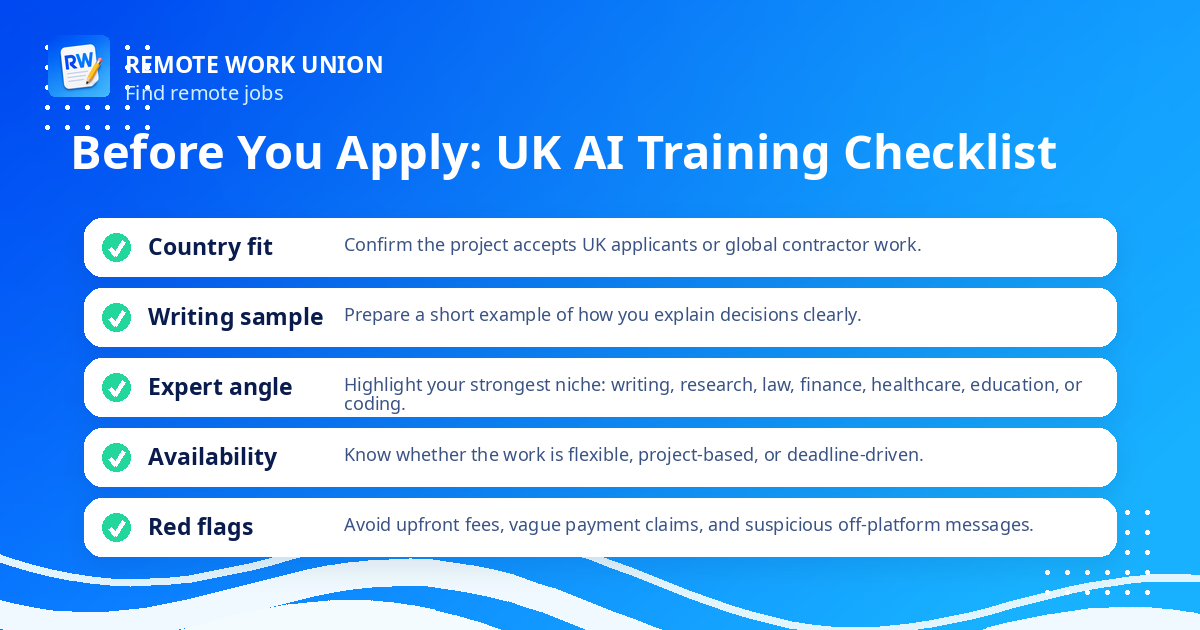
Be cautious if a job asks for an upfront fee, promises guaranteed income, requires you to buy a course before applying, refuses to explain the work, pushes you to move the conversation to an unusual messaging app, or asks for sensitive personal information before basic screening.
How to Build a Stronger UK Applicant Profile
Your profile should make your judgment skills obvious. Do not rely on vague phrases like hard worker, fast learner, or good with computers. AI training platforms need to know what you can review well.
A strong profile for a writing-focused role should mention editing, professional writing, academic writing, content review, grammar, tone, summarisation, fact-checking, prompt writing, and clear feedback. A profile for research roles should mention source evaluation, claim verification, web research, citation checking, and analytical writing. A specialist profile should make domain credentials searchable: solicitor, barrister, NHS clinician, chartered accountant, financial analyst, software engineer, academic researcher.
UK applicants should also mention British English, UK legal research, NHS familiarity, UK education context, UK finance regulation, or UK business writing wherever accurate and relevant.
Resume and Keyword Examples
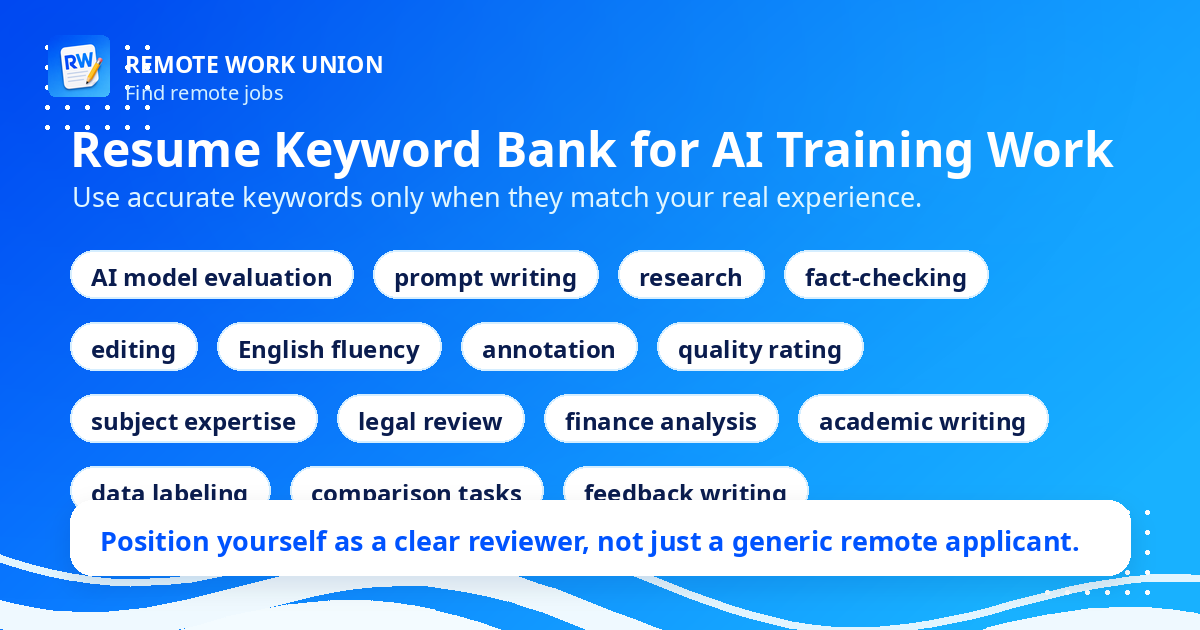
Useful keyword phrases for UK AI training resumes include: AI model evaluation, AI response rating, data annotation, data labelling, prompt writing, prompt evaluation, RLHF, human feedback, chatbot evaluation, AI content review, writing evaluation, editing, fact-checking, research review, source verification, search quality, classification, quality assurance, guideline adherence, and written feedback.
- Writing or editorial applicant: "Reviewed written responses for clarity, accuracy, tone, and instruction-following; provided concise feedback to improve answer quality. Strong British English editorial judgment."
- Research applicant: "Evaluated AI-generated content for factual accuracy, source quality, and claim support. Experienced in academic research, policy review, and evidence-based analysis."
- Domain expert: "Assessed technical content within my subject area for accuracy, completeness, appropriate caveats, and practical usefulness for UK users."
What the Application Process Usually Looks Like
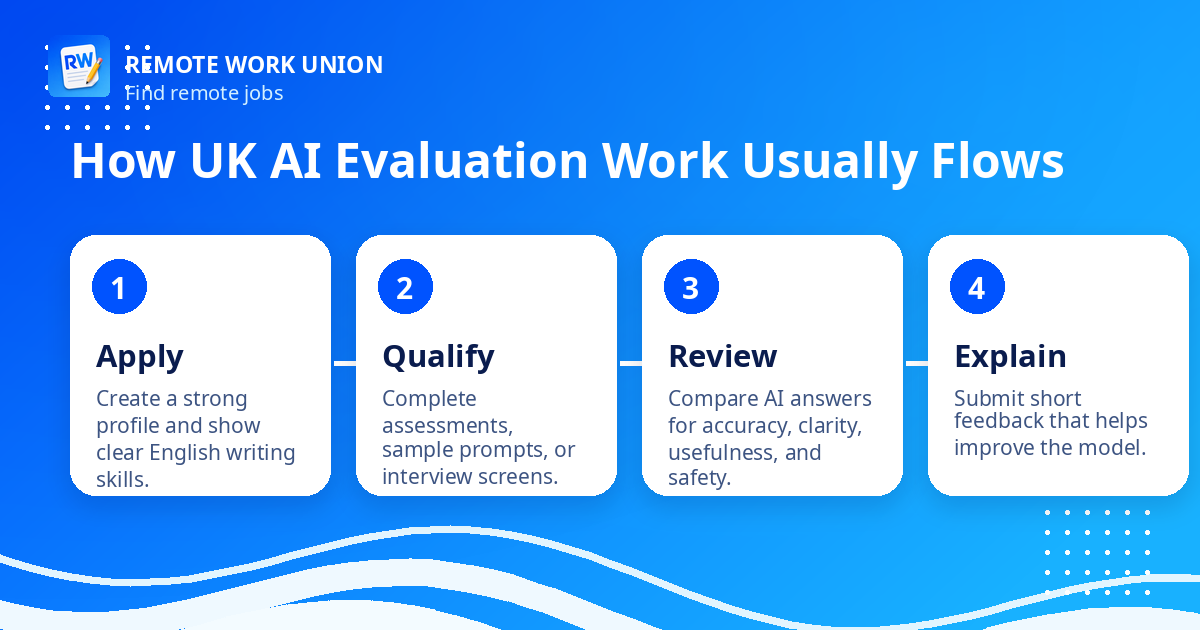
Most AI training applications follow a predictable path: create a profile, select skills and availability, complete an assessment, get matched to projects, complete onboarding, and begin tasks. The assessment is often the filter. Read every instruction carefully. Many applicants fail because they rush, over-explain, ignore the prompt, or miss a hidden requirement.
Once accepted, do not assume task volume will be stable. Remote AI work can slow down when a project ends or pauses. Treat each platform as one possible income stream rather than a guaranteed full-time job, and apply across multiple legitimate platforms to build a pipeline.
Common Mistakes UK Applicants Should Avoid
The first mistake is searching too broadly. "Remote jobs" is too general, and "AI jobs" often returns software engineering roles. Search for the actual task: AI evaluator, model response rater, AI writing evaluator, data annotation, RLHF, prompt evaluator, search quality rater, or AI fact-checker.
The second mistake is applying with a generic resume that does not make your fit for AI review work obvious. Translate your experience into evaluation terms: writing, research, accuracy, quality control, feedback, guidelines, domain knowledge, and judgment.
The third mistake is ignoring location requirements. If a role says UK-only, US-only, or North America, take that seriously.
Note on contractor status: Many remote AI training roles are contractor roles, not traditional employment. UK workers should understand their IR35 status, keep records of payments and expenses, and seek qualified tax advice if the income becomes meaningful. This article is not tax advice.
Frequently Asked Questions
Are remote AI training jobs available in the UK?
Yes. The UK is a strong market for remote AI training work because many projects need fluent British English, professional writing, careful research, and a high standard of academic or editorial judgment. UK applicants can find roles in AI model evaluation, data annotation, writing evaluation, research review, and domain expert review.
What types of AI training jobs suit UK writers?
UK writers are well suited to AI writing evaluator roles, AI response comparison review, content quality review, search quality rating, and editorial review work. Strong academic writing, journalism, or publishing experience can be particularly useful for higher-skill evaluation roles.
Do UK AI training jobs require a degree?
Not always. Many AI evaluation roles care more about assessment performance than formal credentials. However, UK degrees, professional qualifications, and subject expertise can help applicants qualify for specialist review roles in law, finance, healthcare, education, and research.
What keywords should UK applicants use when searching for AI training jobs?
Try combinations like UK AI training jobs remote, AI model evaluator UK, remote AI evaluator United Kingdom, AI writing evaluator UK, data annotation jobs UK, RLHF evaluator remote UK, AI fact-checking jobs UK, search quality rater United Kingdom, and AI content reviewer UK remote contractor.
How do I know if a remote AI training job is legitimate?
Legitimate remote AI work shows a clear role description, basic company or platform information, written payment terms, task examples, and an assessment process. Be cautious of any posting that asks for an upfront fee, promises guaranteed income without a screening process, or refuses to explain what the tasks actually involve.