Searches for AI humanizer jobs are rising because more writers, editors, reviewers, students, freelancers, and remote job seekers are trying to understand where human judgment fits into AI-generated content. The phrase sounds like a new job category, but in practice, most real opportunities are not posted with the exact title "AI humanizer." They usually appear under related names such as AI content editor, AI response reviewer, AI evaluator, prompt evaluator, model quality analyst, AI writing assistant, data annotation specialist, or human feedback reviewer.
That distinction matters. A person searching for "AI humanizer jobs" may be looking for a way to get paid for making AI writing sound more natural. A hiring platform, however, may describe the same work as content quality review, chatbot response evaluation, AI model training, RLHF, prompt testing, or editorial QA. The skill set overlaps, but the job listings use different language.
What "AI Humanizer Jobs" Usually Means
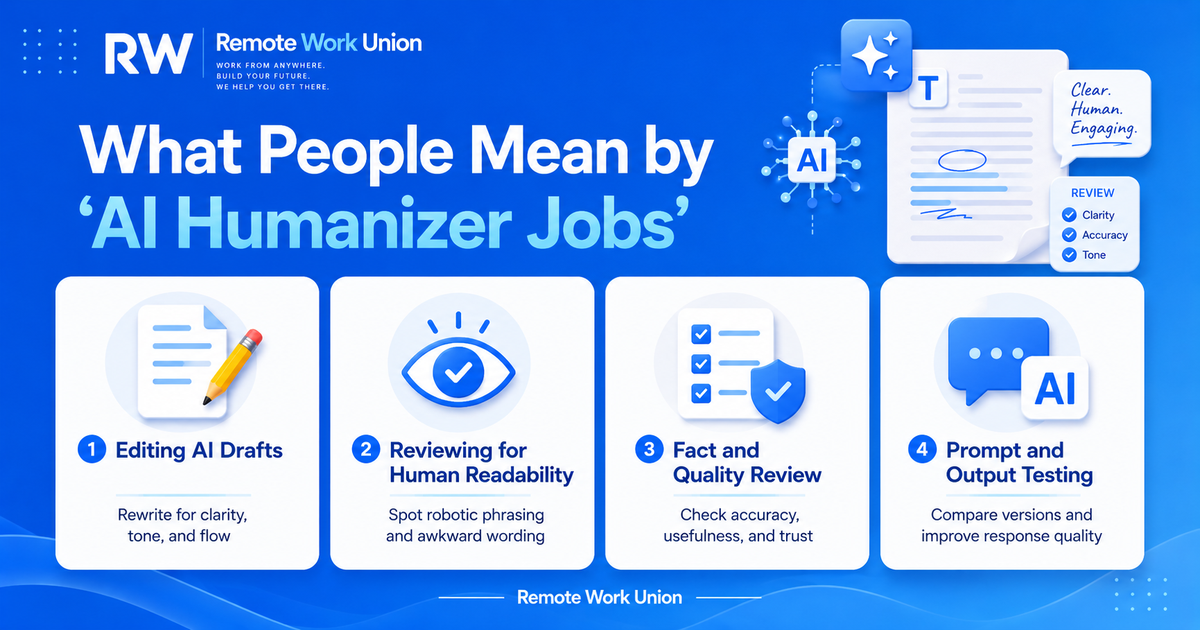
An AI humanizer tool claims to make machine-generated text sound more natural. An AI humanizer job, if the phrase is used by a job seeker, usually means one of several real work categories:
- Editing AI-generated drafts so they read clearly and accurately.
- Reviewing chatbot responses for accuracy, tone, and usefulness.
- Comparing multiple AI answers and selecting the best one.
- Rewriting awkward or robotic phrasing into clearer language.
- Testing prompts and explaining why an output works or fails.
- Checking whether AI content sounds natural for a particular audience.
- Improving formatting, structure, examples, and clarity.
- Flagging content that feels misleading, generic, unsafe, or low-quality.
The important point is that legitimate remote AI jobs rarely pay people simply to "humanize" text in a vague way. They pay for specific judgment: Is the answer correct? Is it helpful? Is it complete? Does it follow instructions? Does it sound natural? Would a real user trust it? Is the response appropriate for the topic, audience, and platform?
Why This Trend Exists Now
The phrase "AI humanizer" grew because many people now interact with ChatGPT, Claude, Gemini, Grok, and other AI tools every day. They see the same problem repeatedly: AI text can be useful, but it can also sound generic, overly polished, repetitive, or strangely confident. Businesses want AI outputs that are accurate, readable, aligned with brand voice, and safe to publish. AI labs and AI training platforms want models that can produce better answers without needing as much human correction later.
That creates demand for human reviewers. A model can generate a draft, but a human reviewer can judge whether the draft is actually good. A model can compare two outputs statistically, but a human can explain why one answer is clearer, safer, more persuasive, more accurate, or more useful. A model can follow a prompt, but a human can identify when the prompt itself is flawed.
Where These Jobs Appear in the Real World
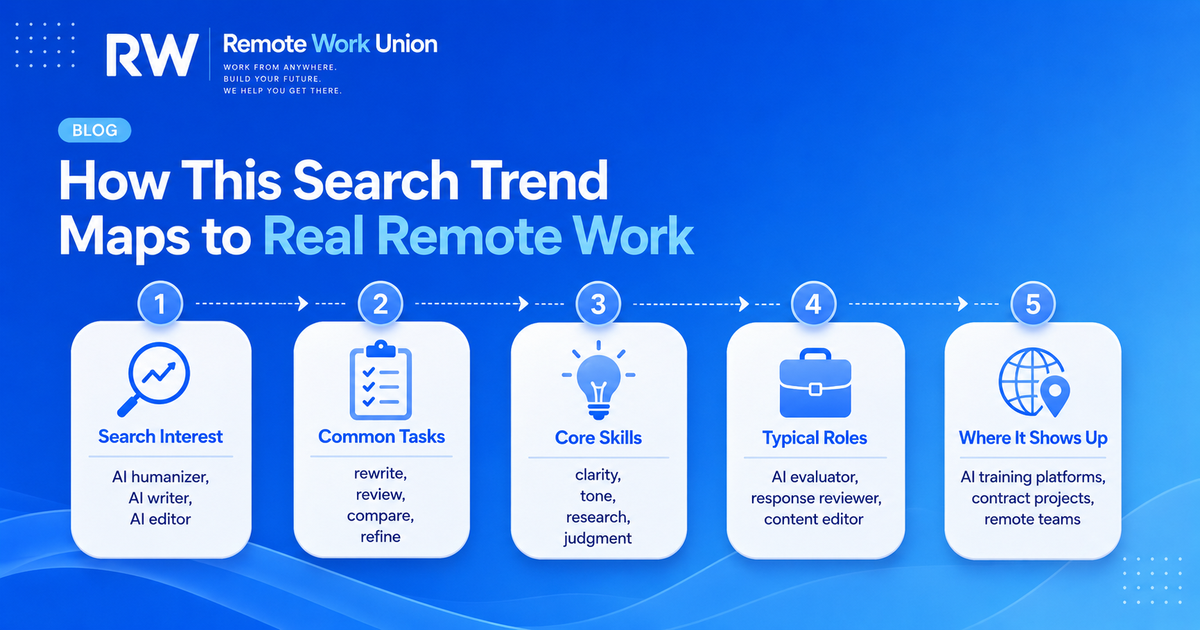
A person searching for AI humanizer jobs should broaden their search terms. The exact phrase may return tool companies, SEO content services, low-quality gigs, or questionable promises about bypassing AI detectors. More serious remote work often appears under job titles like AI Content Editor, AI Response Reviewer, AI Evaluator, AI Model Evaluator, AI Trainer, Prompt Evaluator, Search Quality Rater, Data Annotation Specialist, RLHF Specialist, Human Feedback Reviewer, Chatbot Response Reviewer, Content Quality Analyst, AI Research Assistant, and Language Model Evaluator.
These roles may appear on AI training platforms, remote work job boards, contractor marketplaces, company career pages, and specialized evaluation platforms. Some projects are generalist writing work. Others require subject matter expertise in law, medicine, finance, education, coding, marketing, creative writing, science, or another domain.
Remote Work Union aggregates legitimate remote AI writing and evaluation jobs. Browse roles that match your background.
Find Roles Hiring Now →What the Day-to-Day Work Can Look Like
Most AI writing and review work is not one long creative project. It is structured task work. You may receive a prompt, an AI-generated response, and a rating form. You judge the response against specific criteria and explain your reasoning. Some sessions may involve comparing two AI responses on the same prompt and selecting the stronger one. Others may ask you to rewrite a poor response or verify whether a claim is factually supported.
The work requires reading carefully and writing concisely. A strong reviewer does not just click a number — they explain why the response is helpful or unhelpful, accurate or inaccurate, well-structured or confusing. That written explanation is often the most valuable part of the feedback, because it becomes training data for improving the model.
Skills That Translate Into AI Humanizer Work
Writers, editors, teachers, researchers, customer support professionals, lawyers, healthcare writers, finance analysts, and other domain experts all have skills that apply to AI writing evaluation. The specific skills that matter most are writing clarity, reading accuracy, source checking, instruction-following, and the ability to judge whether a response is genuinely useful rather than merely fluent.
Tool familiarity helps too. If you regularly use ChatGPT, Claude, Gemini, Perplexity, or other AI assistants, you likely already have an intuition for when outputs are good versus when they sound right but are actually missing something. That practical experience is useful context for evaluation work.
Which Job Categories Fit Best
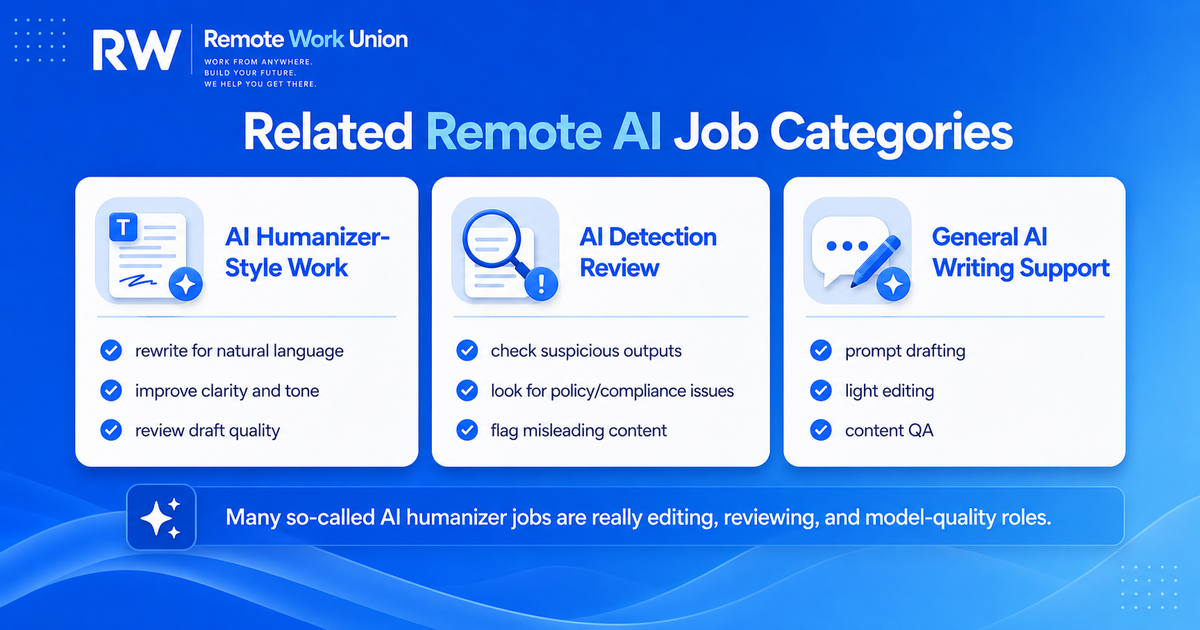
If your primary skill is writing or editing, focus on AI response reviewer, AI content editor, AI writing evaluator, and prompt evaluation roles. These positions pay for editorial judgment: the ability to tell whether a response is clear, accurate, complete, and appropriate for the audience.
If your primary skill is research, focus on AI fact-checker, model quality analyst, search quality rater, and data annotation roles. These positions pay for verification: can you check a claim, evaluate a source, and tell whether an AI system is stating something it cannot actually support?
If you have a professional background — law, finance, medicine, education, engineering — look for domain expert AI evaluation projects in your field. These roles often pay more and have less competition than generalist writing evaluation work.
How to Apply With a Writing or Editorial Background
When applying for AI writing and review jobs, translate your experience into evaluation language. Instead of "I wrote content," write "I evaluated written outputs for clarity, accuracy, and instruction-following." Instead of "I edited articles," write "I reviewed model-generated drafts against editorial rubrics and identified factual and structural problems."
Application tip: When you reach the screening task, approach it like a paid editing assignment. Read the instructions fully. Follow the rubric. Explain each judgment decision in specific terms rather than general impressions. Consistency matters more than impressiveness.
Red Flags in the AI Humanizer Job Market
Because the phrase "AI humanizer" is popular, low-quality listings cluster around it. Be cautious with any posting that asks you to pay for training before seeing the client, promises income without a screening process, describes the work only as "make AI sound human" without explaining the task structure, or cannot tell you who is paying for the work.
Legitimate AI writing evaluation and review jobs have a clear task format, a screening or qualification process, a defined pay structure, and an actual client or platform behind the project. If a listing cannot explain what the work involves in plain language, walk away.
Frequently Asked Questions
What are AI humanizer jobs?
AI humanizer jobs are remote roles involving AI content editing, AI response review, model evaluation, and writing quality work. They rarely appear under the exact title "AI humanizer" — instead, they are posted as AI content editor, AI response reviewer, AI evaluator, prompt evaluator, RLHF specialist, or model quality analyst.
Who is a good fit for AI humanizer jobs?
Writers, editors, teachers, researchers, customer support professionals, lawyers, healthcare writers, finance analysts, and other domain experts are strong candidates. The work rewards reading accuracy, writing clarity, and the ability to judge whether an AI response is genuinely useful — not just fluent.
How do I find legitimate AI humanizer jobs?
Search for the actual job titles used in the market: AI content editor, AI response reviewer, AI evaluator, prompt evaluator, RLHF specialist, chatbot reviewer, search quality rater. Avoid listings that only promise to pay you to "humanize" AI text without a structured review process or clear client.