AI detectors have become one of the most searched topics in the AI economy because almost everyone now has the same question: how can anyone tell whether something was written, edited, summarized, translated, or generated by artificial intelligence?
That question matters in schools, publishing teams, hiring teams, marketing departments, legal offices, customer support operations, software teams, and AI research labs. It also matters for remote workers because AI detection is not just a software category. It is part of a larger shift toward human review, AI quality evaluation, model training, content moderation, fact-checking, prompt evaluation, and data annotation.
The most important thing to understand is simple: an AI detector does not usually prove that a person used AI. Most AI detectors estimate the likelihood that a piece of content contains patterns associated with machine-generated output. That is a useful signal, but it is not the same thing as certainty.
What an AI Detector Actually Does
An AI detector is a tool that looks for signals. Depending on the type of detector, those signals may come from the writing itself, the file history, the platform where the content was created, or special technical markers built into a system.
For text, the detector may examine how predictable the words are, how repetitive the structure is, how much the sentence rhythm varies, whether the writing uses common AI-style transitions, whether the content is unusually smooth, and whether the piece avoids the small inconsistencies common in human writing. Some detectors also compare the text to known examples of AI-generated writing or use a classification model trained to separate likely human text from likely machine text.
This is why AI detector results should be read carefully. The detector is not reading intention. It is not interviewing the writer. It is not proving misconduct. It is looking at patterns and returning an estimate. That estimate can be helpful. It can also be wrong.
The Main Signals AI Detectors Look For
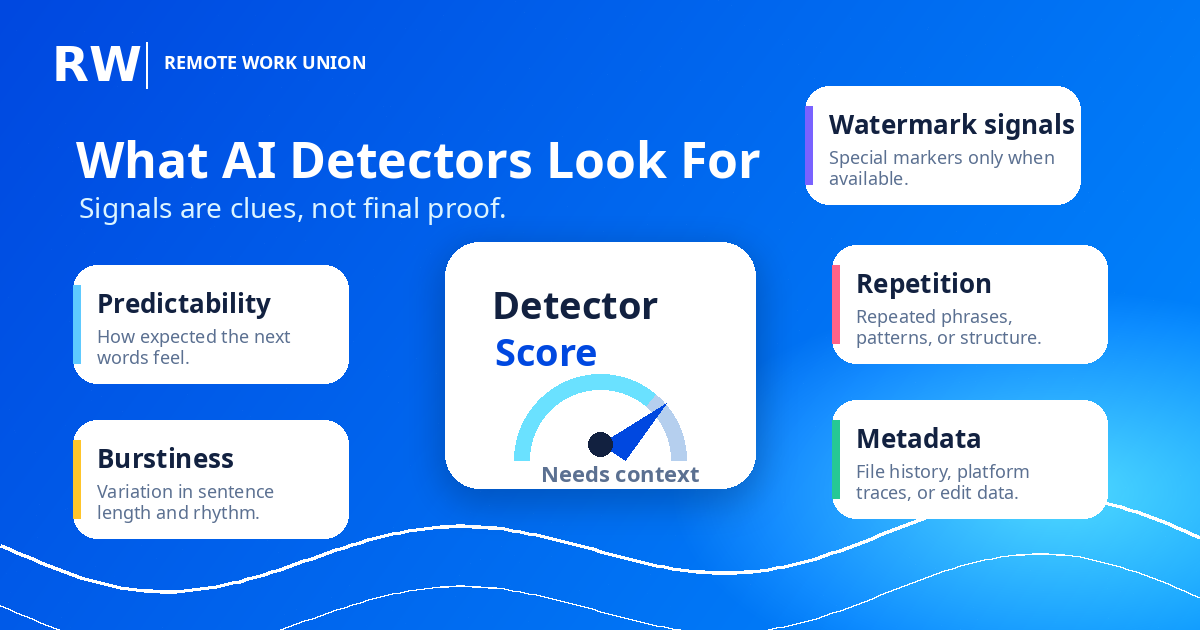
Most AI detectors rely on a mixture of signals. The exact methods vary by tool, but the most common ideas are straightforward to understand.
Predictability: AI-generated writing often follows patterns that are statistically likely. It may choose words, sentence structures, and explanations that sound clean, balanced, and expected. A detector may notice that the next word choices are unusually predictable compared with typical human writing.
Burstiness: Human writing often varies in rhythm. A person may write one short sentence, then one long sentence, then a fragment, then a more detailed paragraph. Machine-generated writing often has a smoother, more consistent rhythm. A detector may look for that smoothness.
Repetition: AI tools often repeat structures, phrases, and logic patterns. A model might write several paragraphs that begin the same way, make the same type of claim, or use similar transitions. Repetitive structure can become part of a detection signal.
Metadata: A document may include edit history, file creation information, platform traces, or other technical data. Metadata can provide context, but it can also be incomplete or misleading, especially when content is copied between tools.
Watermarking: A watermark is a hidden or semi-hidden pattern placed into generated output. Watermarking can be useful when it is available, but it is not universal. A lot of AI-generated content will not contain a reliable watermark, and some content may be changed enough that a watermark is no longer useful.
Why AI Detector Scores Can Be Wrong
AI detector scores can be wrong for several important reasons that remote reviewers and evaluators should understand.
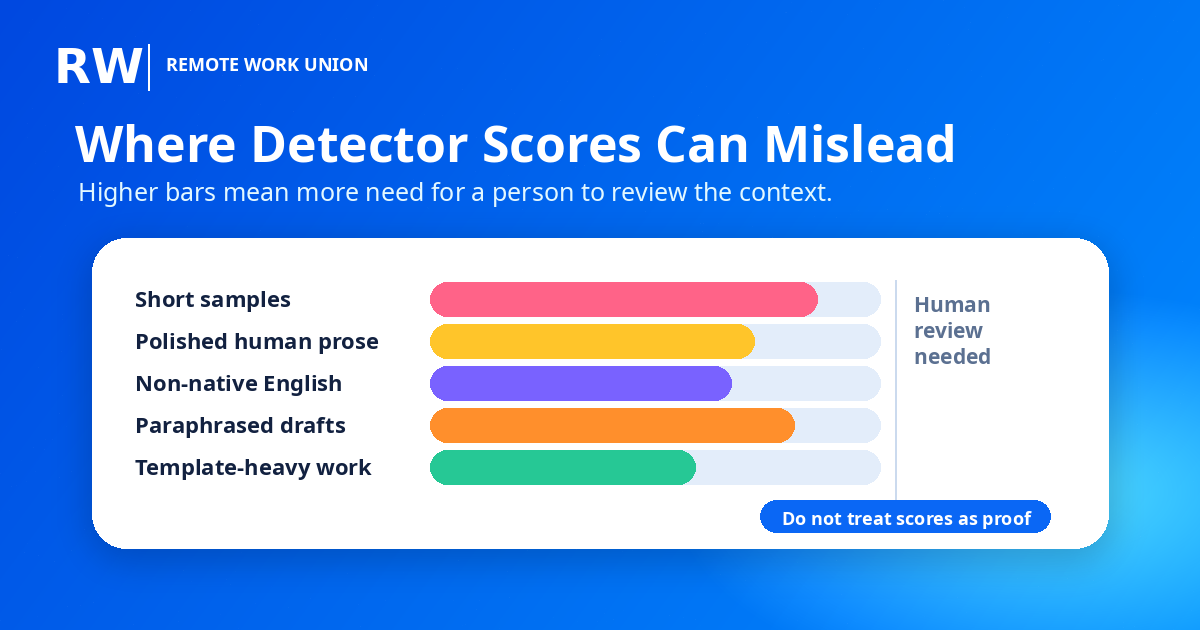
Short samples are one of the biggest problems. A paragraph, a short answer, or a resume bullet may not contain enough information for a reliable judgment. Short samples can look predictable simply because there are only so many ways to say something concise.
Polished human writing can also trigger suspicion. A careful writer may naturally produce clean paragraphs, even sentence lengths, precise transitions, and balanced explanations. Professional writers, lawyers, consultants, and researchers often write in a style that can look machine-like to a detector.
Non-native English creates another issue. A person writing in a second language may use direct sentence structures, common phrasing, or translated patterns that a detector misreads as AI-style writing. A score without context can create unfair conclusions.
Templates can also confuse detectors. Job applications, cover letters, customer support replies, product descriptions, legal disclaimers, and corporate policies often use standardized language that may resemble AI output even when a human wrote it from a template.
Why Human Review Still Matters
Human review matters because the important questions are not purely statistical. A detector can estimate whether text resembles AI output. A human reviewer can ask whether the answer is accurate. That distinction is critical. A fully human-written answer can be wrong, outdated, biased, unsupported, or unsafe. An AI-assisted answer can be accurate, well-sourced, useful, and properly disclosed. The goal is not always to punish AI use. The goal is often to evaluate quality.
A detector can flag smooth writing. A human reviewer can check whether the claims are supported. For example, an AI answer might cite a source that does not actually support the statement. It might summarize a report incorrectly. It might invent a detail. It might make a confident claim with no evidence. A detector score will not fully solve that. A reviewer has to read, compare, and verify.
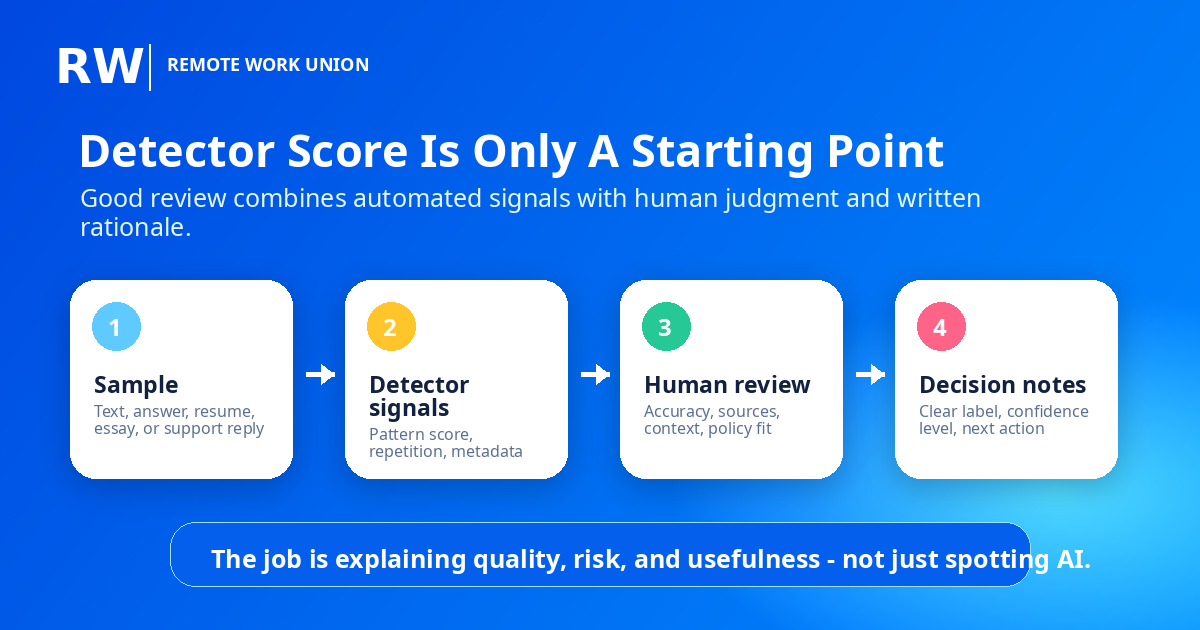
A detector can produce a number. A human reviewer can write a useful explanation. This is one of the most valuable skills in remote AI work. Companies do not just need people to click yes or no. They need reviewers who can explain why an output is better, worse, risky, incomplete, misleading, repetitive, or irrelevant. That explanation becomes training data that helps AI teams improve model behavior.
Remote Work Union connects you to remote AI review and evaluation roles. Find roles that match your skills.
Find Roles Hiring Now →The Connection Between AI Detectors and Remote AI Jobs
The rise of AI detectors is part of a larger market for human judgment. The same companies building models, search assistants, chatbots, AI browsers, coding tools, writing assistants, and enterprise AI systems need humans to evaluate the work.
That is why job seekers are seeing terms like AI evaluator, AI rater, AI trainer, model evaluator, prompt evaluator, AI response reviewer, data annotation specialist, RLHF reviewer, human feedback specialist, content quality analyst, search quality rater, and AI fact-checker. These jobs are not all the same, but they share a common thread: judgment.
Understanding how AI detectors work — and where they fall short — helps remote reviewers build sharper instincts. A reviewer who understands the difference between fluent writing and accurate writing, between confident claims and supported claims, between smooth style and useful content, is better equipped to do the work that AI detection alone cannot do.
Skills That Matter for Remote AI Review Work
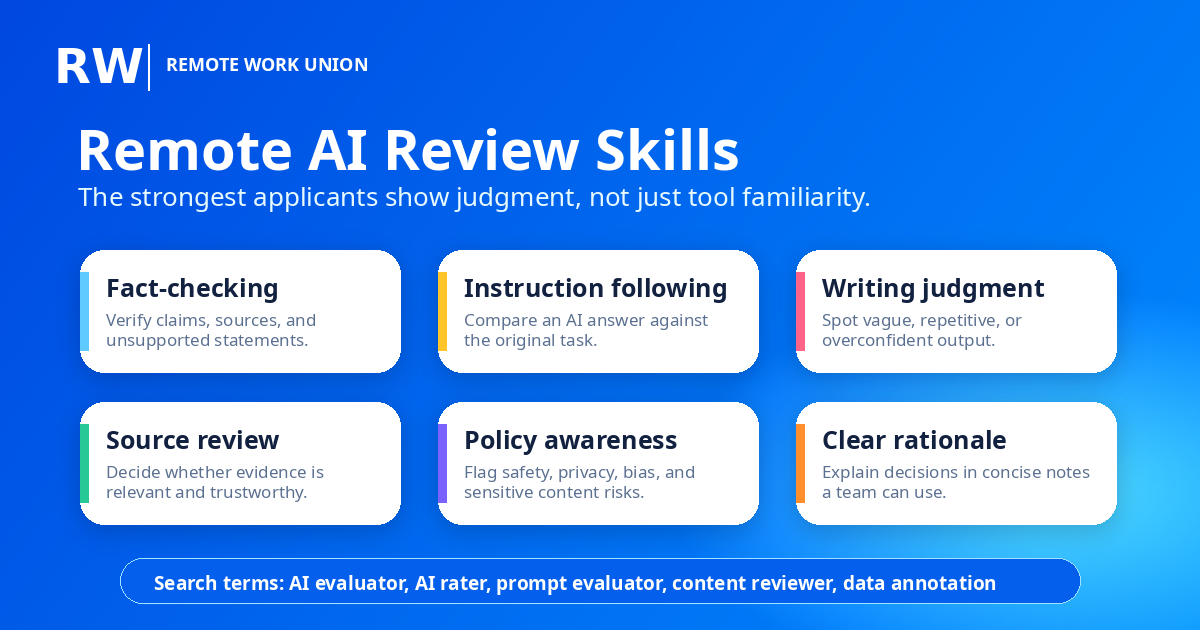
The skills that make a strong AI reviewer are the same skills that a good human evaluator would bring to any quality assessment. Fact-checking helps you verify whether an AI claim is supported. Instruction-following helps you apply the rubric accurately even when your personal preference differs. Writing judgment helps you explain why one response is more useful than another. Source review helps you distinguish reliable evidence from plausible-sounding invention.
Policy awareness matters too. Remote AI roles often include guidelines about what types of content are acceptable — safe, legal, appropriate for the audience, consistent with brand standards. A reviewer who understands those policy boundaries can flag violations clearly without needing to be asked.
Clear rationale is the output. Even if every other skill is strong, a reviewer who cannot explain their judgment concisely is difficult to scale. The explanation is what makes your review useful as training data. Practice writing short, specific reasons for your judgments: not "Response A is better" but "Response A directly answers the question, cites a verifiable source, and avoids the unsupported health claim in Response B."
Next Steps for Job Seekers
If you are interested in remote AI review work, the best starting point is to practice the judgment skills described above. Read AI-generated content and ask yourself: Is this accurate? Does it follow the instruction? Is this claim supported? Which of these two responses is actually more useful, and why?
Then search for roles that match your expertise. Writers, researchers, editors, lawyers, teachers, medical professionals, finance analysts, coders, and generalists with strong reading and writing skills can all find relevant work in AI evaluation. The category is large and growing.
Key takeaway: AI detectors are tools, not final verdicts. Remote AI reviewers who understand this distinction — and who can provide the judgment that detectors cannot — are exactly what AI companies are hiring for.
Frequently Asked Questions
How do AI detectors work?
AI detectors look for statistical patterns in text or other content that suggest machine generation. They examine factors like word predictability, sentence rhythm consistency, repetitive structure, and in some systems, embedded watermarks. They produce probability estimates, not definitive proof of AI use.
Can AI detectors be wrong?
Yes. AI detectors produce false positives on short samples, polished human prose, non-native English writing, and template-based text. They can also fail to flag AI-generated content that has been edited or paraphrased. This is why human review remains an important complement to automated detection.
How does AI detection connect to remote AI review jobs?
The same judgment skills needed to evaluate AI-generated content — noticing unsupported claims, checking sources, assessing tone and accuracy — are core skills in remote AI evaluator, AI rater, model evaluation, and human feedback jobs. Understanding AI detection helps reviewers build sharper evaluation instincts.