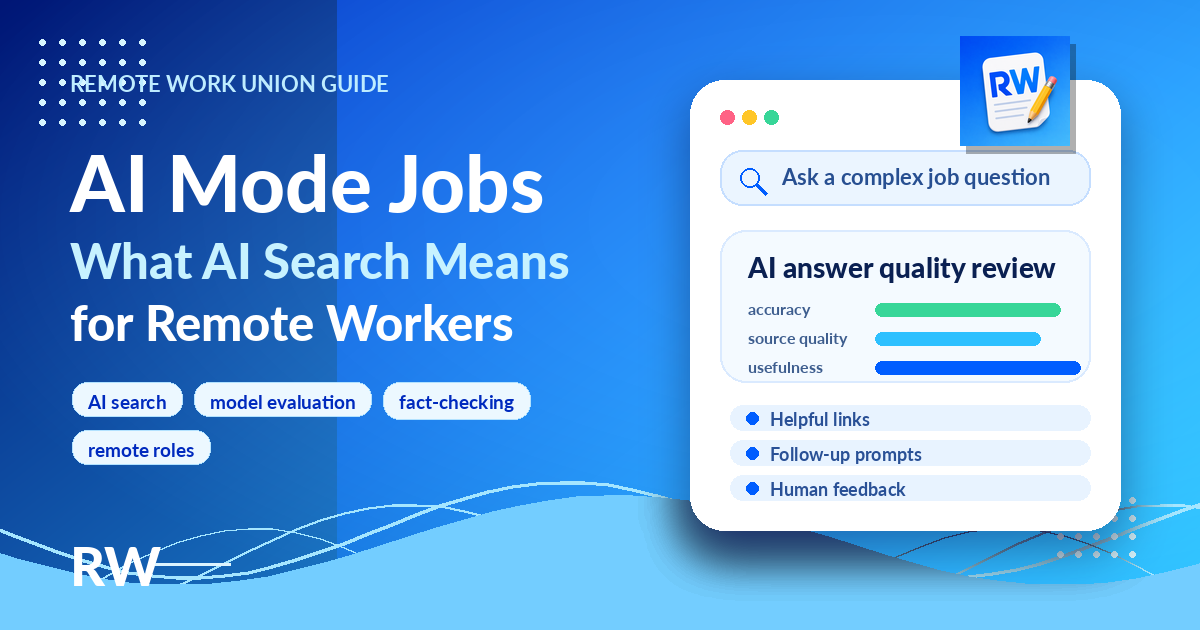
AI Mode jobs are a new search phrase for a broader shift in online work: search is moving from simple lists of links toward AI-generated answers, follow-up questions, source summaries, and conversational research. For job seekers, that does not always mean there is a role officially called "AI Mode reviewer." More often, it means there are remote jobs connected to AI search quality, model evaluation, answer review, prompt testing, source checking, and human feedback.
This matters because AI search systems still need human judgment. A search experience can be fast and polished, but someone still has to evaluate whether the answer is accurate, helpful, safe, well-sourced, and aligned with what the user actually asked. That creates a practical opening for remote workers with strong writing, research, editing, analysis, education, business, legal, finance, healthcare, science, or technical backgrounds.
The best way to understand "AI Mode jobs" is not as one company-specific title. Think of it as a category of work created by AI-powered search. Google, OpenAI, Anthropic, Microsoft, Meta, Grok, and newer AI platforms are all building systems that answer questions, summarize web information, compare sources, and help users make decisions. Those systems need people who can test the answers.
What AI Mode Means for Job Seekers
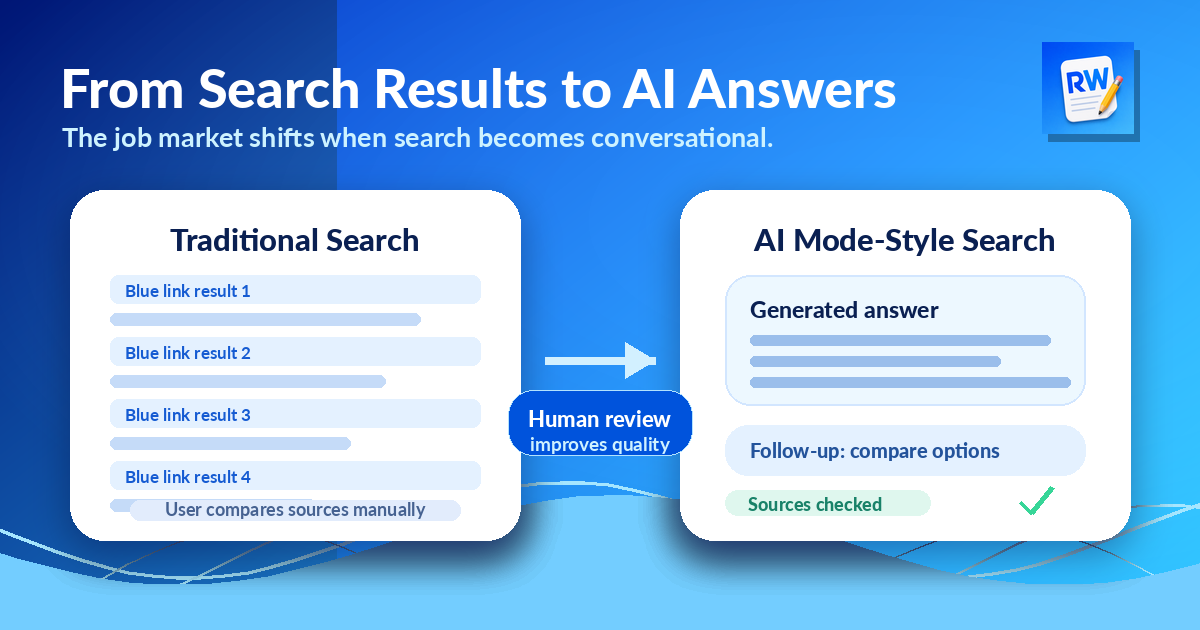
AI Mode refers to a more conversational form of search. Instead of typing a short keyword and scanning ten blue links, a user can ask a detailed question, get an AI-powered answer, review supporting links, and keep asking follow-up questions. The important job-market point is simple: when search becomes an answer engine, answer quality becomes a labor category.
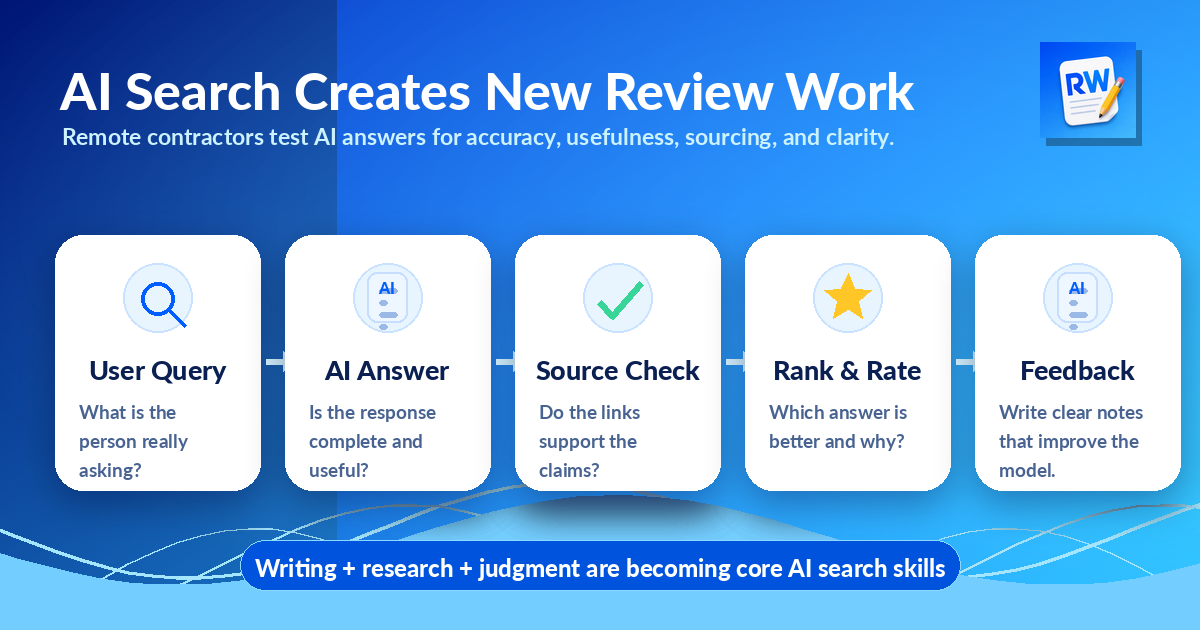
Traditional search quality work focused on whether results matched a query. AI search work can include that, but it adds more layers. A reviewer may need to decide whether a generated answer directly addresses the question, whether the explanation is too vague, whether the model used weak sources, whether important caveats are missing, or whether two competing answers should be ranked differently.
That is why searches like AI Mode jobs, AI search jobs, Google AI jobs, Gemini AI jobs, search quality rater, AI evaluator, AI response reviewer, and AI training jobs often overlap. The person searching may be looking for a job at a specific company, but the actual work may appear on contractor platforms, AI training marketplaces, data annotation vendors, or remote job boards.
The Main Types of Remote Work Connected to AI Search
The first category is AI answer evaluation. In these projects, a contractor reads a prompt and one or more AI responses, then decides which response is better. The task may ask for ratings on helpfulness, accuracy, clarity, completeness, safety, tone, or source quality. This is common in AI model evaluation and RLHF-style work.
The second category is search quality evaluation. These roles are closer to traditional search rater work. The reviewer judges whether a page, source, result, snippet, or answer satisfies the user's intent. As AI search grows, search quality work becomes more about whether the answer experience is useful, not only whether a link is relevant.
The third category is source verification. AI search products often cite or summarize web sources. A human reviewer may check whether those sources actually support the claims. This is important because AI systems can sound confident even when the evidence is thin. People with journalism, research, legal, academic, medical, finance, or editing backgrounds can be strong fits here.
The fourth category is prompt and query testing. AI search systems need to handle long questions, vague questions, local intent, shopping intent, career questions, medical-adjacent questions, financial questions, and confusing follow-ups. A prompt evaluator may test different phrasings and document where the model performs well or fails.
The fifth category is content and policy review. AI search answers must avoid unsafe claims, misleading advice, unsupported recommendations, and low-quality summaries. This work can overlap with AI safety evaluation, content quality review, trust and safety, or policy testing.
Why This Can Fit Non-Technical Remote Workers
A common mistake is assuming AI search jobs are only for coders. Some technical roles do exist, especially for software engineers, data scientists, and machine learning specialists. But many AI evaluation jobs are built around judgment, language, domain knowledge, and clear written feedback.
Business professionals can evaluate strategy, operations, marketing, management, and finance answers. Writers and editors can judge clarity, tone, structure, and factual support. Lawyers and legal researchers can review legal reasoning tasks where allowed by the platform. Teachers and tutors can judge explanations. Doctors, nurses, scientists, coders, analysts, and other specialists may qualify for higher-paying expert projects when platforms need domain knowledge.
For AI Mode-style work, the core question is usually not "Can you build the search engine?" The question is "Can you tell whether the answer is good?" That is a much broader skill set.
Remote Work Union tracks legitimate remote AI training roles across top platforms. Find opportunities that match your background without sorting through vague listings.
Find Roles Hiring Now →What Companies and Platforms Are Really Looking For
Remote AI search work usually rewards people who can be consistent. The platform wants ratings that make sense across many tasks, not random opinions. A strong reviewer can explain why one answer is better than another using specific evidence.
A weak review says, "Answer A is better because it sounds better." A strong review says, "Answer A is better because it directly answers the user's question, includes the missing cost comparison, cites a more relevant source, and avoids the unsupported claim in Answer B." That difference matters.
Companies also look for people who can follow instructions. AI evaluation projects often include detailed rubrics. You may be asked to score factuality separately from helpfulness, or safety separately from writing quality. The best remote workers slow down enough to follow the rubric, but not so much that they overthink every task.
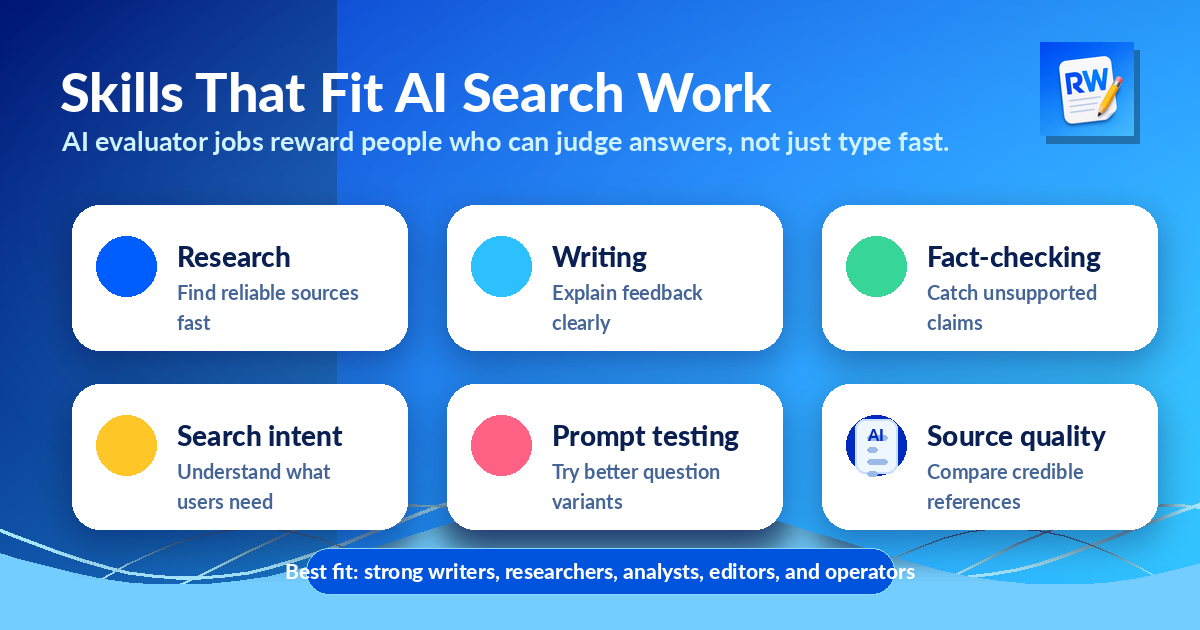
The strongest applicants usually show evidence of research ability, writing ability, subject matter expertise, and comfort with AI tools. A resume does not need to say "AI Mode" to be relevant. It can say model evaluation, answer quality, source verification, AI training, prompt testing, content review, search quality, fact-checking, editorial review, research analysis, or domain expert review.
How to Search for AI Mode Jobs
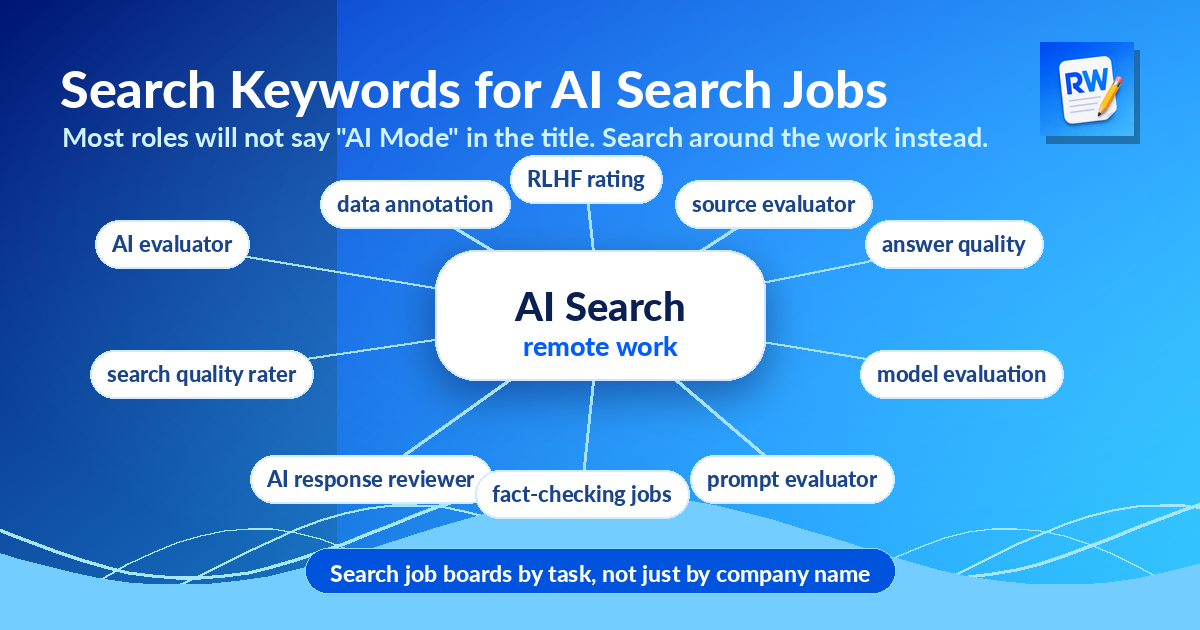
Do not rely on one keyword. "AI Mode jobs" may capture your intent, but many job boards will not use that phrase. Search by the actual work.
Useful keywords include: AI evaluator, AI search evaluator, AI response reviewer, AI model evaluator, search quality rater, prompt evaluator, prompt response reviewer, AI fact-checker, source quality evaluator, data annotation, RLHF evaluator, chatbot evaluator, generative AI evaluator, LLM evaluator, AI writing evaluator, and remote AI training jobs.
Also search around company names, but be careful. "Google AI jobs" or "Gemini AI jobs" may bring up engineering jobs, product jobs, or general corporate roles, not necessarily remote contractor work. The same is true for OpenAI jobs, Anthropic jobs, Microsoft AI jobs, Meta AI jobs, and Grok jobs. Company keywords are useful, but task keywords usually produce more relevant remote opportunities.
Better searches might include: "remote AI evaluator writing," "AI response reviewer contract," "search quality rater remote," "LLM evaluator finance," "AI training jobs for lawyers," "prompt evaluator healthcare," or "AI model evaluation work from home."
How to Position Your Resume
Your resume should make the fit obvious. If you are applying for AI search or AI evaluation work, do not only list job titles. List the skills that translate.
Good resume language can include: evaluated written content for accuracy and clarity; researched complex topics using multiple sources; compared competing recommendations; wrote concise explanations for stakeholders; reviewed claims for factual support; improved prompts and documentation; used ChatGPT or other AI tools to draft, test, summarize, or analyze information; applied rubrics or quality standards; edited customer-facing content; analyzed search intent; created structured feedback.
For specialized applicants, add your subject matter angle. A finance professional should highlight financial modeling, accounting, investing, Excel, market research, or business analysis. A teacher should highlight curriculum, student explanations, grading, assessment, and tutoring. A lawyer or legal researcher should highlight legal writing, issue spotting, citation review, and careful reasoning. A healthcare worker should emphasize clinical documentation, patient education, or medical writing, while avoiding claims that exceed the role.
What to Avoid
Avoid treating AI search work like easy data entry. Some tasks are simple, but higher-quality AI evaluation work depends on careful judgment. If your application suggests you only want passive work, you may look weaker than applicants who show research and writing ability.
Avoid overclaiming. Do not say you worked for Google, OpenAI, Anthropic, Microsoft, Meta, or Grok unless you actually did. If you completed AI training work through a contractor platform, describe the platform relationship accurately.
Avoid making your profile too narrow. If you only search for "AI Mode jobs," you may miss roles titled AI evaluator, search quality rater, data annotator, model response reviewer, AI writing evaluator, or prompt reviewer. The job market often uses older titles for new work.
Avoid ignoring location rules. Some AI training projects are country-specific because of language, tax, legal, data, or client requirements. Even remote roles may require applicants to be in approved countries.
A Simple Example of the Work
Imagine a user asks an AI search system: "What are the best remote jobs for someone with a finance degree who does not want sales?" The system generates two answers.
Answer A gives a generic list: data entry, virtual assistant, customer service, freelance writing, and sales development. It does not mention the finance degree except in passing.
Answer B suggests financial analyst contract work, bookkeeping, FP&A support, Excel reporting, AI finance evaluator projects, accounting support, research analyst work, and remote operations roles. It explains which roles are realistic for entry-level, mid-level, and experienced applicants. It avoids promising guaranteed income.
A good reviewer would likely prefer Answer B because it better matches the user's background and constraint. But the reviewer would still check whether the answer overpromises, whether it includes misleading salary claims, and whether it should mention that many remote roles are competitive. That is the judgment AI search systems need.
The Bigger Opportunity
AI search is not just a threat to old search jobs. It is also a reason new review jobs exist. Every time an AI product answers a complex question, compares options, recommends a path, or summarizes sources, there is a quality problem behind the scenes. Human evaluators help solve that problem.
For remote workers, the opportunity is to translate existing skills into AI-adjacent work. You do not need to call yourself an AI engineer if you are not one. You can be a writer, analyst, researcher, editor, teacher, lawyer, healthcare professional, business operator, or subject matter expert who helps improve AI answer quality.
The people who do best will understand both sides: how users search and how AI answers can fail. They will know how to spot vague answers, weak sources, missing context, hallucinations, unsafe advice, and poor reasoning. They will also know how to write feedback that a model training team can actually use.
Conclusion
AI Mode jobs are best understood as jobs around AI-powered search, not necessarily jobs with that exact title. The real categories are AI evaluator work, search quality rating, answer review, source verification, prompt testing, AI fact-checking, and model evaluation.
As search becomes more conversational, remote work will continue to move toward people who can judge quality. Strong writers, researchers, editors, analysts, business professionals, educators, healthcare workers, legal professionals, finance experts, scientists, and coders can all find different angles into this market.
Key takeaway: Search for the task, not just the company name. AI evaluator, search quality rater, LLM reviewer, and source verifier will find more real remote opportunities than "AI Mode jobs" alone.