AI Mode jobs are part of a broader shift in how people use the internet. Search is no longer limited to a list of blue links. More users now expect AI systems to summarize information, compare options, answer questions, open browser tasks, help with research, and guide decisions directly inside search engines, chatbots, productivity tools, and AI browsers.
That change creates a new category of remote work. When AI systems answer questions, browse pages, cite sources, summarize content, and recommend next steps, companies need people to evaluate whether those systems are useful, accurate, safe, and aligned with what a real user wanted. That is where remote AI evaluator jobs, search quality rater jobs, AI response reviewer jobs, prompt evaluation jobs, browser assistant QA jobs, and data annotation jobs come in.
What AI Mode Jobs Means
AI Mode jobs is a practical job-search phrase for remote roles that support AI-powered search and assistant experiences. These roles usually do not require building the AI model itself. Instead, they involve reviewing how AI systems behave when users ask questions, search the web, summarize pages, compare products, request advice, or ask for help completing a digital task.
In plain English, these jobs ask: Did the AI understand the user? Did it answer accurately? Did it cite the right sources? Did it avoid making unsupported claims? Did it choose helpful next steps? Did it stay within the rules of the task? Could a real person trust the answer?
That type of work matters because AI search and AI browsers are only useful when they can return answers people can rely on. A model may be strong at generating fluent text, but fluency is not the same as correctness. Human reviewers help measure whether the system is actually useful in the real world.
Why Search Is Becoming a Remote Work Category
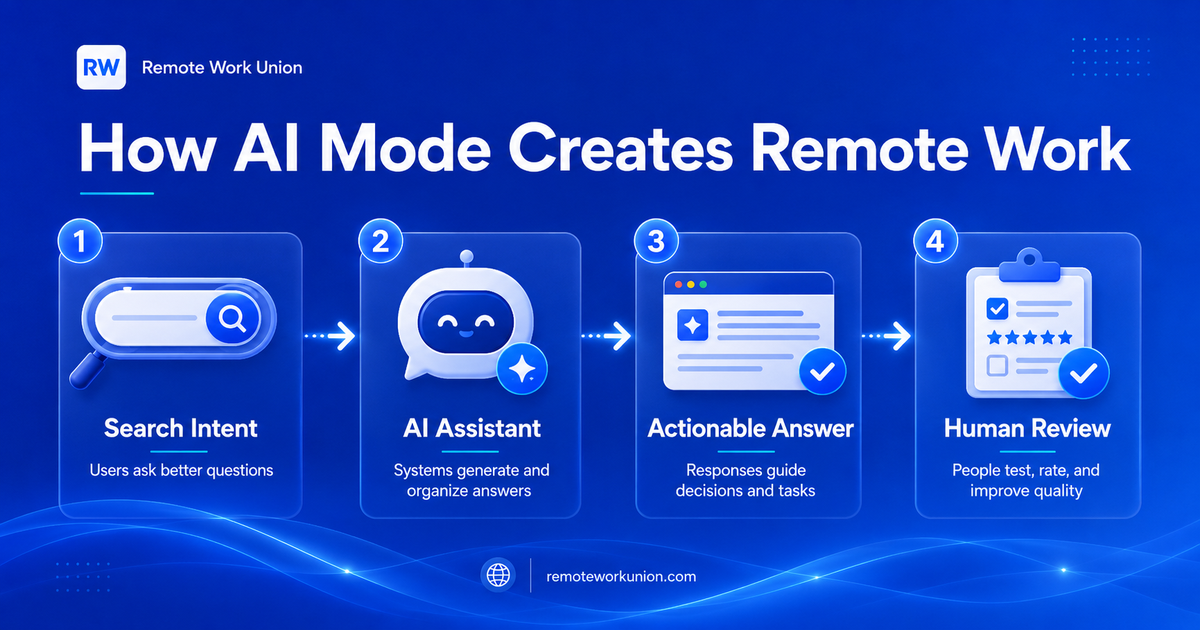
Traditional search created jobs around SEO, content quality, ads, moderation, and search ranking. AI search adds another layer. Instead of only ranking pages, AI systems often generate a direct response. That response may combine search results, reasoning, citations, snippets, maps, product data, business details, user preferences, and previous context.
This creates more places where human judgment is needed. A remote reviewer might compare two AI answers and choose the better one. Another reviewer might check whether a source actually supports a claim. A browser QA tester might see whether an assistant followed instructions correctly inside a web page. A prompt evaluator might test different versions of a request and judge whether the output improves.
Major AI companies and platforms across the ecosystem need this kind of evaluation. Job seekers often search around company names and product ecosystems such as OpenAI, Anthropic, Google, Microsoft, Meta, Apple, xAI, Perplexity, Claude, Gemini, ChatGPT, Copilot, Grok, and other AI labs or AI search products. The roles may be posted directly by companies, through contractors, or through AI training platforms that handle remote projects.
The Jobs Behind AI Mode, AI Assistants, and AI Browsers
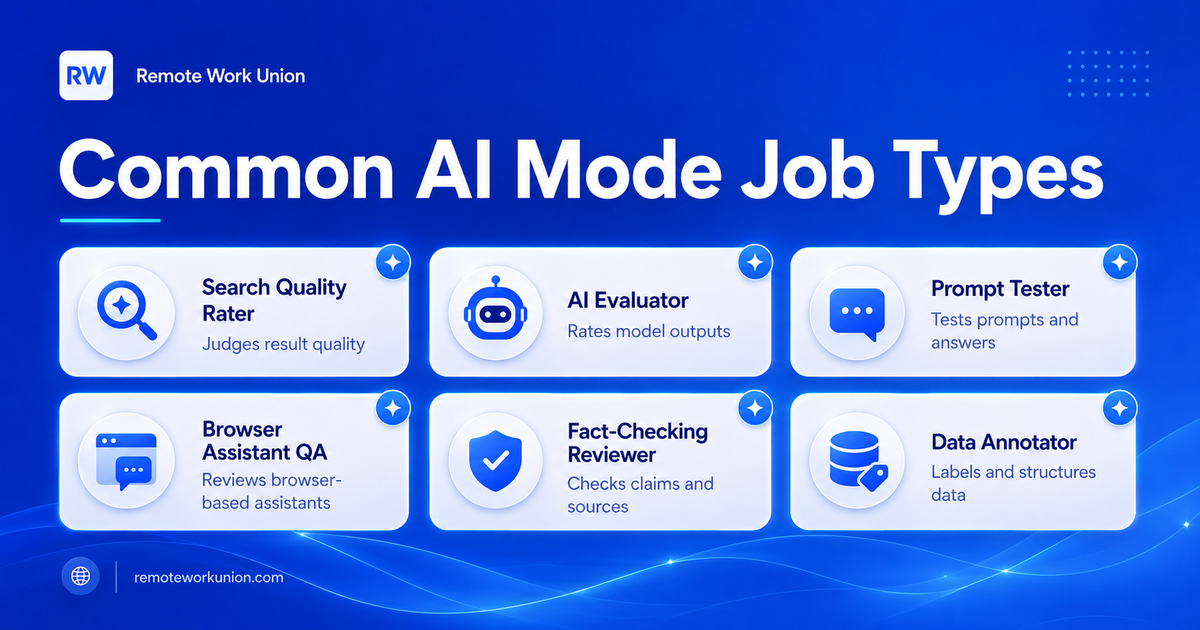
AI Mode jobs are not one single job title. They are a cluster of related roles. The same company may call the work AI evaluator, AI trainer, search quality rater, prompt evaluator, response reviewer, data annotator, quality analyst, browser tester, web evaluator, or fact-checking specialist. The title matters less than the task description.
AI evaluator: AI evaluators review model outputs and decide which answer is better, more complete, more accurate, safer, or more useful. This can involve comparing two chatbot responses, rating a single answer against a rubric, or explaining why one output better satisfies the user request. Strong writing and careful judgment matter more than fancy technical vocabulary.
Search quality rater: Search quality raters judge whether search results, answer boxes, summaries, or AI-generated responses match the user intent. They may review relevance, freshness, helpfulness, source quality, page reputation, or whether the answer resolves the searcher's real problem. This work is especially relevant as search engines add AI answer modes.
Prompt tester: Prompt testers design or evaluate prompts to see how an AI system responds. They may test edge cases, ambiguous questions, local searches, shopping questions, research prompts, coding prompts, writing prompts, or long multi-step tasks. The goal is to find where the system succeeds, fails, refuses incorrectly, hallucinates, or gives incomplete answers.
Browser assistant QA tester: AI browsers and browser assistants create a different type of remote work. Instead of evaluating a static answer, reviewers may test whether an assistant can read a page, summarize it, find information, navigate a task, compare tabs, fill in structured information, or follow a user instruction without breaking the workflow.
Fact-checking reviewer: Fact-checking reviewers focus on claims, evidence, and source support. They check whether the AI response is grounded in the sources it used. This work is important for research-heavy queries, health and finance-adjacent content, legal-adjacent topics, education, news summaries, product comparisons, and business research.
Data annotator: Data annotation jobs support AI systems by labeling, categorizing, ranking, or structuring data. In the AI search and assistant context, that might mean labeling query intent, marking whether a source is relevant, identifying entities, classifying answer types, or tagging examples that help a system learn from human feedback.
What Remote Workers Actually Do in These Roles
Most AI Mode work is not one long creative assignment. It is usually a series of structured tasks. A platform may show you a prompt, an AI answer, search results, source links, instructions, and a rating form. Your job is to apply the rubric consistently and explain your reasoning clearly when required.
A typical task might ask you to decide whether a response is accurate, whether it directly answers the prompt, whether it includes unsupported claims, whether it is too vague, whether it follows formatting instructions, whether it avoids harmful guidance, whether the sources are high quality, or whether the answer is better than another version.
AI evaluation work rewards careful judgment. A smooth answer can still be inaccurate, and a less elegant answer can sometimes be the better one if it is more grounded and complete.
Remote Work Union connects you to legitimate remote AI training and evaluation roles. Apply for free.
Find Roles Hiring Now →Skills That Make You a Stronger Candidate
You do not need to be a software engineer for many AI Mode jobs. Some projects do require coding, data science, legal, medical, finance, education, or language expertise. But many generalist roles are built for people who can read carefully, write clearly, compare information, follow instructions, and explain decisions.
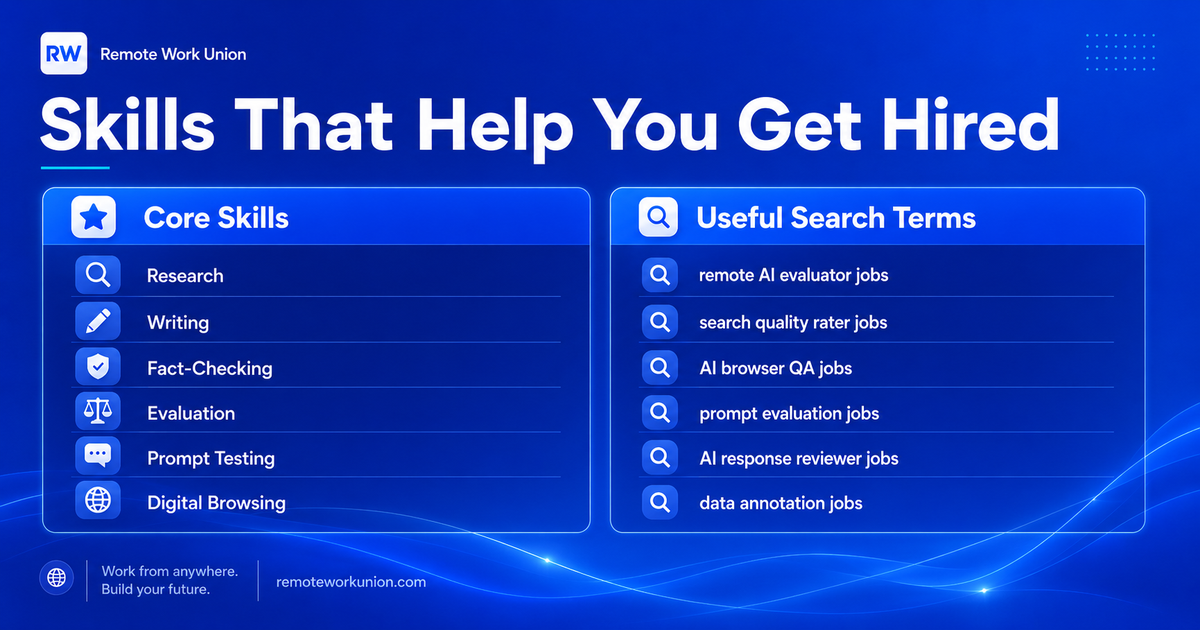
Strong candidates usually have a mix of research, writing, evaluation, and digital literacy. Research helps you verify claims. Writing helps you explain ratings. Evaluation helps you compare two possible answers. Digital literacy helps you understand how search, browsers, AI chatbots, and online workflows fit together.
Useful skills to highlight include fact-checking, web research, writing, editing, proofreading, quality assurance, customer support analysis, teaching, tutoring, legal research, financial analysis, medical writing, data labeling, content moderation, SEO, technical writing, prompt writing, chatbot testing, and AI tool experience.
How to Position Your Background
The best application strategy is to translate your existing experience into the language of AI evaluation. A teacher can emphasize rubric-based grading, feedback, and subject-matter explanation. A writer can emphasize clarity, editing, tone, and response quality. A researcher can emphasize source checking, synthesis, and evidence standards. A customer support worker can emphasize intent detection and helpful problem solving.
A lawyer, paralegal, nurse, accountant, engineer, marketer, or analyst can position their background as domain expertise. AI companies need general reviewers, but they also need experts who can tell when a model is wrong in a specialized field.
Your resume should not just say that you used AI tools. It should show what you can evaluate. Use phrases like evaluated response accuracy, reviewed source quality, compared model outputs, checked factual consistency, followed detailed rubrics, improved prompt clarity, summarized complex information, conducted web research, and documented quality issues.
Search Terms to Use When Applying
Because this category is still fragmented, job seekers should search across multiple phrases instead of relying on one title. Try searches such as AI Mode jobs, remote AI evaluator jobs, AI response reviewer jobs, search quality rater jobs, AI browser QA jobs, prompt evaluation jobs, prompt tester jobs, data annotation jobs, AI training jobs, model evaluation jobs, RLHF jobs, human feedback jobs, chatbot evaluator jobs, AI fact-checking jobs, and web evaluator jobs.
Also combine role keywords with remote work language. Examples include remote AI training jobs, work from home AI evaluator, part-time AI evaluator, flexible AI annotation work, remote search quality rater, AI model trainer from home, and AI assistant QA tester. If you have a specialty, add it to the search: legal AI evaluator, finance AI reviewer, medical AI evaluator, coding AI trainer, bilingual AI evaluator, education AI reviewer, or marketing AI response reviewer.
Red Flags and Realistic Expectations
AI Mode jobs can be real remote opportunities, but the category also attracts low-quality listings. Be cautious with any job that promises guaranteed income, asks you to pay to apply, advertises unrealistic earnings without mentioning skill tests, or refuses to explain the actual work. Real AI evaluation roles usually include assessments, rubrics, project guidelines, quality checks, and some kind of review process.
Applicants should also understand that project availability can change. Many AI training and evaluation jobs are contract-based. Work may come in waves. The best approach is to build a pipeline across several legitimate platforms and roles instead of depending on one source.
Key insight: Pay can vary widely depending on project type, expertise level, language, difficulty, and platform. The more specialized and verifiable your expertise, the more likely you are to qualify for higher-value projects.
The Long-Term Opportunity for Remote Workers
The rise of AI search, assistants, and browsers does not remove the need for human judgment. It changes where that judgment is used. Instead of only writing content or answering support tickets, remote workers may increasingly test whether AI systems can perform those tasks correctly.
This is why AI Mode jobs are useful to understand even if the phrase itself keeps evolving. The underlying work is broader than one product name. Search systems need relevance judgment. Assistants need answer evaluation. AI browsers need workflow testing. Chatbots need human feedback. Data systems need clean labels. Companies need reviewers who can catch mistakes before users rely on them.
For non-technical remote workers, this category is worth watching because it rewards skills many people already have: reading comprehension, research, writing, judgment, patience, and the ability to follow instructions. For specialists, it can turn existing professional knowledge into remote AI evaluation work. For students and generalists, it can be a practical entry point into the AI economy without needing to become a programmer first.
Frequently Asked Questions
What are AI Mode jobs?
AI Mode jobs are remote roles that support AI-powered search and assistant experiences. They include AI evaluator, search quality rater, prompt tester, browser assistant QA tester, fact-checking reviewer, and data annotator positions that help companies ensure AI search results and answers are accurate, helpful, and trustworthy.
Do I need to be a software engineer for AI Mode jobs?
No. Many AI Mode jobs require strong writing, research, fact-checking, and judgment skills rather than programming ability. Some projects require technical expertise, but many generalist roles are designed for people who can read carefully, compare AI outputs, follow instructions, and explain their decisions.
How do I search for AI Mode jobs?
Search across multiple related terms: AI Mode jobs, remote AI evaluator jobs, AI response reviewer jobs, search quality rater jobs, prompt evaluation jobs, AI training jobs, and model evaluation jobs. Combine these with remote work language and your specific skill area for better results.