People who search for Gemini AI training jobs are usually looking for remote work connected to Google's AI ecosystem, Gemini-style assistants, search quality, answer evaluation, AI model feedback, and data annotation. The most important thing to understand is that these roles are rarely labeled in only one way. A job might be called AI evaluator, AI rater, search quality rater, prompt evaluator, model response reviewer, human feedback specialist, data annotation contractor, coding evaluator, safety reviewer, or domain expert reviewer.
This article explains how to search for these roles without wasting time, what the work usually looks like, what skills matter, and how to position yourself for remote AI training projects connected to large AI companies and the broader model evaluation market.
What People Mean by Gemini AI Training Jobs
A Gemini AI training job does not always mean a direct job at Google. In many cases, the phrase describes remote work around AI model improvement, answer quality, search relevance, human feedback, and evaluation tasks connected to the same type of AI ecosystem that powers tools like Gemini, ChatGPT, Claude, Copilot, Meta AI, Grok, and other assistants.
The work is usually not about building the model from scratch. It is about improving how AI systems respond to real users. Human reviewers help decide whether an answer is accurate, useful, safe, well written, properly sourced, and appropriate for the task. That judgment becomes valuable because modern AI systems still need human feedback on ambiguous, subjective, specialized, or high-stakes prompts.
For job seekers, this matters because searching only for the exact phrase "Gemini AI training jobs" can miss most of the real opportunities. The better approach is to search across the surrounding role names: AI evaluator, AI rater, search quality evaluator, AI response reviewer, prompt evaluator, human feedback jobs, RLHF jobs, data annotation jobs, and remote AI training projects.
What the Work Usually Looks Like
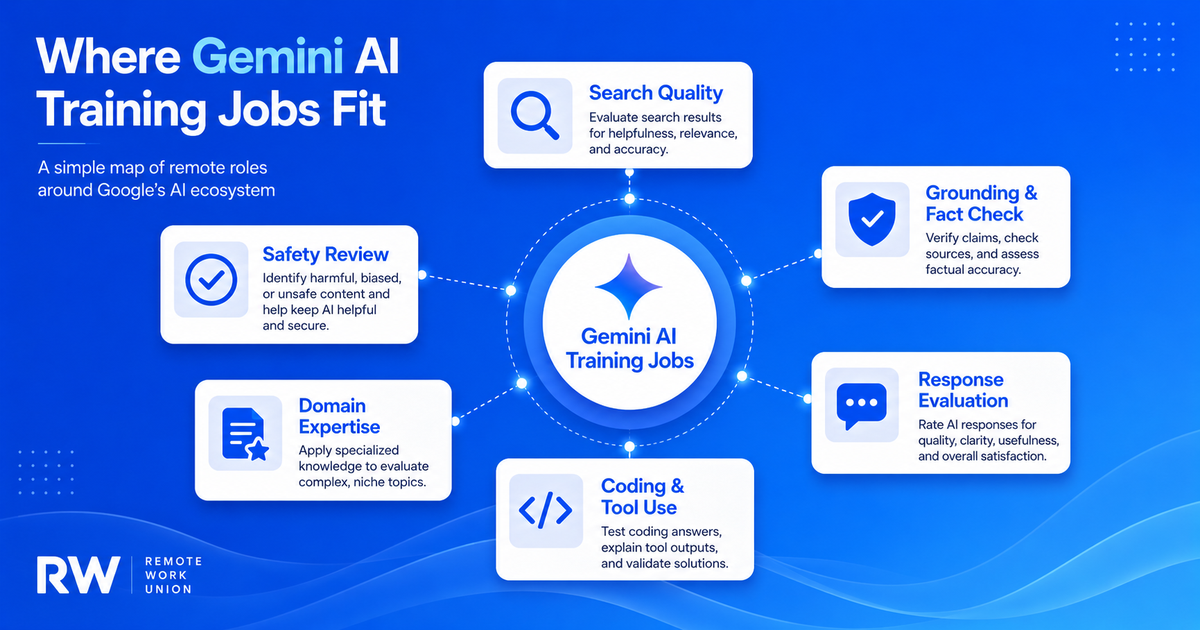
Remote AI training work can vary by platform and project, but most roles fall into a few repeatable patterns. You may compare two AI answers and choose which one is better. You may rate a single answer for helpfulness, factuality, clarity, tone, safety, or instruction following. You may rewrite a weak answer into a stronger one. You may fact-check a claim, identify missing context, label examples, review search results, evaluate code, or use subject knowledge to judge whether an AI system handled a specialized topic correctly.
Some Gemini-adjacent work is close to search quality evaluation. These roles ask reviewers to judge whether search results, snippets, assistant answers, or generated summaries are relevant and useful for a query. Other roles are closer to chatbot response review, where the core task is comparing model outputs. Some projects focus on safety and policy. Others focus on coding, math, finance, healthcare, education, law, language translation, or creative writing.
The common thread is judgment. The strongest applicants are not always the most technical. They are usually people who can read carefully, follow instructions, explain decisions, notice subtle errors, and maintain consistency across a rubric.
Common Job Titles to Search For
The title on the job post may not mention Gemini at all. Search for a wider set of terms so you find more listings around the same kind of work.
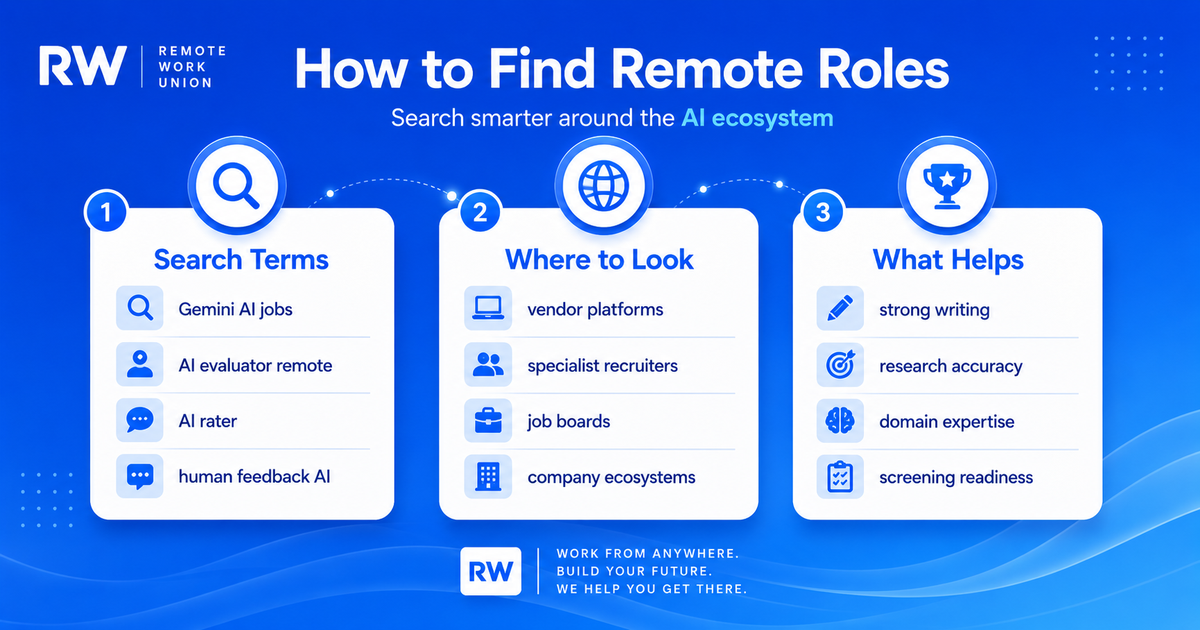
Useful search terms include AI evaluator, AI rater, search quality rater, search quality evaluator, AI model evaluator, AI response reviewer, prompt evaluator, prompt engineer evaluator, human feedback specialist, RLHF contractor, data annotation specialist, AI data annotator, AI trainer, AI model trainer, AI content quality analyst, AI fact checker, AI safety reviewer, language evaluator, bilingual AI evaluator, coding evaluator, domain expert reviewer, and work from home AI jobs.
You can also combine these with company and ecosystem keywords: Google AI jobs, Gemini AI jobs, DeepMind roles, Google contractor AI jobs, remote AI evaluator Google, OpenAI evaluator jobs, Anthropic AI training jobs, Meta AI evaluation jobs, Microsoft AI jobs, xAI evaluator roles, and Claude response evaluation work. Not every search will produce a perfect match, but the variety helps you find listings before they become crowded.
Where to Look for Gemini AI Training Roles
Start with direct company career pages, but do not stop there. Large AI ecosystems often use a mix of full-time teams, vendors, contractors, specialist platforms, research partners, and recruiting marketplaces. That is why a narrow search can make the market look smaller than it actually is.
Search in four places. First, check official career pages for Google, Alphabet, DeepMind, and other major AI companies when you want full-time or highly structured roles. Second, search AI training and data annotation platforms — such as Handshake AI, Mercor, micro1, and Outlier AI — where remote contractor projects are more common. Third, search LinkedIn and general job boards using the wider role titles above. Fourth, track niche remote work sources and communities that surface AI evaluator, model review, and human feedback openings before they are easy to find elsewhere.
Remote Work Union can fit into that fourth bucket. Instead of searching every platform manually, job seekers can use it as a starting point for remote work opportunities and then compare each role by pay, required skills, time commitment, application friction, and credibility.
A Smarter Search Strategy
A strong search strategy uses combinations, not just one keyword. Try one set of searches around the AI product, one around the task, and one around the work arrangement.
Product-focused searches: Gemini AI jobs, Google AI jobs, Google AI evaluator, Gemini evaluator, Google search quality evaluator, AI search evaluator.
Task-focused searches: AI response reviewer, prompt evaluator, AI rater, model evaluator, human feedback AI, RLHF jobs, fact-checking AI jobs, safety evaluation AI, data annotation AI.
Remote-work searches: remote AI evaluator, AI rater work from home, part-time AI training jobs, freelance AI evaluator, remote data annotation, work from home AI jobs, flexible AI contractor roles.
The goal is not to find one magic search term. The goal is to create a repeatable search system that catches different labels for the same kind of work. Save searches, track which terms produce real postings, and remove terms that only produce spam or unrelated results.
Remote Work Union connects you to legitimate remote AI training and evaluation roles across multiple platforms. Apply for free.
Find Roles Hiring Now →Skills That Help You Get Selected
The baseline skill is clear writing. Even when the job is not described as a writing role, most AI evaluation work rewards people who can explain why one answer is stronger than another. Strong grammar, concise reasoning, and careful reading matter more than many applicants expect.
Research accuracy is another major advantage. Reviewers often need to verify claims, check whether a source supports a statement, recognize when an answer overstates certainty, and distinguish plausible writing from true information. The ability to say "this sounds right but is not supported" is valuable in AI training work.
Domain expertise can also create a higher-value lane. Legal researchers, finance professionals, accountants, teachers, healthcare writers, scientists, coders, analysts, bilingual workers, editors, and technical writers may qualify for specialized projects that general applicants miss. If you have subject knowledge, make it visible on your resume and application.
Tool fluency helps too. Applicants do not need to pretend to be AI engineers, but it helps to understand the difference between ChatGPT, Gemini, Claude, Copilot, Meta AI, Grok, and other AI assistants. It also helps to know how prompts work, how AI hallucinations appear, how citations can fail, and why human review remains necessary.
How to Position Your Resume
Do not send a generic remote work resume to an AI evaluation role. The resume should show that you can evaluate language, follow instructions, work independently, and use judgment. Include role-relevant phrases such as AI evaluation, response review, research accuracy, fact-checking, content quality, search relevance, annotation, rubric-based review, editing, prompt testing, model feedback, and domain expertise when they honestly apply.
A strong resume bullet does not need to exaggerate technical experience. It can say that you reviewed written outputs for accuracy and clarity, evaluated content against detailed guidelines, researched factual claims, edited complex explanations for readability, compared multiple answers against a rubric, or used AI tools to support research and quality control. The language should be truthful, specific, and close to the work described in the posting.
If you are a lawyer, teacher, nurse, analyst, coder, marketer, editor, student, researcher, or bilingual speaker, make that lane clear. Specialized AI training projects often need reviewers who can judge topics that a general rater cannot evaluate confidently.
Application Tips for Assessments
Many AI evaluator and AI rater roles use assessments before assigning work. Treat these assessments like paid work, not like quick forms. Read the instructions slowly. Follow the rubric literally. Avoid adding personal preferences unless the rubric asks for them. When asked to compare two answers, explain the specific reason one answer is better: accuracy, completeness, instruction following, safety, clarity, tone, formatting, or usefulness.
Do not rush through examples just because the work is remote. The platforms are often testing whether you can be consistent. A person who gives thoughtful, repeatable ratings is more valuable than someone who gives dramatic but unsupported opinions. If the task asks for citations or source checking, verify the claim rather than trusting a confident answer. If the task asks for rewriting, keep the user's intent intact while improving clarity and correctness.
The simplest rule: Act like the model's answer is not automatically true. Your job is to evaluate it.
Red Flags to Avoid
Because remote AI jobs are popular, fake listings and low-quality opportunities can appear around the same keywords. Be careful with any role that asks you to pay to apply, buy training before seeing the client, provide sensitive identity information before a legitimate onboarding process, or accept vague promises of guaranteed income. Real remote AI work can pay well, but legitimate postings usually still have screening, instructions, contracts, and project limits.
Also be cautious with listings that misuse big company names. A post can mention Google, Gemini, OpenAI, Anthropic, Meta, or Microsoft without being an official role at those companies. That does not automatically make the role fake, since contractors and vendors exist, but it does mean you should verify who is actually hiring, who is paying, what platform you are working through, and what the contract says.
Who These Roles Fit Best
Gemini AI training jobs and similar remote AI evaluator roles are a strong fit for people who like reading, writing, research, detail work, and independent judgment. They can fit students, recent graduates, writers, editors, teachers, legal researchers, healthcare writers, finance professionals, coders, analysts, bilingual workers, and generalists who are comfortable following complex instructions.
They are usually not a good fit for people who want passive income, instant approval, or work with no reading. The best roles require focus. You may have to read long guidelines, handle repetitive rating tasks, and justify small differences between two decent answers. That is exactly why strong reviewers can stand out.
Practical Next Steps
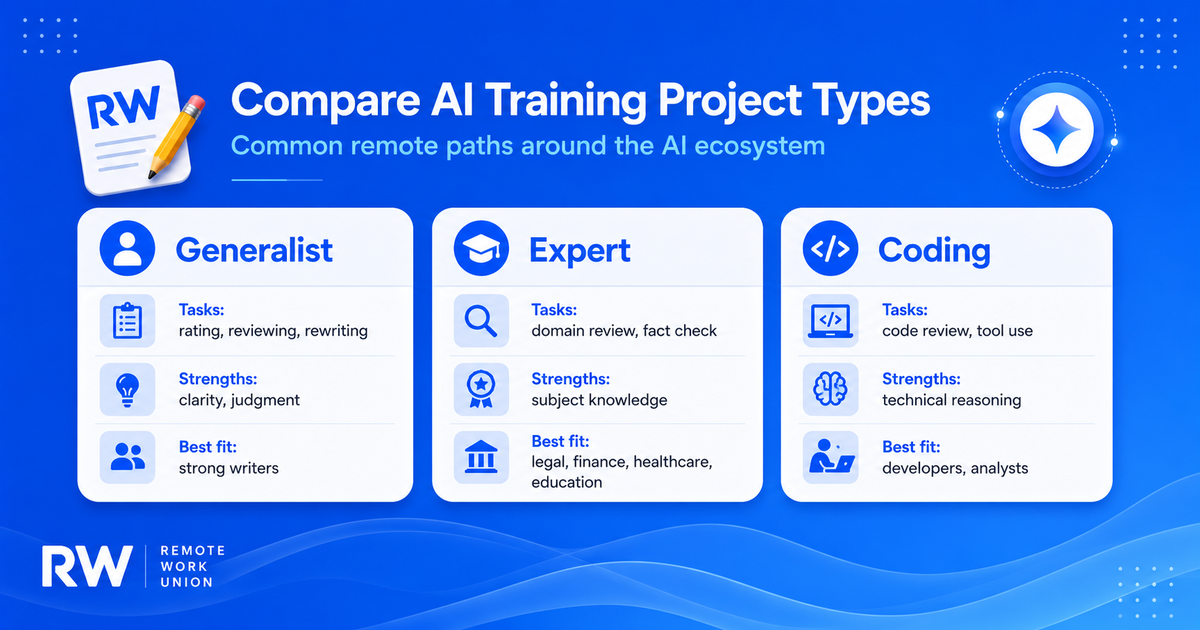
Pick one lane before applying. If you are a strong writer, start with AI response reviewer, prompt evaluator, and human feedback roles. If you are a researcher, search for AI fact-checking, search quality, and AI content quality roles. If you have a professional background, search for domain expert AI evaluator jobs in your field. If you code, search for coding evaluator, code reviewer, and technical AI training projects.
Then build a small application tracker. Record the platform, role title, pay range if listed, assessment status, required skills, and follow-up date. Apply in focused batches instead of randomly clicking every remote job. Over time, you will learn which keywords produce real opportunities and which ones waste time.
The remote AI job market uses confusing labels, but the underlying opportunity is easier to understand: AI systems need humans who can judge quality. If you can write clearly, research carefully, follow instructions, and evaluate answers with discipline, you can search far beyond the exact phrase "Gemini AI training jobs" and find the broader ecosystem of remote AI work.
Frequently Asked Questions
What are Gemini AI training jobs?
Gemini AI training jobs are remote roles connected to Google's AI ecosystem that involve evaluating, rating, and improving AI model outputs. They include AI evaluator, AI rater, search quality rater, prompt evaluator, and AI response reviewer positions at Google, Alphabet, DeepMind, or through contractor platforms.
Do I need a technical background for Gemini AI training work?
Not for most roles. Many Gemini-adjacent AI training jobs reward strong writing, research accuracy, and clear judgment over coding expertise. Domain specialists in law, finance, medicine, education, and other fields can qualify for expert review projects without a software engineering background.
Where can I find Gemini AI training jobs?
Start with official Google, Alphabet, and DeepMind career pages for structured roles, then search AI training platforms and remote work boards using terms like AI evaluator, search quality rater, prompt evaluator, and AI response reviewer. RemoteWorkUnion.com aggregates legitimate remote AI work opportunities across multiple platforms.