People searching for "Ask AI jobs" are usually looking for one of two things: jobs where they ask AI systems questions, or jobs where they review AI answers and help improve the quality of those answers. Both ideas point to the same growing category of remote work: AI training, AI evaluation, prompt-response review, RLHF, and model quality testing.
These roles are not about replacing professional judgment with AI. They are about using human judgment to make AI answers more accurate, useful, clear, and safe. A person might compare two chatbot responses, check whether an answer is factually correct, write feedback explaining which answer is better, or rewrite a weak response so the model has a better example to learn from.
The work can appear under many job titles: AI evaluator, AI trainer, AI content reviewer, search quality rater, model evaluator, prompt response writer, data annotation specialist, RLHF contractor, AI answer reviewer, or AI fact-checker. The exact title changes by platform and company, but the basic goal is consistent: help AI systems produce better answers.
What "Ask AI jobs" usually means
"Ask AI jobs" is more of a search phrase than a single official job title. A job seeker may type it because they have heard that people can get paid to test chatbots, ask AI questions, evaluate answers, or train models. The better way to understand the search is this: these are remote AI jobs where workers help improve answer quality.
Large AI products depend on high-quality answers. People use AI tools to summarize emails, explain legal concepts, write code, plan marketing campaigns, compare products, answer health questions, draft business documents, and search the web. When the answer is vague, wrong, unsafe, outdated, or poorly organized, the product feels less useful. Human reviewers help identify those problems.
That is why companies building AI assistants, search tools, writing tools, coding tools, and productivity software need people who can judge responses. OpenAI-style chatbots, Anthropic-style assistants, Google Gemini-style AI search and productivity tools, Microsoft Copilot-style workplace products, Meta AI-style consumer assistants, and Grok-style conversational systems all depend on some form of testing, feedback, rating, and evaluation.
How people get paid to improve AI answer quality
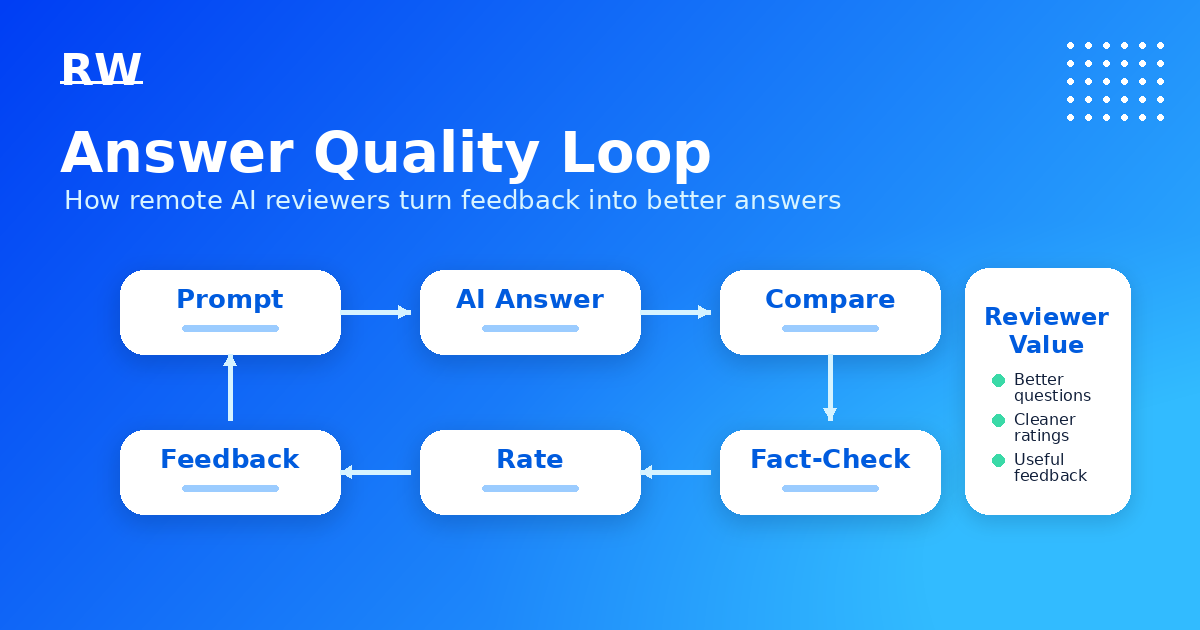
Most AI answer quality work is broken into small tasks. You log into a platform, receive a prompt or response pair, follow a rubric, and submit a judgment. Some tasks are simple and take minutes. Others require research, expertise, or careful writing.
- Writing prompts: You create realistic questions that a user might ask an AI system. Good prompts test reasoning, accuracy, instruction-following, and usefulness.
- Comparing answers: You review Answer A and Answer B, then decide which one is better according to the rubric.
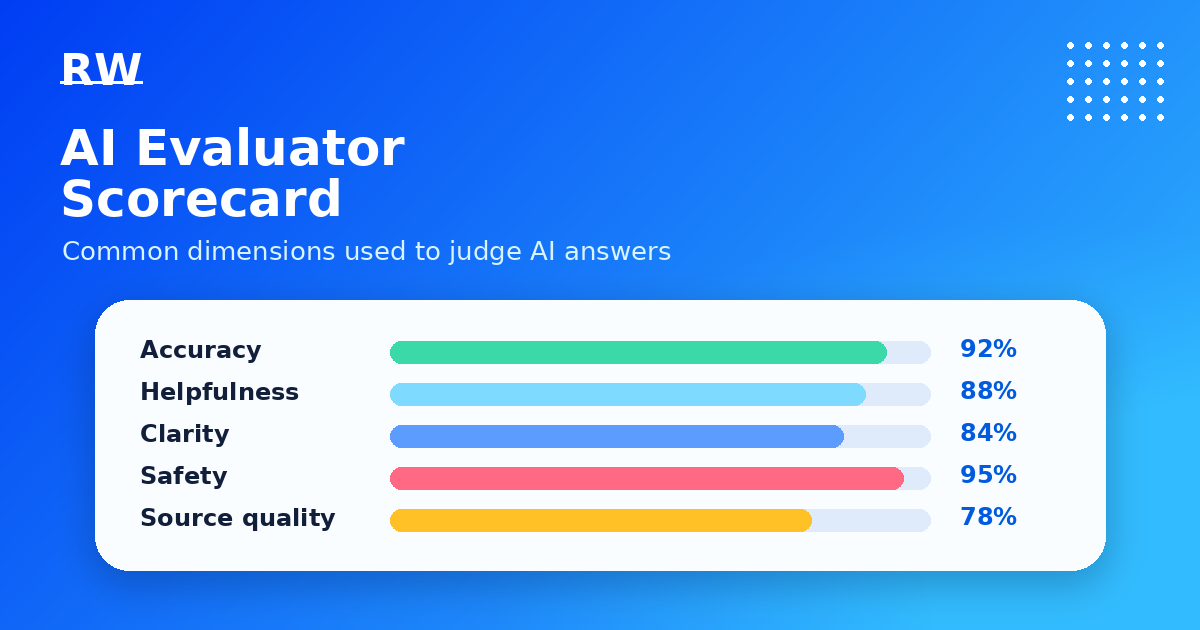
- Rating quality: You score an answer for accuracy, helpfulness, clarity, completeness, tone, safety, or source quality.
- Fact-checking claims: You verify whether the AI made factual errors, unsupported claims, wrong calculations, or misleading statements.
- Explaining your judgment: You write a short explanation showing why one response is stronger, weaker, safer, or more useful.
- Improving responses: You rewrite a flawed answer so it becomes clearer, more accurate, and better structured.
The strongest workers are not just people who know how to use AI. They are people who can tell when an AI answer sounds confident but is still wrong. That skill is valuable because AI systems often produce polished language, even when the underlying answer needs correction.
What an AI evaluator task can look like
A typical task might show a prompt such as: "Explain the difference between an employee and an independent contractor for a small business owner." The platform may then show two AI-generated answers. One answer might be clear but missing important caveats. Another might be detailed but too legalistic for the user. Your job is to decide which answer better satisfies the user request.
A strong evaluator does not just pick the longer answer. They ask better questions: Did the answer directly respond to the prompt? Did it include practical distinctions? Did it avoid giving overconfident legal advice? Did it mention that rules vary by jurisdiction? Was the language clear enough for a small business owner? Did it add useful next steps without pretending to replace a lawyer?
That type of judgment is why these jobs are not limited to coders. Business professionals, writers, creatives, lawyers, teachers, doctors and nurses, scientists, coders, analysts, editors, and researchers can all fit different kinds of AI training work. The best match depends on the subject matter and the platform.
Why human feedback still matters
AI systems can generate answers quickly, but speed is not the same as quality. A model can misunderstand the user, skip an important constraint, give generic advice, hallucinate a source, miss a safety issue, or produce an answer that is technically correct but not useful. Human feedback gives teams a way to measure and improve those weaknesses.
In many AI training workflows, human reviewers create examples of what good answers should look like. They also identify bad answers, compare multiple responses, and explain which answer better follows instructions. Over time, this feedback helps teams evaluate model performance and improve future outputs.
For job seekers, this creates a category of remote work that sits between writing, research, editing, quality assurance, customer understanding, and subject matter expertise. You do not always need advanced technical skills, but you do need careful judgment.
Remote Work Union tracks legitimate remote AI training roles across top platforms. Find opportunities that match your background without sorting through scam listings.
Find Roles Hiring Now →Skills that matter most
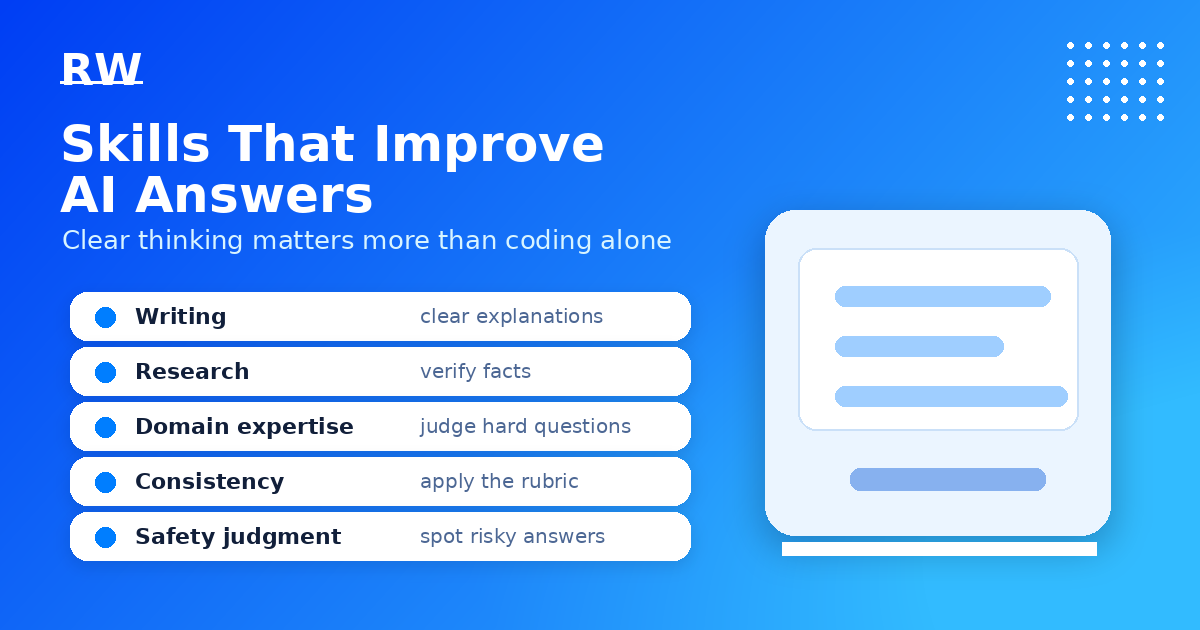
The best AI answer reviewers are consistent. They do not rate based on personal preference alone. They follow the rubric, apply the same standard across tasks, and explain decisions clearly.
- Strong writing: You need to explain why an answer is better, not just say which answer you prefer.
- Research discipline: You need to verify facts without overcomplicating every task.
- Attention to detail: Small errors can change the quality of an answer.
- Domain knowledge: Specialized projects may need legal, medical, finance, science, coding, business, education, or creative expertise.
- Instruction-following: Platforms often provide detailed grading rules. Ignoring the rubric is one of the fastest ways to lose work.
- Safety judgment: Some answers need to be flagged because they could be harmful, misleading, or inappropriate.
You should also be comfortable reading AI-generated text without being impressed by surface polish. Many weak answers look professional at first glance. Good evaluators look beneath the wording and judge whether the response actually solved the user problem.
Who these jobs fit best
Ask AI jobs can fit different backgrounds because AI answer quality is not one skill. It is a combination of writing, judgment, knowledge, research, and consistency. A business analyst may be useful for strategy tasks. A writer may be useful for clarity and tone tasks. A teacher may be useful for explanation quality. A lawyer may be useful for legal reasoning projects. A nurse or medical writer may be useful for healthcare-related evaluation. A software engineer may be useful for code review tasks.
This is important for non-technical applicants. Remote AI work is not only for programmers. Coding projects can pay well, but many AI evaluator jobs need people who can judge language, reasoning, professional advice, user intent, and answer usefulness.
How these roles usually pay
Pay structures vary. Some roles are hourly contract roles. Some are task-based. Some are project-based. Some platforms offer onboarding tests before access to paid work. A few roles may be part-time or full-time, but many remote AI training jobs are flexible contract opportunities.
The important point is that AI training income can be inconsistent. A platform may have plenty of tasks one week and fewer tasks the next. A project can pause. A client can change requirements. A worker may pass one assessment and fail another. For that reason, serious applicants usually apply to multiple platforms instead of relying on one source of work.
A realistic strategy is to treat these jobs like a remote work pipeline: build a strong profile, apply to several AI training platforms, track assessments, improve your resume keywords, and keep searching for new roles as platforms open and close projects.
Search terms to use when looking for Ask AI jobs
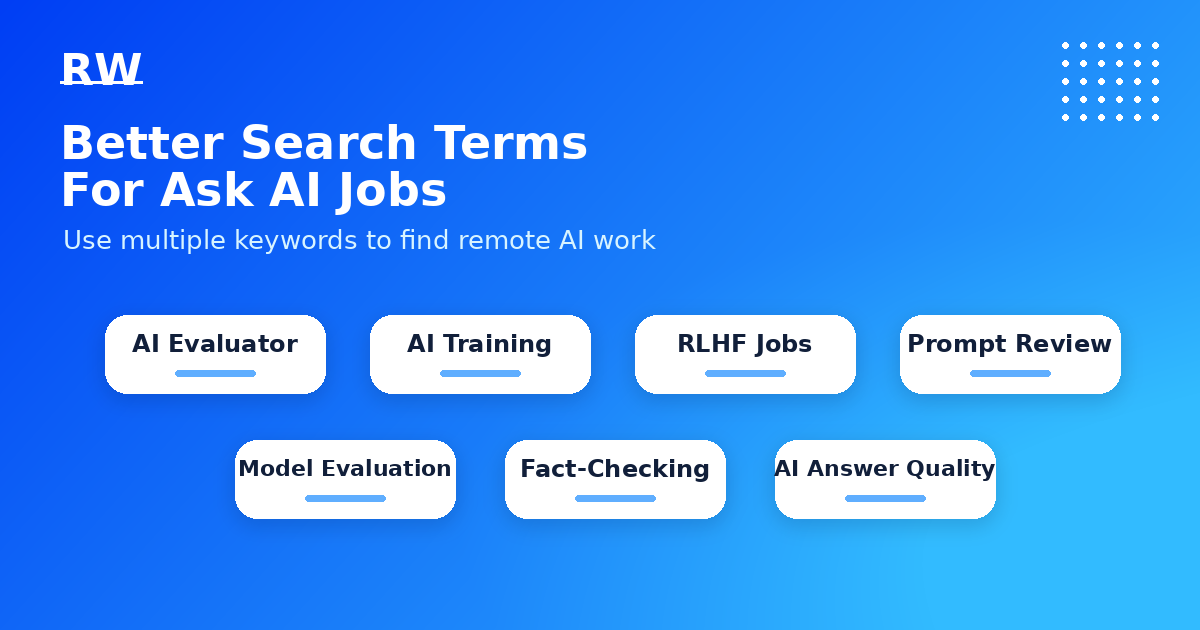
Because "Ask AI jobs" is not always the phrase employers use, search with related terms. This improves your chances of finding real remote roles instead of vague side-hustle content.
- AI evaluator jobs
- AI training jobs
- AI model evaluation jobs
- remote AI reviewer jobs
- prompt response evaluator jobs
- RLHF jobs
- AI fact-checking jobs
- chatbot evaluator jobs
- search quality rater jobs
- AI answer quality jobs
- data annotation AI jobs
- AI content reviewer jobs
You can also search by company, product, or platform. For example, people often search for OpenAI jobs, Anthropic jobs, Google AI jobs, Gemini AI jobs, Microsoft AI jobs, Copilot AI jobs, Meta AI jobs, Grok AI jobs, Outlier AI jobs, Mercor jobs, Handshake AI jobs, micro1 AI jobs, Surge AI jobs, Stellar AI jobs, and LinkedIn AI jobs. The goal is not to assume every company has the same role available. The goal is to use the right language so you can find the roles when they appear.
How to prepare before applying
The best preparation is simple: show that you can write clearly, evaluate carefully, and follow instructions. Your resume should make it obvious that you are a good fit for answer quality work.
- Add relevant keywords such as AI evaluation, model evaluation, content review, research, editing, prompt writing, fact-checking, quality assurance, and data annotation.
- Emphasize your strongest subject areas, such as business, writing, education, law, finance, healthcare, science, coding, operations, marketing, or analytics.
- Prepare for assessments by practicing side-by-side comparison of AI answers.
- Write concise explanations. Many platforms want clear reasoning, not long essays.
- Apply broadly. One platform may reject you while another has a project that fits your background.
If you already have professional experience, do not hide it behind generic "remote worker" language. AI training platforms often need subject matter expertise. A consultant, editor, teacher, nurse, law student, finance analyst, marketer, researcher, or software engineer should make that background easy to see.
Red flags to avoid
Real AI evaluation work should have clear tasks, clear expectations, and a legitimate payment process. Be cautious with any opportunity that promises guaranteed high income with no screening, asks you to pay upfront for access to work, refuses to explain what the work is, or pushes you into unrelated courses before you can apply.
Also avoid treating every AI job post as the same. Search quality rating, data labeling, RLHF writing, expert review, prompt engineering, and AI content moderation can overlap, but they are not identical. Read the description carefully. A role that fits a writer may not fit a coder. A role that fits a lawyer may not fit a beginner. A role that looks remote may still be limited by country, language, or work authorization.
The simple takeaway
Ask AI jobs are best understood as jobs that help AI systems answer better. The work may involve asking questions, comparing answers, checking facts, rating quality, writing feedback, or improving flawed responses. It can be a strong fit for people who write well, think clearly, and have useful professional knowledge.
The opportunity is not just "use AI and get paid." The real opportunity is to become the human quality layer that helps AI tools become more reliable. For remote workers, that means AI training and model evaluation can be a serious category to explore, especially if you already have writing ability, research skills, or subject matter expertise.
Tip: See the platform comparison guide for a breakdown of which AI training platforms match different backgrounds and skill sets.
Frequently Asked Questions
What do Ask AI jobs usually involve?
Ask AI jobs typically involve improving AI answer quality through tasks like comparing two AI responses and choosing the better one, rating responses for accuracy, helpfulness, safety, and clarity, writing feedback explaining which response is stronger, fact-checking AI claims, and rewriting weak responses. The work is about using human judgment to help AI systems produce more accurate and useful answers.
Do you need technical skills for Ask AI jobs?
Not always. Many AI evaluator jobs value writing ability, research skills, domain expertise, and clear judgment over coding skills. Strong writers, business professionals, teachers, lawyers, healthcare workers, and finance experts can qualify for many AI answer quality roles. Coding helps for technical evaluation projects but is not required for most general evaluator roles.
How do Ask AI jobs differ from regular data entry?
Ask AI jobs require judgment, not just data processing. You are not entering information into a form — you are evaluating whether an AI answer is accurate, helpful, safe, and clear. That requires reading carefully, applying a rubric consistently, spotting errors, and writing concise explanations. The best evaluators notice when an AI answer sounds confident but is still wrong.
What search terms work best for finding Ask AI jobs?
Try role-based terms like AI evaluator, AI training jobs, AI model evaluation jobs, RLHF jobs, prompt response evaluator, chatbot evaluator, search quality rater, and AI answer quality reviewer. Also search by expertise area: finance AI evaluator, legal AI training, healthcare AI reviewer, or coding AI evaluation. Company-name searches like OpenAI jobs, Anthropic jobs, Gemini AI jobs, and Google AI training jobs can also help orient your search.