Remote AI evaluation work is one of the most practical online job categories for Canadian applicants who can write clearly, research carefully, and make consistent judgments. These roles are often described with terms like AI evaluator, AI trainer, AI model reviewer, RLHF contractor, data annotation specialist, search quality rater, prompt response evaluator, AI fact-checker, and subject matter expert reviewer. The wording changes by platform, but the core idea is the same: human reviewers help improve AI systems by judging whether model outputs are useful, accurate, safe, complete, and aligned with instructions.
For Canadians, the opportunity is especially relevant because many AI evaluation projects need strong English communication, North American cultural context, time zone compatibility, and specialist knowledge. Some projects may also need French-English bilingual reviewers, Canadian legal or healthcare context, Canadian finance knowledge, or domain experts who can review answers for local accuracy.
What AI Evaluation Work Usually Involves
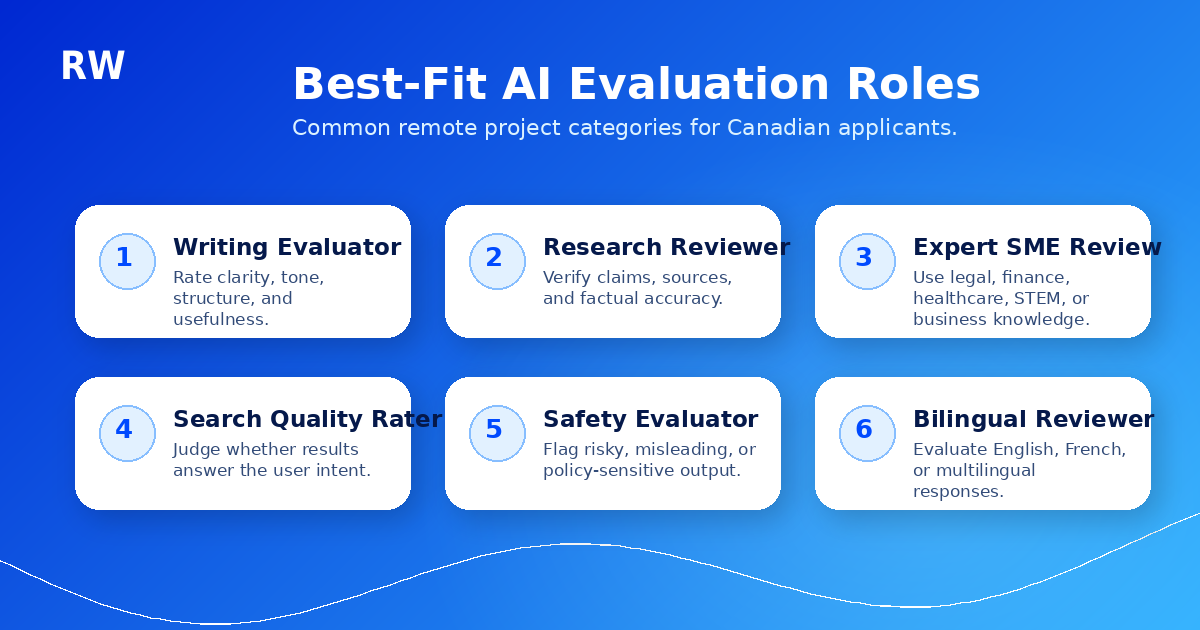
AI evaluation work is not one single job. It is a broad category of remote work where humans review AI-generated answers, compare two responses, write better examples, label data, test prompts, or explain what a model got wrong. A task may ask you to decide which answer is more helpful. Another may ask whether a chatbot followed the user's instruction. Another may ask you to fact-check a response about finance, law, medicine, science, or education.
The best AI evaluation jobs usually reward four things: clear reasoning, careful reading, precise writing, and consistency. Common tasks include ranking two AI responses and explaining which one is better, rating a chatbot answer for helpfulness and accuracy, checking whether an AI answer followed the user's instructions, fact-checking claims and identifying hallucinations, rewriting a weak AI response into a stronger answer, and evaluating specialist answers in law, finance, healthcare, coding, or business.
Why Canadian Applicants Can Be Strong Candidates
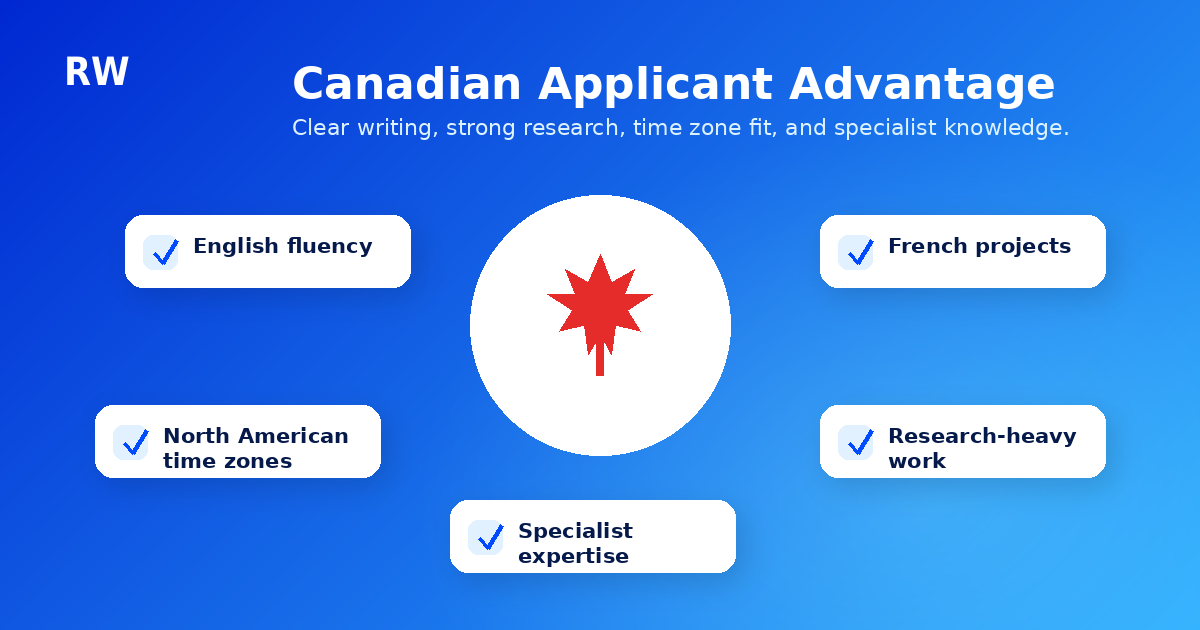
Canadian applicants can have several advantages in remote AI evaluation work, especially for English-language and North American projects. Many AI companies and AI training platforms need reviewers who can understand subtle language differences, detect awkward writing, judge whether an answer sounds natural, and apply a high standard of factual accuracy.
Canada also has a large pool of educated professionals across business, healthcare, law, finance, technology, research, education, and writing. That matters because AI evaluation is moving beyond simple data labeling. A growing share of tasks require subject matter judgment. French-English bilingual ability can also be useful. Some projects need multilingual AI evaluation, translation quality review, localization, French-language prompt testing, or comparison between English and French responses.
Best AI Evaluation Jobs for Canadian Writers
AI writing evaluator jobs are a strong fit for Canadian writers, editors, journalists, content marketers, copywriters, English majors, and communications professionals. These projects may ask you to compare two AI-written answers and decide which one is better, explaining whether a response is too generic, too wordy, too robotic, or missing key details.
AI response comparison reviewer is one of the most common AI evaluation formats. The platform shows a prompt and two model responses. Your job is to decide which response is better and justify your choice. This fits writers because it requires precise explanation — and researchers because it requires skepticism.
Creative writing and style evaluator roles focus on storytelling, dialogue, ad copy, product descriptions, and brand voice. These can be useful for Canadian writers with marketing, publishing, screenwriting, journalism, or social media experience. The task may ask whether a passage sounds human, whether the tone matches the prompt, or whether the writing would appeal to a target audience.
Remote Work Union connects you to legitimate remote AI training and evaluation roles. Apply for free and find roles hiring now.
Find Roles Hiring Now →Best AI Evaluation Jobs for Canadian Researchers
AI fact-checking reviewer jobs are ideal for Canadian researchers, students, analysts, librarians, journalists, and academic writers. The work may involve checking whether an AI response invented a source, misread a statistic, overstated a conclusion, or gave outdated information.
Search quality rater jobs involve reviewing search results, AI search summaries, snippets, query intent, page relevance, or result usefulness. Canadian applicants may be useful for queries with Canadian context — local services, Canadian laws, education, healthcare systems, finance products, provinces, cities, and bilingual search behavior.
AI research assistant evaluator roles need reviewers who can evaluate long-form research answers, checking whether a model answered a complex question thoroughly, used accurate reasoning, cited relevant evidence, and avoided unsupported claims. This is a strong fit for graduate students, academics, analysts, and policy professionals.
Best AI Evaluation Jobs for Canadian Specialists
Subject matter expert AI reviewer jobs are often higher-value because they require knowledge the average applicant does not have. These roles may involve reviewing AI answers in legal research, accounting, finance, tax, medicine, nursing, engineering, education, or scientific research. Platforms may test subject matter knowledge, and exaggerating credentials can lead to failed assessments.
Legal AI evaluator jobs may fit Canadian lawyers, law students, paralegals, legal researchers, and compliance professionals. Tasks may involve reviewing legal summaries, contract explanations, compliance answers, or chatbot responses that touch on legal risk. Canadian legal knowledge can be useful when a project is specific to Canada.
Finance, accounting, and business AI evaluator projects may fit accountants, analysts, consultants, bankers, auditors, MBAs, and business writers. Tasks may ask you to review model answers about budgeting, investing concepts, accounting principles, financial statements, or market analysis.
Coding and technical AI evaluator jobs may fit software engineers, data analysts, computer science students, QA testers, and technical writers. These projects may ask you to review AI-generated code, test whether a solution works, judge whether an explanation is correct, or compare two programming responses.
Skills That Make a Canadian Applicant Competitive
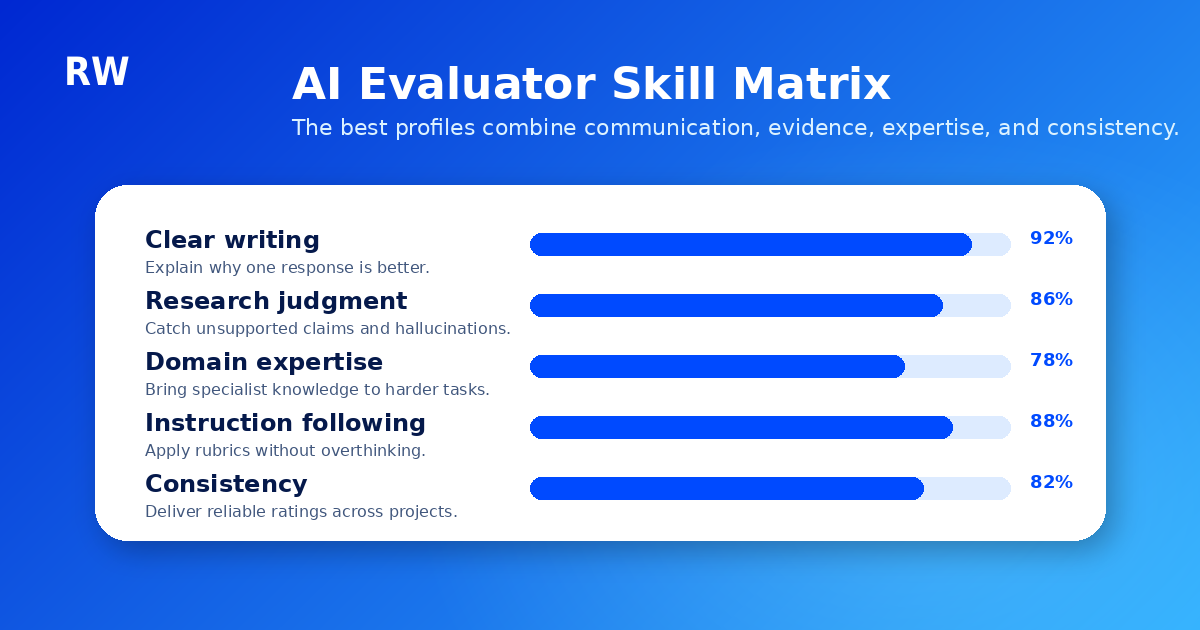
The strongest AI evaluation applicants are not always the fastest typists or the most technical people. Many remote AI training projects reward reliability, clear reasoning, and the ability to make consistent judgments under detailed guidelines.
For writers, emphasize clarity, editing, tone, audience awareness, grammar, structure, and concise feedback. For researchers, emphasize source evaluation, fact-checking, evidence review, citation judgment, and accuracy. For specialists, emphasize credentials, practical experience, domain knowledge, and ability to explain complex topics in plain English. For bilingual applicants, emphasize language pairs, proficiency level, translation review, localization, and cultural context.
Tip: Canadian applicants should also mention relevant language context when true — Canadian English, Canadian French, bilingual English/French, Quebec French, North American business writing, Canadian legal research, or Canadian healthcare writing. Make them searchable.
Where Canadian Applicants Can Search for AI Evaluation Jobs
AI evaluation jobs can appear on dedicated AI training platforms, broader remote job boards, freelance marketplaces, and company career pages. Platforms to search include Mercor, Outlier AI, Handshake AI, micro1, Surge AI, and Stellar AI.
Useful search phrases: remote AI evaluator Canada, AI training jobs Canada, AI model evaluation jobs Canada, AI writing evaluator remote, AI research evaluator remote, RLHF jobs Canada, data annotation jobs Canada, search quality rater Canada, AI fact-checking jobs remote, bilingual AI evaluator French English, subject matter expert AI training.
What Legitimate AI Evaluation Roles Have in Common
A legitimate AI evaluation role usually explains the type of work, the expected skills, the assessment process, the pay structure, and the contractor status. Be cautious with listings that promise guaranteed income, ask for upfront fees, use a copied brand name with a suspicious email domain, avoid explaining what the work involves, or refuse to show contract terms.
How to Build a Resume for AI Evaluation Work
A resume for AI evaluation should quickly show why you can review AI outputs. A strong summary for a writer might say: "Canadian writer and researcher with experience evaluating written content for clarity, accuracy, tone, and instruction following. Skilled in fact-checking, AI prompt review, source evaluation, and concise written feedback."
A specialist summary might say: "Canadian finance professional with experience in analysis, reporting, Excel modeling, and business writing. Interested in AI model evaluation projects that require financial reasoning, spreadsheet review, and accounting concepts."
How to Apply Without Wasting Time
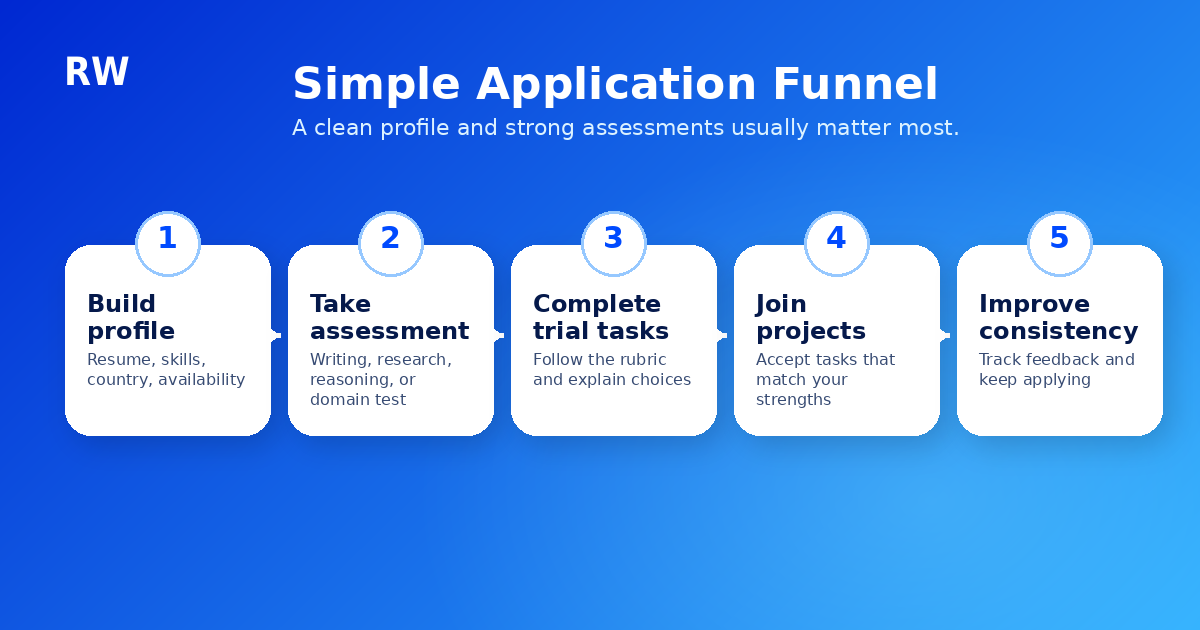
The best approach is to apply in batches, track your results, and adjust based on which platforms respond. Use a simple process: create one AI evaluation resume for general writing, research, and model review roles; create one specialist version if you have domain expertise; search for Canada-eligible roles; apply to several platforms; take assessments slowly and follow the rubric exactly; track where you applied and what happened; and keep improving your profile based on the roles that respond.
Frequently Asked Questions
Can Canadians get remote AI evaluation jobs?
Yes, Canadians can apply for many remote AI evaluation, AI training, data annotation, writing evaluator, research evaluator, and subject matter expert roles. Eligibility varies by platform and project, so applicants should always check location requirements before applying.
Do AI evaluation jobs require coding?
Many AI evaluation jobs do not require coding. Writing, research, fact-checking, search quality, safety review, and general response rating projects often focus on communication and judgment. Coding evaluation jobs exist but are a separate category for technical applicants.
Is French useful for Canadian AI evaluation jobs?
French can be useful for bilingual AI evaluator, translation review, localization, and multilingual AI training projects. It should be listed clearly if the applicant can genuinely evaluate French-language content at the required level.
What is the best AI evaluation job for a Canadian writer?
The best fit is usually AI writing evaluator, AI response comparison reviewer, creative writing evaluator, content quality reviewer, or AI prompt response reviewer. Writers who also have research skills can expand into fact-checking and search quality evaluation.
What is the best AI evaluation job for a Canadian specialist?
The best fit depends on the specialty. Lawyers and paralegals may fit legal AI review. Nurses and medical writers may fit healthcare AI review. Accountants and analysts may fit finance AI review. Software engineers may fit coding AI evaluation. Teachers and academics may fit education and research-heavy projects.