Fast mistake-spotters are a natural fit for AI evaluation jobs. These roles are not only for coders, engineers, or people with advanced technical degrees. Many remote AI evaluation jobs need people who can read carefully, compare two answers, detect when a chatbot ignores instructions, notice factual gaps, and explain what went wrong in a short, structured way.
The common thread is judgment. A good AI evaluator can look at an answer and quickly tell whether it is accurate, complete, safe, clear, and aligned with the user's request. That skill is valuable across AI response reviewer jobs, AI rater jobs, prompt evaluation jobs, human feedback jobs, RLHF projects, AI data annotation jobs, and domain expert review work.
This guide breaks down the best AI evaluation jobs for people who notice mistakes fast, what each role actually involves, which search terms to use, what skills matter, and how to position yourself for remote AI training work.
Why Fast Mistake-Spotters Do Well in AI Evaluation
AI evaluation work rewards a specific kind of attention. You are not just proofreading. You are judging whether an AI answer deserves trust.
People who do well in this category usually have a few habits in common:
- They notice when an answer sounds confident but does not actually answer the prompt.
- They can compare two responses and explain why one is better.
- They catch small instruction failures, like word count, tone, formatting, order, or missing constraints.
- They notice unsupported claims, vague wording, made-up details, and shallow reasoning.
- They can follow a rubric instead of relying only on personal preference.
- They can write brief feedback that helps the model improve.
That combination is useful in nearly every AI evaluation job. The work may be called AI response review, model evaluation, AI rating, data annotation, prompt evaluation, chatbot evaluation, search quality evaluation, or human feedback. The labels vary, but the core skill is consistent: read the task, inspect the answer, identify problems, apply the rubric, and submit a reliable judgment.
What AI Evaluation Jobs Actually Are
AI evaluation jobs are remote or flexible roles where humans review AI-generated outputs. The goal is to help AI systems become more useful, accurate, safe, and aligned with real user expectations.
A typical task might ask you to review a prompt and two AI responses. You may need to choose the better response, rate each answer on several categories, flag errors, or write a short explanation. Some tasks are simple. Others require domain expertise in law, medicine, finance, education, software development, science, creative writing, or research.
Common task types include:
- Ranking two AI answers.
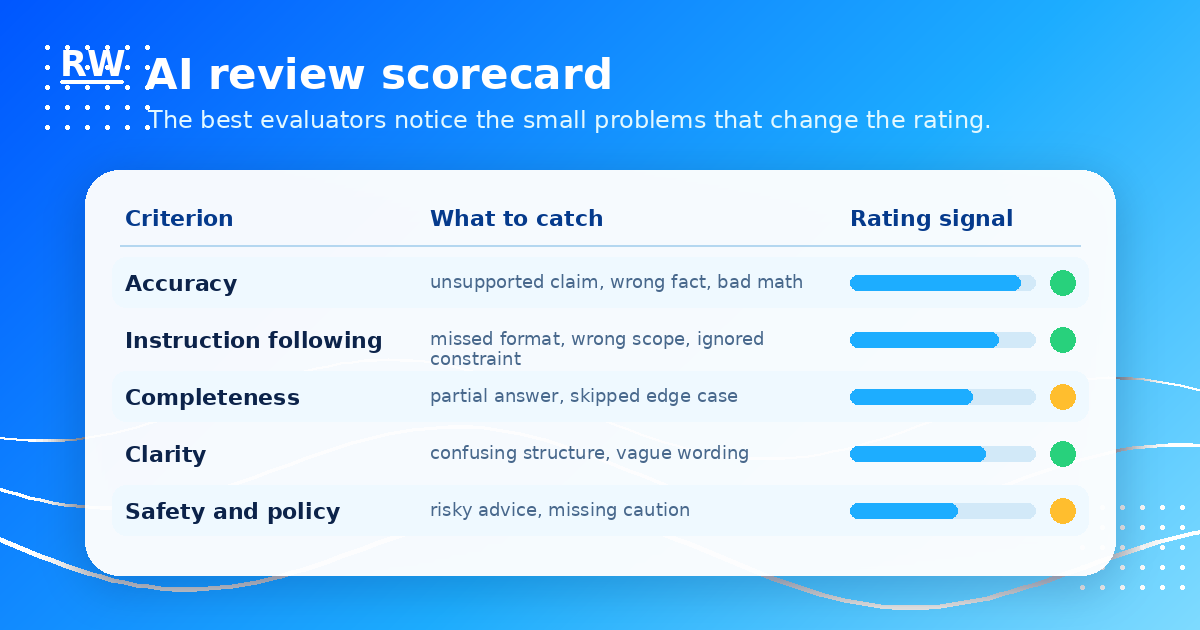
- Rating a single answer for accuracy, helpfulness, clarity, safety, and instruction following.
- Checking whether a response contains factual errors or hallucinations.
- Testing whether an AI system follows a prompt exactly.
- Reviewing search results or AI-generated summaries.
- Writing feedback that explains the best answer and the mistakes in the weaker one.
- Creating or editing prompts that expose model weaknesses.
- Reviewing AI answers in a specialized field.
These jobs are part of the broader AI training and human feedback ecosystem. In some listings, you will see terms like RLHF, model trainer, AI evaluator, response reviewer, prompt evaluator, AI quality analyst, AI data annotator, or language model rater.
1. AI Response Reviewer Jobs
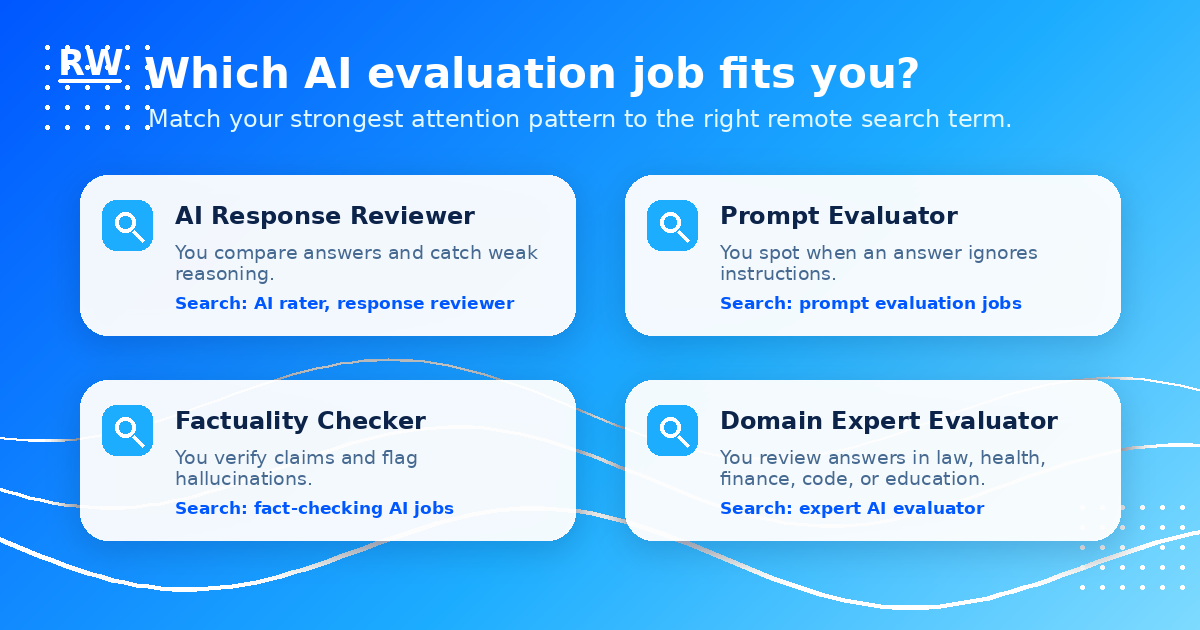
AI response reviewer jobs are one of the clearest fits for fast mistake-spotters. In this role, you review one or more chatbot answers and decide how well they satisfy the user's request.
You might evaluate whether the response is accurate, helpful, complete, concise, safe, properly formatted, or written in the requested tone. You may also compare two model answers and choose the better one.
This is a strong fit if you are good at reading quickly while still catching small issues. For example, one answer may look polished but miss a key instruction. Another may be less elegant but more correct. Good reviewers can separate surface-level writing from actual quality.
Best search terms:
- AI response reviewer jobs
- AI answer reviewer jobs
- chatbot response reviewer
- AI rater jobs
- AI model evaluation jobs
- remote AI evaluator
- AI quality evaluator
What to emphasize on your application:
- Rubric-based evaluation
- Error detection
- A/B response comparison
- Fact-checking
- Written feedback
- Attention to instructions
- Clear explanation of quality issues
This role is useful for writers, editors, researchers, teachers, analysts, customer support professionals, and anyone who has experience judging written work.
2. Prompt Evaluation Jobs
Prompt evaluation jobs focus on whether an AI system followed a prompt correctly. This is different from simply asking, "Is the answer good?" The evaluator needs to ask, "Did the answer do exactly what the prompt required?"
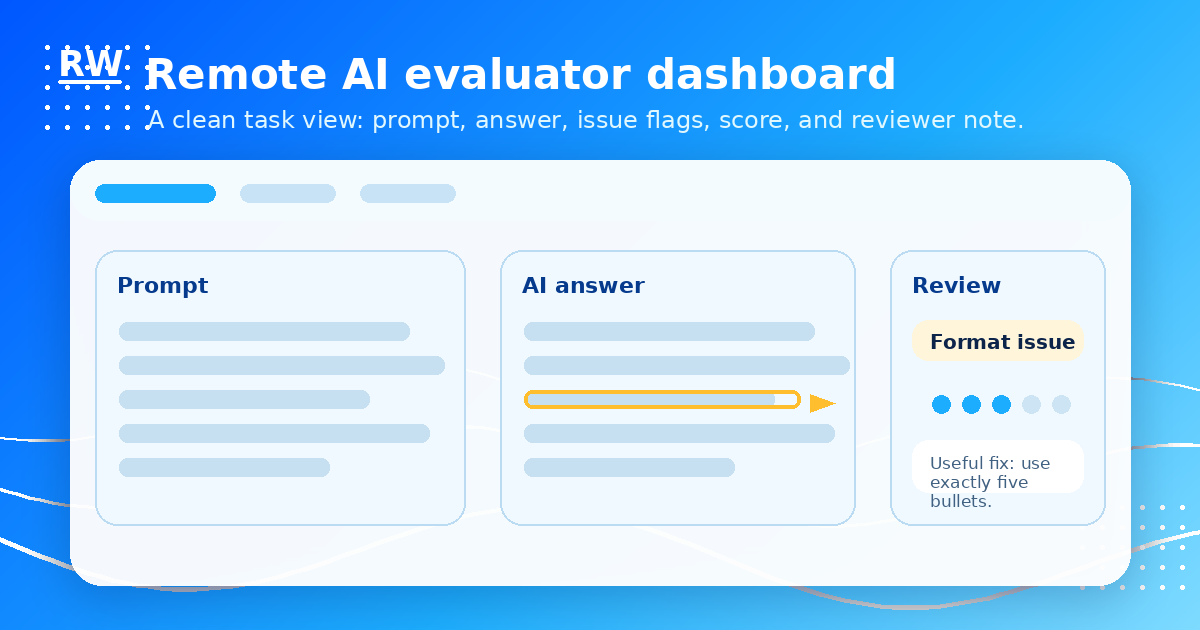
A prompt might ask for a table, a specific tone, a maximum word count, a step-by-step explanation, a list of pros and cons, or a refusal to include certain information. The AI response may look acceptable while still failing one of those requirements.
Fast mistake-spotters are valuable here because prompt failures are often subtle. A model might include six bullets when the prompt asked for five. It might answer in a friendly tone when the user asked for a clinical tone. It might provide general advice when the user asked for a direct recommendation.
Best search terms:
- prompt evaluation jobs
- prompt evaluator remote
- prompt rater jobs
- AI prompt reviewer
- prompt testing jobs
- AI model trainer jobs
- LLM evaluator jobs
What to emphasize on your application:
- Ability to follow detailed instructions
- Sensitivity to format, tone, and constraints
- Clear written explanations
- Experience with ChatGPT, Claude, Gemini, Copilot, or similar AI assistants
- Prompt writing or prompt testing experience
This role is especially good for people who naturally notice when a response is "almost right" but still not compliant.
3. Model Comparison Rater Jobs
Model comparison rater jobs ask you to compare two or more AI outputs and decide which one is better. The task may look simple, but good model comparison requires discipline.
You are not choosing the answer you personally like most. You are choosing the answer that best satisfies the rubric. One response may be more detailed, but the shorter one may be more accurate. One may sound polished, but the other may follow the user's instructions more closely. One may be safer, more grounded, or more useful.
This work appears under several names: A/B evaluation, pairwise ranking, side-by-side comparison, model response comparison, preference ranking, or human feedback.
Best search terms:
- model comparison rater
- AI model comparison jobs
- pairwise ranking AI jobs
- A/B response evaluation
- RLHF jobs
- human feedback jobs
- AI evaluator remote
What to emphasize on your application:
- Comparative judgment
- Consistent rubric use
- Ability to explain why one answer wins
- Pattern recognition
- Bias awareness
- Concise reasoning
This role is a strong fit for people who like making decisions based on evidence rather than rewriting everything from scratch.
4. AI Fact-Checking Jobs
AI fact-checking jobs focus on whether an answer is true, supported, and not misleading. This is one of the most important categories for people who notice mistakes fast.
AI systems can produce answers that sound convincing but contain fabricated details, outdated claims, incorrect math, wrong names, invented citations, or oversimplified conclusions. Evaluators help identify those issues before they become trusted outputs.
Some fact-checking tasks require general research ability. Others need domain expertise. A healthcare evaluator, legal evaluator, finance evaluator, science evaluator, or coding evaluator may need to apply professional knowledge to catch errors that a general reviewer would miss.
Best search terms:
- AI fact-checking jobs
- AI factuality evaluator
- AI hallucination evaluator
- AI research evaluator
- AI answer fact checker
- remote fact-checking AI jobs
- expert AI reviewer
What to emphasize on your application:
- Research skills
- Source evaluation
- Claim verification
- Ability to flag unsupported statements
- Familiarity with citations and evidence
- Domain-specific knowledge, if relevant
This role is especially good for people who instinctively ask, "How do we know that is true?"
5. AI Search Evaluator Jobs
AI search evaluator jobs review search results, AI-generated summaries, answer boxes, or assistant responses connected to search behavior. The job is to judge whether the output is relevant, useful, current, and aligned with the user's intent.
This kind of work is valuable because search is changing. Users increasingly expect AI assistants, search engines, and answer engines to summarize information rather than simply return links. Human evaluators help measure whether those answers are actually good.
A task may ask whether a result is relevant to the query, whether the answer satisfies the user's intent, whether the source is trustworthy, or whether a summary leaves out key context.
Best search terms:
- AI search evaluator jobs
- search quality rater jobs
- search evaluation remote
- AI search quality evaluator
- query evaluation jobs
- relevance rater jobs
- answer quality evaluator
What to emphasize on your application:
- Search intent analysis
- Relevance judgment
- Fact-checking
- Ability to compare sources
- Understanding of user intent
- Clear rating explanations
This role fits people who are good at seeing the difference between a related answer and the right answer.
6. Safety and Policy Evaluation Jobs
Safety and policy evaluation jobs focus on whether AI responses follow guidelines. The work can involve identifying unsafe advice, risky content, privacy issues, harmful instructions, or responses that fail to handle sensitive topics carefully.
This work requires calm judgment. You need to follow the policy, not just your personal instinct. The best evaluators can recognize when a response is too permissive, too vague, too risky, or unnecessarily restrictive.
Best search terms:
- AI safety evaluator jobs
- AI policy evaluator
- trust and safety AI jobs
- AI content quality analyst
- model safety reviewer
- AI risk evaluation jobs
- AI response safety rater
What to emphasize on your application:
- Policy adherence
- Risk detection
- Judgment under ambiguity
- Careful written notes
- Ability to apply rules consistently
- Familiarity with content moderation or quality assurance
This path may fit people with backgrounds in content moderation, compliance, education, legal support, healthcare support, platform operations, or quality assurance.
7. Domain Expert AI Evaluator Jobs
Domain expert evaluator jobs are for people who can review AI answers in a specific field. These roles often pay attention to credentials, work history, education, or portfolio strength.
Examples include:
- Legal AI evaluator
- Medical or healthcare AI evaluator
- Finance AI evaluator
- Accounting AI evaluator
- Education AI evaluator
- Coding AI evaluator
- Science AI evaluator
- Creative writing evaluator
- Language evaluator
- Business analyst AI evaluator
The work is similar to general AI evaluation, but the stakes are higher because the answers require specialized knowledge. A general evaluator may know that an answer sounds plausible. A domain expert can tell whether it is actually correct.
Best search terms:
- expert AI evaluator jobs
- domain expert AI training jobs
- legal AI evaluator jobs
- healthcare AI evaluator jobs
- finance AI evaluator jobs
- coding AI evaluator jobs
- education AI evaluator jobs
- subject matter expert AI jobs
What to emphasize on your application:
- Credentials or work experience
- Field-specific judgment
- Ability to explain technical errors simply
- Quality review experience
- Research and documentation skills
- Experience teaching, reviewing, editing, or auditing work in your field
This is one of the best categories for professionals who want remote AI work without moving into a full-time engineering role.
8. AI Data Annotation Jobs for Quality Review
Data annotation is a broad term. Some data annotation jobs involve labeling images, text, audio, search results, or documents. Other data annotation roles are closer to AI evaluation, where you judge responses and provide structured feedback.
For mistake-spotters, the best opportunities are usually not basic labeling tasks. They are quality-focused annotation tasks: checking answers, labeling errors, classifying intent, rating responses, or reviewing another annotator's work.
Best search terms:
- AI data annotation jobs
- data annotation quality analyst
- AI text annotation jobs
- LLM data annotation
- AI training data reviewer
- annotation reviewer jobs
- data quality evaluator remote
What to emphasize on your application:
- Accuracy
- Consistency
- Quality assurance
- Detail orientation
- Experience with spreadsheets, rubrics, or structured review
- Ability to follow annotation guidelines
This can be a good entry point for people who are new to AI evaluation and want to build experience.
9. Language and Bilingual AI Evaluation Jobs
Language evaluation jobs review AI answers in English or another language. Some tasks focus on grammar, fluency, translation quality, cultural nuance, localization, or whether the answer sounds natural to a native speaker.
Bilingual workers may find opportunities in language evaluation, translation review, localization testing, speech and audio review, or multilingual chatbot evaluation.
Best search terms:
- bilingual AI evaluator jobs
- language evaluator AI jobs
- translation quality rater
- localization evaluator remote
- AI language rater
- English AI evaluator jobs
- multilingual AI training jobs
What to emphasize on your application:
- Native or near-native fluency
- Writing quality
- Translation review
- Cultural nuance
- Grammar and tone judgment
- Ability to explain language issues clearly
This path can be strong for teachers, writers, translators, tutors, editors, and people who can evaluate language with precision.
The Skills That Matter Most
AI evaluation jobs are not just about speed. Speed helps, but speed without consistency creates bad ratings. The best evaluators combine fast pattern recognition with disciplined judgment.
The most important skills include:
1. Instruction Following
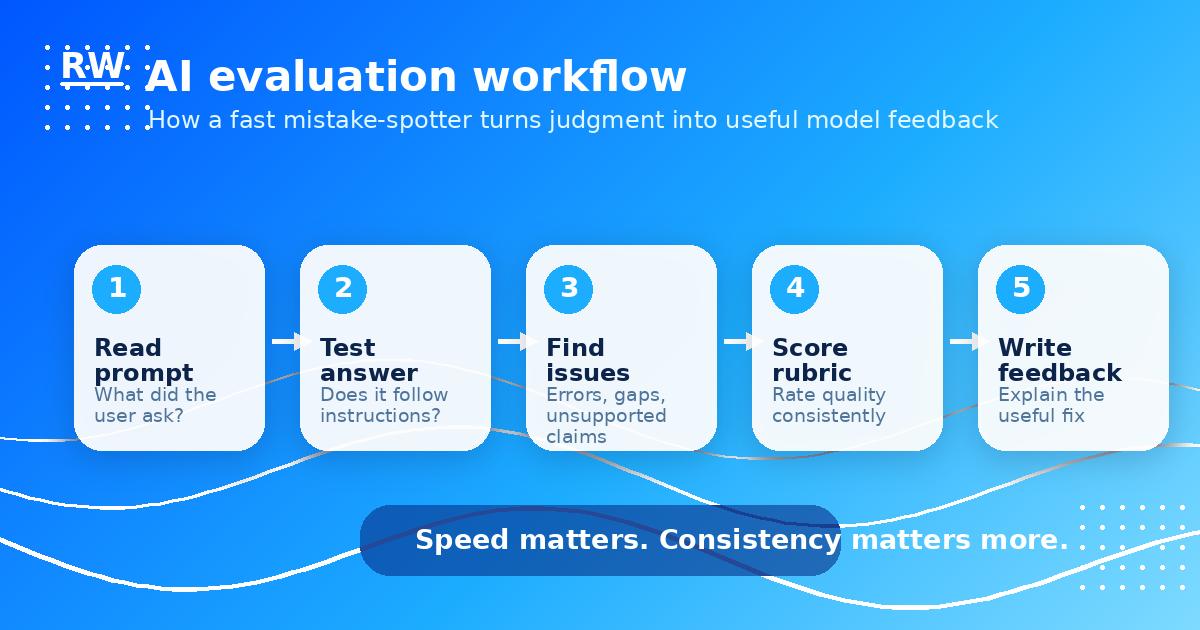
Many AI answers fail because they ignore a constraint. A strong evaluator checks the prompt before judging the answer. Did the user ask for a table? Did they ask for no citations? Did they ask for a specific tone? Did they ask for a direct answer instead of a broad overview?
2. Error Detection
You need to catch factual mistakes, reasoning errors, contradictions, made-up details, missing caveats, and incomplete answers. Fast mistake-spotters often excel here because they notice what feels off before slowing down to verify it.
3. Rubric Discipline
AI evaluation work usually gives you a rating guide. The job is to apply that guide consistently. You may personally dislike a response, but if it satisfies the rubric, the score should reflect that.
4. Concise Written Feedback
You do not need to write an essay for every task. You need to explain the key issue in a way that is useful. A good note might say: "Response A is better because it follows the requested bullet format and avoids unsupported claims. Response B is more detailed but adds information not present in the prompt."
5. Fact-Checking and Source Awareness
When a task involves truthfulness, you need to know how to verify claims. That does not always mean deep research. It means knowing which claims need support and which ones are suspicious.
6. Pattern Recognition
After enough tasks, you start seeing repeated failure modes: answer drift, hallucinated citations, false precision, overconfident claims, missed formatting, vague safety disclaimers, bad math, weak comparisons, and unsupported summaries.
7. Time Management
Many remote AI evaluation projects are task-based. You need to work steadily without rushing so much that quality drops. The best workers develop a rhythm: read the prompt, identify constraints, inspect the answer, apply the rubric, write the note, move on.
Remote Work Union connects you to legitimate remote AI evaluation and training roles across multiple platforms. Apply for free.
Find Roles Hiring Now →Resume Keywords for AI Evaluation Jobs
Use terms that match how these roles are posted. Good resume and profile keywords include:
- AI evaluation
- AI response review
- AI model evaluation
- Prompt evaluation
- Rubric-based assessment
- Human feedback
- RLHF
- Data annotation
- A/B response comparison
- Fact-checking
- Quality assurance
- Error detection
- Instruction following
- Search quality evaluation
- Relevance rating
- Model output review
- Written feedback
- Domain expertise
- Chatbot evaluation
- LLM evaluation
A strong profile does not need to sound overly technical. It needs to show that you can judge quality, follow instructions, and explain your reasoning.
How to Position Yourself as a Fast Mistake-Spotter
If you are applying for AI evaluator jobs, do not only say "detail-oriented." Everyone says that. Show the type of details you catch.
Weak positioning:
"I am detail-oriented and interested in AI."
Stronger positioning:
"I evaluate AI responses for factual accuracy, instruction following, completeness, tone, and clarity. I am comfortable comparing two model outputs, applying a rubric, identifying hallucinations, and writing concise feedback that explains the better answer."
Even if you are new, you can build a short sample portfolio. Create two mock AI answers to a realistic prompt, then write a short evaluation explaining which one is better and why. Include rubric categories like accuracy, helpfulness, instruction following, completeness, and clarity. This demonstrates the actual skill behind the job.
Sample AI Evaluation Task
Here is a simplified example.
Prompt: "Give me five bullet points explaining how to prepare for a remote AI evaluator application. Keep it practical."
Response A gives five bullets, mentions resume keywords, practice tasks, examples of rubric work, application consistency, and avoiding scams.
Response B gives nine bullets, includes vague motivation, repeats itself, and does not mention examples or rubrics.
A strong evaluator would likely rate Response A higher because it follows the requested format and gives more practical advice. Response B may contain useful ideas, but it fails the five-bullet constraint and is less targeted.
The feedback does not need to be long. It just needs to identify the decision-making reason:
"Response A is better because it follows the exact five-bullet format and gives practical application steps. Response B includes extra bullets and more generic advice, so it fails an explicit instruction."
That is the kind of judgment many AI evaluation projects need.
How to Search for Remote AI Evaluation Jobs
Do not rely on one keyword. These roles are posted under many different names. Search across several categories:
General searches:
- AI evaluation jobs
- remote AI evaluator jobs
- AI model evaluation jobs
- AI rater jobs
- AI response reviewer jobs
- AI quality evaluator jobs
- AI training jobs remote
Prompt and model searches:
- prompt evaluation jobs
- LLM evaluator jobs
- model response comparison jobs
- RLHF jobs
- human feedback jobs
- AI model trainer jobs
Research and fact-checking searches:
- AI fact-checking jobs
- AI research evaluator jobs
- AI hallucination evaluator
- search quality rater jobs
- AI search evaluator jobs
Specialist searches:
- legal AI evaluator jobs
- healthcare AI evaluator jobs
- finance AI evaluator jobs
- coding AI evaluator jobs
- education AI evaluator jobs
- bilingual AI evaluator jobs
Company and ecosystem searches:
- OpenAI evaluator jobs
- Anthropic Claude evaluator jobs
- Google Gemini evaluator jobs
- Microsoft Copilot evaluator jobs
- Meta AI evaluation jobs
- data annotation AI jobs
- AI training platform jobs
Search carefully. Some results will be official roles, some will be contractor projects, some will be staffing listings, and some will be generic job-board pages. Read each listing for the actual work, pay structure, required qualifications, location restrictions, and application process.
What to Watch Out For
AI evaluation is a real category, but remote job seekers should still be careful. Avoid listings that promise unrealistic income, ask for upfront payment, use vague job descriptions, or cannot explain the task type.
Be cautious if a listing:
- Requires a fee to access jobs.
- Promises guaranteed hiring.
- Claims you can earn a large income with no screening or skill test.
- Uses a fake company name or copied branding.
- Sends you to a suspicious payment or messaging platform.
- Asks for sensitive personal information before a legitimate application step.
- Refuses to explain whether the work is employment, contract work, or a task-based project.
Legitimate AI evaluation projects usually involve an application, a skills test, identity or eligibility checks, project guidelines, and quality standards.
Who Should Apply for AI Evaluation Jobs?
AI evaluation jobs can be a strong fit for:
- Writers and editors who catch wording problems quickly.
- Researchers who know how to verify claims.
- Teachers and tutors who can explain mistakes clearly.
- Customer support workers who understand helpful answers.
- Analysts who can compare options and apply criteria.
- Lawyers, paralegals, medical writers, finance professionals, coders, or educators with domain expertise.
- Bilingual workers who can evaluate language quality.
- Students and recent graduates who are strong readers and reliable with instructions.
The best applicants are not just "AI fans." They are people who can produce reliable judgments at scale.
Bottom Line
The best AI evaluation jobs for people who notice mistakes fast are roles that turn attention into structured feedback: AI response reviewer, prompt evaluator, model comparison rater, AI fact-checker, search evaluator, safety reviewer, data annotation quality reviewer, language evaluator, and domain expert evaluator.
These jobs reward careful reading, fast error detection, consistent rubric use, and clear explanations. You do not need to be a software engineer to start, although coding and domain expertise can open more specialized projects. The main advantage is being able to see what is wrong, explain why it matters, and rate the response fairly.
Frequently Asked Questions
Do I need to be a coder to do AI evaluation jobs?
No, most jobs need judgment, clear writing, and rubric discipline — coding helps only for technical evaluator roles.
What makes a fast mistake-spotter valuable in AI evaluation?
Speed plus consistency — catching instruction failures, factual gaps, and reasoning errors reliably.
How is AI response review different from proofreading?
Proofreading fixes grammar; AI evaluation judges accuracy, instruction-following, reasoning, and rubric compliance.
What is RLHF and how does it relate to these jobs?
RLHF (Reinforcement Learning from Human Feedback) uses human preference ratings to improve AI — these evaluation jobs are part of that pipeline.
Can I build a resume for AI evaluation without prior AI work experience?
Yes — frame writing, research, editing, or domain expertise as rubric-based evaluation skills, and create sample evaluations.