Bilingual workers are a strong fit for remote AI work because large language models are not only being trained in English. AI systems need to understand prompts, answer questions, summarize documents, follow instructions, translate meaning, and respond naturally across many languages. That creates a practical opening for people who can read carefully in more than one language and explain why one answer is better than another.
The best remote AI jobs for bilingual workers are not the same as traditional translation jobs. Some projects may involve translation quality, but the core skill is judgment. A bilingual AI evaluator might compare two chatbot responses, identify a mistranslation, rate cultural accuracy, write a better answer, or explain why a model misunderstood a regional phrase. A language expert might review whether an AI answer sounds natural to a native speaker, whether it follows the prompt, whether it invents facts, and whether the tone fits the situation.
This is why bilingual AI jobs often appeal to translators, teachers, writers, students, researchers, customer support workers, localization specialists, and people who grew up switching between languages. The work can be remote, flexible, and project-based, but it is still real evaluation work. Strong applicants need language fluency, writing clarity, attention to detail, and the patience to follow a rubric.
Why Bilingual AI Work Is Different From Translation Work
Traditional translation usually asks one main question: can you move meaning from one language into another accurately and naturally? Bilingual AI evaluation asks a broader set of questions. Did the model understand the original prompt? Did it answer in the right language? Did it preserve the user's intent? Did it use the right level of formality? Did it miss a local reference? Did it give a confident answer when it should have been cautious?
A good bilingual AI reviewer is part editor, part fact-checker, part localization reviewer, and part product tester. You are not only checking words. You are checking behavior.
That distinction matters because many applicants undersell themselves. Someone who has translated emails, tutored Spanish, written Portuguese captions, reviewed French documents, handled bilingual customer support, or studied Arabic literature may not think of that experience as AI work. But if they can compare outputs and explain mistakes clearly, those skills can transfer into AI model evaluation, AI response review, data annotation, prompt evaluation, and multilingual quality assurance.
Best Remote AI Jobs for Bilingual Workers
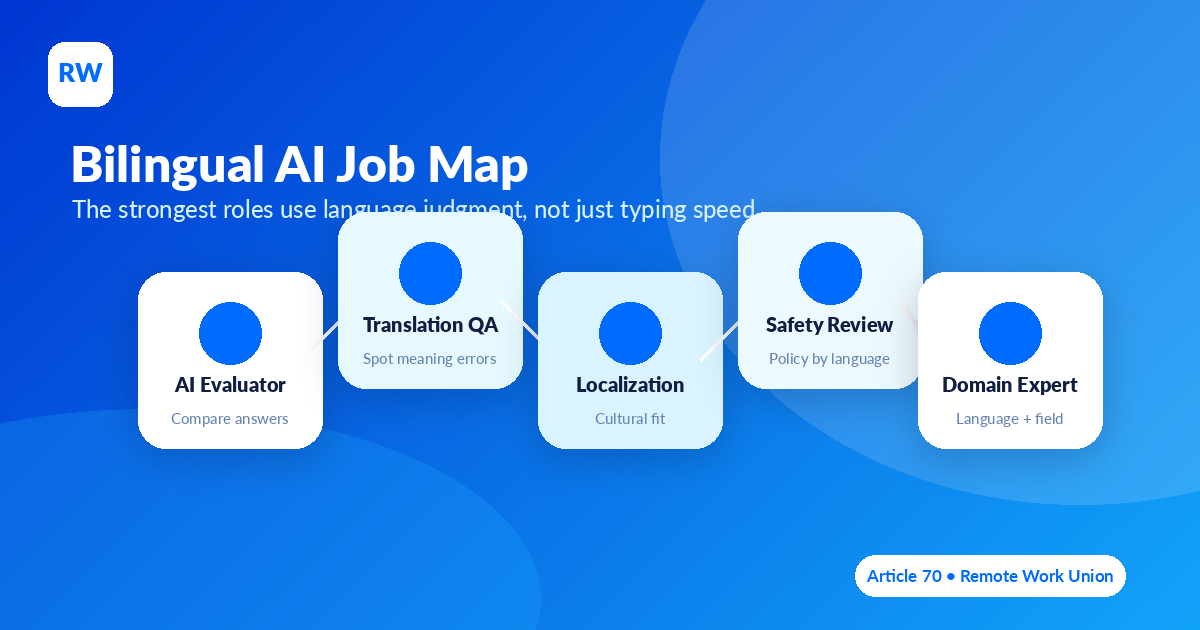
1. Bilingual AI Evaluator
A bilingual AI evaluator reviews model outputs in two languages, usually English plus another language. The work may involve rating responses, comparing answer A against answer B, checking whether the answer follows instructions, or judging whether a response sounds natural to a native speaker.
This is one of the most direct entry points because it uses everyday bilingual judgment. The best candidates can explain their reasoning without writing long essays. A useful note might say: "Answer B is better because it keeps the user's meaning, uses natural phrasing for Mexican Spanish, and avoids the overly literal wording in Answer A." That kind of concise explanation is often more valuable than a generic comment like "B sounds better."
Search terms to use include: bilingual AI evaluator, AI language evaluator, multilingual AI evaluator, language model evaluator, LLM response reviewer, and AI response reviewer remote.
2. Translation Quality Reviewer for AI Outputs
Translation quality review is closer to traditional language work, but the AI version has a different rhythm. Instead of translating a whole document from scratch, you may be asked to review a model-generated translation, identify errors, rate severity, and sometimes provide a corrected version.
Common issues include literal translation, missed idioms, incorrect gender or register, awkward syntax, inconsistent terminology, and mistranslated proper nouns. In higher-quality projects, reviewers may also explain why an error matters. For example, a formal business email translated into casual slang may be grammatically correct but still unsuitable for the user.
This role fits translators, bilingual editors, language teachers, international students, and people with professional writing experience in more than one language.
3. Localization AI Rater
Localization is about adapting content to a market, culture, or audience. A localization AI rater might check whether a model response fits the user's country, dialect, currency, date format, tone, slang, etiquette, or local expectations.
This can be important for languages with major regional variation. Spanish in Mexico, Spain, Argentina, and Colombia can differ in vocabulary and tone. Portuguese in Brazil and Portugal can differ in grammar, phrasing, and cultural expectations. French, Arabic, Chinese, German, and English all have regional contexts where "technically correct" may not be the same as "right for this user."
Localization AI work rewards people who notice practical details. A model might give a restaurant recommendation in the wrong city, use a phrase that sounds unnatural in the target market, or recommend a process that does not apply to the user's country. Human language experts help catch those gaps.
4. Multilingual Prompt Evaluator
Prompt evaluation jobs ask reviewers to test how an AI model responds to instructions. In bilingual projects, you may write prompts in the target language, compare responses, and judge whether the model followed all constraints.
A simple prompt might ask the model to summarize an article in French for a high-school audience. A more complex prompt might ask for a Spanish customer service reply that is polite, concise, legally cautious, and under a certain word count. The evaluator then checks whether the answer satisfies each requirement.
This role fits people who are good at instructions. If you can read a prompt and quickly see what the answer must include, what it must avoid, and what tone it should use, you may be well suited to prompt evaluation work.
5. AI Safety and Policy Reviewer by Language
AI safety review is broader than translation. These projects may ask reviewers to identify harmful content, policy violations, unsafe advice, bias, harassment, self-harm language, medical or legal overconfidence, or culturally sensitive issues in a specific language.
Bilingual reviewers are valuable because unsafe or low-quality AI behavior does not always look the same across languages. A phrase may be harmless in one context but insulting in another. A model may refuse too much in one language and not enough in another. It may misunderstand slang, coded language, or local references.
This role requires maturity and consistency. Applicants should be comfortable reading policy rules and applying them carefully, even when the content is repetitive or uncomfortable.
6. Domain-Specific Bilingual Expert
The highest-value bilingual roles often combine language ability with another skill. Examples include bilingual legal review, bilingual medical writing, bilingual finance evaluation, bilingual coding support, bilingual education review, and bilingual scientific annotation.
A bilingual nurse may review healthcare explanations in Spanish and English. A bilingual lawyer may check legal reasoning across jurisdictions. A bilingual accountant may evaluate finance answers for clarity and correctness. A bilingual software developer may review coding explanations in Japanese, German, Portuguese, or Hindi.
The more specialized the domain, the less the work feels like generic translation. The language skill helps you read and explain. The subject-matter skill helps you judge whether the answer is actually correct.
7. Multilingual Data Annotation and Labeling
Some remote AI jobs use bilingual workers for data annotation. That can include classifying intent, labeling sentiment, marking named entities, tagging categories, correcting transcriptions, or checking whether text belongs to a certain language or dialect.
Data annotation can be more structured and less creative than response evaluation. It may also be more repetitive. However, it can be a useful entry point for applicants who want remote AI work but do not yet have a polished writing portfolio.
Skills That Make Bilingual Applicants Competitive
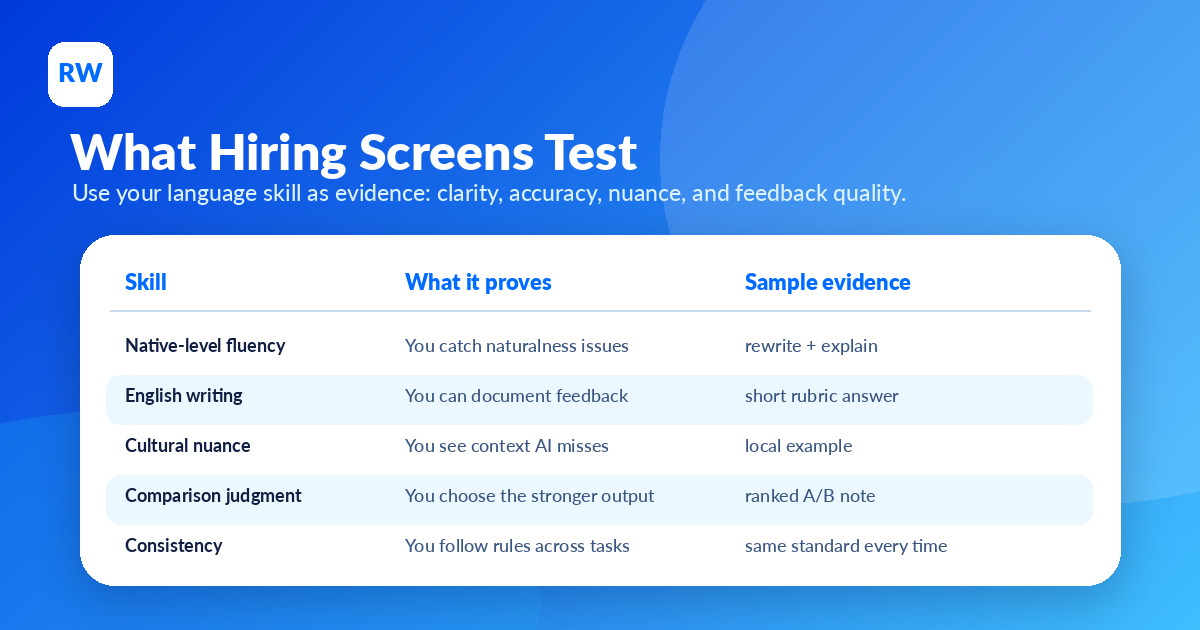
Native or Near-Native Fluency
Many AI language projects prefer native-level fluency in the target language, especially for evaluation, localization, and quality review. You do not need to know every grammar term, but you need to recognize when an answer sounds unnatural, too literal, too formal, too casual, or regionally mismatched.
Applicants should be honest about proficiency. A person who is conversational in a language may be able to do some labeling work, but high-quality evaluation usually requires deeper reading ability. If you would not feel comfortable editing a professional email in that language, you may not be ready for advanced language review tasks.
Strong English Writing
Even when the target language is not English, many AI training platforms use English instructions, English rubrics, and English feedback fields. That means bilingual applicants often need to explain target-language problems in clear English.
This is where many strong speakers lose points. They can tell an answer is wrong, but they cannot explain why in a way a reviewer or project lead can use. Practice writing short, structured comments: what the error is, why it matters, and how to fix it.
Ability to Compare Two Answers
A lot of AI evaluation work is comparative. You may be asked whether response A or response B is better. The best reviewers do not rely on personal preference. They use criteria: instruction following, factuality, completeness, tone, localization, safety, and clarity.
A strong comparison sounds like this: "A is better because it answers all three parts of the prompt and uses natural Brazilian Portuguese. B is fluent, but it omits the user's requested example and uses a phrase more common in European Portuguese."
Cultural Judgment
AI models can be grammatically fluent while still missing culture. Cultural judgment helps reviewers catch inappropriate tone, unnatural politeness, wrong idioms, poor localization, and examples that do not match the user's country or region.
This is especially important for customer support, education, healthcare, finance, travel, and consumer product content. A technically correct answer can still feel untrustworthy if it sounds imported from another market.
Rubric Discipline
Remote AI work often depends on rubrics. A rubric tells you what to rate, how to rate it, and what counts as a minor or major issue. Good reviewers do not invent their own scoring system. They apply the rubric consistently.
This skill is learnable. Before applying, practice with a simple system: rate answers from 1 to 5 for instruction following, accuracy, fluency, tone, and localization. Then write one sentence explaining the biggest reason for the score.
Languages That Can Help in Remote AI Work
There is no permanent list of "best" languages because project demand changes. Large languages such as Spanish, French, German, Portuguese, Arabic, Chinese, Japanese, Korean, Hindi, Italian, Dutch, Turkish, Vietnamese, Indonesian, and Russian often appear in global AI work, but smaller languages can become valuable when a project has a specific coverage need.
Do not assume that only the most common languages matter. AI companies and data platforms may need coverage for regional languages, low-resource languages, dialects, and specialized communities. A bilingual applicant with strong writing ability in a less common language may face less competition when the right project appears.
The practical strategy is to search both broadly and specifically. Use general terms like remote AI evaluator and multilingual AI trainer, then combine them with your exact language: Spanish AI evaluator, French AI trainer, Brazilian Portuguese AI reviewer, Arabic data annotation, Japanese language model evaluator, Korean AI rater, German LLM evaluator, Hindi AI response reviewer.
How to Search for Bilingual AI Jobs
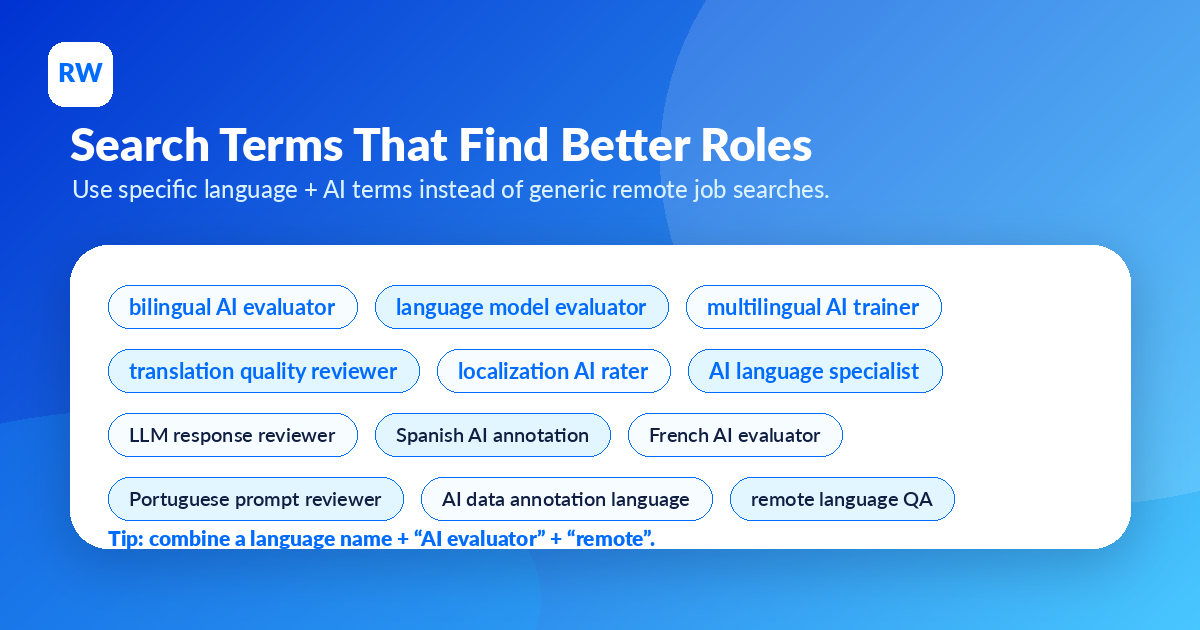
Generic searches like "remote jobs" or "translation jobs from home" can produce too much noise. Better searches combine the work type, the language skill, and the AI context.
Use these search patterns:
[language] AI evaluator remote[language] language model evaluator[language] AI trainer[language] data annotation remotebilingual AI response reviewermultilingual prompt evaluatortranslation quality reviewer AIlocalization AI raterLLM evaluator [language]AI language specialist remote
You can also search by company or platform name plus the role type. Examples include Mercor language specialist, Outlier language evaluator, DataAnnotation bilingual, Scale AI language jobs, Surge AI language reviewer, micro1 AI language jobs, OpenAI evals language, Claude evaluation language, Gemini AI training language, and Microsoft Copilot feedback language.
Not every search result will be a fit. Some will be full-time machine learning roles, some will be traditional translation jobs, and some may be low-quality listings using AI keywords. The goal is to build a repeatable search routine that finds real project-based evaluation work faster.
What to Put in Your Application
A strong bilingual AI application should make the employer's decision easy. Do not only say that you are fluent. Show the kind of judgment the work requires.
Include a short profile line such as: "Bilingual Spanish-English writer with experience reviewing translations, comparing AI outputs, and explaining language errors clearly in English." Then support that claim with concrete evidence.
Useful application materials include:
- A one-page resume with language proficiency listed clearly
- A short bilingual writing sample
- A translation or localization comparison sample
- An example of rating two AI answers against a rubric
- A list of domains you can review, such as healthcare, law, finance, education, customer support, travel, software, or marketing
- Any teaching, tutoring, editing, interpreting, customer service, research, or content moderation experience
Keep samples clean and simple. A hiring reviewer should be able to see within 30 seconds that you can read carefully, explain mistakes, and follow instructions.
Remote Work Union connects bilingual workers and language experts to legitimate remote AI evaluation roles. Apply for free.
Find Roles Hiring Now →A Practical Sample Evaluation Note
Here is the kind of answer that can help a bilingual applicant stand out:
Prompt: Write a short customer support response in Mexican Spanish explaining that a refund can take three to five business days.
Model answer A: Formal, accurate, but uses phrasing that sounds generic and slightly stiff.
Model answer B: Natural and concise, but says the refund will arrive in three days instead of three to five business days.
Better choice: A, with revisions.
Reviewer note: "A is safer because it preserves the refund timeline. B sounds more natural, but it changes the meaning by promising three days. I would revise A to sound warmer while keeping 'de tres a cinco dias habiles.'"
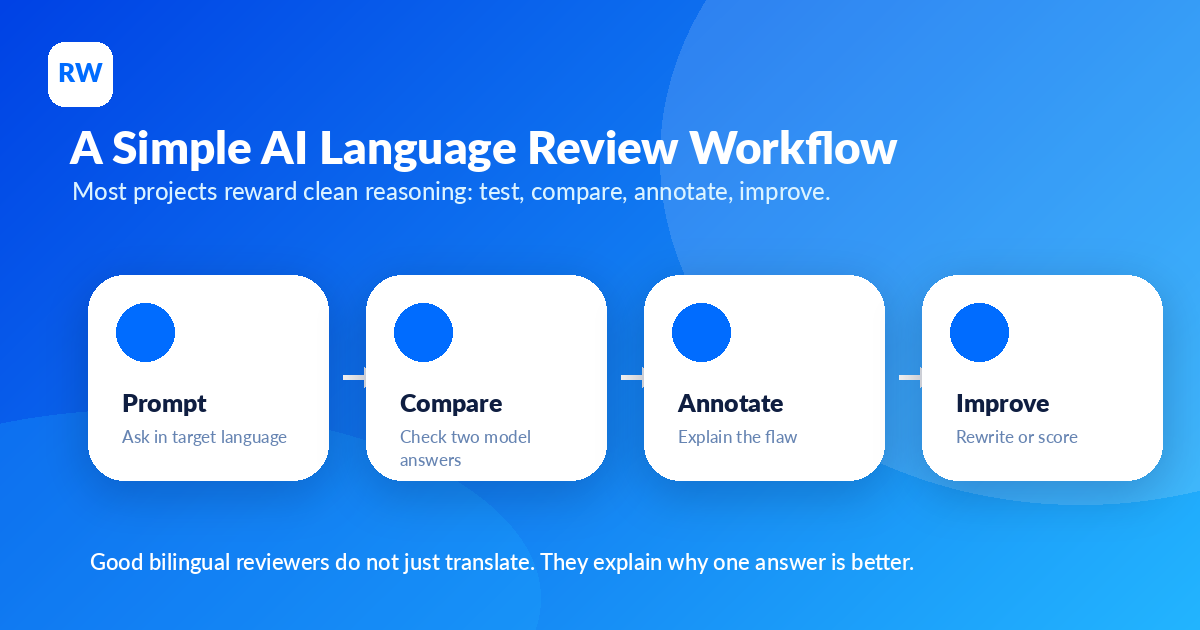
That note does three things well. It compares the options, identifies the risk, and suggests a better version. This is the core of many AI language evaluation jobs.
How to Build Experience Before You Get Hired
You can practice without waiting for a platform to accept you. Pick a topic you know, write a prompt in your target language, generate two AI answers, and evaluate them. Then write a short note explaining which answer is better and why.
Create five samples:
- One translation quality review
- One localization review
- One customer support tone review
- One factuality or research review
- One safety or policy-style review
These samples should not include confidential client content. Use public, harmless examples. The goal is to demonstrate judgment, not to reveal private work.
You can also improve your profile by learning basic AI evaluation vocabulary: rubric, annotation, response ranking, preference rating, prompt evaluation, instruction following, hallucination, factuality, localization, fluency, severity, and edge case.
What to Avoid
Avoid applications that only say "I am bilingual" without proof. Fluency is the starting point, not the whole pitch. The work is about evaluating AI output, so you need to show that you can judge, explain, and improve responses.
Avoid overclaiming languages. If you are fluent in English and conversational in Japanese, do not apply as a native Japanese evaluator. It is better to be accurate and apply for roles that match your real ability.
Avoid vague feedback. Comments like "bad translation" or "sounds weird" are not useful. Strong reviewers explain the error: too literal, wrong register, incorrect tense, unnatural collocation, missing context, poor localization, unsupported claim, or unsafe advice.
Avoid job scams. Real remote work should not require you to pay to get paid, deposit a check for equipment, send money back to a recruiter, or share sensitive identity documents before you have verified the company and offer process.
Red Flags in Remote AI Job Listings
Remote AI work is popular, and popularity attracts low-quality listings. Be cautious with job posts that promise guaranteed income, instant approval, unusually high pay for no screening, or vague tasks like "optimize apps" and "click to earn." Be especially careful if a recruiter moves you off-platform immediately, asks for payment, sends a check for equipment, or pressures you to provide personal information before you can verify the company.
Project-based AI work can also be inconsistent even when it is legitimate. A platform may have plenty of tasks one week and fewer the next. Treat contract AI work as flexible income, not guaranteed salary, unless you have a formal employment agreement.
Who This Is Best For
Bilingual AI jobs are best for people who enjoy reading carefully and making judgment calls. They are not ideal for someone who wants mindless data entry. The strongest candidates usually like language, details, writing, research, and structured feedback.
You may be a strong fit if you can:
- Read fluently in two languages
- Explain small differences in tone or meaning
- Notice when an answer sounds unnatural
- Follow detailed instructions without rushing
- Write concise feedback in English
- Compare two responses objectively
- Handle repetitive tasks without losing accuracy
The work can be a good fit for bilingual college students, recent graduates, translators, language teachers, international professionals, writers, editors, researchers, and people with specialized knowledge in another field.
The Bottom Line
The best remote AI jobs for bilingual workers are not just translation jobs with a new label. They are quality-control roles for language models. AI companies need people who can test whether models understand users across languages, cultures, contexts, and domains.
For bilingual applicants, the advantage is clear: language skill is useful, but language judgment is more valuable. The more clearly you can explain why an AI answer is accurate, natural, safe, localized, and helpful, the more competitive you become for AI evaluator jobs, multilingual data annotation roles, prompt evaluation work, localization AI rater projects, and language expert AI jobs.
Frequently Asked Questions
Do I need to be a professional translator to get bilingual AI jobs?
No, native or near-native fluency and clear written English explanation are the key requirements.
Which languages are most in demand for remote AI evaluation work?
Spanish, French, German, Portuguese, Arabic, Chinese, Japanese, Korean, Hindi are common — but demand changes by project.
How is bilingual AI evaluation different from traditional translation?
AI evaluation adds judgment: checking instruction-following, cultural accuracy, factuality, tone, and localization fit.
Can I combine bilingual skills with domain expertise for better-paying roles?
Yes — bilingual legal, medical, finance, or coding evaluators can qualify for specialist AI projects.
How do I apply for bilingual AI jobs without prior AI experience?
Use language fluency, cultural judgment, and clear English writing as proof; create sample evaluations comparing AI outputs.