In This Article
- Why people who love learning fit remote AI work
- 1. AI response evaluator
- 2. AI data annotation specialist
- 3. Search quality evaluator
- 4. Fact-checking and research reviewer
- 5. Prompt evaluator
- 6. AI content editor
- 7. Subject matter expert reviewer
- 8. AI safety and policy reviewer
- 9. Multimodal AI reviewer
- 10. AI research assistant tasks
- What these jobs usually have in common
- How to know if you are a good fit
- How to position yourself when applying
- What to include in your resume or profile
- Beginner path: where to start
- Mistakes to avoid
- A practical 30-day plan
- FAQ
Some people do not want the same task every day. They like switching subjects, reading unfamiliar material, comparing ideas, and figuring out how something works. That kind of person can be a strong fit for remote AI jobs, especially AI training, AI evaluation, data annotation, prompt review, search quality review, and research-heavy content review.
The important point is that many remote AI jobs are not pure coding jobs. Some of the best roles are built around human judgment. AI companies and AI platforms need people who can read instructions carefully, understand a new topic quickly, compare outputs, spot errors, explain what went wrong, and improve the examples that machine learning systems learn from.
That is why curious workers can have an advantage. A person who loves learning new topics is often comfortable entering a new subject without panic. They know how to ask better questions, scan for context, verify a claim, and turn confusion into a clear answer. Those habits are useful in work involving OpenAI, Anthropic, Google, Meta, Grok, and the broader ecosystem of AI labs, model evaluation platforms, and remote AI training companies.
This guide breaks down the best remote AI jobs for people who love to learn, what the work actually looks like, what skills matter, and how to position yourself when applying.
Why people who love learning fit remote AI work
Remote AI work often sits between research, writing, editing, quality control, and structured judgment. A platform may ask you to review two AI answers and decide which one is better. Another task may ask you to label whether a response follows a policy. Another may require you to fact-check a claim, judge search results, write an ideal answer, or explain why a model made a mistake.
That work rewards people who are willing to learn the rules of each task. In a normal job, you might spend months inside one function. In remote AI training jobs, you may see a writing task one day, a factual accuracy task the next day, and a prompt evaluation task after that. The topic can shift from travel to finance to law to science to software to consumer products.
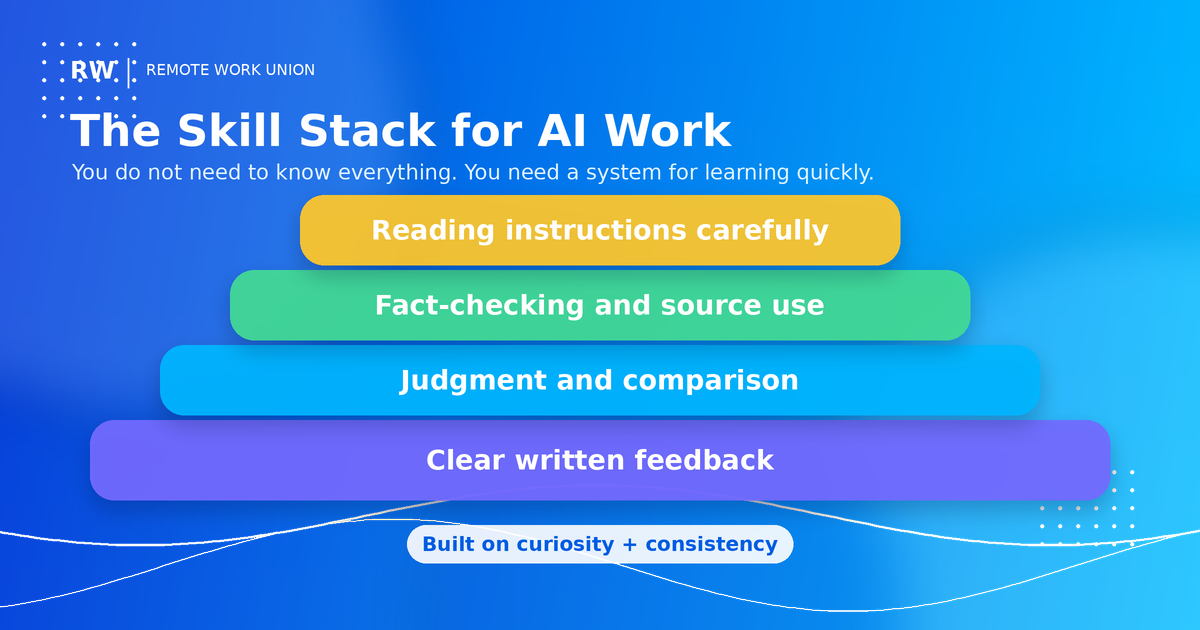
You do not need to be an expert in every subject. You need the ability to learn enough to make a careful judgment. That means reading the instructions, using evidence, checking the details, and writing concise feedback.
1. AI response evaluator
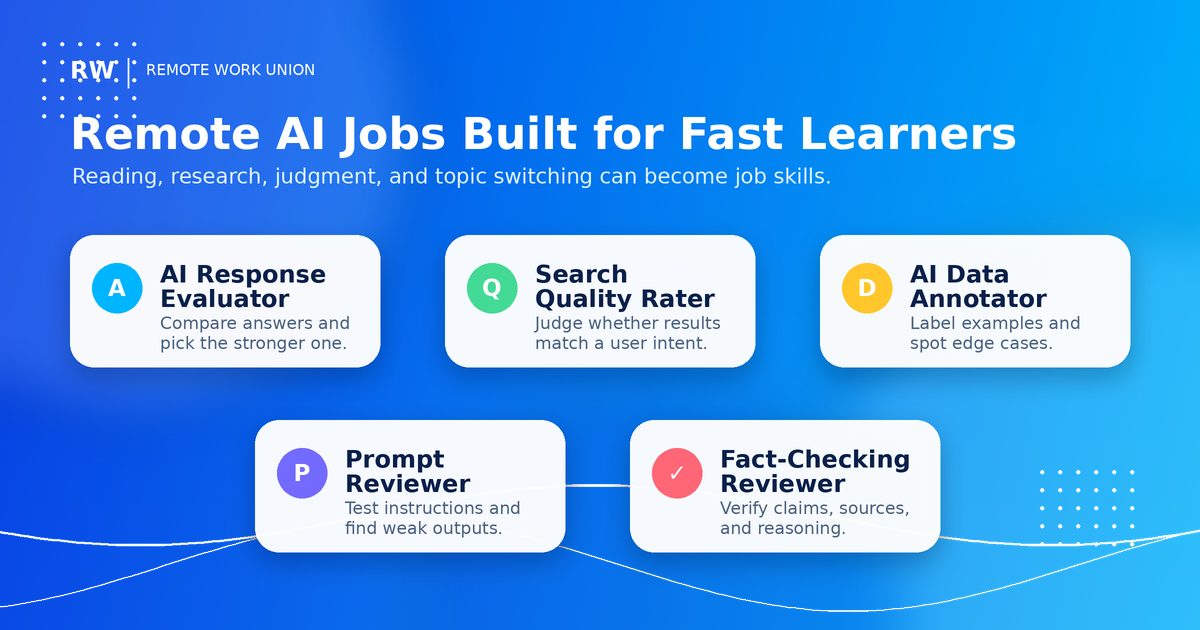
An AI response evaluator reviews answers produced by an AI model. The task may ask you to compare two answers, rate one answer on a rubric, identify factual mistakes, or explain which response is more helpful.
This is one of the strongest remote AI jobs for curious people because every prompt can open a new topic. One assignment may involve resume advice. Another may involve a coding explanation. Another may involve medical-sounding claims, legal concepts, geography, math, history, recipes, or business strategy.
Good AI response evaluators do not just pick the answer that sounds confident. They look at whether the response follows the instructions, answers the actual question, avoids unsupported claims, and gives useful reasoning. They also notice when an answer is polished but wrong.
This role fits people who enjoy reading, comparing, and making decisions. It is especially good for writers, editors, researchers, teachers, consultants, analysts, and people who have strong general knowledge.
Useful keywords: AI evaluator, AI response evaluation, model evaluation, AI training, human feedback, prompt response review, content quality review, remote AI work.
2. AI data annotation specialist
AI data annotation is the work of labeling information so AI systems can learn from it. The data may be text, images, audio, search results, conversations, documents, or structured examples. The work can be simple, but the best annotation tasks require attention and judgment.
For people who like learning new topics, annotation can be interesting because each project has its own rulebook. You may need to learn what counts as a valid category, what counts as a safety issue, what makes an example useful, or how to label a tricky edge case.
Many beginners start with annotation because it is more accessible than expert review. However, stronger annotators move beyond clicking labels. They understand why the label matters. They read the guidelines, remember examples, and flag confusing cases.
This role fits detail-oriented people who can stay consistent. It is good for people who like systems, checklists, and structured decisions.
Useful keywords: AI data annotation, data labeling, machine learning data, text annotation, image annotation, content classification, training data, quality assurance, remote data jobs.
3. Search quality evaluator
Search quality evaluators judge whether search results, AI answers, or recommendation results match what a user is actually looking for. This role is ideal for people who like figuring out intent.
A search query can be ambiguous. The user might be looking for a definition, a product, a local service, a news answer, an image, a comparison, or a quick fact. A search quality evaluator has to infer the goal and decide whether the result satisfies it.
This work trains the same muscles as research and SEO. You learn to ask: What did the user probably mean? Is this result trustworthy? Is it recent enough? Is it too broad? Is it too narrow? Would a real person find this helpful?
This is a strong remote AI job for people who enjoy the internet as a research environment. It can also be a good fit for SEO specialists, content strategists, librarians, researchers, writers, and people who naturally compare sources before believing a claim.
Useful keywords: search quality evaluator, search rater, AI search evaluator, relevance rating, result quality, query intent, search evaluation, remote search jobs.
4. Fact-checking and research reviewer
Fact-checking roles are some of the best remote AI jobs for people who enjoy learning because they turn curiosity into a specific work process. You receive a claim, answer, or passage. Then you verify whether it is accurate, supported, current, and framed correctly.
This work is not only about catching obvious errors. The hardest mistakes are often subtle. An AI model may get the right topic but the wrong date. It may confuse two people. It may cite a weak source. It may summarize a real concept in a misleading way. It may use confident language where the evidence is uncertain.
A good fact-checking reviewer knows how to slow down. They separate claims, search for reliable sources, compare wording, and explain the issue clearly. They do not overcorrect. They do not invent certainty. They can say when something is probably true, unsupported, misleading, outdated, or unverifiable.
This role fits people who enjoy research, journalism, academic work, legal reading, financial analysis, policy review, and source evaluation.
Useful keywords: fact-checking, AI fact-checking, research reviewer, evidence review, source verification, factual accuracy, AI content review, remote research jobs.
5. Prompt evaluator
Prompt evaluators test whether AI prompts and instructions produce good outputs. This can include writing prompts, reviewing prompts, comparing prompt variations, or identifying why a prompt caused a weak answer.
This role is strong for people who like learning because prompt work forces you to understand both the subject and the instruction. A good prompt evaluator asks: What is the task asking the model to do? What constraints matter? What would a great answer look like? Did the model miss a hidden requirement? Did the prompt invite confusion?
Prompt evaluation is not about using complicated buzzwords. It is about clear thinking. The best prompt reviewers can write simple instructions, spot ambiguity, and explain how to improve the task.
This can be a good fit for writers, editors, teachers, curriculum designers, product managers, researchers, and anyone who enjoys explaining directions clearly.
Useful keywords: prompt evaluator, prompt writer, prompt review, AI prompt testing, instruction following, AI training, model feedback, non-coding AI jobs.
Find remote AI evaluation and training roles that match your curiosity and learning style at RemoteWorkUnion.com.
Find Roles Hiring Now →6. AI content editor
AI content editors review AI-generated writing for clarity, usefulness, accuracy, tone, and structure. This can include blog content, summaries, emails, product descriptions, help center articles, educational material, or customer support responses.
This role is a natural fit for people who like learning new topics because AI content can cover almost anything. The editor must quickly understand the intended reader, the goal of the content, and the standard of quality.
A strong AI content editor does more than make the writing smoother. They check whether the answer is complete, whether the structure makes sense, whether claims need support, and whether the content actually solves the reader's problem.
This role fits copywriters, content writers, editors, proofreaders, communications professionals, marketers, teachers, and people with strong writing judgment.
Useful keywords: AI content editor, AI writing reviewer, content quality analyst, AI content review, editorial QA, remote editing jobs, AI writing jobs, content evaluation.
7. Subject matter expert reviewer
Subject matter expert reviewers are brought in when AI tasks require deeper knowledge. The subject could be law, medicine, finance, accounting, math, science, engineering, software, language, education, marketing, or another professional field.
This can be one of the highest-value paths in remote AI work because expert judgment is harder to replace. AI companies need people who can evaluate whether a model is correct inside specialized domains. A general reviewer may notice grammar. A subject matter expert can notice that the reasoning is wrong.
People who love learning can use this path in two ways. First, they can apply in an area where they already have real experience. Second, they can build a stronger niche over time by doing more work in a subject they enjoy.
You should not claim expertise you do not have. But you should not undersell real experience either. If you have worked in accounting, real estate, customer support, legal support, operations, sales, HR, design, engineering, healthcare administration, or education, that background may help with AI review tasks.
Useful keywords: subject matter expert, SME reviewer, expert AI evaluator, domain expert, AI trainer, technical reviewer, legal AI reviewer, finance AI reviewer, remote expert work.
8. AI safety and policy reviewer
AI safety and policy reviewers judge whether model outputs follow safety rules, platform guidelines, or content policies. The work may involve reviewing sensitive content, identifying harmful instructions, checking policy compliance, or labeling whether a response should be allowed, refused, rewritten, or escalated.
This role can be a good fit for people who like learning because policy review requires careful interpretation. You have to understand categories, exceptions, context, and edge cases. You also need consistency. Two similar examples should receive similar labels unless a meaningful detail changes the decision.
This is not the right role for everyone. Some safety tasks may involve uncomfortable material. But for people who are calm, precise, and rules-oriented, it can be a serious remote AI path.
Useful keywords: AI safety reviewer, trust and safety, policy review, content moderation, AI policy evaluation, safety labeling, compliance review, AI quality assurance.
9. Multimodal AI reviewer
Multimodal AI reviewers evaluate AI work involving images, audio, video, documents, charts, screenshots, or combinations of media. As AI systems become more capable, more remote tasks involve more than plain text.
This can be a strong fit for visual thinkers and people who like learning because the task changes depending on the asset. You may review whether a chart was described correctly, whether an image caption is accurate, whether a screenshot was interpreted properly, or whether an audio transcript matches the speaker.
People with design, video, photography, music, education, data analysis, UX research, or document review experience may find this category interesting.
Useful keywords: multimodal AI, image annotation, audio annotation, video annotation, document review, chart analysis, AI visual evaluation, remote AI annotation.
10. AI research assistant tasks
Some remote AI tasks are closer to research assistance than simple annotation. You may be asked to gather examples, summarize sources, compare documents, create evaluation prompts, test claims, or build a small dataset around a topic.
This is one of the best categories for people who love learning new topics because the work is essentially structured curiosity. You receive a problem, learn the context, and turn what you find into usable material.
The best candidates are careful researchers. They track sources, separate facts from assumptions, and write in a way that another person can understand quickly.
Useful keywords: remote research assistant, AI research tasks, AI training data research, source review, knowledge work, AI evaluation, remote analyst work.
What these jobs usually have in common
Even though the job titles vary, many remote AI jobs share the same core workflow.
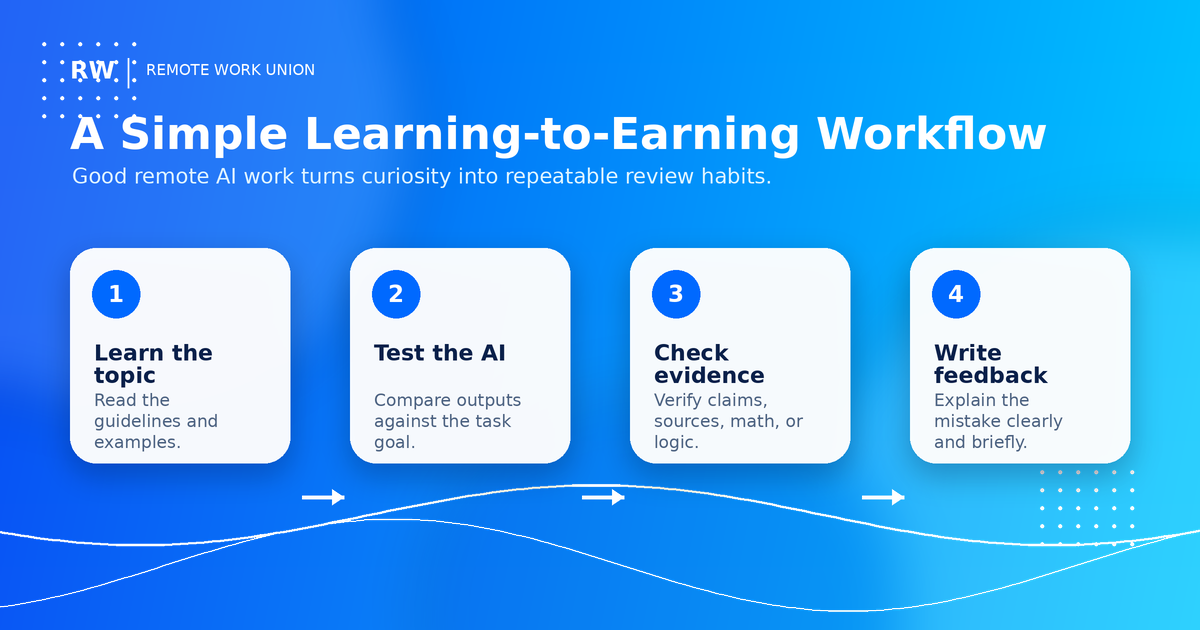
You learn the task instructions. You review examples. You evaluate an AI output or data point. You make a decision. You explain the decision. Then you repeat the process with consistency.
The topic changes, but the habits stay the same. That is why people who love learning can do well. They are not depending on memorizing one narrow task forever. They are building a repeatable way to understand unfamiliar material.
The most valuable habits include reading carefully, asking what the user actually wants, checking evidence, comparing alternatives, noticing contradictions, writing concise feedback, and staying consistent with guidelines.
How to know if you are a good fit
You may be a good fit for remote AI jobs if you enjoy going down research rabbit holes, comparing sources, editing unclear writing, explaining why something is wrong, learning new tools, reading instructions, or switching between topics.
You may also fit if you are the person people ask to review a message before they send it, check whether something is a scam, explain a confusing article, or find the detail everyone else missed.
You may not enjoy this work if you hate reading instructions, need every task to be identical, dislike writing explanations, or get frustrated when guidelines are detailed. Remote AI work can be flexible, but it is still quality-controlled work. Platforms usually care about accuracy, consistency, and following directions.
How to position yourself when applying
When applying for remote AI jobs, do not describe yourself only as a person who wants flexible work. That is too generic. Position yourself as someone who can learn quickly and produce reliable judgments.
Your profile should show evidence of reading, research, writing, editing, analysis, teaching, operations, customer support, legal support, finance, marketing, design, or any other field where you had to understand information and make decisions.
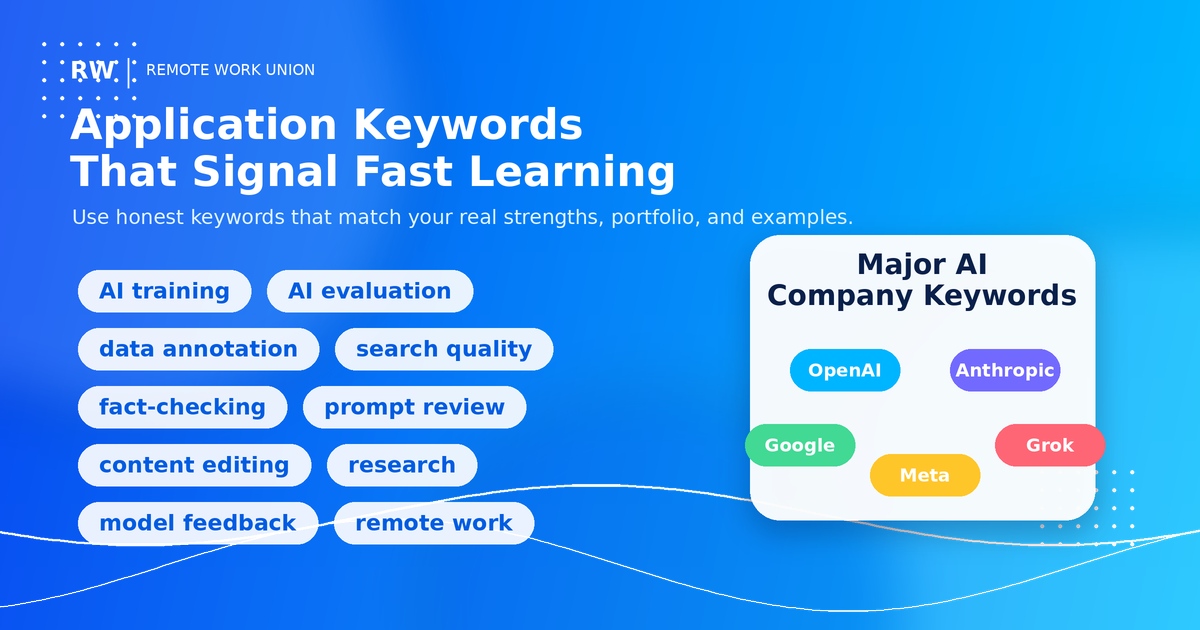
Use keywords honestly. If they match your background, include phrases like AI training, AI evaluation, prompt review, data annotation, fact-checking, search quality, research, content editing, quality assurance, model feedback, and remote work.
A strong profile might say something like: I have experience researching unfamiliar topics, comparing sources, editing written explanations, and following detailed guidelines. I am interested in AI training, model evaluation, data annotation, search quality review, and prompt evaluation tasks that require careful judgment and clear written feedback.
That kind of positioning is stronger than simply saying: I am looking for a remote job.
What to include in your resume or profile
For remote AI jobs, your resume should make your learning ability visible. Do not hide it behind vague phrases like fast learner. Show what fast learning looks like.
Examples of stronger evidence include:
- Researched complex topics and turned them into clear written summaries.
- Reviewed documents, content, or customer issues for accuracy and completeness.
- Followed detailed guidelines while maintaining quality across repeated tasks.
- Compared options, identified errors, and explained recommendations.
- Used AI tools, search tools, spreadsheets, content systems, or research workflows.
- Worked independently in remote, freelance, contract, or deadline-driven environments.
You can also create a simple portfolio. It does not need to be complicated. A few short writing samples, research summaries, before-and-after edits, or examples of clear analysis can help show that you can think and communicate.
Beginner path: where to start
If you are new to remote AI work, start with roles that do not require a narrow expert credential. Look for AI data annotation, AI response evaluation, search quality evaluation, AI content review, prompt testing, and generalist AI training roles.
Apply to multiple legitimate platforms instead of waiting on one. Remote AI work can be project-based, and task availability may rise and fall. A beginner should think in terms of building a pipeline.
Your first goal is not to find the perfect role. Your first goal is to get accepted somewhere, learn the workflow, build a track record, and understand what kind of tasks you are best at.
Over time, you can move toward better-paying or more specialized work. If you discover that you are strong at legal reasoning, finance content, coding explanations, medical terminology, math, language evaluation, or policy review, you can position yourself for more expert tasks.
Mistakes to avoid
The biggest mistake is applying with a vague profile. If your profile says only that you are hardworking and available, it does not tell an AI platform why you should be trusted with evaluation work.
Another mistake is pretending to be an expert in topics you do not understand. This can damage your account and lower your quality score. It is better to present yourself as a strong generalist than a fake specialist.
A third mistake is rushing through qualification tests. Many AI platforms use tests to judge whether you read instructions and follow details. Treat the test like the job itself.
Also avoid any platform that charges you to apply, asks for strange upfront payments, promises guaranteed income with no screening, or pushes you into vague training packages before showing legitimate work.
A practical 30-day plan
Week 1: Prepare your profile. Update your resume with research, writing, analysis, editing, customer support, operations, or subject matter experience. Add AI-related keywords only where they are honest.
Week 2: Apply to several remote AI platforms and remote work boards. Look for AI evaluator, data annotation, prompt reviewer, search quality evaluator, AI content reviewer, and research reviewer roles.
Week 3: Practice the core skills. Take a few AI answers and compare them. Check claims. Rewrite weak feedback into clearer feedback. Practice explaining why one answer is better than another.
Week 4: Review what is working. If you are getting no responses, improve your profile. If you are passing tests but seeing few tasks, join more platforms. If you are getting tasks but struggling with quality, slow down and study the guidelines more carefully.
The goal is to build a system, not chase one lucky listing.
Frequently Asked Questions
Do I need coding skills for remote AI jobs?
Not always. Some AI jobs require coding, but many AI training and evaluation roles focus on writing, research, judgment, editing, fact-checking, search quality, data annotation, or subject matter knowledge. Coding can help, but it is not the only path.
Are remote AI jobs good for people with broad interests?
Yes. Broad interests can be an advantage because many tasks change topics frequently. Generalists who can learn quickly, follow instructions, and explain decisions clearly may fit AI response evaluation, data annotation, prompt review, and research-heavy tasks.
What is the best first remote AI job for a beginner?
The best first options are usually AI data annotation, AI response evaluation, AI content review, prompt testing, and search quality evaluation. These roles can help you learn how AI platforms structure tasks and measure quality.
Can remote AI work become long-term income?
It can become part of a long-term remote work strategy, especially if you build skills and join multiple platforms. However, many remote AI roles are contract-based or project-based, so it is smart to build a pipeline rather than depending on one source.
What kind of person does best in remote AI evaluation roles?
The strongest fit is someone who reads carefully, learns quickly, checks details, writes clearly, and stays consistent. Curiosity matters, but disciplined curiosity matters more.
Remote AI jobs are not only for engineers. The AI industry also needs people who can read, research, compare, edit, label, fact-check, and explain. For people who love learning new topics, that creates a real opportunity.
The best path is to start with generalist AI evaluation or annotation work, build proof that you can follow guidelines, and then move toward the categories where your judgment is strongest. Curiosity can get you interested. Consistency can get you paid.