Being good at research is one of the most useful advantages in remote AI work. Many applicants think remote AI jobs are only for coders, engineers, or people with machine learning backgrounds. That is not true. A large part of AI training, AI evaluation, AI data annotation, and AI model review depends on people who can read carefully, investigate claims, compare sources, and explain what is right, wrong, missing, or misleading.
This matters because AI companies and AI platforms need human judgment. Models can generate answers quickly, but speed is not the same as accuracy. A useful reviewer has to know when an answer sounds confident but is unsupported, when a source is weak, when a claim is too broad, and when the best answer depends on context. That is research work.
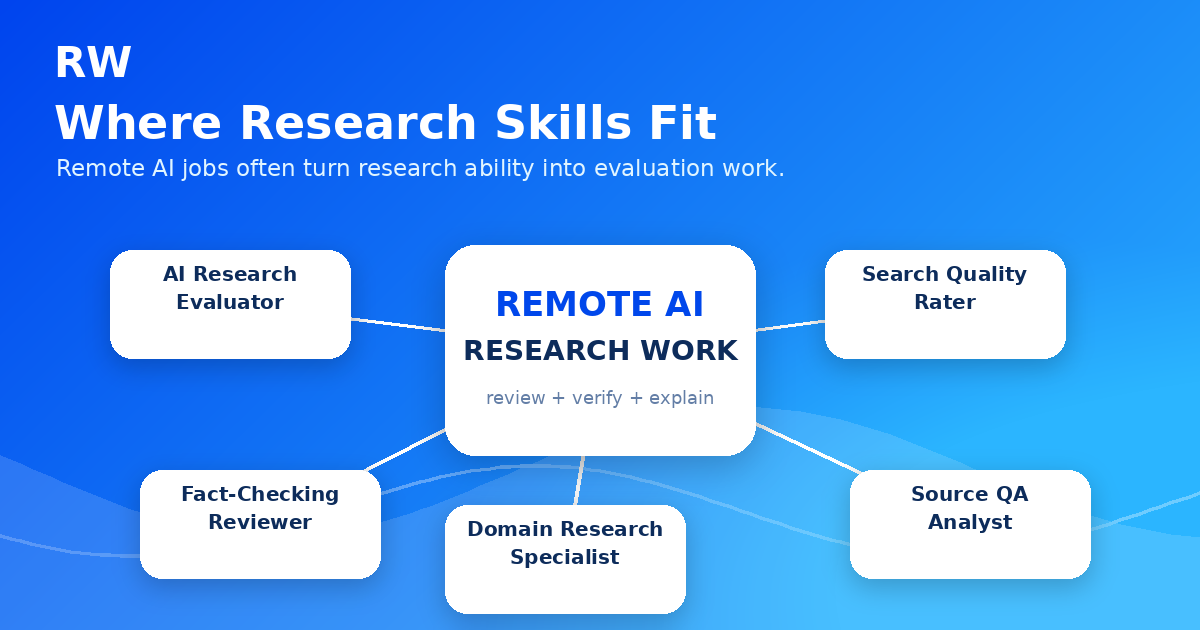
For people who like digging into topics, checking details, and finding the real answer instead of the easiest answer, remote AI jobs can be a strong fit. These roles may appear under titles like AI research evaluator, AI answer reviewer, LLM evaluator, search quality rater, fact-checking reviewer, source quality analyst, AI content reviewer, AI data annotator, or domain research specialist. Platforms such as micro1, Mercor, Handshake AI, and other remote work marketplaces may use different names, but the underlying skill is similar: evaluate information with care.
Why research ability is valuable in remote AI jobs
AI systems are trained and improved through feedback. Some tasks ask you to compare two model responses. Others ask you to judge whether an answer is accurate, helpful, safe, complete, or well sourced. Some ask you to label examples, rewrite weak answers, identify hallucinations, or verify whether a statement is supported by evidence.
Research-minded workers are useful because they do not stop at the first result. They know how to look for primary sources, cross-check a claim, notice when a web page is outdated, and explain uncertainty. In remote AI evaluation work, that discipline is often more important than sounding impressive.
A strong researcher can help AI systems improve in several ways:
- Catching false or unsupported claims before they become training examples.
- Identifying when an AI answer is technically correct but incomplete.
- Comparing sources and deciding which evidence is more reliable.
- Explaining why one response is better than another.
- Turning messy information into a clear, structured answer.
- Noticing when a model has overgeneralized, invented details, or missed an important exception.
This is why research skills apply across major AI companies and AI ecosystems, including work connected to large language models, AI assistants, search products, data labeling pipelines, and model evaluation workflows involving companies like OpenAI, Anthropic, Google, Meta, and Grok. The work is not always branded with the company name, but the category is the same: humans helping AI systems become more accurate and useful.
What counts as being "good at research"?
Being good at research does not mean you need a PhD or a formal academic background. It means you can find information, judge quality, and communicate your reasoning. Remote AI research jobs usually reward practical research habits more than credentials alone.
The most valuable research traits are simple but rare:
- You read the full prompt before answering.
- You separate evidence from opinion.
- You know that the top search result is not always the best source.
- You can summarize without copying.
- You can say "not enough evidence" when the evidence is weak.
- You can explain your reasoning in plain language.
- You notice dates, definitions, edge cases, and missing assumptions.
That last point is important. Many AI evaluation tasks are not about finding one trivia answer. They are about judgment. For example, a model might answer a health, finance, legal, travel, career, or technical question in a way that sounds plausible. A good researcher checks whether the answer is overconfident, outdated, incomplete, or missing a key caveat.
The best remote AI jobs for people who are good at research
The job titles vary by platform, but research ability is especially useful in the following remote AI roles.
1. AI research evaluator
An AI research evaluator reviews AI-generated answers and judges whether the response is accurate, complete, and useful. You may be asked to compare two answers, score an answer against a rubric, or explain what the model missed. This is one of the clearest fits for people who enjoy research because the task often requires checking external information before making a judgment.
Good fit if you like: reading, investigating claims, comparing answers, and writing short explanations.
2. Fact-checking reviewer
Fact-checking reviewers focus on whether claims are true, supported, current, and properly framed. These jobs may involve checking dates, quotes, statistics, public information, product details, historical claims, or current-event context. The work can be tedious, but it is ideal for people who notice when something feels slightly off.
Good fit if you like: source verification, claim checking, and catching confident but wrong answers.
3. Search quality rater
Search quality work evaluates whether results, answers, or snippets satisfy a user query. This can overlap with AI work because modern search products increasingly include AI summaries and model-generated responses. The skill is not just searching. It is understanding intent. A vague query, a local query, a product query, and a research query all require different judgments.
Good fit if you like: search behavior, user intent, relevance, and ranking quality.
4. AI answer reviewer or LLM evaluator
LLM evaluator roles ask humans to review responses from large language models. You might score helpfulness, accuracy, clarity, safety, instruction-following, or tone. Research ability matters because a model can be polished and wrong at the same time. The best reviewers do not get impressed by fluent writing. They check the substance.
Good fit if you like: comparing responses, rating quality, and explaining why one answer is better.
5. AI data annotation with research
Some AI data annotation jobs are simple labeling tasks. Others require research. For example, you may need to classify documents, label web pages, identify entities, verify categories, mark whether a source supports a claim, or create examples that train an AI model to handle research-heavy topics. These roles are often more accessible than expert-only projects, but strong research habits can help you move into better work over time.
Good fit if you like: structured tasks, labels, categories, and careful reading.
6. Domain research specialist
Domain research roles use subject matter knowledge. A finance professional might evaluate investment explanations. A legal assistant might review legal reasoning. A nurse, teacher, engineer, accountant, marketer, real estate professional, or operations manager may be valuable because they can spot errors a generalist would miss. These jobs can pay more when the platform needs a specific background.
Good fit if you have: professional expertise, industry context, or a specialized academic background.
7. AI content editor with research judgment
AI content editor roles are not only about grammar. They often require checking whether an answer is well structured, useful, accurate, and not misleading. People with writing, editing, journalism, content marketing, SEO, research, or communications backgrounds can fit well here because they know how to improve clarity while preserving factual accuracy.
Good fit if you like: editing, source-supported writing, and making information easier to understand.
8. Multilingual research reviewer
If you are bilingual or multilingual, research ability can become even more valuable. AI platforms need reviewers who can evaluate answers across languages, cultures, local references, and regional sources. A fluent speaker who can also research well may qualify for projects that a monolingual reviewer cannot do.
Good fit if you can: read and write clearly in more than one language and understand local context.
What the work looks like day to day
Remote AI research work is usually task-based. You log into a platform, receive a prompt, review instructions, complete the task, and submit your judgment. The exact flow depends on the platform, but the work often includes some version of this process:
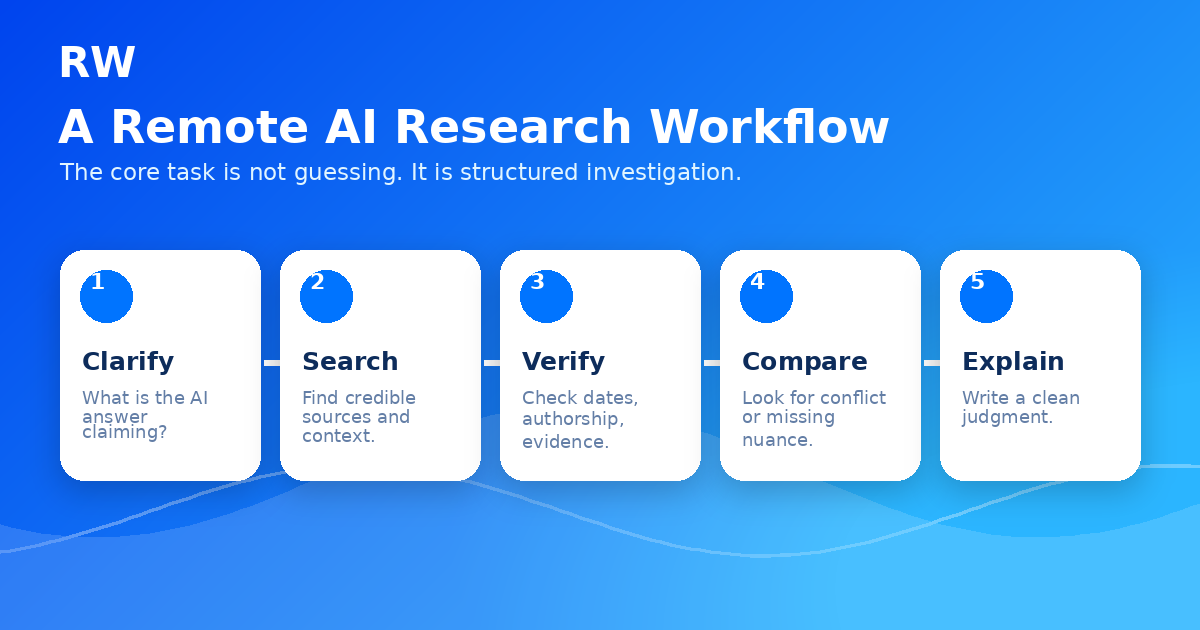
- Read the user prompt or research question.
- Review one or more AI-generated answers.
- Search for evidence when accuracy matters.
- Decide whether the answer is correct, incomplete, unsupported, unsafe, or misleading.
- Compare two responses and choose the better one.
- Write a short explanation that justifies your rating.
- Follow the platform rubric exactly.
The biggest mistake beginners make is treating the task like a casual opinion. AI evaluation work is usually rubric-driven. You are not just saying what you prefer. You are applying criteria. That means the best workers are consistent, careful, and able to explain their judgment.
The research skills platforms want to see
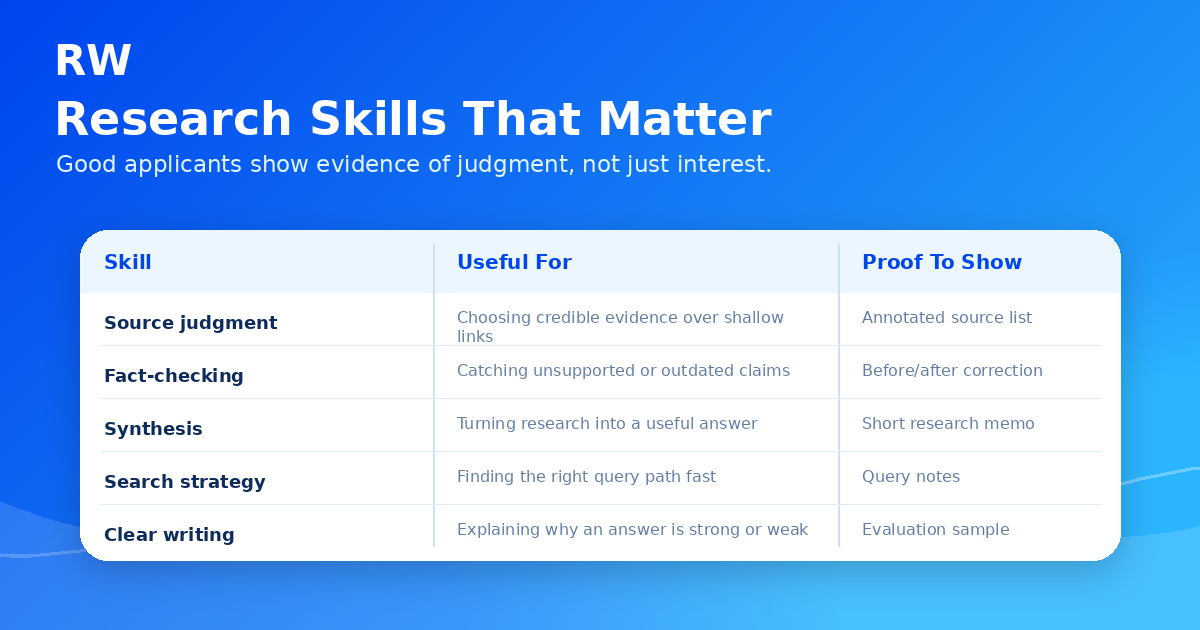
When applying for remote AI jobs, do not just write that you are "good at research." Prove it with specific skills. Platforms and hiring teams want signals that you can be trusted with open-ended information work.
Useful profile keywords include remote AI jobs, AI training, AI evaluation, AI data annotation, LLM evaluation, AI model review, fact-checking, source verification, search evaluation, online research, research analyst, content evaluation, prompt evaluation, answer ranking, writing evaluation, and subject matter expertise.
The strongest research signals include:
- Source judgment: You can tell the difference between a primary source, a credible secondary source, a low-quality blog, a forum comment, and an outdated page.
- Synthesis: You can combine information from multiple sources without turning it into a messy summary.
- Skepticism: You do not accept fluent AI writing as proof that something is true.
- Clarity: You can explain the problem in one or two concise paragraphs.
- Detail orientation: You notice dates, units, names, locations, and exceptions.
- Consistency: You can apply the same rating standard across many tasks.
These skills matter more than a perfect resume. Someone with a formal research background may still perform badly if they ignore the rubric. Someone without a research job title may perform well if they can follow instructions, verify information, and write clearly.
Ready to put your research skills to work in remote AI jobs? Find roles hiring now.
Find Roles Hiring Now →How to prove your research ability without a research job title
Many good applicants have never held a job called researcher. They may have worked in customer support, marketing, recruiting, administration, teaching, sales, journalism, real estate, operations, finance, legal support, or a completely different field. That can still translate into remote AI work if you frame it correctly.
Instead of focusing only on titles, describe the research behavior you used:
- "Verified product details before publishing customer-facing content."
- "Compared policy documents and summarized changes for internal teams."
- "Researched prospects, accounts, and market context for sales outreach."
- "Reviewed documents for inconsistencies, missing information, and errors."
- "Created source-supported summaries for clients or coworkers."
- "Used spreadsheets to organize findings and identify patterns."
A platform does not need to believe that you are a career researcher. It needs to believe that you can complete research-heavy tasks reliably. Your application should make that obvious.
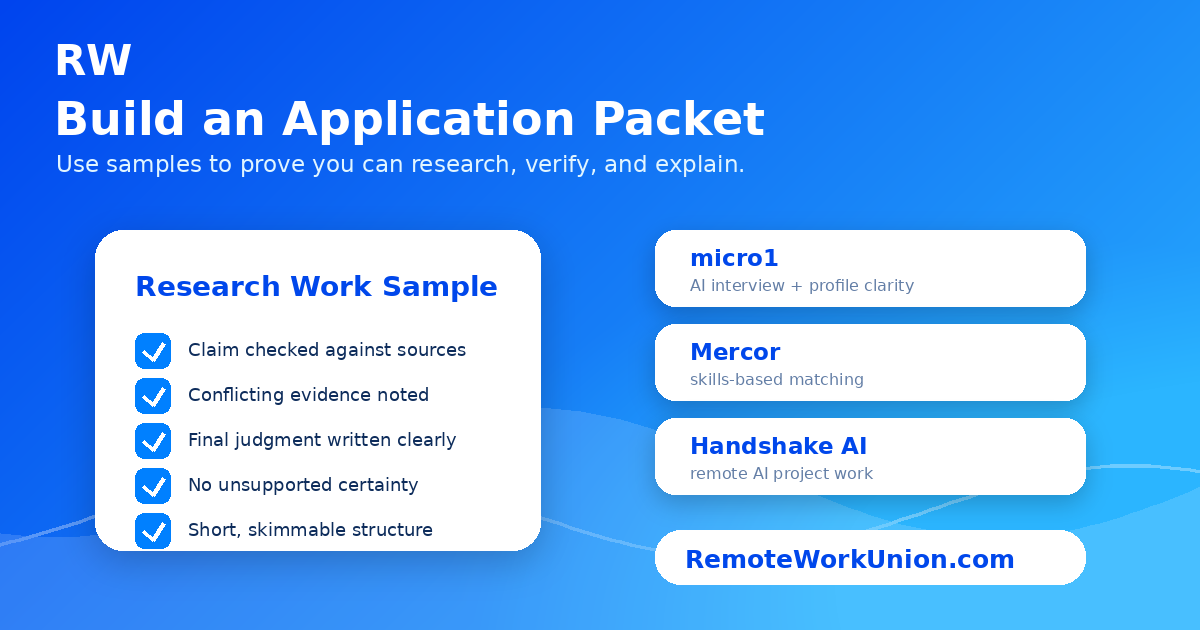
Build a simple research work sample before applying
A small work sample can help you stand out, especially if your resume does not already show research experience. It does not need to be long. A clean one-page sample is better than a bloated report.
Create one of these samples:
- Claim verification sample: Choose a public claim, check it against credible sources, and explain whether it is supported, unsupported, partly true, or missing context.
- AI answer comparison sample: Ask an AI tool a research-heavy question, compare two answers, identify errors, and rewrite the stronger version.
- Source quality sample: Pick five sources on a topic and rank them by credibility, relevance, and usefulness.
- Short research memo: Answer a question in 300 to 600 words with clear sourcing logic and a brief conclusion.
The goal is not to write a school paper. The goal is to show how you think. Include the question, your search process, what you checked, what you concluded, and why. That kind of sample fits remote AI evaluation work because it mirrors what many reviewers do every day.
How to write a stronger remote AI application
Your application should be direct. Platforms like micro1, Mercor, Handshake AI, and similar remote AI work sites often process many applicants. A vague profile gets skipped. A clear profile gives the reviewer or matching system more reasons to place you into relevant projects.
A strong application should explain three things:
- What topics you can research well.
- What type of evaluation work you can do.
- Why your judgment is reliable.
For example, a weak sentence is: "I am interested in AI and I am a fast learner." A stronger sentence is: "I have experience researching complex topics, comparing sources, identifying unsupported claims, and writing concise evaluations. I am especially strong at fact-checking, source review, and turning messy information into clear summaries."
That sentence gives the platform usable matching signals. It includes keywords, but it also describes real work behavior.
Remote AI research resume keywords to include
Use keywords naturally. Do not stuff every phrase into one paragraph. Add the terms that actually match your background. For a research-focused remote AI profile, useful keywords include:
- AI research evaluator
- LLM evaluator
- AI answer reviewer
- AI training
- AI data annotation
- AI evaluation
- model response evaluation
- prompt evaluation
- fact-checking
- source verification
- online research
- search evaluation
- research analyst
- content quality review
- answer ranking
- writing evaluation
- subject matter expert
- no coding required
Also include topic-specific keywords. If you have background in finance, legal, healthcare, education, engineering, marketing, software, real estate, science, policy, travel, or local knowledge, include that. General research ability is useful, but domain knowledge can make you more valuable.
Common mistakes research-minded applicants make
Research-minded people can still fail remote AI applications if they present themselves incorrectly. Avoid these mistakes:
- Applying with a generic resume that never mentions AI evaluation, fact-checking, source review, or research.
- Saying you are "detail-oriented" without giving any proof.
- Overstating technical ability if you do not code.
- Writing long academic paragraphs when the platform needs concise task judgment.
- Ignoring instructions during the application or AI interview.
- Treating the work like casual browsing instead of structured evaluation.
- Using AI to write every answer without checking whether it is accurate.
The last mistake matters. AI tools can help you organize thoughts, but they cannot replace your judgment. If your work sounds polished but has unsupported claims, you are showing the exact weakness these platforms are trying to fix.
How to move from beginner research tasks to better projects
Many people start with general AI data annotation or basic review work. That is fine. The goal is to build a record of accuracy, consistency, and reliability. Better projects often go to workers who follow instructions, maintain quality, and show domain strength.
To improve your chances over time:
- Apply to multiple legitimate platforms instead of relying on one account.
- Keep your profile updated with research and topic keywords.
- Track which projects you qualify for and which skills they request.
- Save non-confidential examples of your research process.
- Learn to write shorter, clearer explanations.
- Build expertise in a few areas instead of presenting yourself as good at everything.
- Avoid rushing tasks when accuracy matters.
Higher-value remote AI work usually requires more judgment. If you can show that you are accurate, careful, and useful on research-heavy tasks, you give yourself a better chance of moving beyond low-level labeling.
Who remote AI research jobs are best for
Remote AI research jobs are a good fit for people who like independent work and do not need constant meetings. They can work well for writers, editors, analysts, students, recent graduates, paralegals, teachers, librarians, journalists, marketers, consultants, operations professionals, finance workers, and generalists who are naturally curious.
They are also a good fit for people who want work from home jobs that use their brain without requiring phone calls, cold calling, or a traditional office schedule. Some projects are flexible and task-based, which can make them useful for people building income around another job, school, parenting, caregiving, or freelance work.
They are not a good fit for everyone. If you hate reading instructions, get bored by detail, dislike writing explanations, or want guaranteed full-time hours from a single platform, remote AI work may frustrate you. The best approach is to treat it like a real skill-based work channel, not a guaranteed paycheck.
Frequently Asked Questions
Do I need coding skills for remote AI research jobs?
Usually, no. Some technical projects require coding, but many AI evaluation, fact-checking, answer review, and data annotation projects do not. Research ability, writing clarity, and judgment can be enough for many roles.
Can beginners get remote AI research work?
Yes, but beginners need to prove they can follow instructions and evaluate information carefully. A clear profile and a small work sample can help.
Are these jobs full-time?
Some remote AI roles are contract-based, project-based, or task-based. Do not assume one platform will provide steady full-time hours. Many workers apply to multiple platforms to keep a steadier flow of work.
Which platforms should research-minded applicants look at?
Applicants often explore platforms such as micro1, Mercor, Handshake AI, and other remote AI training or AI evaluation sites. The right platform depends on your skills, country, availability, and the projects currently open.
What should I put on my profile?
Use specific terms such as fact-checking, source verification, AI evaluation, LLM evaluator, AI answer review, search evaluation, online research, research analyst, AI data annotation, and subject matter expertise. Add the topics you know well.
What is the biggest advantage for research-minded workers?
They can catch problems that fluent AI writing hides. A model can sound confident while being wrong. A good researcher checks the answer, explains the issue, and helps improve the training signal.
Bottom line
Remote AI jobs are not only for technical workers. People who are good at research can qualify for valuable work because AI systems need human reviewers who can verify, compare, and explain information. If you can evaluate sources, catch unsupported claims, write clearly, and follow detailed instructions, you may be a strong fit for remote AI research work.
The best next step is to build a profile that makes your research ability obvious. Use the right keywords, show the topics you know, create a short work sample, and apply to legitimate platforms with clear expectations. Research is not just an academic skill. In the AI job market, it can become remote work.