Communications and PR professionals are already trained for a remote-first job market. The core work is not tied to a specific office desk. It is tied to writing clearly, understanding audiences, managing reputation, shaping messages, spotting risk, coordinating with stakeholders, and explaining complicated ideas in a way people can actually use.
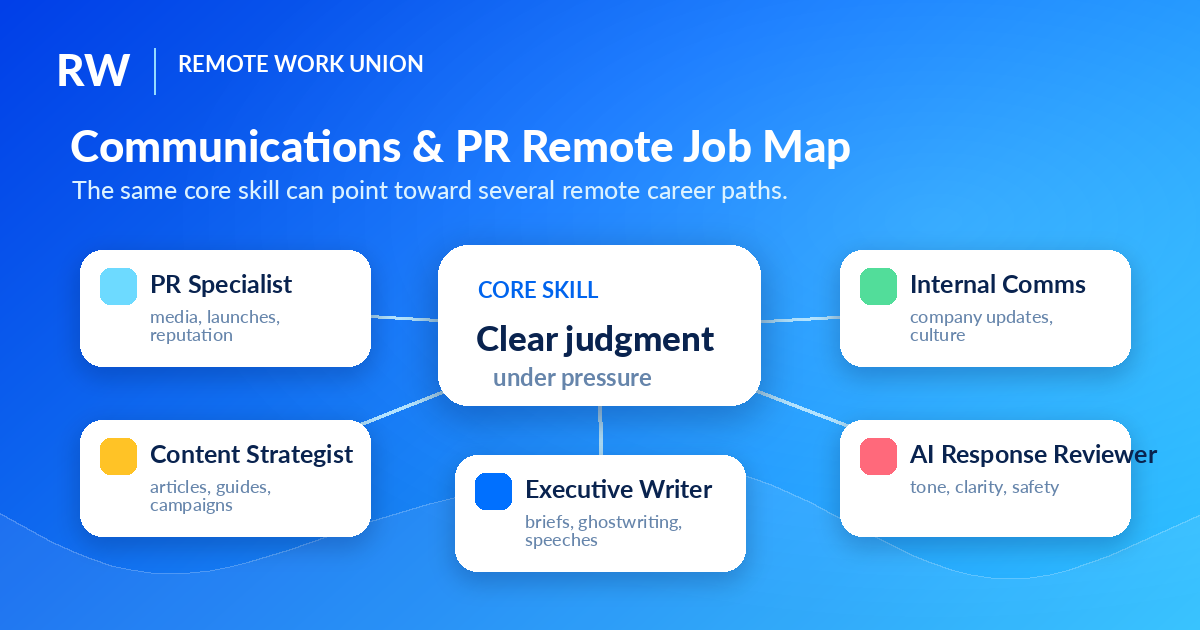
That matters because many remote jobs are built around those exact skills. A strong communications background can lead to remote PR roles, media relations jobs, internal communications jobs, content strategy roles, brand messaging work, executive communications, community management, customer research, and AI training work. The job title may change, but the underlying value is usually the same: companies need people who can turn information into trust.
This is especially true as AI companies and AI-powered businesses grow. Teams building and improving AI systems need reviewers who can judge tone, clarity, persuasion, safety, brand fit, factual quality, and user experience. A communications or PR professional may not be a coder, but they often have the judgment that AI training and AI evaluation work requires.
The best path is not to search only for "public relations" jobs. Search broader. Look for remote communications, content, brand, reputation, research, editorial, AI reviewer, AI trainer, AI evaluator, and customer-facing writing roles. The more ways you describe your skill set, the more remote work opportunities you can find.
Why communications and PR skills translate well to remote work
Communications work has always been about operating across distance. PR professionals pitch journalists they may never meet in person. Internal communications teams write for employees across time zones. Content strategists coordinate with product, legal, sales, support, and leadership teams through documents, calls, briefs, and async feedback. Remote work does not weaken that skill set. It often makes it more valuable.
The strongest remote workers are not just available online. They are clear online. They know how to summarize, document, prioritize, and reduce confusion without needing constant meetings. Communications professionals are used to doing this. They can take messy inputs, turn them into a narrative, and help other people understand what matters.
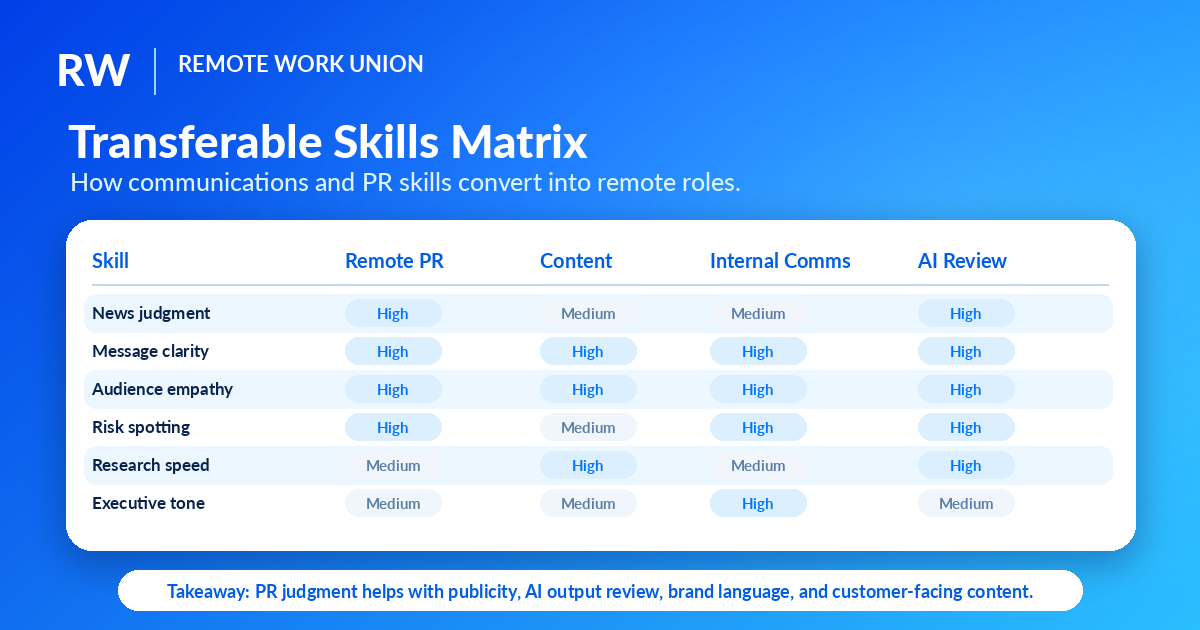
PR also trains a kind of judgment that many remote jobs need. You learn what should be said, what should not be said, what could be misread, what needs context, what sounds defensive, what sounds credible, and what might create unnecessary risk. That judgment is useful in media relations, customer communications, brand strategy, crisis response, content quality review, AI evaluation, and many forms of remote operations.
The mistake many communications professionals make is assuming their only remote options are traditional PR agency jobs. In reality, your skills can fit across a wider group of remote work categories.
The best remote jobs for communications and PR professionals
Below are the strongest remote work paths for people with communications, PR, media, content, brand, or reputation experience.
1. Remote communications manager
A remote communications manager helps a company control how it explains itself to employees, customers, partners, press, and the public. This role can include company announcements, leadership messaging, product updates, blog posts, internal memos, newsletters, crisis preparation, and cross-functional communication.
This is one of the most direct work from home jobs for communications professionals because it uses the full communications skill set. You need strong writing, sound judgment, organization, and the ability to keep messaging consistent across channels.
Good search terms include remote communications manager, remote corporate communications, work from home communications specialist, remote brand communications, and internal communications remote job.
2. Remote PR specialist or media relations specialist
Remote PR specialists help companies get coverage, respond to press, build media lists, write pitches, prepare statements, and shape external narratives. Some roles are in-house. Others are at agencies. Many can be done remotely because the core work is writing, research, outreach, coordination, and follow-up.
This can be a strong fit if you understand how reporters think, how to write a tight pitch, and how to avoid sounding like generic marketing copy. A good PR worker knows the difference between a company announcement and a story someone outside the company would care about.
Remote PR work is usually best for people who can handle rejection, move quickly, and stay organized. If you dislike outreach, consider content strategy, internal communications, editorial review, or AI evaluation instead.
3. Content strategist
Content strategy is one of the best remote work categories for PR professionals because it combines audience understanding, messaging, SEO, editorial planning, and business goals. A content strategist may plan blog content, landing pages, white papers, newsletters, case studies, social posts, product explainers, or thought leadership.
PR professionals often transition well into content strategy because they already know how to find an angle. They understand hooks, credibility, positioning, and audience relevance. The main adjustment is learning how content supports search traffic, conversion, retention, and long-term brand trust.
Search for remote content strategist, remote content marketing manager, SEO content strategist, editorial strategist, brand content manager, and work from home content jobs.
4. Executive communications and ghostwriting
Executive communications is a high-leverage remote path for strong writers. This work can include LinkedIn posts, speeches, investor updates, internal notes, founder letters, press statements, podcast talking points, and thought leadership essays.
The skill is not simply writing in a polished voice. The skill is sounding like a specific person while protecting the company, clarifying the message, and making the executive look credible. PR professionals are often good at this because they understand tone, timing, audience, and reputational stakes.
This path works especially well for people who can write in multiple voices and handle sensitive information with discretion. A small portfolio of before-and-after writing samples, anonymized executive notes, or sample founder posts can help you stand out.
5. Internal communications specialist
Internal communications is a strong remote job category because distributed companies need clear updates. Employees need to understand what changed, why it matters, and what they should do next. Internal comms teams write announcements, policy updates, company newsletters, onboarding content, leadership messages, change management notes, and employee engagement campaigns.
This work is less public than media relations, but it still requires strong judgment. Bad internal communication creates confusion. Good internal communication makes a company feel more organized.
If you have experience translating leadership decisions into plain language, this path can fit well. Search for remote internal communications, employee communications specialist, change communications manager, remote people communications, and culture communications jobs.
6. Brand messaging and positioning specialist
Brand messaging roles are built around clarity. Companies need someone to define how they talk about their product, market, customers, and point of view. This can include website messaging, product positioning, tagline development, campaign language, sales enablement, launch messaging, and competitive differentiation.
PR professionals can be strong candidates because they are trained to explain why something matters. They can separate the actual story from the noise. They can also spot language that sounds impressive internally but weak externally.
For remote applications, build a portfolio that shows messaging frameworks, landing page rewrites, positioning notes, or campaign language. Employers want to see that you can make a message sharper, not just longer.
7. Social media strategist or community manager
Social media and community roles can be remote-friendly because they depend on writing, publishing, listening, and responding online. A social media strategist may plan content calendars, write posts, manage brand voice, coordinate campaigns, analyze performance, and respond to audience trends.
A community manager may engage users, moderate discussions, answer questions, surface feedback, and protect the tone of a brand community. PR experience helps because public conversations can shift quickly. A good community or social lead knows when to respond, when to escalate, when to clarify, and when not to make things worse.
This path is best for communications professionals who are comfortable with fast feedback loops and public-facing language.
8. Crisis communications and reputation analyst
Crisis communications work can be remote, especially when the role focuses on monitoring, message development, scenario planning, stakeholder updates, and written response frameworks. Companies need people who can think clearly when something sensitive happens.
A reputation analyst may monitor news, social sentiment, customer feedback, public complaints, regulatory issues, or competitor narratives. The work often requires research, pattern recognition, and careful writing.
This is not always an entry-level path, but it can be valuable for experienced PR professionals. If you have handled difficult announcements, public complaints, sensitive customer issues, or media scrutiny, make that visible in your application.
Want to match your communications skills to remote AI training roles? Find opportunities hiring now.
Find Roles Hiring Now →9. AI response reviewer or AI communication evaluator
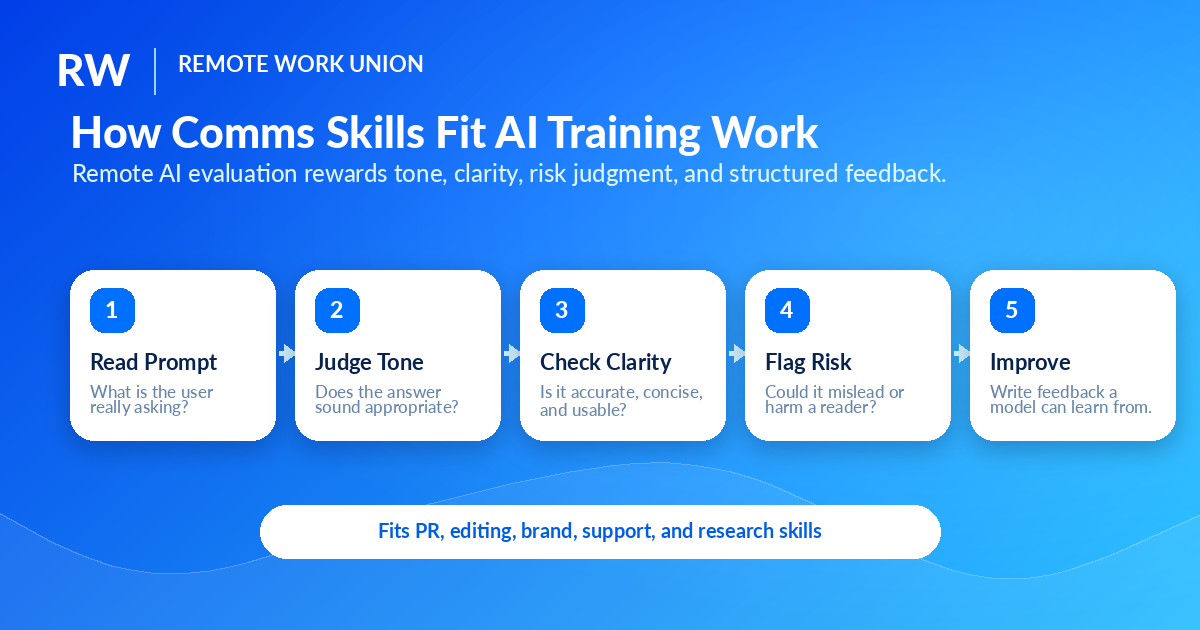
AI response review is one of the most relevant newer remote work paths for communications professionals. In these roles, you may review AI-generated answers, compare two responses, rate clarity and helpfulness, identify tone problems, flag unsafe or misleading language, rewrite responses, or explain why one answer is better than another.
This work can appear under titles such as AI trainer, AI evaluator, AI response reviewer, AI content reviewer, AI annotation specialist, prompt evaluator, model evaluator, or AI quality analyst. You may see opportunities connected to AI labs, AI platforms, data annotation companies, or contractor marketplaces serving major AI companies such as OpenAI, Anthropic, Google, Meta, and Grok.
Communications and PR professionals can be strong fits because they understand audience, tone, trust, and ambiguity. A model can produce fluent text that still sounds wrong, evasive, exaggerated, confusing, or brand unsafe. A communications professional is trained to notice that gap.
You do not need to position yourself as technical if the role does not require coding. Position yourself as someone who can evaluate language quality, user intent, factual clarity, reputational risk, and communication effectiveness.
10. Prompt writer or AI content quality specialist
Prompt writing and AI content quality roles are closely related to communications work. These jobs may involve writing prompts, testing model responses, creating examples, editing outputs, reviewing AI-generated content, or building rubrics for quality.
A PR background helps because prompts are communication tasks. You are defining the audience, context, desired output, constraints, and tone. You are also judging whether the result fits the situation.
This can be a good remote work option for communications professionals who like testing, editing, and structured feedback. It can also be a bridge between traditional content work and AI training work.
11. Customer research and insights communicator
Some remote jobs sit between research, marketing, support, and communications. Customer research and insights roles may involve reading interviews, summarizing feedback, turning survey data into takeaways, identifying customer pain points, and writing reports for leadership.
PR professionals can fit this path because they know how to turn scattered information into a clear narrative. The job is not only collecting data. It is explaining what the data means and why a team should care.
Search for remote customer insights, voice of customer analyst, research communications, customer marketing strategist, and customer feedback analyst.
12. Public affairs, nonprofit communications, and advocacy roles
Public affairs and nonprofit communications roles often need strong writing, policy awareness, stakeholder communication, campaign planning, and message discipline. Many organizations hire remote communications professionals to support newsletters, reports, advocacy campaigns, grant communications, donor updates, coalition messaging, and media outreach.
This path can be a good fit if you have experience explaining complex topics to non-specialist audiences. It may also suit people who care about mission-driven work and want communications work beyond consumer marketing.
How to position your PR background for remote AI work
If you are applying to AI training, AI evaluation, or AI annotation roles, do not write your application as if you are asking for a traditional PR job. Translate your experience into the language those platforms care about.
Instead of saying only "I have PR experience," say that you have experience reviewing tone, improving clarity, checking claims, identifying audience fit, handling sensitive messaging, writing concise explanations, and giving structured feedback. These are the skills that matter when reviewing AI output.
A strong positioning statement could look like this:
That statement connects PR experience to AI training work without pretending to be a software engineer.
What to include in your remote work profile
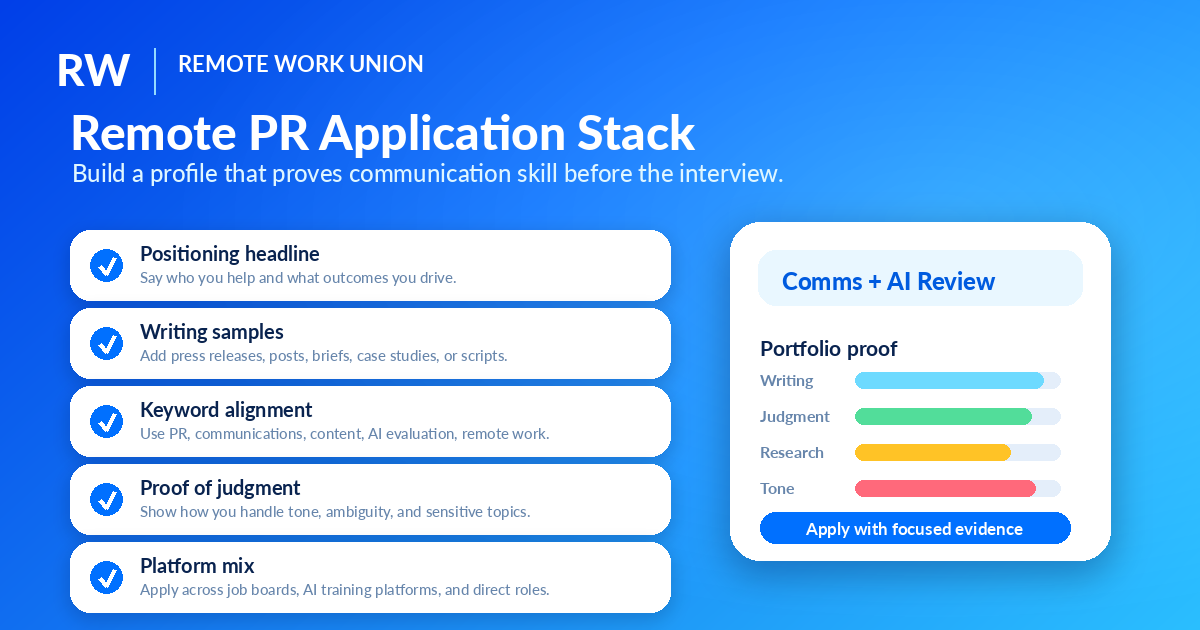
A remote communications profile should prove your judgment quickly. Hiring teams and AI platforms may review many applications. Make the value obvious.
Include a short headline that describes your strongest angle. Examples: "Remote communications specialist with PR and AI evaluation experience," "PR writer focused on brand voice, clarity, and reputation," or "Communications professional skilled in content strategy, editing, and AI response review."
Include writing samples that show range. A press release, article, executive memo, social campaign, internal announcement, pitch, case study, or sample AI response evaluation can all help. If you cannot share client work, create clean sample pieces. For AI evaluation roles, a sample that compares two answers and explains which one is clearer can be useful.
Use the right keywords without stuffing. Remote communications, public relations, media relations, content strategy, editorial review, AI training, AI evaluation, AI annotation, prompt writing, brand voice, reputation management, and stakeholder communications are all relevant terms.
Also show that you can work asynchronously. Mention documentation, remote collaboration, written feedback, project management tools, deadline ownership, and cross-functional communication when they are true.
How to search for these jobs without missing good matches
Do not rely on one search term. A communications professional should search in clusters.
For traditional communications work, search remote communications specialist, corporate communications remote, PR specialist remote, media relations remote, internal communications remote, brand communications remote, and public affairs remote.
For content and editorial work, search remote content strategist, editorial strategist, content marketing manager, SEO content writer, brand writer, executive ghostwriter, newsletter strategist, and thought leadership writer.
For AI-related work, search AI trainer, AI evaluator, AI response reviewer, AI content reviewer, AI annotation, prompt evaluator, prompt writer, language model evaluator, and model response reviewer.
For broader remote work, search work from home writing jobs, remote research jobs, remote jobs no phone calls, remote content quality jobs, and remote brand voice jobs.
The goal is to avoid being trapped by old job titles. Your skill set is broader than "PR." It includes writing, judgment, research, message strategy, audience analysis, and risk awareness.
Who is the best fit for this path?
Remote communications and PR work is a strong fit for people who are good at writing, but writing alone is not enough. The best candidates are precise, calm, fast readers, and strong editors. They can interpret messy information without overreacting. They can understand what a company is trying to say and what an audience is likely to hear.
This path is especially good for people who notice tone problems quickly. If you can tell when a statement sounds defensive, when a headline overpromises, when a paragraph is confusing, or when an answer technically responds but does not actually help, you have a useful remote skill.
It is also a good path for career changers. Former journalists, marketers, customer support leads, social media managers, nonprofit communicators, agency workers, executive assistants, researchers, and editors can all move into remote communications or AI evaluation work if they can prove judgment and writing quality.
Common mistakes to avoid
The first mistake is applying only to jobs with "PR" in the title. That cuts out many roles where your skills fit. Search for communications, content, editorial, brand, research, AI evaluation, and quality review roles too.
The second mistake is using a vague profile. "Strong communicator" is not enough. Every applicant says that. Be specific. Say what kind of communication you are strong at: media pitching, executive writing, internal announcements, crisis messaging, AI response review, brand voice, or customer-facing content.
The third mistake is sending applications without proof. Communications jobs are evidence-based. Include samples. If you do not have samples, create them. A clean writing sample is better than asking a hiring manager to imagine your ability.
The fourth mistake is ignoring AI training work because it sounds technical. Some AI roles require coding or deep subject expertise. Many language-focused roles do not. A communications professional may be qualified for AI evaluation work because the job is about language judgment, not software engineering.
The fifth mistake is applying to platforms that charge workers to start. Legitimate remote work platforms and AI training platforms should pay workers. Be cautious with any opportunity that asks for upfront fees, paid training packages, or personal financial information before a real onboarding process.
A practical application plan
Start by choosing two tracks: one traditional communications track and one AI-related track. For example, apply to remote PR and content strategy roles while also applying to AI evaluator and AI response reviewer roles. This gives you more chances without making your profile feel random.
Next, build a small portfolio. Include three to five samples. One can be a press-style announcement. One can be a blog or article. One can be an internal memo. One can be a brand voice rewrite. One can be an AI response review sample where you compare two answers and explain the better one.
Then rewrite your resume around outcomes and skills. Replace generic bullets with concrete language. Instead of "handled communications," write "wrote external announcements, media pitches, and stakeholder updates for product and brand initiatives." Instead of "managed social media," write "developed audience-specific messaging across social channels and monitored engagement for brand risk and customer feedback."
Finally, apply in batches. Use one version of your resume for PR and communications roles, one for content strategy roles, and one for AI training or AI evaluation roles. The same background can be realigned for each target.
Final thoughts
Communications and PR professionals should not view remote work as a narrow field. Their skills are useful across public relations, internal communications, content strategy, brand messaging, executive writing, community management, customer insights, crisis response, and AI training.
The most important shift is language. Do not define yourself only by old titles. Define yourself by what you can do remotely: write clearly, judge tone, protect trust, explain complex ideas, improve content, evaluate AI responses, and help companies communicate with less confusion.
Remote work rewards people who can create clarity without being in the room. That is exactly what strong communications and PR professionals already do.
Frequently Asked Questions
Can communications and PR professionals do remote AI evaluation work?
Yes. AI evaluation and AI response review roles require judgment about tone, clarity, audience fit, and communication quality — all skills that communications and PR professionals develop directly. You do not need to be a coder or software engineer for many of these roles. Platforms connected to AI companies such as OpenAI, Anthropic, Google, and Meta regularly hire people who can evaluate language quality and provide structured written feedback.
What remote work jobs pay well for communications experts?
Strong-paying remote options include executive communications and ghostwriting, AI model evaluation for language and brand review, remote PR director and communications manager roles, content strategy and SEO editorial leadership, and expert AI training work at higher tiers. AI evaluation expert roles can pay $50–$200 per hour depending on the platform and the skill required.
Do I need to retrain or learn new skills to transition from PR to remote AI work?
Not necessarily. Many AI evaluation and AI response review roles value the judgment skills communications professionals already have: spotting tone problems, identifying misleading language, flagging reputational risk, improving clarity, and explaining why one message is better than another. Repositioning how you describe your skills — rather than learning an entirely new field — is often the main adjustment needed.
What is the difference between AI trainer and AI evaluator roles?
AI trainer roles typically involve writing prompts, creating example conversations, editing model outputs, or building training data. AI evaluator roles typically involve rating or comparing AI responses, flagging errors, and providing feedback that helps improve model quality. Communications professionals can fit both paths, but evaluator roles tend to require strong reading and judgment skills more than technical expertise.
What should I include in a remote communications profile to stand out?
Include a clear headline describing your strongest angle, writing samples that show range (press releases, executive memos, editorial content, or sample AI response evaluations), specific keywords like media relations, brand voice, content strategy, AI evaluation, and AI response review, and concrete examples of outcomes rather than generic descriptions like "strong communicator." If you cannot share client work, create clean sample pieces to demonstrate your judgment.