Being good at using AI tools is not just a personal productivity upgrade — it is increasingly a job skill that remote employers and AI platforms specifically value. Whether you use ChatGPT, Claude, Gemini, Grok, Perplexity, Midjourney, or other AI tools regularly, you have developed a form of AI fluency that translates into remote work opportunities. This guide explains how to convert that fluency into income.
The key insight most people miss is this: the remote job market is not just looking for people who built AI systems. It is looking for people who understand how AI behaves, what good AI output looks like, and where AI tools fall short. That understanding — which comes from everyday use — is exactly what a growing range of remote roles, platforms, and freelance categories value and pay for.
What "AI Skills" Actually Means for Remote Work
There are two types of AI skills that matter for remote work, and understanding the distinction helps you position yourself correctly.
The first is AI tool fluency — using ChatGPT, Claude, Gemini, and other tools effectively to write, research, summarize, code, and problem-solve. This is the skill most people think of when they say they are good at AI tools. It includes knowing how to write a clear prompt, how to get better outputs through iteration, how to use AI tools to speed up research, and how to combine multiple AI tools to complete complex tasks efficiently.
The second is AI evaluation ability — judging whether AI outputs are accurate, safe, useful, and well-reasoned. This is a different skill, and it is especially valued by AI training platforms that need human reviewers. Evaluation ability means knowing what makes an AI response good or bad, being able to spot hallucinations and reasoning failures, and being able to explain your assessment clearly.
Both matter. Tool fluency makes you faster and more useful in writing, operations, research, and content roles. Evaluation ability makes you a strong candidate for AI training, expert review, and model improvement work. Many people have both and do not realize how to present them separately.
Tip: When applying for remote roles, identify which type of AI skill the job actually values. Some roles want tool fluency; others want evaluation judgment. Using the right language for each is what separates relevant applications from generic ones.
Top Remote Job Categories for People Who Use AI
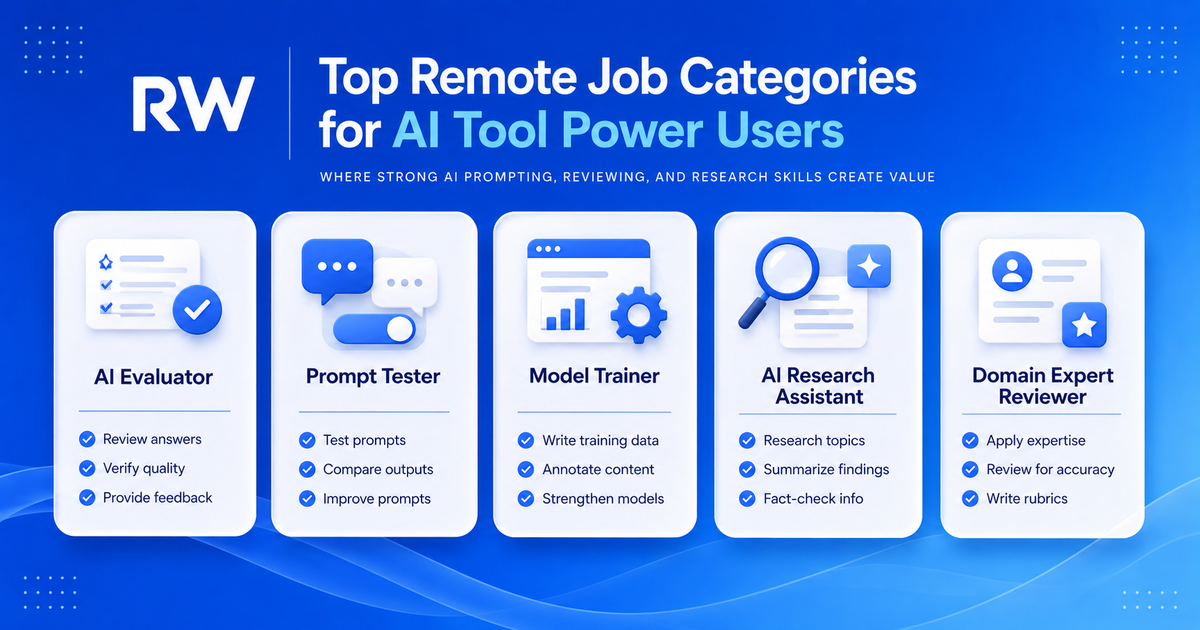
AI fluency opens doors across a wider range of remote job categories than most people expect. These are the strongest categories for people who use AI tools regularly:
- AI Training and Evaluation — using your ability to judge AI quality to review model outputs on platforms like Handshake AI, Mercor, micro1, and Outlier AI. This is one of the most accessible entry points for people with AI tool experience and strong reading or domain skills.
- AI-Assisted Writing and Editing — using AI tools to produce faster, better written content while maintaining human oversight and editorial judgment. Clients increasingly want writers who can use AI responsibly, not writers who avoid it.
- AI-Powered Research — using AI to find, organize, and summarize information faster for clients, businesses, or research projects. Strong researchers who use AI tools can deliver results significantly faster than those who do not.
- Prompt Engineering Support — helping companies write, test, and refine prompts for their AI workflows. Many businesses are integrating AI tools but lack the experience to write prompts that produce reliable results.
- AI Operations and Automation — using no-code AI tools to automate business processes for clients. This category rewards people who understand both what a business needs and how AI tools can reduce repetitive work.
- AI Content Strategy — helping businesses decide how to integrate AI tools into their content workflow. This is a consulting and advisory role for people who understand both content quality and AI tool behavior.
- AI Tutoring and Training — teaching others how to use AI tools effectively. As AI adoption grows, demand for clear, practical instruction is growing alongside it.
- Customer Support with AI Tools — handling support queues more effectively using AI-assisted response drafting. Support professionals who can use AI to respond faster and more accurately are more valuable to remote employers.
Which AI Skills Lead to Remote Income
Not all AI tool experience translates equally into remote income. The skills that tend to create the most consistent opportunity are:
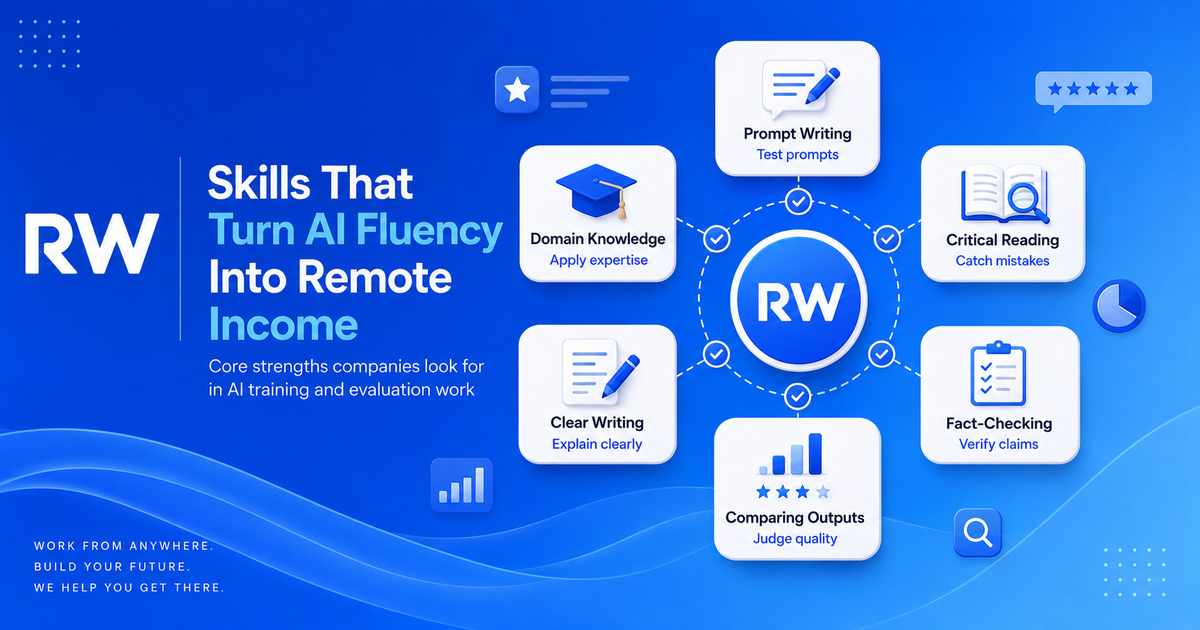
- Understanding how prompts work and how to write them clearly. Knowing how to frame a request, what context to provide, and how to iterate toward better outputs is a practical skill with direct applications in writing, research, and evaluation work.
- Knowing what makes an AI output good or bad. Being able to distinguish a clear, accurate, helpful response from one that sounds plausible but is wrong or incomplete is the foundation of evaluation work.
- Being able to spot hallucinations, unsafe advice, and reasoning failures. This is a more refined skill, and platforms that do AI model training pay for it specifically.
- Using AI tools to produce clean, polished written work. The ability to use AI assistance without producing generic, low-quality output — and to edit AI-generated content into something genuinely good — is a real skill most people have not developed.
- Explaining AI concepts in plain language to non-technical audiences. Tutoring, strategy consulting, and support roles all value the ability to translate AI behavior into clear, practical terms.
- Automating repetitive tasks using no-code AI platforms. Zapier, Make, and similar tools combined with AI integrations allow you to build practical automations that businesses will pay for.
These skills are increasingly common in job descriptions and platform requirements. The people who can demonstrate them specifically — rather than vaguely claiming "AI experience" — get better matches and better rates.
How AI Tool Fluency Translates to Paid Remote Work
If you use AI tools to write, research, and problem-solve, you already understand how they behave, fail, and improve. That understanding is exactly what AI training platforms need — people who can recognize the difference between an AI answer that sounds plausible and one that is actually accurate and useful.
AI fluency gives you context that makes evaluation work faster and more accurate. When an experienced AI user reads a response, they are doing something different from what a casual user does. They are noticing when the structure is too formulaic, when a claim does not quite match what they know about the topic, when the AI avoided the actual question, or when the response is technically correct but practically useless. That pattern recognition is what platforms are paying for.
The same logic applies in writing, research, and content roles. Businesses hiring remote writers increasingly want people who can use AI tools intelligently — not to replace judgment, but to accelerate it. The writer who can draft, refine, and deliver faster using AI tools, while maintaining actual editorial quality, is more competitive than the writer who refuses to use them or the writer who uses them without oversight.
How to Position Your AI Skills on Applications
The most common mistake AI-fluent job seekers make is positioning their skills too vaguely. Saying "I use AI tools" tells an employer almost nothing. The question is not whether you use AI — it is what you can do, judge, and deliver because of that experience.
Replace generic claims with specific capability statements. Here are examples of the shift:
- Instead of "I use ChatGPT and Claude" — write "I evaluate AI-generated content for factual accuracy, instruction compliance, and reader usefulness."
- Instead of "I use AI for research" — write "I use AI-assisted research to deliver faster, better-sourced reports, with verification of claims against primary sources."
- Instead of "I'm good at AI tools" — write "I can build automated workflows using AI tools that reduce repetitive admin tasks for small business clients."
- Instead of "I understand how AI works" — write "I can identify hallucinations, reasoning failures, and safety issues in AI-generated text across general and domain-specific topics."
Translate tool familiarity into capability statements. Every capability statement should answer the same question: what can this person do, judge, or deliver that is useful to me? If your application language does not answer that question specifically, it is not working hard enough.
Remote Work Union connects you to legitimate remote AI jobs and evaluation roles across multiple platforms. Apply for free.
Find Roles Hiring Now →The Fastest Paths From AI Fluency to Remote Income
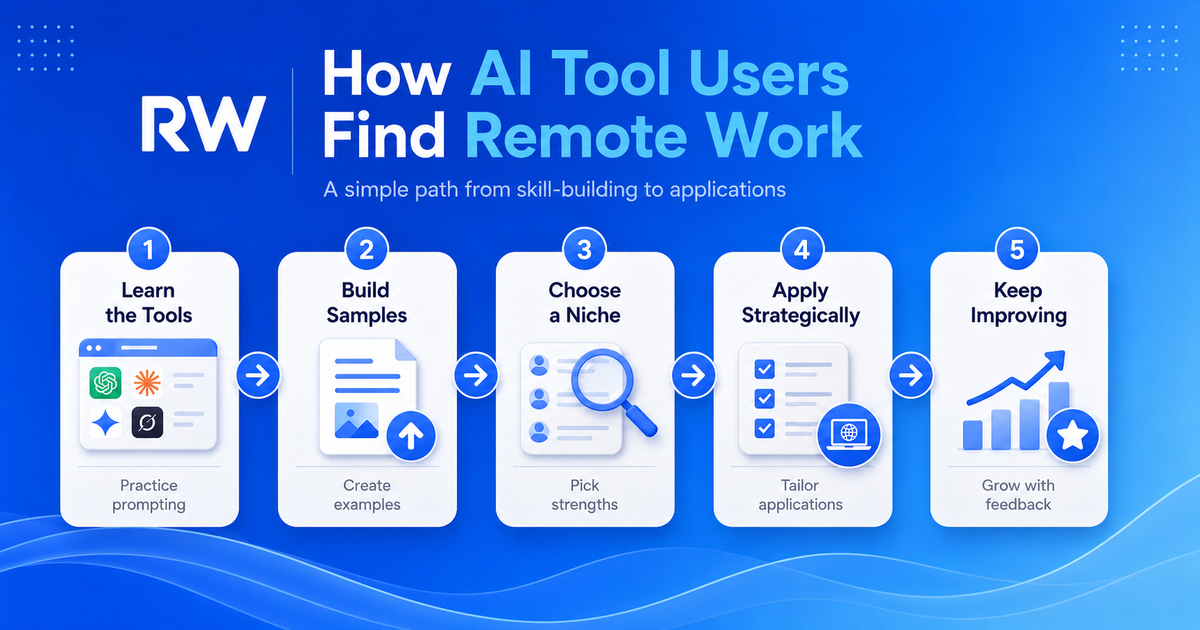
If you want to move from AI tool familiarity to actual remote income as quickly as possible, these are the most reliable paths:
- Apply to AI training and evaluation platforms (Handshake AI, Mercor, micro1, and Outlier AI). Your existing AI fluency makes you a stronger evaluator from day one. These platforms have structured onboarding and can generate income within weeks of acceptance.
- Offer AI-assisted writing or research services on freelance platforms. Position yourself as a writer or researcher who delivers faster and better results using AI tools responsibly. Upwork, Contra, and direct outreach to content businesses are strong starting points.
- Apply for remote operations or content roles that explicitly list AI tool proficiency in the job description. These are growing in number across job boards like We Work Remotely, Remote OK, and LinkedIn remote filters.
- Build a simple AI automation for a business and document it as a portfolio piece. A single, well-documented automation — even a basic one — demonstrates the practical ability to apply AI tools to real business problems.
- Teach AI tools — tutoring on Wyzant, offering workshops through your network, or creating written guides. Teaching forces you to articulate what you know clearly, and the market for practical AI instruction is growing.
These paths are not mutually exclusive. Many people start with AI training and evaluation work, build their income there, and use that foundation to expand into writing, research, or consulting work over time.
Common Mistakes AI-Fluent Job Seekers Make
AI-fluent job seekers often have more to offer than their applications suggest. These are the mistakes that create the gap:
- Saying "I use ChatGPT" without explaining what that enables. The tool name is not the credential — the capability is.
- Not translating AI tool experience into evaluation or editing skills. If you have been using AI tools for months, you have developed real pattern recognition about quality. That is not obvious from "I use AI tools."
- Applying only to "AI" job titles and missing the broader range of remote roles that value AI fluency: writing jobs, research contracts, operations roles, support positions, and content strategy work.
- Assuming AI fluency is enough without proof. Samples, portfolio pieces, documented automations, and credentials still matter. AI fluency is the context; proof is the evidence.
- Underpricing AI-assisted work because it felt "too easy." If you delivered better, faster output because of your AI tool skills, that skill created the value — price it accordingly.
Tip: The fastest improvement you can make to any remote work application is replacing general AI claims with specific capability statements. Take ten minutes before applying to write two or three sentences that answer: "What can I do, judge, or deliver that is useful for this specific role?"
Frequently Asked Questions
Can AI skills alone get me a remote job?
AI fluency helps, but combining it with a specific domain skill — writing + AI, finance + AI, law + AI — creates much stronger positioning. Employers and platforms are not just looking for people who use AI tools. They are looking for people who can produce better outputs, evaluate quality accurately, or improve AI systems in ways that require real domain knowledge alongside tool fluency.
Do AI evaluation jobs require knowing how to build AI?
No. Evaluation is about judging outputs, not building systems. AI evaluation jobs ask you to compare responses, check for accuracy, identify reasoning failures, and assess whether an AI answer genuinely helps the person who asked. The skills required are reading comprehension, domain knowledge, clear judgment, and the ability to explain your evaluation — not programming or machine learning.
How fast can I turn AI skills into remote income?
People who apply seriously and consistently typically see their first remote AI income within two to four weeks of starting applications. The key variables are profile clarity, the strength of your expertise lane, and how quickly you complete screening tests and qualification tasks. Applying to multiple platforms simultaneously compresses the timeline significantly.
Do I need to disclose when I use AI tools?
Check each platform's policy carefully. Many platforms allow AI tool use for personal productivity — such as organizing your thinking, drafting notes, or doing background research — but have specific restrictions for the actual task work being evaluated or submitted. Reading the platform's terms before starting any task is essential. When in doubt, ask.
Final Takeaway
AI fluency is a real, transferable, and increasingly valued skill in the remote work market. The key is translating it from "I use AI tools" into "here is what I can do, judge, improve, and deliver because I understand how AI systems behave." That translation is what separates people who talk about AI from people who build income from it.
The opportunity is genuine. Platforms, companies, and freelance clients are all looking for people who combine real domain knowledge with AI tool experience. If you have been using these tools seriously, you have more to offer than your current applications probably show. The work now is positioning — turning familiarity into proof, and proof into income.