Some people skim. Other people see the typo, the missing comma, the wrong number, the repeated line, the bad label, the broken link, the odd sentence, the mismatched instruction, and the small mistake everyone else missed.
That second group has a real advantage in remote work.
A strong eye for detail is not just a personality trait. It is a work skill. Remote teams need people who can review information carefully without being watched, follow instructions exactly, compare outputs against a standard, and explain what needs to be fixed. That skill shows up in work from home jobs across AI training, AI evaluation, data annotation, proofreading, quality assurance, research, compliance, operations, and content review.
This is especially true as major AI companies and AI platforms continue to rely on human judgment. Models connected to OpenAI, Anthropic, Google, Meta, Grok, and other AI ecosystems need high-quality review work behind the scenes. A model may generate the answer, but humans still help judge whether the answer is accurate, useful, safe, well-written, and aligned with the instructions.
For people who notice mistakes quickly, remote work is not limited to customer service or phone-based jobs. Detail-oriented applicants can build flexible income around review work, editing work, QA work, and AI training tasks that reward precision.
What This Article Covers
- Why Detail-Oriented People Are Valuable in Remote Jobs
- 1. AI Response Evaluator
- 2. Data Annotation Specialist
- 3. Data Annotation QA Reviewer
- 4. Search Quality Rater
- 5. Proofreader or Copy Editor
- 6. Fact-Checker and Research Reviewer
- 7. QA Tester for Websites and Apps
- 8. Compliance Documentation Reviewer
- 9. Transcription QA and Audio Review
- 10. Prompt and Instruction QA
- 11. Content Moderation and Trust and Safety Review
- 12. Operations Data Cleanup Specialist
- Which Detail-Oriented Job Should You Start With?
- How to Show Attention to Detail in Your Application
- Work Sample Ideas
- What to Avoid
- Frequently Asked Questions
Why Detail-Oriented People Are Valuable in Remote Jobs
Remote work creates a simple problem for companies: they need people who can be trusted to do accurate work without constant supervision.
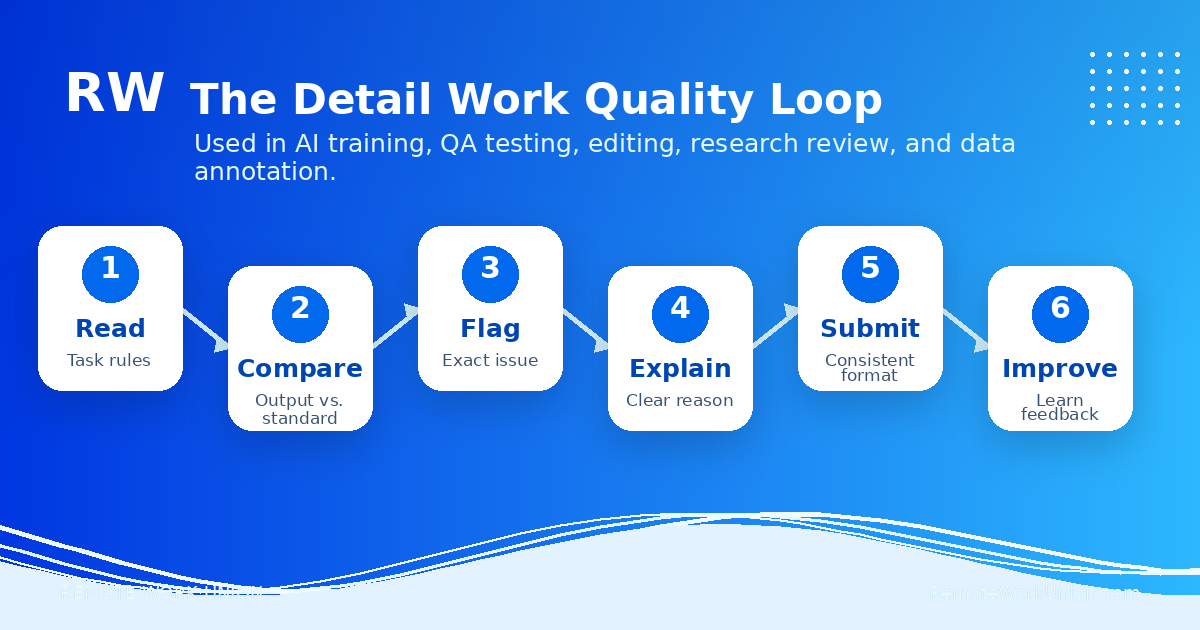
In an office, a manager can walk over and check progress. In a remote role, your work product has to speak for itself. That makes attention to detail more valuable. Companies want workers who can read instructions, avoid careless errors, document decisions, and produce consistent results.
Detail matters even more in remote AI jobs. AI training and AI evaluation projects often involve small decisions repeated many times. A reviewer may need to compare two model responses, decide which one is better, flag factual errors, check formatting, identify unsafe content, or explain why a response failed the prompt. One careless rating can create noise. Thousands of careful ratings can improve a system.
The same pattern applies outside AI. A proofreader checks language. A QA tester checks software. A compliance reviewer checks documentation. A search quality rater checks whether results match user intent. A data annotation specialist checks labels. A content reviewer checks policy alignment. All of these jobs turn careful observation into business value.
The best remote work jobs for detail-oriented people usually have five things in common: they involve written instructions, they reward accuracy over speed alone, they require consistent judgment, they can be done from a laptop, and they produce a visible output that can be reviewed.
1. AI Response Evaluator
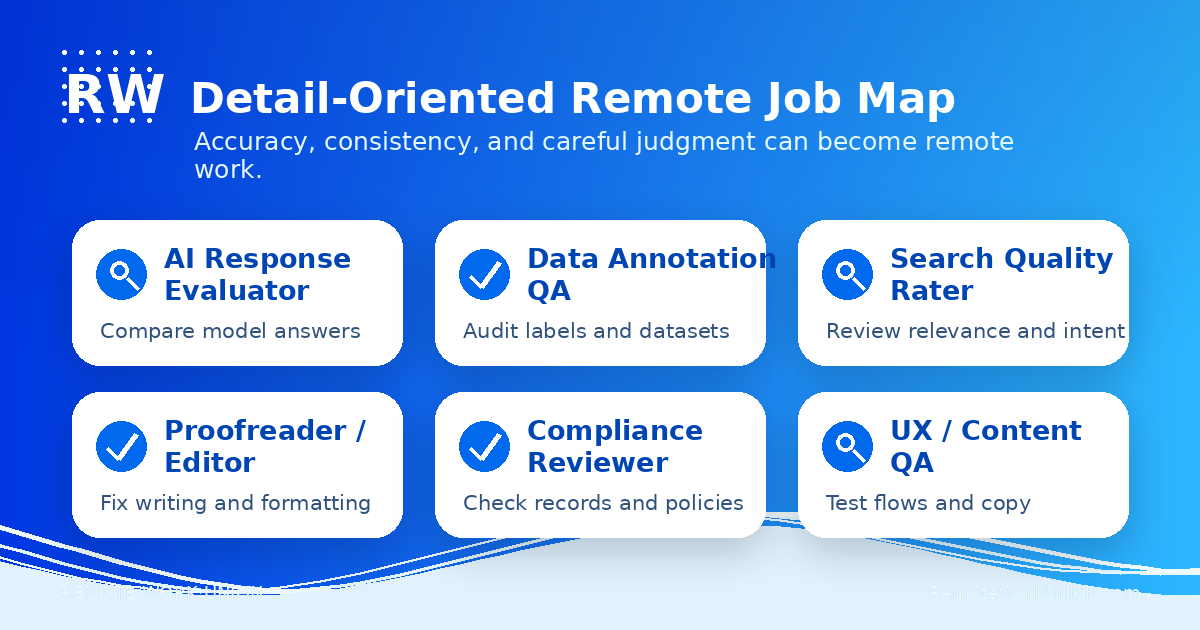
AI response evaluator is one of the strongest remote AI jobs for people who notice small differences in quality.
In this role, you review answers generated by AI models. You may compare two responses and decide which is better. You may check whether an answer follows the prompt, avoids hallucinations, uses a helpful tone, cites information correctly, or refuses unsafe requests appropriately. Some projects are general. Others are expert-level and require legal, medical, finance, coding, science, writing, language, math, or business knowledge.
This role is a good fit for detail-oriented people because the work is not just about liking one answer more than another. You need to explain your judgment. You need to notice when an answer sounds confident but is wrong, when it misses a constraint, when it uses vague reasoning, or when it gives a technically correct answer that does not actually help the user.
Relevant keywords: AI evaluator, AI response reviewer, AI trainer, AI model evaluation, AI rater, LLM evaluator, remote AI training, AI feedback specialist, AI quality reviewer.
Platforms such as micro1, Mercor, Handshake AI, and similar marketplaces are often discussed by applicants looking for remote AI evaluation work. Availability can vary by country, expertise, and current project demand.
Pay range: General AI evaluation typically pays $20+/hr. Expert-tier AI review can reach $50–$200/hr depending on domain knowledge and platform.
2. Data Annotation Specialist
Data annotation is the process of labeling information so AI systems can learn from it. This may involve text, images, audio, video, search results, conversations, documents, or structured data.
A detail-oriented person can do well because annotation requires consistency. You may need to decide whether a sentence expresses a certain intent, whether an image contains a specific object, whether a transcript is accurate, whether a document belongs in a certain category, or whether a model response meets a stated rule. The most important skill is not speed. It is matching the guideline.
Data annotation jobs appear under titles such as data annotator, AI data specialist, data labeling associate, AI training data reviewer, language data annotator, image annotation specialist, text annotation reviewer, and dataset quality analyst.
3. Data Annotation QA Reviewer
Data annotation QA is a level above basic labeling. Instead of only creating labels, you review labels created by other people or systems.
This is an excellent remote job for people who naturally spot inconsistencies. You might audit whether a labeler followed the instruction guide, identify repeated mistakes, correct bad labels, or write feedback that helps improve future work. The job requires patience because the errors can be subtle.
Search terms: annotation QA, data quality analyst, labeling QA reviewer, AI data QA, dataset reviewer, data validation specialist, and quality control annotator.
4. Search Quality Rater
Search quality rating is remote work built around relevance and intent. A rater reviews search results and decides whether they match what a user likely wanted.
This can include checking whether a result is helpful, current, trustworthy, localized, safe, or aligned with the query. It may also involve comparing two result pages, judging snippets, or rating content quality. People with strong attention to detail can do well because search quality work requires nuance. A result can be related to a query but still not useful.
Search quality jobs may be listed as search evaluator, search engine evaluator, internet rater, search quality analyst, ads quality rater, web search evaluator, or online data analyst.
5. Proofreader or Copy Editor
Proofreading is one of the clearest work from home jobs for people with an eye for detail. The job is to catch errors in spelling, grammar, punctuation, formatting, word choice, and consistency.
Copy editing goes further. It may involve improving clarity, checking tone, removing repetition, tightening structure, or making sure content follows a style guide. These jobs are common across marketing teams, publishers, agencies, online education companies, newsletters, and content platforms. They also overlap with AI work because AI-generated content often still needs human editing.
Search terms: remote proofreader, online editor, copy editor, content editor, AI content editor, blog editor, manuscript proofreader, technical editor, and editorial QA.
6. Fact-Checker and Research Reviewer
Fact-checking is a natural fit for detail-oriented people who like research.
Remote fact-checkers verify claims, dates, names, statistics, quotes, sources, citations, and context. This type of work is especially important in remote AI jobs because AI models can produce fluent answers that sound correct even when they are wrong.
Strong fact-checkers are skeptical without being cynical. They know how to separate a claim from an assumption. They understand that a source can be real but still not support the exact sentence being written.
Relevant job titles: fact-checker, research analyst, content researcher, AI research reviewer, citation reviewer, source verification specialist, editorial researcher, and online research evaluator.
Ready to turn your eye for detail into remote income? Find roles hiring now on RemoteWorkUnion.com.
Find Roles Hiring Now →7. QA Tester for Websites and Apps
Quality assurance testing is a practical remote job for people who notice when things do not work the way they should.
A QA tester checks websites, apps, forms, checkout flows, user dashboards, buttons, links, layouts, error messages, login screens, mobile views, and user journeys. Some QA roles require technical skills, but many entry-level testing roles focus on manual testing. This work can also overlap with content QA.
Search terms: remote QA tester, manual QA tester, website tester, app tester, software QA analyst, user acceptance tester, bug tester, and content QA specialist.
8. Compliance Documentation Reviewer
Compliance review is a strong remote path for detail-oriented people with experience in law, finance, healthcare administration, insurance, HR, operations, or regulated industries.
The work often involves reviewing documents, forms, records, policies, claims, contracts, applications, or internal files to make sure they are complete and aligned with a standard.
Search terms: compliance reviewer, document reviewer, claims reviewer, remote compliance analyst, policy reviewer, contract reviewer, legal document reviewer, audit support specialist, and records quality analyst.
9. Transcription QA and Audio Review
Transcription QA involves checking transcripts for accuracy. A reviewer listens to audio and compares it against the written text, catching misheard words, speaker labeling mistakes, missing punctuation, formatting problems, timestamps, and unclear sections.
Search terms: transcription QA, audio reviewer, speech data annotator, voice data reviewer, transcript editor, caption QA, language data reviewer, and audio annotation specialist.
10. Prompt and Instruction QA
As AI tools become more common, companies need people who can test prompts, instructions, workflows, and model behavior. The work may involve checking whether a prompt produces the expected output, whether an AI agent follows a sequence correctly, whether instructions are ambiguous, or whether a response format breaks under edge cases.
Search terms: prompt evaluator, AI prompt tester, AI workflow QA, prompt writer, prompt reviewer, AI instruction specialist, model behavior tester, and AI operations QA.
11. Content Moderation and Trust and Safety Review
Content moderation requires careful judgment. Reviewers check whether content violates a platform policy, is mislabeled, needs escalation, or should remain live. Applicants should understand that some projects may involve difficult material.
Search terms: content moderator, trust and safety reviewer, policy enforcement specialist, content quality analyst, safety evaluator, marketplace integrity reviewer, and abuse prevention analyst.
12. Operations Data Cleanup Specialist
Many businesses have messy data. Detail-oriented remote workers can help clean it. This role may involve checking spreadsheets, updating CRM records, deduplicating contacts, fixing product listings, reviewing form submissions, cleaning tags, standardizing naming conventions, or making sure internal systems match.
Search terms: data cleanup specialist, operations assistant, remote operations coordinator, CRM data specialist, data validation specialist, spreadsheet QA, ecommerce listing reviewer, and product data analyst.
Which Detail-Oriented Job Should You Start With?
The best starting point depends on what kind of details you notice naturally.
If you notice bad writing, start with proofreading, editing, AI content review, or AI response evaluation. If you notice logic gaps, start with AI evaluation, fact-checking, research review, or search quality rating. If you notice process problems, start with QA testing, operations cleanup, or compliance review. If you notice classification errors, start with data annotation or annotation QA. If you notice policy edge cases, trust and safety or compliance may fit.
A good rule: do not choose the role that sounds most impressive. Choose the role where your mistakes will be lowest.
Practical tip: Your first application should emphasize the type of detail work you already do well — not the broadest possible claim. A sharper profile gets matched faster than a vague one.
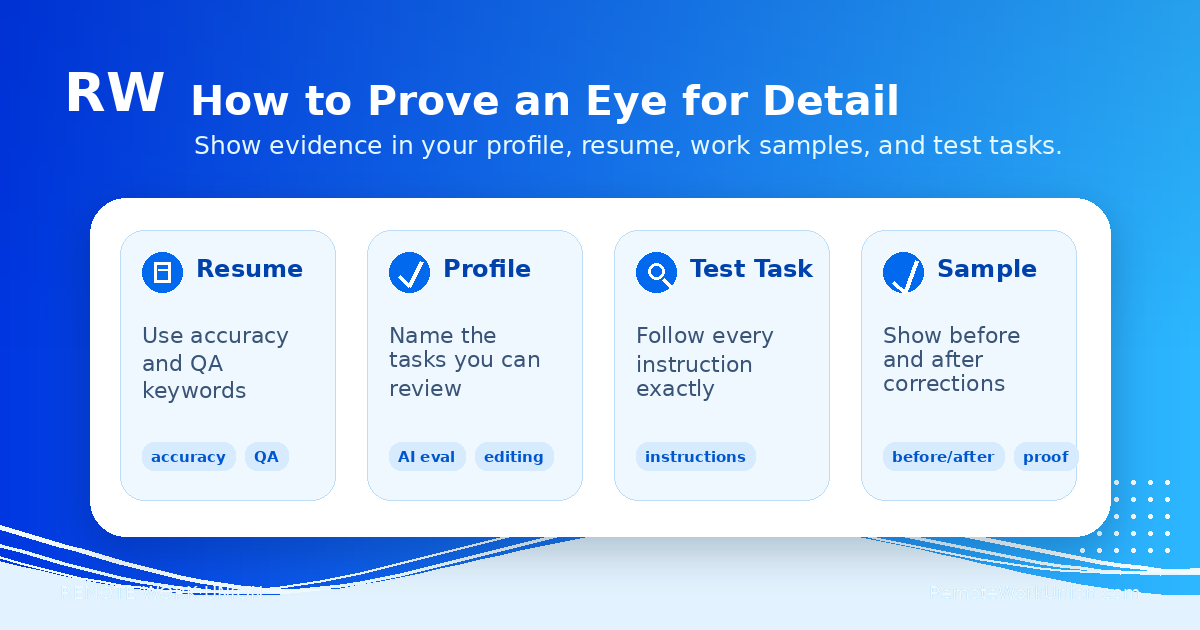
How to Show Attention to Detail in Your Application
Most applicants say they are detail-oriented. That does not prove anything. You need to show it.
Use concrete evidence: reviewed customer records for accuracy; edited long-form content for grammar, style, and structure; checked data entries against source documents; audited AI responses for factual errors; tested website flows and documented bugs; verified citations; cleaned spreadsheets.
For remote AI jobs, include keywords such as AI training, AI evaluation, data annotation, model response review, content quality, factual accuracy, instruction-following, QA, research, editing, proofreading, and reasoning.
Work Sample Ideas for Detail-Oriented Remote Jobs
For proofreading: a before-and-after edit of a short article. For QA testing: a sample bug report. For AI evaluation: a short comparison of two answers to the same prompt explaining which is better. For research review: how you would verify a claim. For data cleanup: a messy spreadsheet before and after standardization.
A good detail-oriented sample has three parts: the original problem, the correction or judgment, and a clear explanation of why the correction matters.
What to Avoid
The first mistake is applying too broadly without customizing your profile. The second is rushing test tasks. The third is only looking for full-time roles — many legitimate AI evaluation jobs begin as contract work. The fourth is paying to start — real remote work platforms do not charge a fee just to apply.
Frequently Asked Questions
Can detail-oriented work become a long-term remote career?
Yes. At the beginning you may do basic review tasks, simple annotation, or manual QA. As you gain experience, you can move into expert review, QA lead work, editorial management, compliance analysis, or domain-specific AI training.
Do I need a degree to get these jobs?
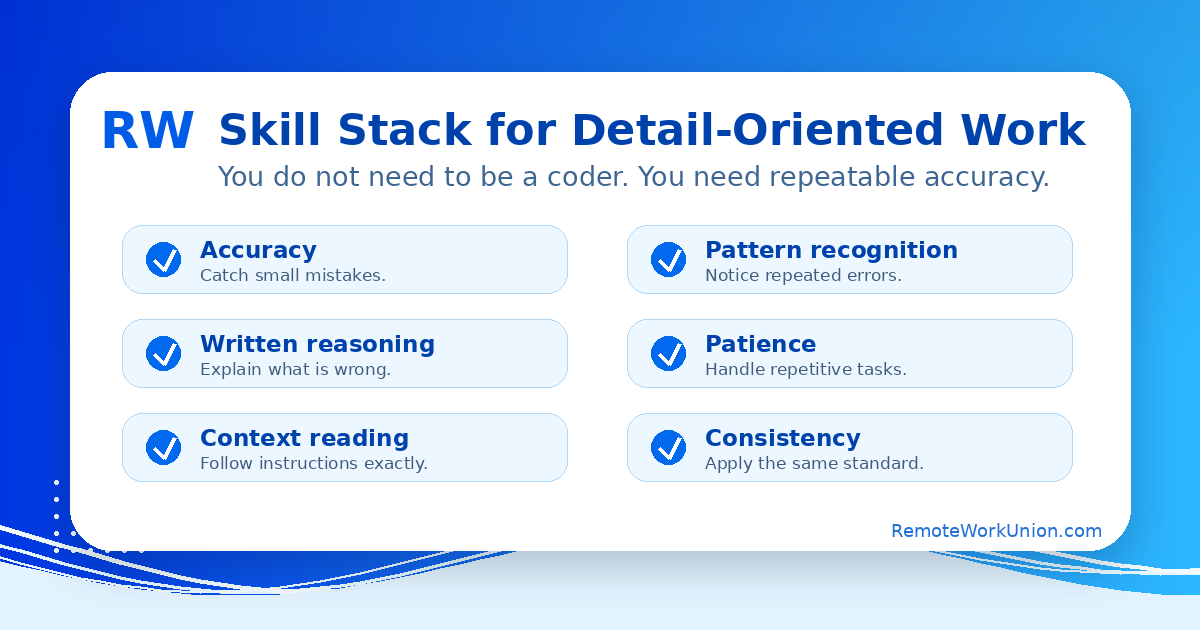
No specific degree is required for most detail-oriented remote work. What matters is your ability to follow instructions consistently, catch errors, and explain your reasoning clearly.
How much do detail-oriented remote jobs pay?
General AI training and annotation work often pays $20+/hr. Expert review work can reach $50–$200/hr depending on domain knowledge and platform.
Can I do multiple detail-oriented remote jobs at the same time?
Yes. Many remote AI workers combine platforms — an annotation role plus a proofreading contract plus a search quality project, for example. Managing multiple accounts requires tracking but is a common strategy.
What is the fastest way to get started?
Update your profile around your specific type of attention to detail, apply to two or three platforms, and complete any qualification tests carefully without rushing.